Best Lawn Mowers for Even Cut: Height Settings That Decide the Result
As an Amazon Associate we earn from qualifying purchases. Details
Updated 20 October 2026 | Author: Editorial team, bestelectriclawnmower.org
The person typing best lawn mowers for even cut wants a mower that leaves the lawn looking uniform, without ridges, scalped strips or patchy spots. None of the four mower listings in this set states a cut-quality result, so no listing can promise an even cut. What the listings do state is a height range, a deck width and a set of settings a buyer can check. Read next to what two university guides say about blades, grass height and wet turf, those fields show what to look for and where each mower fits.
Quick answer
- No listing here states how evenly a mower cuts. The university guides we opened tie evenness mainly to a sharp blade, to removing no more than a third of the grass at each mowing, and to mowing dry turf.
- Choose the height first. Illinois Extension suggests 2½ to 3 inches for most home lawns, so the top setting of a mower should reach that range.
- Of the four listings, the LawnMaster and Casince reach 3 inches. The HEINPRO reaches 2.6 inches and the DORTALA orange reaches 2.56 inches. The DORTALA has three fixed settings, while the other three have five or six.
- Keep the blade sharp and mow dry grass. Those are the two habits the guides connect most directly to the look of the cut.
Why a cut looks uneven
An uneven cut shows up as ridges, streaks, or patches where the grass tips look torn rather than trimmed. The university pages we opened tie those patterns to a dull blade, to cutting too much grass at once, and to clumps left behind when the grass is wet. None of them blames a brand or a model.
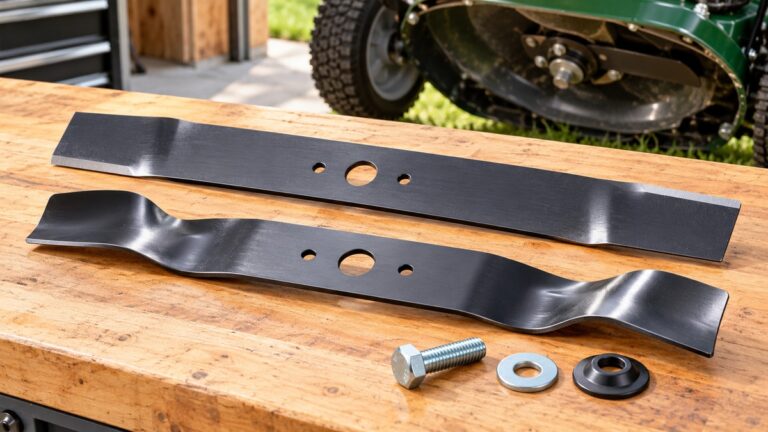
The Illinois Extension mowing guide says a sharp mower blade cuts the grass blade cleanly, which gives the lawn an even appearance, and it links a dull blade to damage that can make disease more likely. The UF/IFAS guide for Florida lawns says the blade of a rotary mower needs regular sharpening and balancing for the best possible cut. Both put the blade at the center of the cut, not only the deck or the motor.
Neither page gives a fixed sharpening interval, so the schedule has to come from the mower’s manual and from what the grass tips look like after a pass. Pale, shredded tips are a sign to check the blade. That check is a field observation you can make yourself, not a result from either guide.
The height math behind the one-third rule
Illinois Extension describes the one-third rule: mow often enough that no more than a third of the grass leaf comes off in one cutting. The rule makes the mowing trigger taller than the cutting height. If the cut you want is H, the grass should be about 1.5 times H before you mow. A 2.5-inch cut means mowing when the grass reaches 3.75 inches. A 3-inch cut means waiting until it reaches 4.5 inches.
That changes how a height setting should be read. A top setting of 3 inches does not mean the lawn can stay at 3 inches through a fast-growing week. In spring, Illinois Extension says mowing may need to happen more than once a week, so a height that fits the rule can also be a height you mow often.
The table applies the rule to each listing. The step is the difference between neighboring settings. The trigger column multiplies the lowest and highest settings by 1.5.
| Listing (catalog title) | Height settings | Step between settings | Mow when grass reaches |
|---|---|---|---|
| HEINPRO 14-inch cordless | 1 to 2.6 inches, five positions | 0.4 inch | 1.5 to 3.9 inches |
| LawnMaster 15-inch corded | 1 to 3 inches, six positions (specification) | 0.4 inch | 1.5 to 4.5 inches |
| Casince 17-inch cordless | 1 to 3 inches, six positions | 0.4 inch | 1.5 to 4.5 inches |
| DORTALA 13-inch corded, orange | 0.99, 1.77 and 2.56 inches | about 0.8 inch | about 1.5 to 3.84 inches |
Three of the four listings have a 0.4-inch step. The LawnMaster and Casince steps are computed from their ranges and positions, because neither listing states a step size. The LawnMaster bullet describes five positions from 1.4 to 3 inches, which also gives a 0.4-inch step. The DORTALA’s three settings leave a gap of nearly 0.8 inch, so a cut between two of them cannot be set exactly.
Checked against the Illinois range, all four listings include a setting of at least 2.5 inches, which is the bottom of the 2½ to 3 inch range. Only two listings, the LawnMaster and the Casince, reach 3 inches. If your lawn needs a 3-inch cut, those two are the only mowers in this set that reach it.
The four decks compared
Deck width sets how many passes a lawn needs, and each pass is a place where two strips can meet unevenly. The four widths are 13 inches for the DORTALA orange, 14 inches for the HEINPRO, 15 inches for the LawnMaster (specification) and 17 inches for the Casince.
Counting passes across a 100-foot strip without overlap gives about 92 passes for the 13-inch deck, about 86 for the 14-inch, 80 for the 15-inch and about 71 for the 17-inch. A real mowing pass overlaps the one before it, so these counts are a floor for comparison, not a plan. On the same strip, the 17-inch deck makes about 22 fewer passes than the 13-inch one. Fewer passes do not guarantee a more even cut, but they leave fewer seams to get right.
What each listing says about an even cut
The HEINPRO listing describes a brushless motor and a 14-inch deck with five height positions from 1 inch to 2.6 inches. It also includes a mulch plug. That matters for the one-third rule, because the Illinois guide says mulching mowers do not perform at peak efficiency when the lawn is too tall.
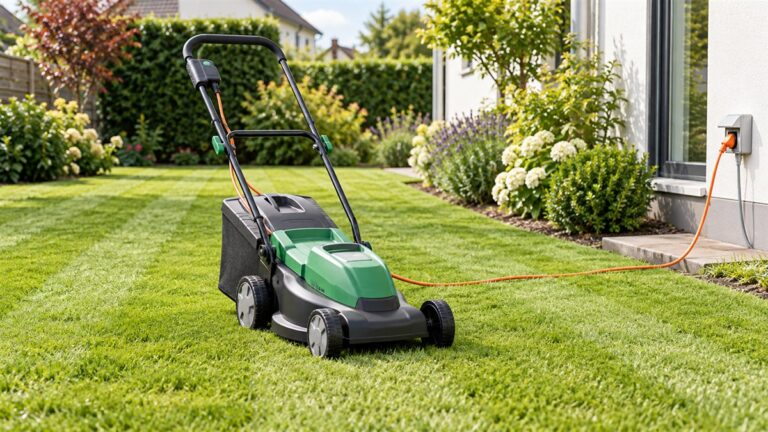
The LawnMaster listing describes a corded 15-inch mower with a 7-gallon bag and push handles that fold. One bullet says five cutting positions from 1.4 to 3 inches, while the specifications list six positions from 1 to 3 inches. Its cutting width is 15 inches in the specifications and 14 inches in a bullet. For an even cut, both the width and the height range need to be settled before you buy, and this listing leaves both open.
The Casince listing describes a 17-inch deck, six height settings from 1 to 3 inches, and two 4.0Ah batteries. A bullet also gives a range of 25 to 75 millimeters, which converts to about 0.98 to 2.95 inches, so the metric and imperial figures do not match exactly. The wide deck is the reason it has the fewest passes in the count above.
The DORTALA orange listing gives three heights, 0.99, 1.77 and 2.56 inches, and a 13-inch deck, the narrowest here. Its folding handle makes storage easier. The listing also says a safety lockout requires the safety button to be pressed before the mower will run.
How to choose a mower for an even cut
- Write down the height you want. For most home lawns, start with 2½ to 3 inches, following Illinois Extension.
- Confirm the top setting reaches that height with room to spare. A top setting of 2.6 inches stops short of 3 inches, the top of the range.
- Count the steps. A 0.4-inch step lets you move a little at a time. A gap near 0.8 inch leaves you choosing between two heights.
- Match the deck to the lawn. A wider deck makes fewer passes over the same ground.
- Decide battery or cord first, because the choice sets where you can mow. A corded mower needs an outlet within reach. A battery mower needs a compatible pack and charger.
1. HEINPRO Cordless Lawn Mower Compatible with Dewalt 20V MAX Battery (HEINPRO 14-inch cordless mower for DeWalt 20V MAX packs)
Pros
- The listing gives five height settings from 1 inch to 2.6 inches, in steps of 0.4 inch.
- It is written to fit DeWalt 20V MAX lithium-ion packs, so an owner who already has that system does not buy a new pack with the mower.
Cons
- The battery and charger are not included, so the mower does not run until a compatible pack is added.
- Its top setting of 2.6 inches stops short of the 3-inch top that two other mowers here reach.
Best for: A DeWalt 20V MAX owner who wants a 14-inch cordless mower with five height settings.
Skip if: You do not own a compatible 20V MAX battery and charger, or you need a setting above 2.6 inches.
View on Amazon (affiliate link)
2. LawnMaster MEB1114K Electric Corded Lawn Mower 15-Inch 11AMP (LawnMaster 15-inch corded electric mower with a 7-gallon bag)
Pros
- The listing describes a corded electric drive, so there is no battery to charge or replace.
- It has a 7-gallon bag and push handles that fold for storage.
Cons
- The width is 15 inches in the specifications and 14 inches in a bullet, so the deck size needs a check.
- No cord length is stated, which limits how far the mower can reach from an outlet.
Best for: A lawn near an outlet, for an owner who does not want to buy or charge a battery.
Skip if: You need a single, consistent cutting width, or your lawn is far from an outlet and you have no cord plan.
View on Amazon (affiliate link)
3. Cordless Lawn Mower, 17-Inch Walk Behind Lawn Mower for Garden (Casince 17-inch cordless walk-behind mower with two 4.0Ah batteries)
Pros
- At 17 inches it has the widest deck in this set, with six height settings from 1 to 3 inches.
- The listing names two 4.0Ah batteries in its highlights and bullets, so the packs are part of the offer.
Cons
- The included-components field reads 1, so it is not clear that both batteries ship in the box.
- A bullet gives 14 kg for the weight and the specifications give 30 pounds, so the weight is not settled.
Best for: A lawn where the wider deck saves passes and the owner wants the battery pair in the same listing.
Skip if: You need a verified weight or a clear battery inclusion before you order.
View on Amazon (affiliate link)
4. DORTALA 13-Inch 12 Amp Corded Electric Lawn Mower, 1400W (Orange) (DORTALA 13-inch corded electric mower with three height settings)
Pros
- The listing gives its three heights as 0.99, 1.77 and 2.56 inches, exact values a buyer can check against a lawn.
- A safety lockout requires the safety button to be pressed before operation, according to the listing.
Cons
- Three settings leave gaps of about 0.8 inch, so a height between two settings cannot be chosen.
- At 13 inches it has the narrowest deck here, which means more passes across the same lawn.
Best for: A small lawn near an outlet where three fixed heights are enough.
Skip if: You need a setting near 3 inches, or you want a deck wider than 13 inches.
View on Amazon (affiliate link)
A mowing routine that keeps the cut even
Start with the blade. Check the grass tips after a pass, and have the blade sharpened and balanced when they look torn. Illinois Extension and UF/IFAS both connect a sharp, balanced blade to a clean cut.
Next, wait for dry turf. UF/IFAS says never to mow wet turf with a rotary mower, because clippings can clog the machine, and Illinois Extension says it is never advisable to mow when the grass is wet. Wet passes can also leave clumps on the lawn that show up as a pattern.
Then set the height and mow by growth, not by the calendar. Illinois Extension says lawns should be mowed according to the rate of grass growth, removing no more than one-third of the grass leaf in a single cutting. If you mulch, the same guide says a mulching mower does not perform at peak efficiency when the lawn is too tall or wet, so the one-third rule applies to mulching too.
Finally, change direction from time to time if you want. Illinois Extension says changing direction is optional, and that mowing the same direction each time should not be a problem on taller turf typical of home lawns.
Debris, footwear and wet-grass safety
Debris is the next check. UF/IFAS advises picking up stones, sticks and other debris before mowing, to avoid damaging the mower and to avoid injury from flying objects. Clear the path before the first pass of the day, not halfway through the lawn.
Footwear and eye protection come next. UF/IFAS EDIS publication ENH979/EP236 advises heavy, closed-toed shoes and eye protection when mowing. The same page warns that mowing a wet lawn can be dangerous if you slip, and that it can be tough on the mower. The UF/IFAS page on mowing a Florida lawn adds that open-toed footwear and bare feet should be avoided.
Electrical and battery notes
The four listings split into two groups. The LawnMaster and DORTALA orange are corded, and neither listing states a cord length. The HEINPRO is a battery mower that needs a compatible DeWalt 20V MAX battery and charger, neither of which is included. The Casince uses two 4.0Ah batteries, although its included-components field reads 1.
The pages we opened do not cover cord handling, so this post makes no cord safety claim. Read the manual’s cord instructions before you mow, and check the reach of the cord against the lawn before you start. For a separate question about electric mowers in wet grass, see electric lawn mower wet grass. For a corded comparison with a different deck width, see the corded 16-inch mower guide.
For batteries, the EPA page on used lithium-ion batteries says these batteries and devices should not go in household garbage or recycling bins. It advises taping battery terminals and placing each battery in its own plastic bag, and it warns that even used batteries can have enough energy to injure or start fires. A damaged battery should go back to its manufacturer for handling instructions. Because the HEINPRO needs a DeWalt lithium-ion pack, that EPA advice applies to any pack you buy for it, both when it is working and when it reaches the end of its life.
Mistakes to avoid
- Choosing a mower for its deck width alone. Deck width says nothing about the height range, which is the setting the one-third rule depends on.
- Picking a three-setting mower for a lawn that needs a height between two of its settings.
- Mowing wet grass to finish on time. The pages we opened all say to wait for dry turf.
- Skipping the blade check because the mower is new. The listings do not say when a blade needs sharpening, so the check has to be made by eye.
- Reading a runtime figure as a promise for your lawn. Runtime depends on grass, terrain and height, and the listings say so.
FAQ
Will any of these four mowers give a perfectly even cut?
No listing here states a cut-quality result, and the pages we opened do not compare mowers. What you can check is the height range, the deck width, and the blade and wet-grass habits in the university guides. A mower that reaches your height, used with a sharp blade on dry grass, is the realistic target.
What height should I set for an even cut?
Illinois Extension suggests a height between 2½ and 3 inches for most home lawns. The same page says that for most home lawns the easiest approach is to set one height and keep it. Choose the height first, then use the one-third rule to decide when to mow.
How often should I mow to keep to the one-third rule?
Mow as the grass grows, not on a fixed day. Illinois Extension says that in spring the lawn will likely need more than one mowing a week. The rule itself stays the same: no more than a third of the leaf in one cutting.
Does blade sharpness matter as much as the height setting?
The guides tie blade sharpness to the look of the cut and to the health of the grass, but they do not rank it against height. Check both. A sharp blade does not change how much grass a single pass removes, so the one-third rule still applies.
Is a three-setting mower enough for an even cut?
It can be, if one of its heights matches your lawn. The DORTALA orange offers 0.99, 1.77 and 2.56 inches. If your target falls between two of those, you cannot set it exactly, and the mowing trigger for the height you do pick has to be calculated again.
Bottom line
Pick the height first, confirm the top setting reaches it, and mow dry grass with a sharp blade under the one-third rule. Of the four listings here, the LawnMaster and Casince reach 3 inches, while the HEINPRO and DORTALA stop just short of that.
How we chose
We began with the question as a buyer types it: which mower gives the most uniform cut. The research set for this keyword has four mower listings, and all four are used here. We read each listing’s title, bullets and specifications in full. The picks rest on those catalog fields, and no price or customer feedback data was used.
The criteria came from the listing fields a buyer can check: the height range and number of settings, the step between settings, the deck width, and the power setup, corded or battery. For the cut itself we used four university pages: the Illinois Extension mowing guide, the UF/IFAS guide to mowing a Florida lawn, the UF/IFAS homeowner lawn practices publication, and the EPA page on used lithium-ion batteries. We opened each page with curl on 20 October 2026 and matched each sentence we cite against the stripped page text.
No listing in this set was dropped for type, because all four are mowers. The trigger heights and pass counts are arithmetic on the listed figures, and the formula is given in the text above each table.
What we could not verify
- Whether any listing cuts more evenly than another. None states a cut-quality result, and the pages we opened do not compare mowers.
- The LawnMaster cutting width. Its title and specifications say 15 inches, but one bullet says 14 inches.
- The LawnMaster height settings. Its specifications list six positions from 1 to 3 inches, while a bullet describes five positions from 1.4 to 3 inches.
- The Casince height range. A bullet gives 1 to 3 inches and also 25 to 75 millimeters, which is about 0.98 to 2.95 inches, so the two statements do not match exactly.
- The Casince brand. The catalog brand field reads “Home,” while its specifications read “Casince.”
- The Casince weight. A bullet gives 14 kg and the specifications give 30 pounds.
- Whether the Casince batteries come in the box. Its highlights name two 4.0Ah batteries, but its included-components field reads 1.
- The HEINPRO runtime. The listing gives 15 to 20 minutes on one 4.0Ah DeWalt battery and says coverage varies. The pages we opened do not cover that figure, and the listing does not say how it was measured.
- Cord length for the LawnMaster and DORTALA. Neither listing states one, and the pages we opened do not cover cord rules.
- Blade material, blade balance and sharpening intervals for any listing. The listings do not state them.
- Any link between one height setting and one grass type. The pages we opened give the Illinois range for most home lawns and nothing narrower.
Sources
- University of Illinois Extension, Mowing Your Lawn: the 2½ to three inch height for most home lawns; the one-third rule; a sharp blade cuts cleanly; no mowing when the grass is wet; spring mowing may need more than once a week; mulching mowers and tall or wet lawns; changing direction is optional.
- UF/IFAS EDIS, Mowing Your Florida Lawn (ENH10/LH028): blade sharpening and balancing for the best cut; clearing stones and sticks before mowing; no rotary mowing of wet turf; electric mowers come in cordless and corded models; footwear.
- UF/IFAS EDIS, Homeowner Best Management Practices for the Home Lawn (ENH979/EP236): closed-toed shoes and eye protection; wet mowing can be dangerous when you slip.
- U.S. EPA, Used Lithium-Ion Batteries: lithium-ion batteries should not go in household garbage or recycling; tape terminals and bag each battery; used batteries can still injure or start fires; contact the manufacturer for a damaged battery.