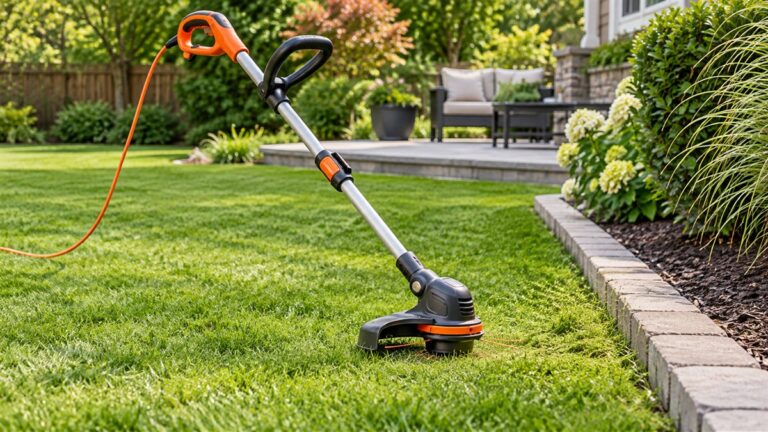
Best Lawn Mowers for Lazy People: Least-Effort Picks Compared
As an Amazon Associate we earn from qualifying purchases. Details
Updated 20 October 2026 | Author: Ken
The person typing best lawn mowers for lazy people wants a mower that asks the least of them: little pushing, little setup and little upkeep. In this group the answer splits in two. A robot does the pushing, and its listing describes app setup and an automatic return to a dock. The push mowers are lighter and simpler, and the lightest is listed at 7 pounds, but each still needs you to push, plug in or charge. This post compares the four picks on the weight, battery, cord and setup facts their listings state.
Quick answer
- The least effort in this group is the NovorikX X3 robot. Its listing says it mows on its own, returns to its dock when the battery runs low and sends app alerts.
- If you must push, the BLACK+DECKER 15-inch corded mower is the lightest listed at 7 pounds. It needs a cord that reaches the lawn.
- The Houselife and wevgbv cordless picks are bare tools. Their listings say the batteries are not included, so the real effort is the batteries you have to add.
- The Houselife’s listed 22 pounds is about three times the BLACK+DECKER’s 7 pounds (22 / 7 = 3.14), a real difference over a long push.
Count the effort in four parts
Effort is not one number. It has four parts: pushing, setup, power and cord management. Each mower moves the effort from one part to another. A robot removes most of the pushing and adds setup work, such as placing a dock and reviewing zones in the app. A corded push mower removes charging but adds the cord. A cordless push mower removes the cord but adds battery purchases and charging. A bare cordless tool adds the most work up front, because you must buy or already own the battery before the mower does anything.
Read each pick against those four parts. The robot’s listing covers pushing and setup in detail. The push mowers’ listings cover weight and handle features. The cordless listings cover batteries and compatibility, and the corded listing covers the motor and the collection bag. Only the robot listing describes the mower moving on its own, so it is the only pick that takes pushing off the list entirely.
The weights and operation modes in the listings
The table below gathers the facts the four listings state for weight, operation mode and the power or battery package. Where a listing does not state a fact, the table says so.
| Pick | Power | Weight (spec table unless noted) | Operation mode (spec table) | Battery or cord in the box |
|---|---|---|---|---|
| BLACK+DECKER 15-inch | Corded electric, 10 amp | 7 pounds | Manual | Corded; no cord length given; collection bag included |
| NovorikX X3 robot | Battery with dock charging | 20.7 pounds | Automatic | Not stated in the listing text |
| Houselife 14-inch | Battery, bare tool | 22 pounds (from the bullets; no weight in the spec table) | Manual | Bare tool; batteries not included |
| wevgbv 15-inch 3-in-1 | Battery, bare tool | Not stated | Manual | Bare tool; batteries not included |
The lightest pick is the corded BLACK+DECKER at 7 pounds. The heaviest listed weight is the robot at 20.7 pounds, but you do not carry or push a robot’s weight in the same way, so that number matters less for effort. The Houselife’s 22 pounds shows up on every mow, because you push the mower across the lawn. The listing calls the mower ultralight, but the weight it gives is 22 pounds, and that is what you will feel.
The wevgbv listing does not state a weight, which is a gap in a list built around effort. Ask the maker for the figure before you buy if weight matters to you.
How much pushing a quarter acre takes
A quarter-acre lawn is 10,890 square feet, which is also the area in the robot’s title. A push mower works in strips, so you can estimate the walking by dividing the area by the cutting width and leaving out overlap. The BLACK+DECKER’s 15-inch deck is 1.25 feet wide, so the lawn is 10,890 / 1.25 = 8,712 feet of strips. That is 8,712 / 5,280 = 1.65 miles of pushing before you allow for overlap, turns and the edges around beds and trees.
The Houselife’s 14-inch deck is slightly narrower, so it needs a little more walking for the same lawn. The robot’s 7.1-inch deck is much narrower. The BLACK+DECKER’s 15-inch width is 15 / 7.1 = 2.11 times the robot’s, so the robot needs about twice as many passes to cover the same ground. The robot does not need you to push, so for the robot those extra passes are a question of time, not effort.
The estimate is a rough one, because it assumes straight strips and no overlap. Use it to compare the picks, not to predict a particular mowing session. The listings do not give a per-session time for any of the four mowers.
The robot: least push, most setup
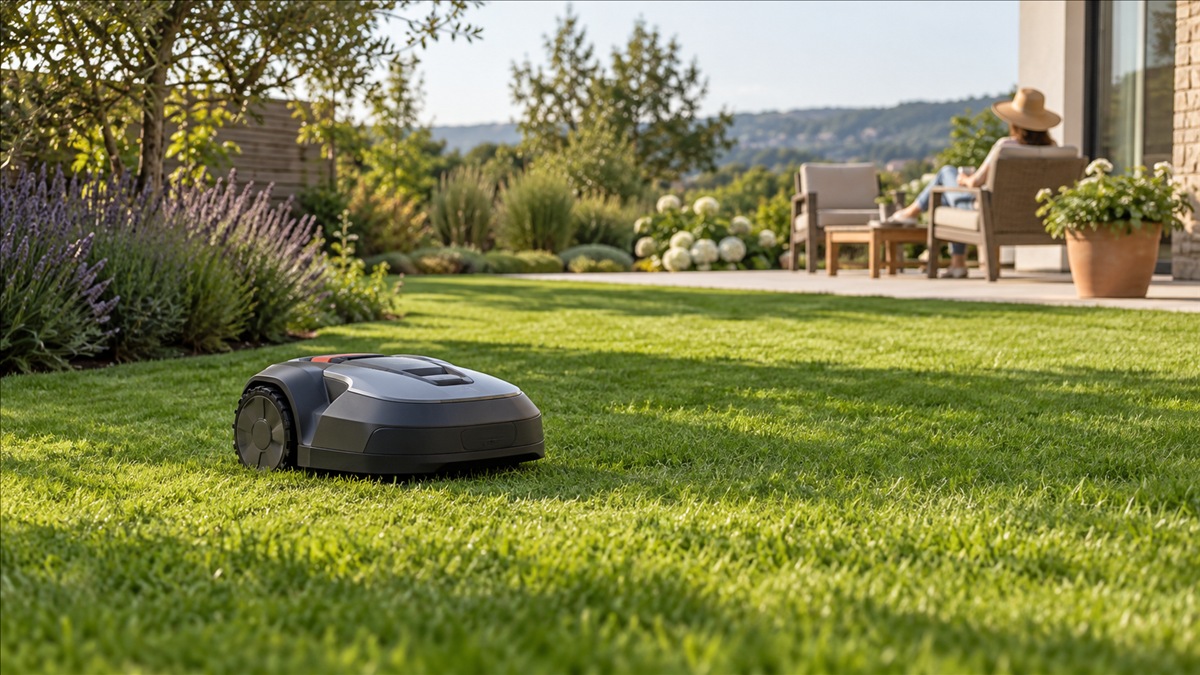
The NovorikX X3 is the only pick that does not need you to push. Its title lists RTK positioning, dual AI vision, wire-free operation, zero-edge cutting, app control, a cutting height range of 0.98 to 2.36 inches and a 35 percent slope rating. The bullets say it recognizes more than 200 kinds of objects in the yard, returns to its dock when the battery is low, resumes unfinished cycles after it recharges, and sends app alerts if it strays beyond a virtual boundary or becomes trapped. The listing also describes multiple work zones, so a lawn with separate front, back and flower-bed areas can be set up as separate schedules.
The robot’s trade-off is the cut. The spec table gives a 7.1-inch cutting width. Compared with the Houselife’s 14-inch deck, 14 / 7.1 = 1.97, so the Houselife covers about twice the width per pass. That makes the robot’s narrow cut a question of time, not effort. The robot runs on its own schedule, and a narrow cut means it takes longer to cover the same ground. The listing does not give a coverage figure per charge, so the time it takes on your lawn is not something the listing can tell you.
The battery figures are short. The spec table gives a battery average life of 2 hours. The listing gives a three-year manufacturer warranty. A bullet gives a noise figure of 58 dB(A), but the listing does not give a test condition, so that figure cannot be compared with another mower. The bullets also give an IPX6 water-resistance rating and a rain sensor that sends the mower back to its dock. For a comparison of robots on a smaller lot, see our robot lawn mower for small lawn guide. For the trade-offs of robotic mowing in general, see our pros and cons of robotic lawn mower.
Setup is the part of the effort the robot does not remove. The listing describes RTK and app-based mapping, but it does not give a setup time, and the bullet that describes perimeter wires is cut off in the listing text we used. Read the setup section of the manual before you assume the robot needs no work at the start.
Push picks: light, simple and corded or cordless
The BLACK+DECKER 15-inch is the lightest pick at 7 pounds. Its listing describes a bike-style handle for comfort, a push-button start, six cutting heights from 1 to 3 inches and a collection bag in the box. It calls the mower ideal for a 1/8-acre lot. An eighth of an acre is 43,560 / 8 = 5,445 square feet, so a larger yard means more time pushing this mower. The listing also says its winged blade gives 30 percent better clipping collection. That is a maker’s claim, and the listing does not say how it was measured.
Its power is a 10-amp corded electric motor on 120 volts. The listing does not state a cord length, so you must confirm the reach before you buy. The University of Texas at Austin factsheet we opened says an extension cord must be able to handle the amperage rating of the equipment it powers, must not be an indoor cord used outdoors, must not be frayed or damaged, and should be a three-wire type so it can be grounded. Keep the cord clear of the path you push along. For more on cords for these mowers, see our extension cord for electric lawn mower guide.
The Houselife 14-inch is a bare-tool cordless push mower. Its listing says the battery and charger are not included, and that the battery compartment holds a maximum of two 4.0Ah batteries. It is designed to run on two 20V DeWalt MAX packs for 40 volts. The spec table gives a 14-inch cutting width, six height settings from 0.98 to 3 inches, a 35-liter bag (9.25 gallons) and a one-year manufacturer warranty. The bullets describe the mower as suitable for seniors and homeowners with small to medium yards. That is the maker’s description, not a measured result.
The wevgbv 15-inch is also a bare tool, and its listing says plainly that the unit does not include any batteries. It says it works with DeWalt 20V MAX batteries from a list of model numbers. The spec table gives a 15-inch cutting width and a manual operation mode. The bullets describe a 3000W brushless motor, a folding handle and three interchangeable attachments: a circular saw blade, a diamond-shaped alloy saw blade and trimmer line. The 3000W figure is the maker’s rating, and the listing does not say how it was measured. The listing does not state a weight or a warranty term.
Check these before the first mow
- Cord reach: measure from the outlet to the far corner of the lawn, and check the cord’s rating against the mower’s amps, as the University of Texas factsheet describes. The BLACK+DECKER listing gives no cord length, so this check is yours to make.
- Battery count: the Houselife listing says its compartment holds up to two 4.0Ah batteries and is designed for two 20V DeWalt MAX packs. The wevgbv listing names DeWalt 20V MAX batteries from a model list. Count the packs you own before you buy either bare tool.
- Dock and boundary: for the NovorikX, place the dock and set the boundary zones in the app before the first run. The listing says the app sends alerts when the mower leaves its boundary.
- Weight: the two numbers to compare are the BLACK+DECKER’s 7 pounds and the Houselife’s 22 pounds, because those are the weights you will feel on each pass.
- Blade work: the UF/IFAS page says to shut off the mower before adjusting or cleaning the blade, and to wear eye and ear protection while you mow.
- Old batteries: when a battery wears out, the EPA page says it should not go in household trash or recycling bins.
How we chose
We began with the mowers, robots and cordless tools that the catalog matched to effort-focused searches. Battery chargers and adapters that came back in the same search were left out, because they do not mow. Manual reel mowers are outside this site’s electric and cordless scope, so none is included. Four picks remained: one corded push mower, one robot mower and two bare cordless tools.
Each pick stays because its listing gives a fact that bears on effort. For the robot, that is the automatic mowing, the dock return and the app alerts. For the corded push mower, it is the 7-pound weight. For the two bare tools, it is the cutting width and the battery compatibility. The order is not a ranking. The listing text we used has no star or sales information, so the order does not reflect those.
What we could not verify
- The robot’s setup time is not in the listing. The app and RTK setup are described, but no time is given, and the perimeter-wire bullet is cut off mid-sentence in the text we used.
- The robot’s coverage per charge is not stated. Its title gives a quarter-acre figure, but the listing does not say whether that is per charge or per mowing cycle.
- The 58 dB(A) noise figure on the robot has no test condition attached.
- The BLACK+DECKER winged-blade claim of 30 percent better clipping collection is the maker’s figure, and the listing does not say how it was measured.
- The BLACK+DECKER spec table lists the warranty as “Blend,” which is not a clear term. No cord length is given.
- The Houselife spec table gives product dimensions of 1 by 1 by 1 inch, which cannot be the mower’s size. The 22-pound weight comes from a bullet, and the bullets’ performance and noise claims are not measured in the listing.
- The wevgbv listing gives no weight, no warranty and no runtime, and its 3000W figure has no stated test condition.
- The DeWalt compatibility for the Houselife and wevgbv picks is the listing’s own claim, and the battery is not in the box. Confirm it against the DeWalt model list.
- The pages we opened do not cover robot mowers, cord length, or the effort involved in a particular lawn, so those points remain open.
1. BLACK+DECKER Electric Lawn Mower with Bike Handle, 15-Inch, 10-Amp, Corded (BEMW472BH) (Corded 15-inch with bike handle, 7 pounds)
Pros
- The spec table gives a 7-pound weight, the lightest pick in this group.
- The listing describes push-button start, six height settings from 1 to 3 inches and a collection bag in the box.
Cons
- The listing says it is corded electric and gives no cord length.
- The listing says it is ideal for a 1/8-acre lot, which is 5,445 square feet.
Best for: A small, flat yard that a cord reaches easily, where a light push matters most.
Skip if: You cannot run a cord to the lawn, or your yard is larger than the 1/8 acre the listing names.
View on Amazon (affiliate link)
2. NovorikX X3 Robot Lawn Mower with RTK+Dual AI Vision,Wire-Free 1/4 Acre Robotic Lawnmower,Zero-Edge (Wire-free robot with app control and dock return)
Pros
- The listing describes automatic mowing, a return to the dock on low battery and app alerts if the mower leaves its boundary.
- The listing says it supports multiple work zones and includes a rain sensor that sends it back to the dock.
Cons
- The spec table gives a 7.1-inch cutting width, which takes more passes than a 14-inch deck.
- The spec table gives a battery average life of 2 hours, and the listing gives no coverage figure per charge.
Best for: A buyer who wants the least push effort and can set up a charging dock and a clear mowing area.
Skip if: Your yard has slopes steeper than the 35 percent the listing gives, or you cannot place a dock.
View on Amazon (affiliate link)
3. 40V Cordless Lawn Mower Compatible with Dewalt 2x20V MAX Battery (Bare 14-inch cordless, DeWalt-compatible)
Pros
- The spec table gives a 14-inch cutting width, six height settings from 0.98 to 3 inches and a 35-liter bag.
- The bullets describe a 22-pound weight and a folding design for storage.
Cons
- The battery and charger are not included, and the battery compartment holds up to two 4.0Ah batteries.
- The spec table gives product dimensions of 1 by 1 by 1 inch, which does not match a mower, so confirm the size with the maker.
Best for: An owner who already has two DeWalt 20V MAX batteries and wants a wider push mower.
Skip if: You do not own compatible batteries, or you need a light mower to lift or carry.
View on Amazon (affiliate link)
4. Cordless Lawn Mower Compatible with Dewalt 20v Battery, 3000W 3-in-1 Battery Powered Mower (Bare 3-in-1 tool with three attachments)
Pros
- The spec table gives a 15-inch cutting width, and the listing says it works with DeWalt 20V MAX batteries from a model list.
- The listing says it comes with three interchangeable attachments: a circular saw blade, a diamond-shaped alloy saw blade and trimmer line.
Cons
- The listing says it does not include batteries, and it gives no weight or warranty term.
- The bullets give a 3000W brushless motor rating with no test condition attached.
Best for: A buyer who already has DeWalt 20V MAX batteries and wants one tool with several attachment options.
Skip if: You need a stated weight, a warranty term or a battery in the box.
View on Amazon (affiliate link)
FAQ
Is a robot mower really the least-effort option?
In this group, yes, on the listing facts. The NovorikX is the only pick that moves on its own, returns to its dock and sends app alerts. The listing does not give a setup time, and its 7.1-inch cut means more time to cover a lawn. Setup, mapping and zone choices still need your attention.
Can a lazy-friendly push mower be light enough to carry?
The BLACK+DECKER is the lightest listed at 7 pounds. The Houselife is listed at 22 pounds in its bullets, which is heavy enough that you will push it rather than carry it. Check the weight you will be pushing before you buy, and treat the wevgbv weight as unknown until the maker gives one.
Do I need to buy batteries for the cordless picks?
Yes. The Houselife and wevgbv listings both say the battery and charger are not included. The Houselife listing says its compartment holds up to two 4.0Ah batteries, and it is designed to run on two 20V DeWalt MAX packs for 40 volts. The wevgbv listing says it works with DeWalt 20V MAX batteries from a model list.
What should I know about the cord on the corded mower?
The BLACK+DECKER listing says it is corded electric and does not state a cord length. The University of Texas factsheet says an extension cord must handle the amperage rating of the equipment, must not be an indoor cord used outdoors, must not be frayed or damaged, and should be a three-wire type so it can be grounded. Confirm the reach before you buy, and keep the cord out of the path you push along.
How should I dispose of a worn battery from a cordless pick?
The Environmental Protection Agency page we opened says lithium-ion batteries should not go in household trash or recycling bins, and should be taken to separate recycling or household hazardous waste collection points. To prevent fires, tape the terminals and place each battery in a separate plastic bag. If a battery is damaged, the EPA page says to contact the battery or device manufacturer for specific handling information.
Bottom line
If you want the least effort, pick the robot when you can set up a charging dock and a clear mowing area, and accept the narrow cut and the setup work. Pick the 7-pound corded push mower when a cord can reach the lawn and you still want to push. Treat the two bare cordless tools as a choice for owners who already own compatible batteries, because the batteries are not in either box.
Sources
- U.S. EPA, Used Lithium-Ion Batteries: lithium-ion batteries should go to separate recycling or household hazardous waste collection points; tape the terminals and bag each battery separately to prevent fires; contact the manufacturer for handling information on a damaged battery.
- University of Texas at Austin Environmental Health and Safety, Factsheet: Extension Cords: cords must handle the amperage rating of the equipment; do not use an indoor cord outside; do not use frayed or damaged cords; cords must be three-wire type so they may be grounded.
- U.S. Consumer Product Safety Commission, 16 CFR 1205.1 (text via Cornell Legal Information Institute): the standard addresses contact with the rotating blade, primarily of the foot and hand, and defines walk-behind power lawn mowers with a minimum cutting width of 12 inches.
- UF/IFAS Gardening Solutions, Lawn Mower Care and Safety: keep children out of the yard when you are mowing; shut off the mower before adjusting or cleaning the blade; wear eye and ear protection.