Best Lawn Edger Battery Powered: Seven Cordless Options Compared
As an Amazon Associate we earn from qualifying purchases. Details
Updated 20 October 2026 | Author: Ken, bestelectriclawnmower.org
The best lawn edger battery powered for most yards is the one that runs on a pack you already own and gives an edging method you can match to your edge. Seven cordless listings in our catalog record for this keyword can edge a lawn. Two are dedicated edgers with a blade, and five are string trimmers that edge with a head angle, a wheel or an edge guide. This guide compares all seven on what each listing states, and it reports the figures that conflict rather than picking one.
Quick answer
- Check the battery first. Three of the seven listings include packs, and the other four need a pack you already own or must buy.
- Dedicated edgers and edging trimmers cut differently. Read each method line before you compare the cut widths.
- Two packs of 3.0 Ah give more total charge than two packs of 2.0 Ah, and the DEGGE listing is the only one that names 3.0 Ah packs.
- Runtime figures in this set are mostly manufacturer claims or single-spec figures, so treat them as the maker’s numbers rather than a common test.
Dedicated edgers and edging trimmers in one set
A dedicated battery edger carries a blade that follows an edge. Its job is a clean line along a sidewalk, a driveway or a bed. Two listings in this set are built that way: the worksky listing for a Milwaukee-compatible unit, and the BLACK+DECKER 20V MAX kit with its battery and charger. Both describe a blade with a depth adjustment, and both suit a buyer who wants the edge cut rather than trimmed.
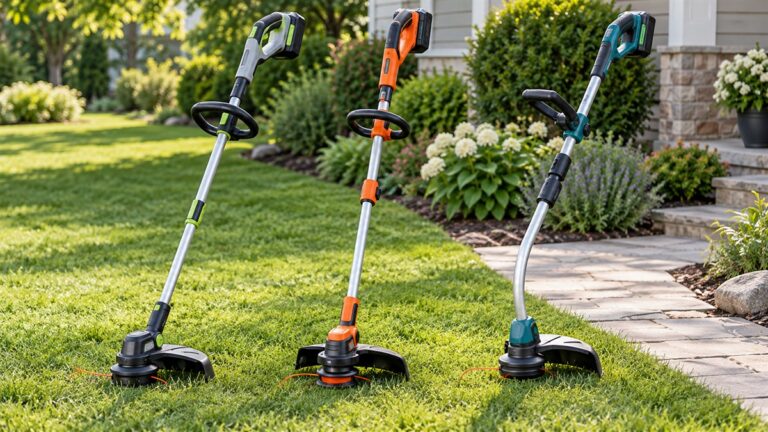
The other five are string trimmers that edge. The ZUYIYI, SUNCHERS, DEGGE, XGFDRE and Yudara listings all describe a string head with a turning head, a wheel or an edge mode. A string head clears grass and weeds around the edge, and it can edge a walk when its head is set square to the surface. The listings do not show how clean that edge looks, so the choice between a blade and a string head depends on the look you need along a hard border.
The distinction matters for safety too. The Virginia Tech guide says lawn edgers with metal blades can cut through underground objects, splinter concrete and throw sparks, and it says string trimmers can throw stones, sticks and other objects at high speed. A blade edger carries the first hazard, and a string head carries the second. Check which head a listing describes before you start, because the safety steps differ.
Check the battery before you compare the edger
The battery decides whether a listing is a purchase or a plan, so it comes first. Five listings name a specific platform: a Milwaukee-compatible pack, two Makita 18V listings, a DeWalt 20V MAX pack and the BLACK+DECKER 20V MAX kit. The SUNCHERS and DEGGE listings name only a voltage, 20V and 21V. The table below shows what each listing states about its battery.
| Listing | Battery named | Pack in the box |
|---|---|---|
| worksky edger | Milwaukee 18V compatible | No, tool only |
| ZUYIYI trimmer and edger | Makita 18V models named | No, batteries not included |
| SUNCHERS trimmer and edger | 20V with 2 x 2.0Ah packs | Yes, two packs and a charger |
| DEGGE trimmer and edger | 21V with 2 x 3.0Ah packs | Yes, two packs and a charger |
| XGFDRE trimmer and edger | DEWALT 20V MAX | No, bare tool |
| Yudara trimmer and edger | Makita 18V models named | No battery |
| BLACK+DECKER 20V MAX edger kit | 20V MAX | Yes, one 1.5 Ah pack and a charger |
A listing that names a platform does not confirm that every pack in that family fits. The ZUYIYI and Yudara listings name specific Makita model numbers, and the XGFDRE listing names a long list of DeWalt 20V MAX packs. Match your pack’s exact model number to the listing before you order, and do not assume that two names in the same family are interchangeable.
The Milwaukee-compatible worksky listing says you can use an existing battery ecosystem, but it names no model numbers in its bullets. Confirm the pack type on the product page before you buy, because the listing states the platform in its title and in one bullet only.
The two-pack arithmetic
Two listings give two packs each, and their amp-hour figures differ. The DEGGE listing gives two 3.0 Ah packs, and the SUNCHERS listing gives two 2.0 Ah packs. The arithmetic is simple. 3.0 plus 3.0 equals 6.0 amp-hours for the DEGGE pair, and 2.0 plus 2.0 equals 4.0 amp-hours for the SUNCHERS pair. 6.0 divided by 4.0 is 1.5, so the DEGGE pair holds half again as much total charge on paper.
Total charge is not runtime, though. A tool’s runtime depends on its motor and on the cut you make, and neither listing gives a test that shows how the two pairs compare under the same load. The DEGGE listing says up to 70 minutes with two batteries, and it labels that figure a manufacturer claim. The SUNCHERS listing says around 30 minutes of continuous use with its two packs, and its specification table gives a 30-minute average battery life.
So the honest comparison is on the numbers each listing gives: amp-hours per pack, the count of packs, and the runtime figure with its source. Do not divide one runtime figure by another and call the result efficiency, because the two listings describe different loads and different cut widths.
The Yudara listing gives a different figure. Its specification table gives a 45-minute average battery life, and its bullets describe a battery remaining display. Like the other runtime figures in this set, it does not describe the test conditions behind the number.
Edging geometry: depth, angle and wheels
Edge geometry is where a battery edger earns or loses its keep. The worksky listing describes three depth settings that run from 1.3 inches to 1.75 inches, which is a 0.45-inch range. 1.75 minus 1.3 equals 0.45, so the depth adjustment covers a narrow band. Its dual wheels, which the bullets give as 1.77 inches at the front and 4 inches at the rear, keep the blade tracking straight along the edge.
The BLACK+DECKER kit describes four height settings and a 7.5-inch blade with a 1.75-inch cut capacity, and a built-in edge guide helps you run along a hard border. Its 1.75-inch cut capacity matches the top of the worksky depth range, although the two listings describe those figures in different terms. A longer edge guide or a wider blade does not appear in either listing.
The string units describe their heads differently. The ZUYIYI listing says its rotating head pivots 180 degrees horizontally and 60 degrees vertically, and its handle adapts to slopes. The SUNCHERS listing describes a head that adjusts from 0 to 90 degrees, and it includes an auxiliary wheel. The XGFDRE listing describes a cutting head that adjusts from 0 to 90 degrees and an auxiliary handle that turns 180 degrees. The Yudara listing describes edger wheels with a 90-degree rotating head.
The angle range matters for the square edge. A head that goes to 90 degrees reaches a walk or a bed edge at a right angle, but a head that stops short covers less of the corner. The ZUYIYI and XGFDRE listings give their ranges in degrees, and the SUNCHERS and Yudara listings give their ranges in the same way, so you can compare them directly.
A wheel carries part of the weight along a hard edge. The worksky dual wheels, the SUNCHERS auxiliary wheel and the Yudara edger wheels are the three wheel arrangements in this set. The ZUYIYI and XGFDRE listings do not describe a wheel in their bullets, so a buyer who needs a wheel should confirm it before ordering.
Weight, reach and the load on your arm
Weight decides how long you can keep the edge straight before your arm tires. The worksky listing gives 7.2 pounds in its specification table and in its bullets. The ZUYIYI listing gives 5.5 pounds. 7.2 minus 5.5 equals 1.7, so the worksky edger is 1.7 pounds heavier than the ZUYIYI trimmer. The XGFDRE listing gives 4.3 pounds, and the Yudara listing gives 2.3 kilograms in its specification table.
The DEGGE listing gives two weights. Its bullets say 5.9 pounds with a battery, and its product information table says 4.7 pounds. 5.9 minus 4.7 equals 1.2, which is a conflict the listing does not resolve. The SUNCHERS listing gives no weight, and the BLACK+DECKER listing gives no weight either. A buyer who needs a weight figure should not assume one for either.
Reach matters too, and the shaft figures differ a lot. The DEGGE shaft runs from 49.6 to 57.5 inches, a range of 7.9 inches, because 57.5 minus 49.6 equals 7.9. The XGFDRE shaft runs from 45 to 57 inches in its bullets, and the Yudara shaft runs from 4.1 feet to 5.0 feet. These figures are listing values in different units, so compare them only after converting them the same way.
For the job itself, a lighter head is easier to hold steady along a long edge, but it has less mass to push through a tough edge. A heavier head is steadier on a long run, and it works better on a hard border where the blade meets soil. Pick the weight that matches the tougher of your two jobs, and do not let the lighter number decide the purchase on its own.
Runtime figures, read with their source
Runtime is the figure most buyers want first, and it is the figure these listings give least consistently. The DEGGE listing states up to 70 minutes with two 3.0 Ah packs, and it marks that number as a manufacturer claim. The SUNCHERS listing states around 30 minutes with its two 2.0 Ah packs. The Yudara specification table gives a 45-minute average battery life. The BLACK+DECKER listing states that its kit can edge up to 815 feet on one charge, which is also a manufacturer figure. The worksky, ZUYIYI and XGFDRE listings state no runtime figure in minutes.
Because the figures come from different sources and different tests, they are best read as the maker’s claims. A buyer who wants a real comparison needs to run the same edge with each unit and time it, and this guide does not do that. We report the number, its source and its gap, and we leave the ranking to your own edge.
The runtime that matters is the time for one edge, not the time on a full charge. A 30-minute pack covers a short border with room to spare, but a long walk may need a second pack in hand. Plan the packs for the longest edge you cut in one sitting, not for the average run.
Safety for a battery edger
The battery adds its own hazards. The U.S. EPA says lithium-ion batteries should not go in household garbage or recycling bins, and it says to tape the battery terminals and place each battery in its own plastic bag. The agency also says even used batteries can have enough energy to injure or start fires.
The string heads and the blade heads carry different risks. The Virginia Tech guide says string trimmers can throw stones, sticks and other objects at high speed. Clear the edge first, because the UF/IFAS lawn mower guidance says to clear the lawn of debris that could be thrown. The same Virginia Tech guide says to make sure no bystanders, children or pets are within a 50-foot radius and to wear eye and ear protection, and the UF/IFAS guidance makes the same eye and ear point for lawn work.
A blade edger needs its guard in place, and the Virginia Tech guide says not to run a lawn edger without its guards or shields. The string guides on the trimmers do the same job for the string head, and the guide says not to remove them. If a guard blocks a cut, change the head angle or the depth setting rather than removing the guard.
Battery edgers have no cord, so the cord check does not apply. The Virginia Tech guide’s cord rules are for electric trimmers, and none of the seven listings here is a corded unit. If a pack is damaged, the EPA advice is to contact the battery or device manufacturer for handling information.
When a battery edger is the wrong choice
A battery edger is not always the right pick. If you already own a battery trimmer with an edging head and only edge once a season, a second edger may not earn its place in your shed. A combo unit can do both jobs with one pack.
A blade edger suits a buyer who edges often and wants a clean line along a hard border. The worksky and BLACK+DECKER listings describe that setup. A string head suits a buyer who trims grass and weeds as well as edging, and the ZUYIYI, SUNCHERS, DEGGE, XGFDRE and Yudara listings describe that mix.
A tool that does not state its edging method leaves you to guess. The Yudara listing names edger wheels, the XGFDRE listing names an edger in its title and a 0 to 90 degree head in its bullets, and the ZUYIYI listing names a pivoting head. Skip any unit whose method line you cannot match to your edge, because the listing will not tell you how it edges.
How we chose
We started from the seven cordless edger and edging listings in our catalog record for this keyword, as the record stood on 20 October 2026. We did not add or drop any item from the set. Each card uses the listing’s own bullets and specifications, and each card names a skip-if condition. We did not use price, availability or customer feedback data when choosing.
Each listing had to pass three checks. It had to be a cordless tool, it had to describe an edging method or give a figure that bears on edging, such as a head angle, a blade size or a depth setting, and it had to give at least one specification in its data. Items that failed a check are listed after the cards, with the reason.
Where a listing gives two figures for the same spec, the card reports both. Where a listing gives a runtime figure, the card names the source of that figure, and the comparison does not treat a manufacturer claim as a measured result.
1. Brusless Lawn Edger Compatible withMilwaukee 18V Battery (No Battery) (Milwaukee-compatible dedicated edger)
Specs from the listing (checked ):
- Power Source: dc
- Item Weight: 7.2 pounds
- Speed: 3500 rpm
- Manufacturer Warranty Description: 3 Year Warranty
Pros
- The listing describes a 9-inch steel blade with three depth settings and dual wheels for tracking along an edge.
- The listing gives 7.2 pounds in both its specification table and its bullets, so the weight is consistent.
Cons
- The listing sells the unit as tool only, so a Milwaukee-compatible pack has to come from you.
- The depth adjustment covers a narrow range, from 1.3 inches to 1.75 inches, according to the listing.
Best for: An owner of a Milwaukee 18V pack who wants a dedicated blade edger with wheels.
Skip if: Skip if you need a battery in the box or a string head for grass beside the edge.
View on Amazon (affiliate link)
2. 15″ Cordless String Trimmer & Lawn Edger for Makita 18V Battery (Makita 18V trimmer with auto feed)
Specs from the listing (checked ):
- Power Source: Battery Powered
- Cutting width: 12 inches
- Item Weight: 5.5 pounds
Pros
- The listing describes a rotating head that pivots 180 degrees horizontally and 60 degrees vertically.
- The listing describes an auto line feed and a foldable shaft for compact storage.
Cons
- The batteries are not included, and the listing names Makita 18V models you must match.
- The title says 15 inches, but the specification table gives a 12-inch cutting width, so the width is not settled.
Best for: A Makita 18V owner who wants a light trimmer with an edging head and a foldable shaft.
Skip if: Skip if you do not own one of the Makita 18V models named in the listing.
View on Amazon (affiliate link)
3. 20V Electric Cordless String Trimmer, 2X 2.0Ah Battery Powered Lawn Trimmer (20V trimmer and edger with two packs)
Specs from the listing (checked ):
- Power Source: Battery Powered
- Cutting width: 12 inches
- Speed: 9500 rpm
- Battery Average Life: 30 minutes
Pros
- The listing includes two 2.0 Ah packs and a charger, so the tool is ready to use in the box.
- The listing describes a head that adjusts from 0 to 90 degrees and an auxiliary wheel for edging.
Cons
- The listing gives a 12-inch cutting width and a 9500 rpm motor, but it gives no weight.
- The specification table gives an average battery life of 30 minutes, which is the runtime figure to plan around.
Best for: A buyer who wants packs and a charger in the box and a trimmer that also edges.
Skip if: Skip if you need a weight figure or a longer runtime than 30 minutes before you buy.
View on Amazon (affiliate link)
4. DEGGE Cordless Electric Weed Wacker, 2X 3.0Ah/ 21V/ 12″ Battery Weed Eater | 2 in 1 String Trimmer (21V trimmer and edger, two 3.0 Ah packs)
Specs from the listing (checked ):
- Cutting width: 12 inches (auto-feed swath)
- Motor speed: 8,500 RPM
- Battery: 2 x 3.0Ah 21V batteries (listed as included)
Pros
- The listing includes two 3.0 Ah packs and a charger, the largest pack rating in this set.
- The listing describes a shaft that adjusts from 49.6 to 57.5 inches and a handle that rotates 90 degrees.
Cons
- The bullets give 5.9 pounds with a battery, while the product table gives 4.7 pounds, so the weight is not settled.
- The 70-minute runtime with two packs is labeled a manufacturer claim in the listing.
Best for: A buyer who wants the largest pack rating here, with packs and a charger included.
Skip if: Skip if you need a settled weight figure or a runtime you can test yourself before buying.
View on Amazon (affiliate link)
5. Cordless Weed Wacker for Dewalt 20V MAX Battery(No Batteries), 12 in Electric Weed Eater, 4 in 1 (DeWalt 20V MAX compatible, four-in-one)
Specs from the listing (checked ):
- Power Source: Battery Powered
- Cutting width: 8 inches
- Item Weight: 4.3 pounds
Pros
- The listing names a head that adjusts from 0 to 90 degrees and an auxiliary handle that turns 180 degrees.
- The package includes two circular saw blades and two straight-edge blades, so the unit can switch between edge and brush work.
Cons
- The title says 12 inches, but the specification table gives an 8-inch cutting width, so the width is not settled.
- The battery and charger are not included, so a DeWalt 20V MAX pack has to be bought separately.
Best for: A DeWalt 20V MAX owner who wants a trimmer with several blade types for edges and brush.
Skip if: Skip if you need a settled cutting width or a battery in the box before you buy.
View on Amazon (affiliate link)
6. Cordless Weed Wacker & Edger Compatible with Makita 18V Battery, 3-In-1 Folding 150cm/59in (Makita 18V trimmer with edger wheels)
Specs from the listing (checked ):
- Power Source: Battery Powered
- Cutting width: 10 inches
- Speed: 23000 rpm
- Battery Average Life: 45 minutes
Pros
- The listing describes edger wheels with a 90-degree rotating head and a 180-degree swivel handle.
- The listing describes a battery remaining display and a telescopic shaft that extends from 4.1 to 5.0 feet.
Cons
- The listing says no battery is included, and it names Makita 18V models you must match.
- The specification table gives a 10-inch cutting width, and the bullets state a speed of up to 23,000 rpm.
Best for: A Makita 18V owner who wants a trimmer with edger wheels and a battery display.
Skip if: Skip if you do not own one of the Makita 18V models the listing names.
View on Amazon (affiliate link)
7. BLACK+DECKER 20V MAX Cordless Edger Lawn Kit, 1.5 Ah Battery & Charger Included, 4 Position (BLACK+DECKER 20V MAX dedicated edger kit)
Specs from the listing (checked ):
- Power Source: Battery Powered
- Number of Batteries: 1 Lithium Ion batteries required. (included)
- Item Type Name: BLACK AND DECKER 20V EDGER
Pros
- The kit includes a 1.5 Ah pack and a charger, so it is ready to use in the box.
- The listing describes a 7.5-inch blade with a 1.75-inch cut capacity and four height settings.
Cons
- The listing gives no weight in its specification table, so the load on your arm is not stated.
- The 815-foot figure is a manufacturer figure on one charge, and the listing does not describe its test conditions.
Best for: A buyer who wants a dedicated blade edger with a pack and charger in the box.
Skip if: Skip if you need a weight figure, a wider cut or a warranty term before you buy.
View on Amazon (affiliate link)
What we could not verify
- Runtime under the same load. The DEGGE, SUNCHERS, Yudara and BLACK+DECKER figures come from different sources and test conditions, so we cannot rank them on a common basis.
- Edge quality. None of the listings reports how straight or clean the finished edge is, so we cannot say which design leaves the cleanest line.
- Voltage on the DEGGE listing. The title and specifications say 21V, and the listing does not show the pack rating beyond that.
- Weight on the DEGGE and SUNCHERS listings. The DEGGE bullets say 5.9 pounds and its table says 4.7 pounds, and the SUNCHERS listing gives no weight.
- Cut width on the ZUYIYI and XGFDRE listings. The ZUYIYI title says 15 inches, but its specification table gives 12 inches. The XGFDRE title says 12 inches, but its specification table gives 8 inches. We report both.
- Warranty. The worksky listing gives a three-year term in its specification table, and the other listings state no term in the data we used.
- Noise and vibration. None of the listings gives a decibel or vibration figure, so those comparisons are not possible from the data.
- Battery compatibility for the Milwaukee-compatible worksky edger. It names the platform, but it gives no model numbers.
Listings without a card
- A cordless leaf blower with two packs, from SUPEAIR. It is a blower, not an edger, so it does not fit this roundup.
- A handheld electric sprayer from HIFAY. It is a garden sprayer, not an edger.
- A cordless 2-in-1 hedge shear with a 5-inch blade, from WorkNeon. Its title mentions grass, but its bullets describe hedge, branch and shrub cutting, and no edging head.
- A cordless garden tiller from DEVTBLUN that is compatible with Milwaukee 18V packs. It is a tiller, not an edger.
- A cordless lawn edger with a 20V battery from a listing with no brand, whose local data holds only the title, with no bullets or specifications. The card would have no listing facts to rely on.
FAQ
Is a battery edger as good as a string trimmer with an edging head?
It depends on the edge you need to cut. A blade edger cuts a clean line along a hard border, while a string trimmer with an edging head clears grass and edges at the same time. The listings in this set do not report edge quality, so pick the tool whose method line matches your border.
Which listings in this set include a battery?
Three listings include packs in the box. The SUNCHERS listing includes two 2.0 Ah packs and a charger, the DEGGE listing includes two 3.0 Ah packs and a charger, and the BLACK+DECKER kit includes one 1.5 Ah pack and a charger. The other listings sell the tool bare or name a battery you must buy.
How long will a battery edger run on one charge?
The listings give different figures, and they are not measured the same way. DEGGE says up to 70 minutes with two packs and labels it a manufacturer claim, SUNCHERS says around 30 minutes, and Yudara gives a 45-minute average battery life. Plan for the longest edge you cut in one sitting, and carry a second pack if the walk is long.
Can I put an old edger battery in the household trash?
No. The U.S. EPA says lithium-ion batteries should not go in household garbage or recycling bins. Tape the battery terminals, place each battery in its own plastic bag and take it to a recycling point. The agency names Earth 911 and Call2Recycle as two ways to find a recycler.
Should I remove the guard to get a cleaner edge?
No. The Virginia Tech guide says not to operate a lawn edger without its protective guards or shields in place, and it says not to remove the protective guards or string guides on a trimmer. Change the head angle or the depth setting if the guard blocks the cut.
Bottom line
Check the pack you already own before you compare any feature. Then match the edging method to your border, using the listing’s own method line, and compare the shaft, the weight and the runtime only as each listing states them. Treat any used battery as hazardous waste when its life ends.
For a battery-powered trimmer that also edges, see our Black and Decker cordless weed eater post. For a 60V string trimmer, see our DEWALT FlexVolt string trimmer post.
Sources
- U.S. EPA, Used Lithium-Ion Batteries: disposal, terminal taping, separate bags and fire risk, opened 20 October 2026
- Virginia Tech Extension, Powered Hand Tools Safety: Lawn Care Training Guide: throw hazard, metal-blade edger hazard, bystander distance, guards and cord checks, opened 20 October 2026
- University of Florida IFAS Extension, Lawn Mower Care and Safety: eye and ear protection and debris clearing, opened 20 October 2026