Huiaipaic 12-Amp Smart Battery Charger Review: Voltage, Amps and Chemistry
As an Amazon Associate we earn from qualifying purchases. Details
If you are considering the Huiaipaic smart battery charger, the first questions are which battery chemistry it supports and what its output is. A charger that is set for the wrong chemistry or voltage can damage a battery, and the listing gives two different amp figures. This review covers only what the listing states about voltage, amperage, input, connector, cable, modes, protection and warranty. It does not report any test of the charger on a battery, and it does not describe how to repair or dismantle a battery. Use the listing to decide whether the charger matches your battery, and follow the battery maker’s instructions and the charger’s manual for every charge.
Quick answer
The Huiaipaic is a yellow and multicolored smart battery charger for 12-volt and 24-volt batteries, with battery clamps and a 7-foot cable, according to the bullets. The title gives 12 volts at 10 amps and 24 volts at 7.5 amps, while the bullets and specs give 12 amps, so the amp figure conflicts. The bullets list lithium, lead-acid, AGM, gel, flooded, deep cycle and maintenance-free batteries as supported chemistries. The input is 110 volts in the specs and 110 to 230 volts in the bullets. The specs give a 2-year manufacturer warranty.
What to check in a battery charger
Four details decide whether this charger fits. Each one can rule it in or out.
1. Battery voltage and chemistry. The specs give a 12-volt output, and the title gives 24 volts as well. The bullets list several chemistries: lithium, lead-acid, AGM, gel, flooded and deep cycle batteries. Match the charger’s mode to your battery’s chemistry, and do not use a mode the battery’s maker does not recommend. If you are not sure of the chemistry, check the battery label or the maker’s manual.
2. Amperage conflict. The title pairs 12 volts with 10 amps, and 24 volts with 7.5 amps. The bullets describe a 12-amp charger, and the specs list the amperage as 12 amps. The listing gives two amp figures for the same product, so check the product page for the official output before you connect a large battery.
3. Input and cable. The specs give 110 volts input, and the bullets give 110 to 230 volts at 50 to 60 hertz. The bullets say the cable is 7 feet long and the connector is battery clamps. Use the plug that matches your outlet, and keep the cable clear of water and heat.
4. Protection, warranty and certification. The bullets describe reverse polarity protection, protection against sparks and overcharge, and an LCD screen. The specs list CE, RoHS, FCC, IEC60335, EN61000 and EN55014, and a 2-year manufacturer warranty. This review does not verify the certifications, which the listing names without a test body.
Use these rules to choose:
- Choose this charger if your battery is a 12-volt or 24-volt lead-acid, AGM, gel or lithium type that the listing names, and you will confirm the amp output.
- Choose a different charger if you need a single confirmed amp output, because the listing gives two.
- Choose a different charger if your battery chemistry is not among those the listing names.
For other charger options, the best battery charger for Troy Bilt lawn mower guide covers a mower battery, and the best lawn mower battery voltage and amps guide explains battery ratings.
1. 12-Amp Smart Battery Charger,Lithium,Lead-Acid(AGM/Gel/SLA) Pulse Repair Car Battery (Review verdict)
Specs from the listing (checked 2026-10-13):
- Output Voltage: 12 volts_of_direct_current
- Input Voltage: 110 volts
- Amperage: 12 A
- Specification Met: CE, RoHS, FCC,IEC60335, EN61000, EN55014
- Warranty Description: 2 Year Manufacturer
- Connector Type Used on Cable: Battery Clamps
Pros
- Supports lithium, lead-acid, AGM and gel batteries, per the title and bullets
- Battery clamps and a 7-foot cable, per the bullets
- 2-year manufacturer warranty, per the specs
Cons
- Amp output conflicts: 10 and 7.5 amps in the title, 12 amps in the specs
- Input voltage given as 110 volts in the specs and 110 to 230 volts in the bullets
- Charger only, with no battery included
Best for: A reader who needs a 12-volt or 24-volt charger for a battery chemistry the listing names, with the amp output checked first.
Skip if: Skip if you need a confirmed single amp output, a battery chemistry the listing does not name, or a battery that is damaged.
View on Amazon (affiliate link)
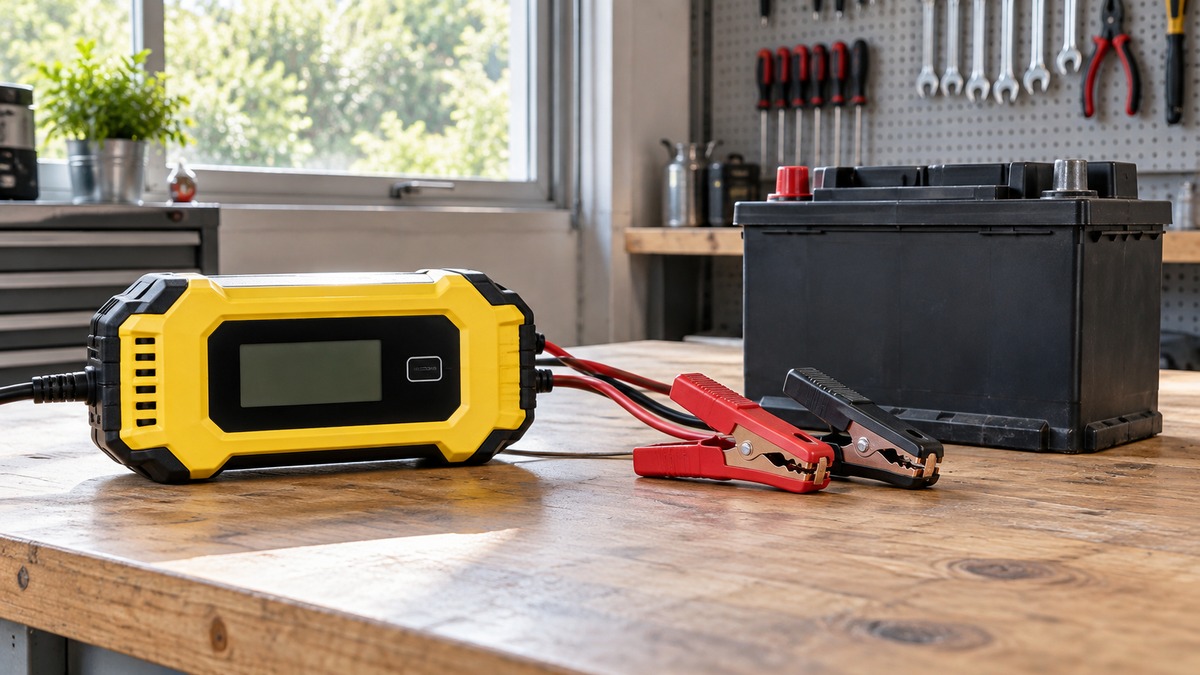
The Huiaipaic battery charger
The charger is a multicolored unit with red and yellow in its color field, sized at 2.76 by 5.31 by 2.76 inches, and weighs 1.8 pounds. The model number is HSK-12V/24V-Yellow(US). The listing has no included components field, so check the box for the clamps, cable and any manual. The bullets describe a desulfator and maintainer mode, and a deep-cycle mode, as well as a diagnosis and pulse repair function for batteries that will not start.
The charger fits a reader who wants a single charger for a car, a garden tractor or a yard battery that uses a 12-volt or 24-volt lead-acid or lithium pack, and who will check the amp output first. The bullets describe the charger as a way to keep a battery topped up between uses.
The listing has several things to check. The amp figures conflict, as noted above. The charge time field reads 1 hour, but the listing gives no battery size or charge state for that figure. The specs give 110 volts input, while the bullets give a range up to 230 volts. The product is a charger only, and the listing does not include a battery, so check what the battery needs before you buy.
Who should skip it: a reader who needs a confirmed single amp output, a reader whose battery chemistry is not named in the listing, and a reader who wants a charger for an electric mower’s built-in battery without checking the mower’s manual first.
Battery safety
Battery safety comes before any charge. Follow the battery maker’s instructions and the charger’s manual for the mode to use, and do not charge a battery that is damaged, swollen or leaking. Charge in a ventilated space, away from sparks and open flames, and keep the clamps from touching each other. Disconnect the battery before any blade work on a mower, as the battery safety guidance says, and do not work on the battery’s internal parts.
The bullets describe protection against reverse polarity, sparks and overcharge. Those are the maker’s descriptions, and this review does not test them. Keep the charger on a flat, dry surface during a charge.
Worked example: how a 7.5-amp 24-volt charge sits below the 10-amp 12-volt figure
Compare that output with the 12-volt figure in the title, so you can see how the two outputs differ.
- 12-volt output in the title: 10 amps.
- 24-volt output in the title: 7.5 amps.
- Difference between the two outputs: 10 minus 7.5 = 2.5 amps.
Check the arithmetic again. 10 minus 7.5 is 2.5. The example shows that the title’s 24-volt output is 2.5 amps lower than the 12-volt output. The bullets and specs give 12 amps for the charger, so the output for your battery depends on the page you trust. Check the product page for the official figure.
Why the battery type sets the charge
The Wikipedia overview of battery chargers says the charging protocol depends on the size and type of the battery. Some battery types tolerate overcharging, while others cannot, and overcharging can damage them, reduce their capacity or cause overheating. Chargers may use temperature or voltage sensing to control the charge. That is why the listed chemistries matter: a mode set for one battery type can be wrong for another.
The lead-acid battery
The Wikipedia overview of lead-acid batteries says they are rechargeable and were first invented in 1859. They have relatively low energy density and heavier weight than modern batteries, but they can supply high surge currents, which is why they are common in motor vehicles. The charger’s lead-acid, AGM and gel modes are for that family of batteries. Check the battery label before you pick a mode.
Five common mistakes
- Trusting one amp figure. The title gives 10 and 7.5 amps, and the specs give 12 amps.
- Choosing the wrong mode. Match the mode to the battery chemistry the charger supports.
- Charging a damaged battery. Do not charge a battery that is swollen or leaking.
- Assuming the input range. The specs give 110 volts, and the bullets give 110 to 230 volts.
- Assuming the certifications were tested here. The listing names them without a test body.
FAQ
What batteries does it charge?
The bullets list lithium, lead-acid, AGM, gel, flooded, deep cycle and maintenance-free batteries.
What output does it give?
The title gives 12 volts at 10 amps and 24 volts at 7.5 amps. The bullets and specs give 12 amps.
What is the input voltage?
Those two input figures disagree: one is 110 volts, the other a range of 110 to 230 volts.
How long is the cable?
The bullets say 7 feet.
Does it come with a warranty?
Does it include a battery?
No. The listing describes a charger only.
Bottom line
The Huiaipaic smart charger suits a reader who needs a 12-volt or 24-volt charger for a lead-acid, AGM, gel or lithium battery that the listing names, with battery clamps and a 7-foot cable. The listing conflicts on the amp output, states 110 volts for input in the specs and a wider range in the bullets, and gives a 2-year warranty. Confirm the amp output on the product page, match the mode to your battery, and do not charge a damaged battery.
Sources
- Battery charger, Wikipedia: the charging protocol depends on battery type; some types can be damaged by overcharging.
- Lead-acid battery, Wikipedia: a rechargeable battery that can supply high surge currents and is used in motor vehicles.