What Mower Deck Width Changes About Mowing Time
As an Amazon Associate we earn from qualifying purchases.
A wider cutting deck covers more ground on each pass, so the same lawn needs fewer passes. The person typing “what does mower deck width change about mowing time” usually wants to know how many minutes a wider deck saves. The answer comes from a simple formula: passes fall as deck width rises, and at the same ground speed the time falls with them. The sources we opened give deck widths and a self-propel speed range, but they do not give a mowing pace, so every minute figure below is an estimate with its inputs shown.
Quick answer
- Deck width sets how much grass each pass covers. On the same lawn at the same ground speed, a wider deck needs fewer passes and so less cutting time.
- For a 100-foot by 100-foot example lawn, the estimate is about 21 minutes with a 21-inch deck and about 15 minutes with a 30-inch deck, both at the 3.1 MPH top self-propel speed in the 21-inch listing.
- Turns, overlap, stops and grass conditions sit outside the formula. None of the pages we opened give a time value for them.
How deck width sets the number of passes
A mower pass covers a strip as wide as its cutting deck. Across a lawn of a given width, the number of strips depends on deck width alone, and each strip runs the full length of the lawn. A wider deck means fewer strips and a shorter total path to travel. That is the core of the answer, and every other factor only adjusts it.
Deck widths the manufacturers state
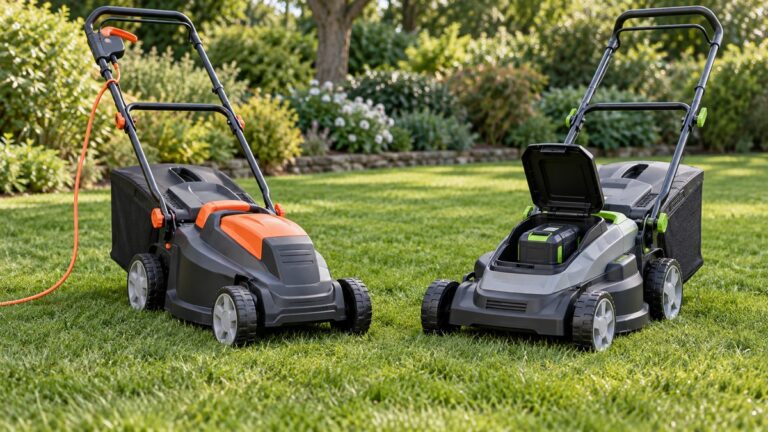
The EGO listing for its 21-inch self-propelled mower gives the deck as a “21-inch deck.” The EGO listing for its 30-inch dual-motor model describes a “wide-cutting 30-inch Super Composite deck.” That same 30-inch page also lists a “22-inch cast aluminum deck” in a separate self-propelled kit, so this post uses 22 inches as a middle case. These three widths are the only deck sizes used here. They come from EGO’s own pages, so they describe EGO models and not the decks of other brands.
The pass count formula
Passes equal the lawn width divided by the deck width, rounded up to a whole number. The formula assumes no overlap between passes, so it gives the smallest pass count that covers the width at that deck size. Turning passes into minutes needs the lawn length and a ground speed.
A worked calculation for mowing time
The estimate has three inputs: the lawn width, the deck width and the ground speed. It uses these three formulas:
- Passes = lawn width divided by deck width, rounded up
- Path length = passes times lawn length
- Estimated cutting time = path length divided by ground speed
The example lawn is 100 feet wide and 100 feet long. Those two dimensions are assumptions chosen to keep the arithmetic simple, and no source gives them. To convert inches to feet, divide by 12. A 21-inch deck is 1.75 feet, a 22-inch deck is about 1.83 feet, and a 30-inch deck is 2.5 feet.
The ground speed comes from the 21-inch listing, which states a variable self-propel range of .9 to 3.1 MPH. The listing gives that range as drive speed, so this post treats it as an input to the estimate and not as a measured mowing pace. Converting miles per hour to feet per minute uses 5,280 feet per mile and 60 minutes per hour. At 3.1 MPH that is 3.1 times 5,280 divided by 60, or 272.8 feet per minute. At 0.9 MPH it is 79.2 feet per minute. The 30-inch listing does not state a drive speed, so the same range is applied to it for comparison.
Take the 21-inch deck first. A 100-foot width divided by 1.75 feet gives about 57.1, which rounds up to 58 passes. Each pass is 100 feet long, so the path is 5,800 feet. At 272.8 feet per minute that path takes about 21 minutes. At 79.2 feet per minute it takes about 73 minutes. The table lays out all three decks the same way.
| Deck width | Deck in feet | Passes across 100 ft | Path length | Estimate at 3.1 MPH | Estimate at 0.9 MPH | Source |
|---|---|---|---|---|---|---|
| 21 inches | 1.75 | 58 | 5,800 ft | about 21 min | about 73 min | Deck: EGO 21-inch listing. Speed range: same listing. Passes and times: calculation. |
| 22 inches | 1.83 | 55 | 5,500 ft | about 20 min | about 69 min | Deck: EGO 30-inch listing page, 22-inch kit. Speed range: 21-inch listing, applied. Passes and times: calculation. |
| 30 inches | 2.50 | 40 | 4,000 ft | about 15 min | about 51 min | Deck: EGO 30-inch listing. Speed range: 21-inch listing, applied. Passes and times: calculation. |
Compare the 21-inch and 30-inch rows. The 30-inch deck needs 18 fewer passes, about 31 percent fewer, and the estimate drops by the same share. The reason is that time follows path length at a fixed speed. The estimates are ranges, not promises. The 3.1 MPH column gives the short end and the 0.9 MPH column gives the long end.
What the formula leaves out matters. Each pass ends in a turn, so the 21-inch deck makes 57 turns across this lawn while the 30-inch deck makes 39. None of the pages we opened state a turn time, so the estimate does not include one. Overlap between passes is also left out. Overlap adds passes and raises the time, and no page we opened gives an overlap figure to use.
The same formula on a smaller and a larger lawn
The formula scales with lawn size, so the minutes that separate two decks grow or shrink with the lawn. This section uses two more example lawns: a smaller one, 50 feet wide and 80 feet long, and a larger one, 150 feet wide and 200 feet long. Both sizes are assumptions, not sourced figures. The deck widths and speeds are the same as in the first example, and every estimate uses the same three formulas.
| Lawn (example) | Deck width | Passes | Path length | Estimate at 3.1 MPH | Estimate at 0.9 MPH | Source |
|---|---|---|---|---|---|---|
| 50 ft by 80 ft | 21 inches | 29 | 2,320 ft | about 8.5 min | about 29 min | Deck and speed: as in the first table. Calculation. |
| 50 ft by 80 ft | 22 inches | 28 | 2,240 ft | about 8.2 min | about 28 min | Deck and speed: as in the first table. Calculation. |
| 50 ft by 80 ft | 30 inches | 20 | 1,600 ft | about 5.9 min | about 20 min | Deck and speed: as in the first table. Calculation. |
| 150 ft by 200 ft | 21 inches | 86 | 17,200 ft | about 63 min | about 217 min | Deck and speed: as in the first table. Calculation. |
| 150 ft by 200 ft | 22 inches | 82 | 16,400 ft | about 60 min | about 207 min | Deck and speed: as in the first table. Calculation. |
| 150 ft by 200 ft | 30 inches | 60 | 12,000 ft | about 44 min | about 152 min | Deck and speed: as in the first table. Calculation. |
On the smaller lawn, the gap between the 21-inch and 30-inch estimates at top speed is about 2.6 minutes, and both stay far inside any stated runtime. On the larger lawn the gap grows to about 19 minutes. The percentage saving stays near the same in both cases, about 30 percent, because the pass count drops by roughly the same share. The larger lawn shows a limit that the smaller one does not. The 21-inch estimate of about 63 minutes at top speed is longer than the 60 minutes the listing states for one charge with its 7.5Ah battery. The 30-inch estimate of about 44 minutes sits inside the 75 minutes stated for two included 6.0Ah batteries. Those are manufacturer figures, and the listing does not say how its runtime applies at full top speed. Both estimates leave out turns, so a real mow of that size takes longer than either number.
Overlap changes the pass count
Overlap is a choice you make when you set up a mow, and it changes the formula. If each pass overlaps the one before by a set width, each new pass covers only the deck width minus that overlap. The pass count then becomes the lawn width divided by the deck width minus the overlap, rounded up:
- Passes with overlap = lawn width divided by (deck width minus overlap), rounded up
The pages we opened do not state a recommended overlap, so this post does not put a number in that place. The tables above set overlap to zero. Any overlap you add raises the pass count above the table figures, and the time rises by the same share. A wider deck still needs fewer passes at any overlap you choose, as long as the overlap is smaller than the deck width.
What the self-propel speed range does and does not tell you
A self-propel range describes how fast the drive moves the mower when the feature is on. It does not describe how fast you cut grass across a whole lawn, because real cutting time also includes turns, stops, obstacles and any time spent emptying a bag. The 21-inch listing presents the range as a variable setting, which means you choose the drive speed within it. Nothing on the pages we opened ties that setting to a mowing rate, so the calculation uses the range only as a bound.
Mowing practice can change the time more than the deck does
The Illinois Extension page gives the one-third rule for how much grass to remove in a single cut. Its wording is “Follow the one-third rule.” The same page also says “It is never advisable to mow when the grass is wet.” A wider deck does not change either point. The page adds that mulching mowers “do not perform at peak efficiency if the lawn is too tall (removing more than one-third of the grass blade) or if the lawn is wet.” The pages we opened do not put a time penalty on tall or wet grass, so the worked calculation does not add one.
Battery runtime is a separate limit
Runtime is the other limit on a long mow. The 21-inch listing states that the mower “delivers up to 60 minutes of runtime on a single charge with the recommended 56V 7.5Ah” battery. The 30-inch listing states “delivering up to 75 minutes of runtime on a single charge (with the two included 6.0Ah batteries).” Both are manufacturer claims. On paper, the 21-inch estimate of about 21 minutes fits inside the stated 60 minutes, but the stated figure applies to one charge and the result you see will differ. Real runtime changes with grass, cutting height and terrain.
For how battery voltage and amp-hour ratings compare across mowers, read lawn mower battery voltage and amps. For the wider trade-offs of battery power, including what changes when you pick a corded model, see pros and cons of battery-powered lawn mowers.
Safety notes that apply to any deck width
A wider deck does not change the blade hazard. The Ag Safety page describes a fast-turning cutting edge and warns that “At these speeds, the blade can damage anything or anyone in its path.” That warning applies to any mower, whatever the deck size.
On slopes, the same page gives direction advice for a walk-behind mower: “When using a walk-behind mower, mow across the slope to reduce the risk of contact with the mower blade.” The OSHA page covers riding mowers, but it points to the manufacturer’s stated limit rather than to deck width. It says: “Do not operate mowers on slopes that exceed the angle limits specified by the manufacturer.” It also says: “Look for a label on the mower with this information.” Read that label before you mow a slope, whatever the deck size.
A checklist before you compare listings
Run these four checks before you compare two mowers by deck width. Each one either supplies a number the formula needs or changes what that number means.
- Find the deck width for the exact model. The 21-inch EGO listing states a “21-inch deck,” and the 30-inch listing describes a “wide-cutting 30-inch Super Composite deck.”
- Find the self-propel speed range, if the model has one. The 21-inch listing states “Variable speed self-propel: .9 – 3.1 MPH,” and that range is the speed input for the estimate.
- Find the runtime and the battery it refers to. A runtime figure without its battery is not comparable. The 21-inch listing ties its 60-minute figure to a 7.5Ah battery, and the 30-inch listing ties its 75-minute figure to two included 6.0Ah batteries.
- Check what is in the box. The 21-inch product family includes a “Self-Propelled Mower (bare tool)” option, so a listing you read may not include a battery or charger. Read the kit name before you compare runtimes.
How we chose
We chose pages that state a deck width, a speed range or a runtime for a named model, plus extension and government pages on mowing practice and slope safety. The five pages listed at the end of this post were opened on 2026-10-22 and read as text. Every quoted sentence was checked word for word against the saved page text. The two EGO pages are manufacturer pages, so the deck widths, speed range and runtime figures describe those models only. The two safety pages are written mainly about riding mowers, and we cite them only for the general blade and slope points they state. We did not compare decks from other brands because the pages we opened did not give their widths.
What we could not verify
The listings state deck widths for named EGO models, and we could not check those widths against any other source. The runtime figures are manufacturer claims, and we could not check them against independent data. We could not verify mowing pace on a real lawn, so the times above are calculations and not observations. We could not verify how turns, overlap and stops change the time for any deck, because the pages we opened do not state those values. The OSHA page covers riding mowers, so we could not verify how its slope guidance applies to a walk-behind beyond what the Ag Safety page says.
What the sources do not say
The pages we opened give no mowing pace for either EGO model. They do not state an overlap figure, a turn time or a target number of passes for a lawn. The Illinois page gives a cutting-height rule and wet-grass guidance, but it does not turn either one into minutes. The EGO 30-inch page does not state a drive speed, so the calculation applies the 21-inch range to it for comparison. None of the pages we opened compares a 21-inch deck with a 30-inch deck on a real lawn.
FAQ
Does a wider deck always save mowing time?
Not always, but on the same lawn at the same ground speed it usually does. A wider deck needs fewer passes, which shortens the path the mower travels. Turns, overlap, obstacles and grass conditions still add time, and the pages we opened do not state how much.
How many passes does a 21-inch deck need across 100 feet?
Divide 100 feet by 1.75 feet to get about 57.1, then round up to 58 passes. A 30-inch deck needs 40 passes across the same width, using 2.5 feet per pass. These counts assume no overlap between passes.
Is the self-propel speed the same as mowing speed?
No. The 21-inch listing states a variable self-propel speed of .9 to 3.1 MPH, and that range describes the drive. Your actual mowing pace depends on how you walk, how often you stop and the lawn itself.
How long does the battery last with a bigger deck?
The pages we opened do not say how deck width changes battery use. The manufacturer states up to 60 minutes of runtime with a 7.5Ah battery on the 21-inch model, and up to 75 minutes with two 6.0Ah batteries on the 30-inch model. Actual run time depends on grass, cutting height and terrain.
Should I mow wet grass to finish sooner?
No. The Illinois Extension page says “It is never advisable to mow when the grass is wet.” A wider deck does not change that advice. The same page adds that mulching mowers do not perform at peak efficiency when the lawn is wet.
Can a wider deck make a steep slope safer to mow?
The pages we opened do not say that. The OSHA page says “Do not operate mowers on slopes that exceed the angle limits specified by the manufacturer.” It also says “Look for a label on the mower with this information.” Check the label on your mower before you decide, and treat deck width as a separate question.
Bottom line
Compare mowers by pass count first. Divide your lawn width by the deck width, round up, and then convert passes to minutes using the ground speed the manufacturer states.
Sources
- EGO POWER+: 21″ Self-Propelled Cordless Lawn Mower by EGO POWER+ (opened 2026-10-22)
- EGO POWER+: POWER+ Mower 30″ Super Composite Deck with Dual Motors Kit (Two 6Ah Batteries) (opened 2026-10-22)
- University of Illinois Extension: Mowing Your Lawn (opened 2026-10-22)
- Safety, Health and Wellness in Agriculture (eXtension): Riding Lawnmower Safety (opened 2026-10-22)
- OSHA: Dangers of Roll-Overs of Riding Mowers (opened 2026-10-22)