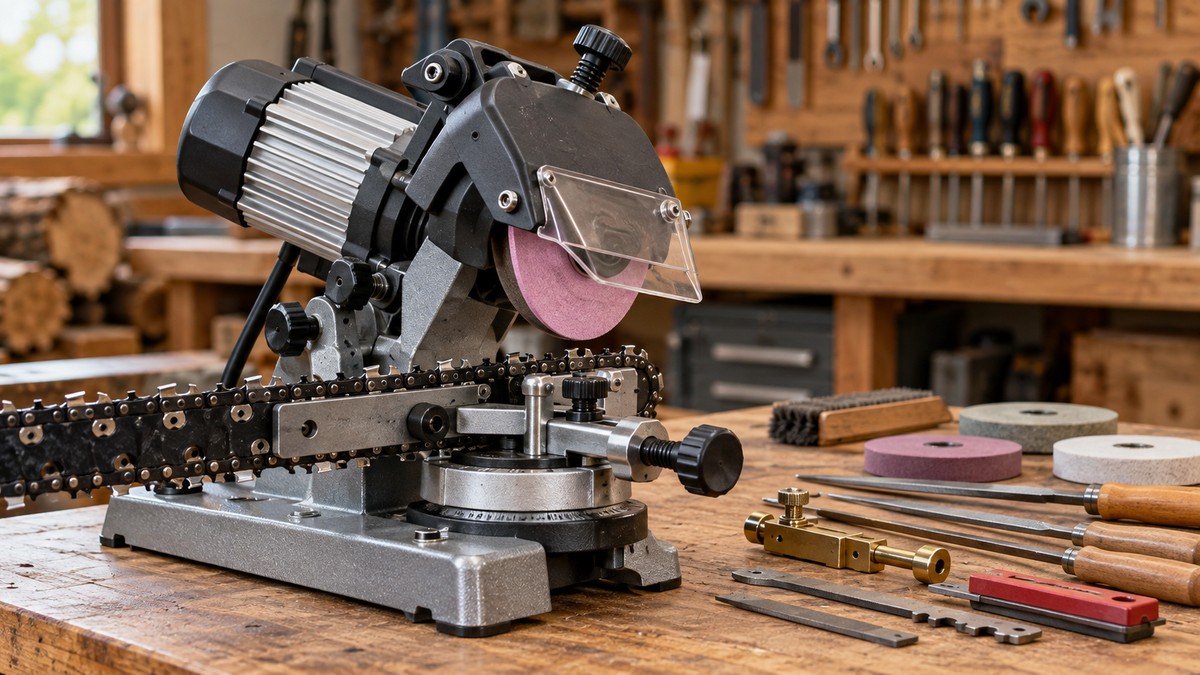
Best Electric Chainsaw Sharpener: Nine Bench, Kit and Cordless Models Compared
As an Amazon Associate we earn from qualifying purchases. Details
The best electric chainsaw sharpener depends on where you sharpen and what you already own. A bench unit with a clamp suits a shop or garage where the chain comes off the saw. A handheld kit that works on the bar suits a chain you would rather leave on the saw. A cordless tool suits someone who already owns a DeWalt 20V MAX battery. This guide compares nine listings from one Amazon results page, using their titles and feature bullets only. The extension pages we opened agree on the core point: a sharp chain is part of safe cutting.
Quick answer
- Bench unit with a clamp: The VEVOR 140W and VEVOR 85W listings are bench units. The 140W names four pitch sizes, including 0.404 inch.
- On the bar: The EzzDoo kit and the NEO-TEC kit both say they sharpen without taking the chain off the saw. The NEO-TEC adds an angle guide with three settings.
- DeWalt 20V owners: The DDKUN listing names DeWalt 20V MAX batteries as compatible, and says the battery is not included.
- Cordless handheld: The VEVOR cordless lists a 2000 mAh battery and 1.01 pounds. Charging takes 1.5 to 2.5 hours, and the listing gives no run time.
Why a sharp chain is the reason to buy one
Oregon State University Extension’s guide to chain saws for woodland owners gives the practical reason: “Correct sharpening lessens your fatigue and ensures that cuts are straight and remove wood “chips” rather than sawdust.” The same guide sets the limit on sharpening. It says to “Immediately replace a saw chain at the first sign that it has become dull, damaged, or unable to cut straight.” A sharpener restores a chain that is still sound. It does not repair a damaged one.
The UW-Madison Extension forestry page makes the link to kickback. It says that “A dull chain creates dust and makes the sawyer want to push hard, which is an unsafe habit that can lead to fatigue and increases the risk of kickback.” Oklahoma State University Extension describes the mechanism in its 2023 chainsaw safety article: “Kickback occurs when the rotating chain hits a solid object or the chain is pinched in a cut.” Its advice on the chain is short: keep it properly sharpened.
None of these pages compares sharpeners. They describe what a dull chain does to the cut and to the operator, which is the reason to own a sharpener at all. The rest of this guide is about which tool fits which setup.
Power and speed figures, as the listings state them
The listings give motor power in watts and speed in revolutions per minute. They do not give load conditions, cord lengths or wheel counts for every model, so the table reports each figure as written.
| Pick | Power or speed (listing) | Pitch sizes named (listing) | Power source (listing) |
|---|---|---|---|
| VEVOR 140W bench | 140 W, 5700 rpm | 1/4, 0.325, 3/8, 0.404 inch | Electric; no cord length |
| EzzDoo handheld kit | Speed setting 2; no wattage | Not named; 3 bit sizes | Electric; no wattage |
| KonKell 230W bench | 230 W, 3000 rpm | 1/4, .325, 3/8, .404 inch | Not named |
| KonKell 250W bench | 250 W, 8400 rpm | 1/4 to 3/8 inch | Not named |
| NEO-TEC on-saw kit | 180 W, 10,000 to 37,000 rpm | All standard file sizes | Electric; on-saw |
| PRETEC rotary kit | 6 speeds, 1000 to 35,000 rpm | Not named | 120V electric |
| DDKUN vise sharpener | Up to 6500 rpm no-load | Common sizes; none listed | DeWalt 20V battery, not included |
| VEVOR 85W bench | 85 W, 5000 rpm no-load | Wheels 3.2 mm and 4.7 mm | Electric; no cord length |
| VEVOR cordless handheld | 5000 to 30000 rpm, 5 speeds | Not named; 3.2 mm collet | 2000 mAh battery, Type-C charging |
Two rows show how far the figures can mislead. The VEVOR 140W lists 140 W and the VEVOR 85W lists 85 W. Dividing one by the other gives 140 ÷ 85 = 1.65, so the first listing has about 1.65 times the stated wattage. The NEO-TEC lists a top speed of 37,000 rpm, and the VEVOR 140W lists 5,700 rpm. Dividing gives 37,000 ÷ 5,700 = 6.49. Those are different tools under different conditions, so neither ratio tells you which one sharpens better. It tells you only what each listing states.
Weight is easier to compare because each figure is stated plainly. The KonKell 250W lists 1.55 kg. Converting at 2.2046 pounds per kilogram gives 1.55 × 2.2046 = 3.42 pounds. The VEVOR cordless lists 1.01 pounds, so the bench unit is 3.42 ÷ 1.01 = 3.39 times the cordless tool’s weight. That comparison is a fair one only if you plan to carry the tool, which a bench unit is not meant for.
Bench units: the chain stays in a clamp
The bench listings are built around a clamp or a vise. The VEVOR 85W describes “a chain fixing clamp and mounting holes for secure workbench fixation,” and says the clamp “holds the chain firmly in place.” The KonKell 250W describes a mountable base that “minimizes movement during operation.” The DDKUN listing says to “Secure the saw chain in the vise and use the chain stop” so each cutter sits in the same place.
The VEVOR 140W adds two features that matter for setting angles. Its listing names a bright LED light and “a quick measurement scale,” and says the scale makes adjustments easier to repeat. The KonKell 230W uses an adjustable grinding head and a rotating turntable, so the angle can be set at more than one position. The listing does not say how many angle positions the turntable offers, so check the setting range before you rely on it for a particular chain.
Bench units are the right choice when the chain comes off the saw and goes to the bench. The listings do not say whether a chain must come off, and this is the question to answer from the manual before you buy. Sharpening on the bench also makes it easier to keep the wheel and the clamp in one position, which is the point of the vise listings.
Handheld kits that work on the bar
The EzzDoo listing says its kit sharpens “chains directly on the bar, with no chain removal required.” It includes six titanium-coated diamond bits in three common sizes. The bullets name speed setting 2 as the setting used with the bits, and they make a bit-life claim: “one bit can typically sharpen 5 or more chains under normal use.” That is a listing claim. The pages we opened do not confirm it, so treat it as the seller’s estimate.
The NEO-TEC kit is a 180W on-saw tool. Its listing says it “allows direct on-saw sharpening,” and includes an angle attachment for 25, 30 and 35 degree grinding angles. It also includes six titanium-plated diamond wheels in 5/32, 3/16 and 7/32 inch. The NEO-TEC listing says the kit fits “gas-powered, electric, and oil chainsaws of almost any brand.” That claim is broader than any page we opened can check, and no pitch list is given to match it.
The VEVOR cordless handheld is the one battery tool in the group. Its listing gives a DC 8V system with a 2000 mAh battery and Type-C charging, and says the battery “recharges in just 1.5–2.5 hours.” It has five speeds, from 5000 to 30000 rpm, four grinding heads and a 25, 30 and 35 degree angle guide. The listing weighs it at 1.01 pounds (0.46 kg). It gives no run time, so a figure for how many chains one charge covers is not available.
Rotary and cordless vise kits
The PRETEC kit is a 120V rotary tool set with 54 pieces. Its listing names six speeds from 1000 to 35,000 rpm, a pure copper motor, nine titanium-coated diamond bits and a preset angle attachment at 35, 30 and 25 degrees. The same box covers “sharpening, grinding, cutting, carving, polishing, engraving.” That breadth is useful if you already use a rotary tool, and a burden if you want only a chain sharpener, because most of the box is for other jobs.
The DDKUN listing is a cordless tool for DeWalt 20V MAX batteries, with a vise, a chain stop, a ±35 degree vise angle and up to 6500 rpm no-load speed. The listing says “Tool only; battery and charger not included.” If you already own the battery, this is a bench-mounted option. If you do not, the battery is a separate purchase that the listing does not price.
Matching the chain pitch before you buy
The pitch is the figure most likely to rule a tool out. The UW-Madison Extension page explains where the pitch is found: “Each cutter tooth has a code indicating the chain pitch,” and each pitch matches a round file size. Check the code on your chain, or the saw manual, before you choose.
Only two listings give a full pitch list. The VEVOR 140W and the KonKell 230W both name 1/4, 0.325 (or .325), 3/8 and 0.404 inch. The KonKell 250W names 1/4 to 3/8 inch and no .404. The VEVOR 85W names wheel thicknesses, 3.2 mm and 4.7 mm, and says they fit “small chains like household small electric saws” and “medium chains like forestry/horticulture electric saws.” The DDKUN listing says it is “designed for common saw chain sizes and pitches” without naming them. The remaining listings name no pitch list at all.
If your chain is 0.404 inch, the KonKell 250W is ruled out by its own listing. If your chain is a size the listing does not name, ask the seller in writing before you buy, or choose a tool that names your pitch.
Choosing by setup
Three setups cover most buyers. The first is a shop or garage where chains come off the saw and go to a bench. The VEVOR 140W and the KonKell 230W are the two bench units with a full pitch list, and the VEVOR 85W is the lower-power option with a clamp. The second setup is a chain that stays on the saw, where the on-bar kits fit: the EzzDoo kit and the NEO-TEC kit. The third setup is a battery you already own. The DDKUN listing is built for a DeWalt 20V MAX battery, and the VEVOR cordless carries its own 2000 mAh battery.
A mixed setup, with one saw at the shop and one in the field, points to two tools. A bench unit handles the saw at home. A cordless or on-bar kit handles the field, where a cord or a workbench is not available. The listings do not give field run times, so plan the number of chains you expect to do on one charge.
Safety steps from the extension pages
The Wisconsin page gives the first step: “Before sharpening, make sure to turn your chainsaw off (and if it’s battery-powered, remove the battery from the saw).” That step applies to every tool in this guide, because each one works on a chain that is attached to a saw or a bar.
The second step is to keep the chain sharp and to replace it when the sharpening no longer works. Oklahoma State advises keeping the chain properly sharpened, and Oregon State says to replace it at the first sign that it is dull, damaged or unable to cut straight. A sharpener does not change either rule.
The third step is about how you cut once the chain is sharp. The Wisconsin page warns that a dull chain pushes the sawyer to press harder, which raises the risk of kickback. A sharp chain removes that reason to press. The pages we opened do not give electric sharpener instructions beyond the manufacturer’s manual, so follow the manual for the tool you choose.
Picks at a glance
1. VEVOR Electric Chainsaw Sharpener, 140W Electric Saw Chain Blade Sharpener 5700RPM, Professional (Bench unit with four named pitch sizes)
Pros
- The listing gives a 140W motor and 5700 rpm no-load speed
- Three grinding wheels, 3.2, 4.5 and 6.0 mm, cover more than one chain size
- The listing names four pitch sizes, including 0.404 inch
Cons
- The listing describes a bench tool and gives no cord length or weight
- The listing does not say whether the chain has to come off the saw first
Best for: Sharpening several chains at a workbench
Skip if: Your chain pitch is larger than 0.404 inch, or you need a tool for the job site
View on Amazon (affiliate link)
2. Electric Chainsaw Sharpener Kit – Chain Saw Sharpener Tool (Handheld kit that sharpens on the bar)
Pros
- The listing says the chain does not have to be removed from the bar
- Six titanium-coated diamond bits in three sizes come in the kit
- The listing gives speed setting 2 as the setting for its bits
Cons
- No wattage, rpm or battery type appears in the bullets
- The bit-life claim of five or more chains is a listing claim we could not check
Best for: Owners who want to sharpen on the bar without taking the chain off
Skip if: You need a motor rating or a battery platform before you buy
View on Amazon (affiliate link)
3. 230W Electric Chainsaw Sharpener – 3000 RPM Motor, Multi-Angle Turntable – Sharpens 1/4″, .325″ (230W bench unit with a turntable)
Pros
- The listing gives a 230W motor and a maximum speed of 3000 rpm
- A rotating turntable and adjustable grinding head give multi-angle sharpening
- Two wheel sizes come in the box, 1/8 inch and 3/16 inch
Cons
- The listing gives no weight or cord length
- The bullets do not say how many angle positions the turntable offers
Best for: A bench sharpener for mixed pitch sizes, including 0.404 inch
Skip if: You need a handheld tool you can take to the job site
View on Amazon (affiliate link)
4. Electric Chainsaw Sharpener, 250W High-Speed Chain Grinder with Adjustable Angle, Heavy-Duty (250W mountable bench unit for 1/4 to 3/8 inch chain)
Pros
- The listing gives 250W at 8400 rpm
- The listing describes a secure mounting base that limits movement during use
- The listing gives a weight of 1.55 kg, about 3.4 pounds
Cons
- The listed pitch range is 1/4 to 3/8 inch, with no 0.404 inch
- The listing does not give a wheel count or wheel size
Best for: Mounted sharpening for 1/4 and 3/8 inch chains
Skip if: You own 0.404 inch chains
View on Amazon (affiliate link)
5. NEO-TEC Electric Chainsaw Sharpener Kit On-Saw Quick Sharpening Tool with Angle Guide 6 Titanium (On-saw kit with angle guide and six wheels)
Pros
- The listing says it allows direct on-saw sharpening, with no chain removal
- The angle guide offers 25, 30 and 35 degree grinding angles
- Six titanium-plated diamond wheels in 5/32, 3/16 and 7/32 inch come in the kit
Cons
- The listing says it fits gas, electric and oil chainsaws of almost any brand, which we could not check
- The listing does not say which speed range suits which wheel
Best for: On-saw sharpening with a set angle guide
Skip if: You want a bench clamp rather than a tool that works on the saw
View on Amazon (affiliate link)
6. Electric Chainsaw Sharpener Kit – Chain Saw Sharpener Tool, Rotary Tool Kit (120V rotary kit for chains and other jobs)
Pros
- The listing describes a 120V electric kit with six speeds from 1000 to 35,000 rpm
- Nine titanium-coated diamond bits in three sizes and a 25, 30 and 35 degree angle attachment
- The listing describes a pure copper motor
Cons
- The kit is a rotary tool set for carving, polishing and engraving too, so there are more parts to store
- The listing gives 54 pieces but no pitch list for the chains it sharpens
Best for: Owners who want one rotary kit for chain work and other jobs
Skip if: You want only a chain sharpener, because most of the box is other accessories
View on Amazon (affiliate link)
7. Cordless Chainsaw Sharpener for DeWalt 20V Battery(Batteries not included) (Vise-mounted cordless sharpener for DeWalt 20V)
Pros
- The listing names DeWalt 20V MAX batteries as compatible
- A vise and a chain stop hold the chain in place, according to the listing
- The listing gives up to 6500 rpm no-load speed and a ±35 degree vise angle
Cons
- Tool only: the battery and charger are not included
- The listing gives no wattage and no cord or weight figure
Best for: A DeWalt 20V owner who wants a bench-mounted cordless sharpener
Skip if: You do not already own a DeWalt 20V MAX battery
View on Amazon (affiliate link)
8. VEVOR Electric Chainsaw Sharpener, 85W Bench Saw Chain Sharpener 5000RPM, Professional Chainsaw (85W bench unit with a clamp and shield)
Pros
- The listing gives an 85W motor and 5000 rpm no-load speed
- A chain fixing clamp and mounting holes hold the chain for a workbench
- A transparent protective shield blocks sparks and debris, according to the listing
Cons
- The listing names two wheel sizes, 3.2 mm and 4.7 mm, and no pitch list
- The listing does not give a weight or cord length
Best for: A workbench sharpener for small and medium electric saw chains
Skip if: You need on-bar sharpening, because this is a bench clamp design
View on Amazon (affiliate link)
9. VEVOR Cordless Chainsaw Sharpener, 5-Speed Adjustable Electric Saw Chain Sharpener 5000-30000 RPM (Battery handheld with an angle guide)
Pros
- The listing describes a 2000 mAh battery with Type-C charging
- Five speed settings from 5000 to 30000 rpm and an angle guide at 25, 30 and 35 degrees
- The listing gives 1.01 pounds (0.46 kg), which is light for a handheld
Cons
- The listing says charging takes 1.5 to 2.5 hours and gives no run time
- It has a 3.2 mm collet and four heads, but no pitch range is named
Best for: Handheld sharpening where a cord would get in the way
Skip if: You need a run-time figure before you buy
View on Amazon (affiliate link)
How we chose
We searched Amazon for the keyword and read the first results page. We kept listings whose title names a sharpener. That removed four bench chain grinders whose titles do not use the word sharpener, and two chainsaws, one of which has self-sharpening in its title. We left out the sponsored results on the page.
Ten listings remained, and we used all ten in page order. One of them is a bench mount whose listing has no feature bullets, so it is not a pick in this guide. The other nine each state a power or speed figure, or a power source, and each card gives the figure from its own listing.
Each pick card gives a reason drawn from that listing, one or two limitations, and a skip case. We did not use prices, ratings, sales figures or rankings. The order of the picks does not rank them.
What we could not verify
- Sharpening quality, edge life and how quickly any tool sharpens a chain. The pages we opened do not compare these models.
- The EzzDoo claim that one bit can sharpen five or more chains. It is a listing claim.
- The NEO-TEC claim that its kit fits gas, electric and oil chainsaws of almost any brand. It is also a listing claim, and no pitch list is given to check it against.
- Run time for the VEVOR cordless. The listing gives a charging time only.
- Cord lengths, weights and wattage for every model. The figures use different conditions, so a difference in watts is not a difference in sharpening power.
- Electrical safety for any of these tools. The pages we opened do not cover it, so the manual and the cord or battery instructions are the reference.
- The pitch range for the VEVOR 85W, the DDKUN and the cordless VEVOR, which list no pitch list.
- Any safety certification. The listings do not name one.
This guide covers sharpeners only. If you are still choosing a saw, our pole saw comparisons are a separate read: Seesii vs Autubin pole saws and DocSmart vs AVADA pole saws.
FAQ
Is an electric sharpener better than filing by hand?
The pages we opened do not compare electric and hand filing for speed or accuracy. Oregon State University Extension describes an electric grinder made for saw chains as the way to sharpen when you return home or go to a saw shop. The UW-Madison page describes hand filing with a file held at a consistent 90-degree angle. Both methods appear in the pages we opened. The electric tools in this guide save the file work, but none of the listings gives an accuracy figure.
Do I have to take the chain off the saw?
It depends on the tool. The EzzDoo and NEO-TEC listings say the chain can stay on the bar. The DDKUN listing has you secure the chain in a vise. The bench listings do not say whether the chain must come off, so read that part of the manual before you buy. Whatever you choose, turn the saw off and remove the battery if it has one.
What chain pitch do I need?
Find the pitch on the chain or in the saw manual. The UW-Madison page says each cutter tooth has a code for the pitch, and each pitch matches a round file size. Two bench listings name four pitch sizes, one names two, and the rest give no pitch list. A tool with no pitch list is not ruled out, but you need to confirm the match with the seller before you buy.
When should I replace the chain instead of sharpening it?
Replace it when the chain shows damage or stops cutting straight after sharpening. Oregon State University Extension says to “Immediately replace a saw chain at the first sign that it has become dull, damaged, or unable to cut straight.” A sharpener cannot repair a damaged cutter.
Does a higher wattage mean a sharper chain?
Not from the listings. They state wattage and speed, but none gives an edge-quality figure, and the pages we opened do not link motor size to how well a chain is sharpened. Compare the pitch list, the setup and the power source first, and use wattage only as a note about the tool.
Bottom line
Pick the tool by how you work. A bench unit fits a shop where the chain comes off the saw, an on-bar kit fits a chain that stays on, and a cordless vise or handheld fits a battery you already own. Check the chain pitch against the listing before you pay, because the pitch list is the figure most likely to rule a tool out. Then turn the saw off and remove the battery before you start, as the Wisconsin page advises.
Sources
- Oregon State University Extension, EC1124 “Safe and Effective Use of Chain Saws for Woodland Owners” (PDF), opened 2026-10-20: https://extension.oregonstate.edu/sites/extd8/files/documents/ec1124.pdf
- UW-Madison Extension, forestry page “Buying and Maintaining a Chainsaw”, opened 2026-10-20: https://forestry.extension.wisc.edu/learn/chainsaw/buying-and-maintaining/
- Oklahoma State University Extension, “Chainsaw Safety” (2023 article), opened 2026-10-20: https://extension.okstate.edu/articles/2023/chainsaw_safety