How to Clean Battery Contacts on Cordless Tools
As an Amazon Associate we earn from qualifying purchases.
If you need to know how to clean battery contacts on cordless tools, the short answer is this: remove the battery, wipe the contacts with a dry, lint-free cloth or a soft brush, avoid solvents, and let the terminals dry before the battery goes on the charger.
The manufacturer pages we opened do not agree on every detail. DeWalt describes a slightly damp cloth, Husqvarna describes a dry one, and only one Husqvarna page mentions compressed air. None of the pages gives a cleaning schedule or names a contact cleaner, so this guide sticks to the methods they do describe.
Quick answer
- Switch the tool off and take the battery out before any cleaning. Husqvarna and STIHL both say this for battery chainsaws.
- For dust, use a dry, lint-free cloth or a soft brush. For dirt, DeWalt says a clean, slightly damp cloth, with no solvents.
- Skip solvents, and keep liquids and oils away from the battery.
- Charge the battery only after the terminals are clean and dry. Husqvarna says a dirty or wet battery must not go into the charger.
Why clean the contacts
Husqvarna’s US chainsaw page says that keeping a battery-powered tool clean is essential for the product’s longevity and optimal performance. That is a general manufacturer statement. The page does not say how much cleaning changes runtime, charging speed, or battery life, and the other pages we opened do not say either. Treat the claim as a reason to keep the contacts clean, not as a measured result.
Battery voltage and amp-hour ratings are a separate question. For those, see lawn mower battery voltage and amp-hour ratings.
Safety before you clean
These points come from the manufacturer pages in the sources list. Each one applies before any cleaning step.
- Remove the battery from the tool first. Husqvarna’s US chainsaw page says to remove the battery from the product, and STIHL’s guide for battery chainsaws says to remove the battery and engage the chain brake. For other cordless tools, the pages we opened give no separate rule, so check your manual.
- Do not use solvents on the pack. DeWalt says to clean batteries with a slightly damp cloth and not to use solvents.
- Keep the pack away from liquids and oils. DeWalt says to avoid exposing batteries to liquids, oils, or extreme temperatures.
- Do not charge a battery that is dirty or wet. Husqvarna’s UK charging page warns against putting a dirty or wet battery in the charger.
- Do not use a battery with visible damage or cracks, and do not attempt repair or service. DeWalt gives both points and says to visit a service center for help.
Cleaning steps for battery and charger contacts
Work through these steps in order. Each step names the source behind it.
- Switch the tool off and take the battery out. Before any contact work, make sure the tool is switched off and cannot start. STIHL’s guide says to make sure the chainsaw is switched off and cannot start during maintenance, and to remove the battery from a battery chainsaw first. Husqvarna’s US page gives the same first step: remove the battery from the product before cleaning its connectors.
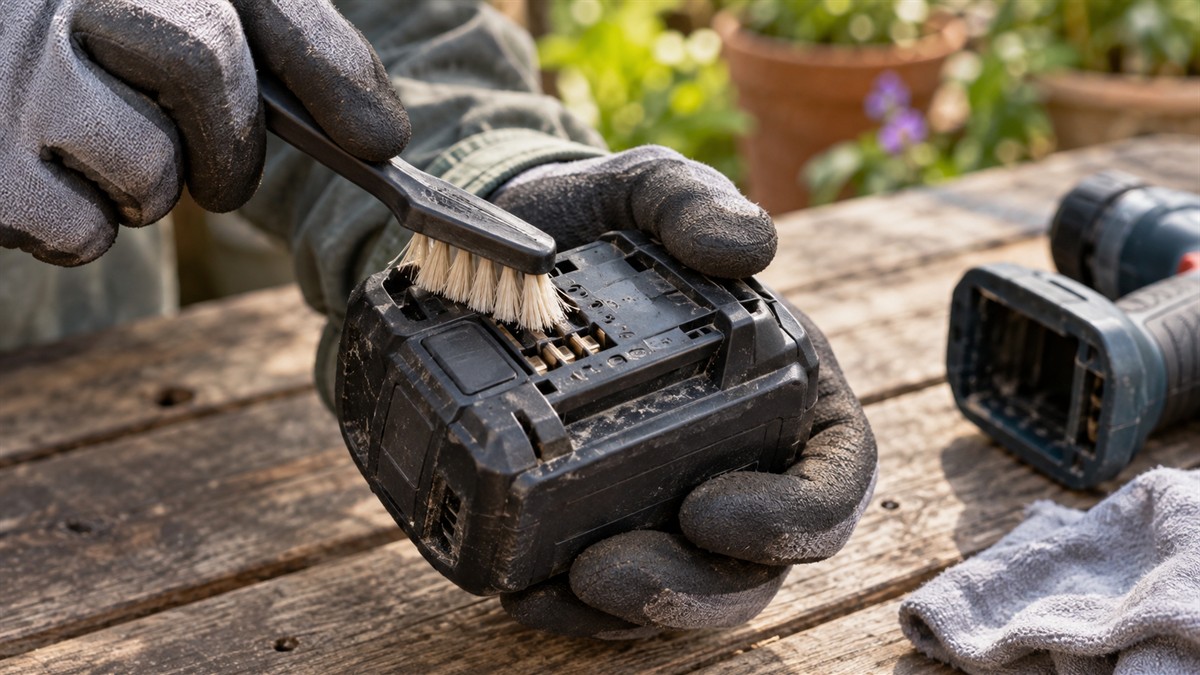
- Dust the contacts with a dry, lint-free cloth or a soft brush. Husqvarna’s AU maintenance page says to wipe the terminals with a dry, lint-free cloth to remove dust, debris or moisture. STIHL’s guide says that if the electrical contacts need it, you can clean them with a brush. Keep the battery out of the tool for this step.
- Use compressed air only with the battery out, and only if your manual allows it. Husqvarna’s US chainsaw page tells you to use compressed air to clean the battery connectors, after the battery is removed. The page gives no distance, no pressure setting, and no eye-protection step. Its advice covers the chainsaw’s battery connectors, and the pages for other packs do not mention compressed air for battery contacts.
- Wipe any dirt with a clean, slightly damp cloth. DeWalt says to clean batteries with a clean, slightly damp cloth, and not to use solvents. STIHL says to clean the battery with a damp cloth. Keep the cloth slightly damp rather than wet, and keep liquid away from the pack.
- Dry the terminals completely. Husqvarna’s UK charging page says the battery, the charger and the terminals on the battery must be clean and dry. The pages we opened do not give a drying time, so do not move to the charger until the terminals are dry.
- Put the battery back, and charge it only when the contacts are dry. Husqvarna’s US page says to put back the battery after cleaning the connectors. Husqvarna’s UK page warns that a dirty or wet battery must not go into the charger.
Cleaning the charger terminals
The charger has contacts too, and the pages differ on how to clean them. Husqvarna’s AU page says to dust the charger exterior and terminals with a dry cloth or a soft brush. STIHL’s chainsaw guide says to wipe the charger with a damp cloth and to clean its electrical contacts with a brush if necessary. The pages do not settle the cloth question, so check your charger’s manual before you choose one. The sources we opened also do not say whether to unplug the charger before cleaning it.
Cleaning methods by source
The table lists what each opened page states about cleaning battery or charger contacts. “not stated” means the page does not cover that point.
| Source | Battery removed first | Cloth or brush | Compressed air | Solvents or liquids |
|---|---|---|---|---|
| DEWALT battery safety page (US) | not stated for cleaning | Clean, slightly damp cloth | not stated | Do not use solvents; avoid liquids and oils |
| Husqvarna battery chainsaw page (US) | Yes: remove the battery from the product | not stated | Use compressed air on the battery connectors | not stated |
| STIHL chainsaw cleaning guide (US) | Yes for battery chainsaws: remove the battery and engage the chain brake | Damp cloth for the battery; brush for electrical contacts if necessary | not stated for battery contacts | not stated |
| Husqvarna charging page (UK) | not stated for the tool; the page covers removing the battery from the charger when full | not stated | not stated | Do not charge a dirty or wet battery |
| Husqvarna maintenance page (AU) | not stated for cleaning | Dry, lint-free cloth for battery terminals; dry cloth or soft brush for charger terminals | not stated | not stated |
Read across the table and two differences stand out. The cloth guidance is not the same on every page, and only one page recommends compressed air for battery connectors. Each row shows what that page says, not what every manufacturer says.
Where the sources disagree
The biggest difference is the cloth. DeWalt says a slightly damp cloth for the battery. Husqvarna says a dry, lint-free cloth for the terminals and a dry cloth or soft brush for the charger. STIHL says a damp cloth for both the battery and the charger. These are not the same instruction, so this post reports all three rather than picking one. If you are unsure, use the method in your tool’s manual.
The second difference is compressed air. For battery and charger contacts, only the Husqvarna US chainsaw page recommends it. STIHL’s guide mentions compressed air for the cooling air slots on the saw, which is a different part. The DeWalt and Husqvarna UK and AU pages do not mention it. Because the one mention has no distance, pressure, or eye-protection detail, do not treat it as a complete procedure.
What we could not verify
- How often to clean the contacts. None of the pages we opened gives an interval.
- Whether a named contact cleaner, alcohol, or grease is safe. None of the pages names one, and this post does not recommend a product.
- How long the terminals need to dry. The pages say the terminals must be dry but give no time.
- Whether compressed air is safe for every pack. Only one page mentions it for battery connectors, and it gives no distance or pressure.
- Whether the advice fits every brand. Each page describes its own manufacturer’s packs and chargers. This post does not say that one brand’s battery fits another brand’s tool.
What the sources do not say
The pages cover different products, and none of them is a general guide to every cordless tool. The DeWalt page talks about cleaning batteries in general, not the terminals in particular. The Husqvarna US page covers the battery connectors on a chainsaw. The two Husqvarna pages cover a BLi-X 36 V battery and its charger, so their steps are a pattern for other packs, not a rule for them.
No page we opened describes corrosion on the contacts, how to remove it, or when a contact is too damaged to clean. No page describes cleaning the charger beyond dusting, brushing, or wiping it. Where a question goes beyond these pages, the manual for your tool and charger is the next place to look.
How we chose
We set three criteria. The page had to be a manufacturer’s own support, product, or safety page. It had to state a cleaning, charging, or handling rule that could be copied word for word from the saved text. And it had to open as a plain HTML page on 2026-10-22. We opened seven pages on that date and cite five. The two not cited, a Power Tool Institute page and a STIHL battery-life page, did not give contact-cleaning steps.
Three of the cited pages are US pages: DeWalt, Husqvarna US, and STIHL US. Two are Husqvarna pages for the UK and Australia. No US Husqvarna page on BLi-X terminal cleaning was among the pages we opened, so the UK and AU pages are cited as non-US locale pages. Manufacturer PDF manuals were not opened, because the fetch step reads HTML pages only. Retail listings, blogs, forums, and review sites were not used.
FAQ
Can I clean battery contacts with rubbing alcohol?
The pages we opened do not name rubbing alcohol. DeWalt says to clean battery packs with a clean, slightly damp cloth and not to use solvents, so the methods in this post do not include alcohol. Check your tool’s manual before you put any liquid on the contacts.
Do I have to remove the battery before cleaning?
For the battery chainsaws in these sources, yes. Husqvarna’s US page says to remove the battery from the product, and STIHL’s guide says to remove the battery and engage the chain brake. For other cordless tools, the pages we opened give no separate rule, so follow the manual for your model. Removing the battery first is the one step both chainsaw pages share.
Is compressed air safe for battery connectors?
Husqvarna’s US chainsaw page says to use compressed air to clean the battery connectors, with the battery removed. The other pages we opened do not mention compressed air for battery contacts, and STIHL’s compressed air mention is for the saw’s cooling air slots. The Husqvarna page gives no distance, pressure, or eye-protection details, so do not treat it as a full procedure. Check your manual before you use compressed air on any pack.
Can I charge the battery right after I wipe the contacts?
Husqvarna’s UK charging page says the battery, the charger and the battery terminals must be clean and dry, and that a dirty or wet battery must not go into the charger. The pages do not give a drying time. Wait until the terminals are dry before you put the battery on the charger.
Should I put grease or a contact treatment on the terminals?
The pages we opened do not recommend grease, a contact treatment, or any named product for battery contacts. DeWalt advises keeping batteries away from oils, so the manufacturer advice in this post does not include an oily product. This post does not recommend a product for contact cleaning.
What if the battery is damaged or the contacts look corroded?
DeWalt says not to use a battery with visible damage or cracks, and not to attempt repair or service. It says to visit a DEWALT Service Center for help with the battery. The pages we opened do not describe corrosion removal, so do not try to repair the battery or scrape away corrosion. If the battery still will not charge after cleaning, read the guide to a lawn mower battery that is not charging.
Bottom line
Charge the battery only when its terminals are clean and dry. Take the battery out, dust the contacts with a dry cloth or a soft brush, wipe any dirt with a slightly damp cloth and no solvent, then let the terminals dry before the battery goes on the charger.
Sources
- DEWALT: Top 10 Lithium Ion Battery Storage & Safety Tips (opened 2026-10-22)
- Husqvarna: How to clean a battery-powered chainsaw (opened 2026-10-22)
- STIHL: How to Clean a Chainsaw (opened 2026-10-22)
- Husqvarna UK: Charging a BLi-X 36 V battery (opened 2026-10-22)
- Husqvarna AU: How to maintain and store your BLi-X 36V battery for maximum performance (opened 2026-10-22)