How to Clean a Cordless Blower Air Intake
As an Amazon Associate we earn from qualifying purchases.
This guide explains how to clean cordless blower air intake openings and vents without damaging the unit. Remove the battery first, let the moving parts stop, clear large debris by hand, and then clean the intake with compressed air. The sources disagree on whether a damp cloth is safe, so check your owner’s manual before you pick a wiping method.
The steps below apply to battery-powered blowers only. Some manufacturer pages also cover petrol engines, and those engine steps are not used here.
Quick answer
- Switch the blower off and remove the battery before you clean the intake or the vents.
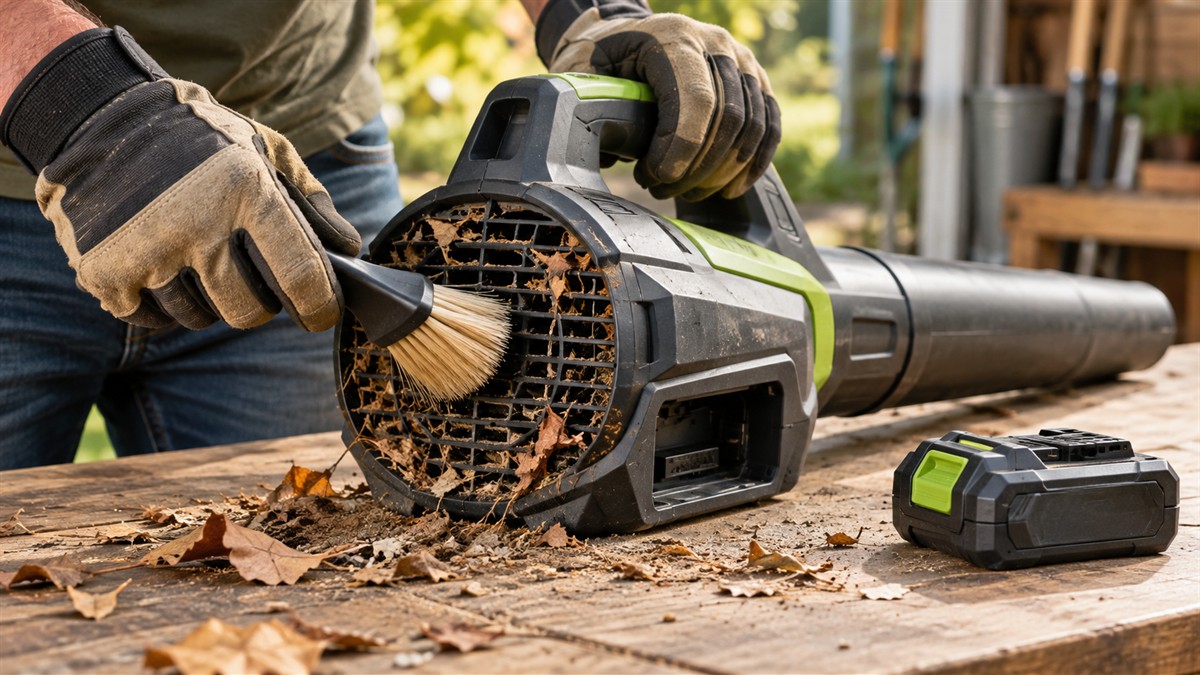
- Remove large debris such as wet leaves and mud by hand, then clear leaves, twigs and clippings from the intake.
- Clean the motor air intake with compressed air, as the Husqvarna battery-blower section describes.
- Check the vents for blockage before you run the blower again.
Safety before you clean
Start by switching the blower off and removing the battery. Snow Joe’s troubleshooting guide puts the switch-off first: “Always turn the blower or blower/vacuum OFF before troubleshooting.” Give the blower time to stop completely. The same guide says to “Wait for all moving parts to stop before checking the vents, inlet cover, tube, or vacuum area.”
Keep water away from the unit. Husqvarna’s battery-powered section says to “Clean the external parts of the product with a dry cloth. Do not use water.” EGO’s weather advice gives the reason: “using an electrical tool when it’s raining can cause the battery to get wet and damage the tool overall.” EGO also lists protective gear as part of using the blower safely: “Correct clothing includes sturdy boots, eye protection and work gloves.”
What you need
For a battery blower, the sources we opened name three things. Compressed air is named for the motor air intake by Husqvarna. A dry cloth is named for the outside of the unit by Husqvarna. A damp, clean cloth or sponge is named for wiping the inlet area by EGO. For a battery blower, these sources do not name a brush, so this guide does not add one. Snow Joe’s guide names the vents, the inlet cover and the tube as parts to check, but it describes checking for blockage rather than a cleaning tool.
For a wider comparison of models, see the cordless leaf blower guide, and for a different brand’s option, the Black+Decker 18V leaf blower guide is another place to compare.
Intake and vent cleaning by source
Each source describes a different level of detail. The table shows what each one states for the battery, the cleaning method, the water or cloth advice, and the intake or vent location. Cells say “not stated” where the source is silent.
| Source and page | Battery step | Cleaning method stated | Water or cloth | Intake or vent location |
|---|---|---|---|---|
| Husqvarna US, battery-powered section | Remove the battery before any maintenance | Clean the air intake with compressed air (weekly); clean the air intake for the fan | Dry cloth; no water | Not stated |
| Snow Joe troubleshooting, 24V and 20V cordless units | Remove the 24V battery or batteries before checking the vents (24V section) | Check that nothing is blocking the vents | Not stated | Vents, inlet cover and tube named |
| EGO Power+ UK, before first use | Not stated | Remove twigs, leaves or clippings from the inlet; wipe with a damp, clean cloth or sponge | Damp, clean cloth or sponge | Behind the blower tube |
| EGO Power+ UK, maintenance page | Not stated | Remove large debris by hand; wipe the whole exterior | Clean, damp cloth | Not stated |
| ECHO leaf blower maintenance, vent check | Not stated | Check all air vents, intake and exhaust, for obstruction, dirt, debris or clippings | Not stated | Intake and exhaust vents |
Intervals are the one place the sources give numbers. Husqvarna’s battery section lists exterior cleaning as a daily task and the air intake as a weekly task. EGO’s maintenance page says maintenance should be proper practice after every use. A blower used on five days a week therefore has the Husqvarna intake task once a week and the EGO task on each of those five days. The sources do not agree on one schedule, so the table keeps both.
Steps to clean the air intake
These steps combine the battery-powered guidance from the sources. Where a step comes from one brand, the step names that brand.
- Turn the blower off and remove the battery. Husqvarna and Snow Joe both put the battery step first, before any work on the vents or the intake.
- Wait for the moving parts to stop. Snow Joe’s guide asks for this before you check the vents, so do not reach into the intake while the fan is still turning.
- Remove large debris by hand. EGO’s maintenance page says to “remove any large pieces of debris such as wet, stuck leaves and mud from the blower by hand.”
- Find the air intake. On EGO blowers, the air inlet “is located behind the blower tube.” The other sources we opened do not give a location for other brands, so check your manual for yours.
- Clear the intake. EGO says to “check for debris, such as twigs, leaves, or grass clippings, that are blocking it and remove them.”
- Clean the motor air intake with compressed air. Husqvarna says to “Clean the air intake with compressed air.” Its list also says to “Clean the air intake for the fan,” but it gives no method for that opening, so use the compressed air step only where your manual agrees.
- Wipe the area as your manual allows. EGO says: “Once removed, wipe it down with a damp, clean cloth or sponge.” Husqvarna says to use a dry cloth and no water. These sources disagree, so this guide does not choose between them.
- Check the vents before you restart. ECHO’s vent check asks you to “Check all air vents – Intake and exhaust – for obstruction, dirt, debris, or clippings.” Confirm that the vents are open before you start the unit again.
Why a blocked intake matters
EGO says a clogged air inlet “can impact the blower’s efficiency and performance, draining its battery quicker than it should.” ECHO says battery blowers “still rely on adequate airflow,” even though they do not need the active cooling of a gas engine. In practice, a clear intake protects the airflow the blower depends on. EGO ties the intake to both performance and battery drain, and ECHO ties battery blowers to airflow.
Mistakes that leave the intake dirty
- Cleaning before the battery is out. Both Husqvarna and Snow Joe place the battery step first, so do it before you open or clean anything near the intake.
- Wetting the outside. Husqvarna’s battery section says to clean the external parts with a dry cloth and to avoid water, and EGO’s weather advice warns about water reaching the battery.
- Stopping at the surface. EGO’s first-use page puts removing the debris before wiping. Check the openings for leaves and clippings after you wipe, not just the outside of the unit.
- Skipping the vents. Snow Joe’s guide asks you to check that nothing is blocking the vents. A clear intake does not clear a blocked vent, so check both.
How we chose
We opened five brand or manufacturer support pages on 2026-10-22: Husqvarna US, Snow Joe support, EGO Power+ UK (two pages) and ECHO. We left out retailer blogs and parts sellers that the search returned, because they are not manufacturers. The EGO pages are UK pages, and no US EGO page on cleaning the blower intake turned up in the searches. ECHO’s vent-check list sits under a gas-blower heading, so only the vent-check line is taken from it, and only because ECHO says battery blowers still rely on airflow. We did not rank the sources.
What we could not verify
We could not verify the cleaning steps for any single model. The Husqvarna battery section is generic, the Snow Joe page is a troubleshooting guide, and the EGO steps come from UK pages. We could not verify the intake location for blowers other than EGO’s. ECHO’s vent check does not say whether its battery models have the same openings.
We also could not verify whether a damp cloth is safe. Husqvarna says “Do not use water.” EGO says to wipe with a damp cloth or sponge. Those are different models and different instructions, and the sources do not settle the question.
What the sources do not say
- None of the five sources gives a time needed to clean the intake.
- The sources we opened do not say which brush or tool suits the inside of a battery blower’s intake.
- The Snow Joe 20V section we opened does not mention the vents or the intake.
- The sources do not say whether the fan air intake and the motor air intake are the same opening.
FAQ
Do I need to remove the battery before I clean the air intake?
Yes, for battery blowers, according to the sources that address it. Husqvarna says “Remove the battery before you perform any maintenance.” Snow Joe says “For battery-powered models, remove the battery or batteries.” The EGO cleaning pages do not mention a battery step, so follow the battery step in your own manual. If your blower takes a DEWALT battery, the DEWALT leaf blower battery options post covers that battery.
Should I clean the intake with water or a damp cloth?
The sources disagree. Husqvarna says to clean the external parts with a dry cloth and says “Do not use water.” EGO says to wipe the inlet area “with a damp, clean cloth or sponge.” Use the method in your manual. If your manual is silent, this guide cannot tell you which method is right.
Where is the air intake on my blower?
On EGO blowers, the EGO page says the air inlet “is located behind the blower tube.” The other sources we opened do not give a location for their blowers. Look at the diagram and the parts list in your owner’s manual before you clean.
How often should I clean the air intake?
The sources give different schedules. Husqvarna’s battery section lists the air intake as a weekly task and the exterior as a daily one. EGO says maintenance “should be proper practice after every use.” Where the schedules differ, follow the one in your manual.
Why does a dirty air intake matter on a battery blower?
EGO says a clogged air inlet “can impact the blower’s efficiency and performance, draining its battery quicker than it should.” ECHO says that battery blowers “still rely on adequate airflow,” so a clear intake keeps the airflow the blower depends on.
Do the gas blower steps apply to a cordless blower?
No. The Husqvarna page includes petrol sections with engine steps, and the ECHO page includes gas-blower steps for the filter and cooling system. This guide uses only the battery-powered steps. ECHO notes that battery blowers generate less heat and need less active cooling than gas blowers, so the engine steps on that page do not apply to a cordless unit.
Bottom line
Remove the battery and let the moving parts stop before you clean. Follow your manual’s wiping method. If the manual says no water, clean the outside with a dry cloth and the intake with compressed air only.
Sources
- Husqvarna US: Maintenance for a leaf blower (opened 2026-10-22)
- Snow Joe Support: Leaf Blower Vacuum Troubleshooting (opened 2026-10-22)
- EGO Power+ UK: Checking over your cordless leaf blower before its first use (opened 2026-10-22)
- EGO Power+ UK: How to maintain your leaf blower (opened 2026-10-22)
- ECHO: Leaf Blower Maintenance (opened 2026-10-22)