Is It Safe to Charge a Mower Battery Overnight?
As an Amazon Associate we earn from qualifying purchases.
Is it safe to charge a mower battery overnight? The sources we opened do not say yes. Two Husqvarna pages tell you to remove the battery once it is fully charged, which rules out leaving it on the charger after it shows full. The sources do not settle whether a charger that switches itself off makes an overnight charge safe, so this guide sets out what the manufacturer pages say and where they stop.
The answer depends on your own charger and battery. The pages we opened cover Husqvarna BLi-X packs, STIHL AP packs, and one DeWalt pack, so a rule for one brand is not a rule for another.
Quick answer
- Not as a routine. None of the manufacturer pages we opened says that leaving a mower battery on the charger overnight is safe.
- Husqvarna’s UK and AU pages say to remove the battery once it is fully charged, and to unplug the charger after charging.
- STIHL’s chart lists full-charge times from 40 minutes to 430 minutes, depending on the charger and pack, so some charges run for hours.
- Whether a charger that shuts off by itself makes overnight charging safe is not stated. Check your charger’s own manual.
What the pages say when the battery is full
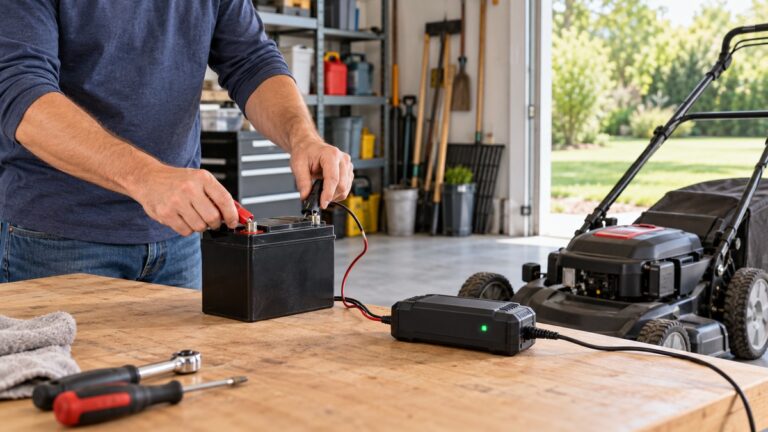
The Husqvarna UK charging page gives the full-charge steps for a BLi-X battery. It says to connect the charger to a power outlet, then the battery to the charger. To check the charge, push the battery indicator button: “When all the LED indicators illuminate, the battery is fully charged.” The page’s next instruction is direct: “Remove the battery from the battery charger when it is fully charged.”
The Husqvarna AU page gives the same instruction and a reason: “Once fully charged, remove the battery from the charger to avoid overcharging or unnecessary wear on the charger.” Its unplugging step is: “Once charging is complete, disconnect both the battery and the power plug.” It adds: “Leaving the charger powered continuously can reduce its lifespan.”
Taken together, the two pages say a full battery should come out of the charger, and the charger should be unplugged once charging is done. A battery left on the charger overnight after it shows full goes against both instructions. Neither page says the rule changes for a charger that switches off by itself.
Safety before and during charging
These points come from the pages named in the sources list. They apply to any overnight or unattended charge.
- Do not put a dirty or wet battery in the charger. The Husqvarna UK page says: “WARNING: Do not put the battery in the battery charger if it is dirty or wet.”
- Do not use a battery with visible damage or cracks. DeWalt’s US page says: “Do not use batteries with visible damage or cracks.”
- Stop using a charger that shows a solid red light. The Husqvarna UK charger page says a solid red light “typically indicates a serious issue with a charger or battery,” and tells you to stop using the charger and contact a dealer.
- Keep batteries away from liquids, oils, and extreme temperatures. DeWalt’s US page says: “Avoid exposing batteries to liquids, oils, or extreme temperatures.”
- Use the correct battery and charging system. STIHL’s charging page gives that advice.
Full-charge times on STIHL’s chart
STIHL’s AP System Battery Chart gives charging times in minutes to 80% and to 100% capacity, for each charger and pack. Across the chart, the time to 100% runs from 40 minutes to 430 minutes. The table pulls out seven rows that show the spread. Each cell reads minutes to 80% and minutes to 100%, in that order.
| Pack | Charger | Minutes to 80% | Minutes to 100% | Source |
|---|---|---|---|---|
| STIHL AP 300 S | AL 301 | 55 | 80 | STIHL AP System Battery Chart |
| STIHL AP 500 S | AL 301 | 70 | 90 | STIHL AP System Battery Chart |
| STIHL AR 2000 L | AL 301 | 220 | 290 | STIHL AP System Battery Chart |
| STIHL AR 3000 L | AL 301 | 330 | 430 | STIHL AP System Battery Chart |
| STIHL AP 300 S | AL 501 | 30 | 45 | STIHL AP System Battery Chart |
| STIHL AP 500 S | AL 501 | 40 | 55 | STIHL AP System Battery Chart |
| STIHL AR 3000 L | AL 501 | 170 | 220 | STIHL AP System Battery Chart |
Worked example. The longest 100% time on the chart is 430 minutes, for an AR 3000 L on an AL 301. Divide by 60: 430 ÷ 60 ≈ 7.17 hours, or 7 hours 10 minutes. If a charge started at 10:00 p.m., the chart’s figure would put the 100% point at 5:10 a.m. The chart does not say what the charger does after that point, whatever the start time. Pack capacity is a separate number, and for the voltage and amp-hour side of it, see lawn mower battery voltage and amp-hour ratings.
Where the pages stop
STIHL’s charging page describes the AL 301 with the words “Safe battery charging thanks to the active cooling system.” It does not say that the charger is suited to unattended charging, and it does not say whether the cooling system runs after a pack is full.
The Husqvarna UK charger page allows one case where a battery stays in the charger: “Leave the battery in the charger. Charging will begin automatically when the battery reaches a safe temperature.” That is a waiting case, when the pack is too hot or too cold to start. It is not a full-battery case, and the page does not extend it to overnight charging after a pack is full. If a pack will not charge at all, read the guide to a lawn mower battery that is not charging.
Charging habits that affect the battery
STIHL’s charging page gives a routine, not a time limit: “Maintain the proper charging routine. Only use a stronger charger if your usage demands it. A faster charging speed, like more frequent charging, puts more strain on the battery.” It also says: “There is no need to recharge immediately after brief usage as this will lead to reduced battery life.” Those are habits, not overnight rules. They do not say an overnight charge is harmful, and the pages do not give a figure for wear from any charging pattern.
Husqvarna’s AU page points the other way, at the charger: leaving the charger powered continuously “can reduce its lifespan.” That is a statement about the charger, not the battery.
How to charge the way the Husqvarna pages describe
These steps come from the Husqvarna UK and AU pages for BLi-X packs. The sources do not give steps for other chargers.
- Connect the charger to a power outlet. The charging LED flashes once, according to the Husqvarna UK page.
- Connect the battery to the charger. The charging LED illuminates. Do not put in a battery that is dirty or wet, because the page warns against it.
- Check the charge. Push the battery indicator button. When all the LED indicators illuminate, the battery is fully charged.
- Remove the battery from the charger. Do this once it is fully charged, as the UK page says. Leaving it in longer is the case the AU page warns about, because of overcharging and wear on the charger.
- Disconnect the power plug. Do not pull on the power cord. The UK page gives that instruction.
- Unplug the charger once charging is complete. The AU page says to disconnect both the battery and the power plug at that point.
- If a light shows a fault, follow the charger page. For a flashing red light, the Husqvarna UK charger page says: “Unplug and retry. Contact support if the issue persists.” For a solid red light, stop using the charger and contact a dealer.
What the sources do not say
- Automatic shutoff. None of the pages we opened says whether a charger that stops by itself makes an overnight charge safe, or what a stopped charger does to a pack left in it.
- Battery effects. The Husqvarna AU page names overcharging and wear on the charger, but it does not say what overcharging does to the pack itself.
- Heat and fire risk. The pages we opened do not discuss heat or fire risk from leaving a charger connected while unattended.
- Charger models. The pages do not list which STIHL, Husqvarna, or DeWalt chargers have automatic shutoff.
- Other brands. The DeWalt US page gives charging-location advice but no overnight rule. The DeWalt, EGO, and Milwaukee manuals that came up in search are PDFs, which the fetch step cannot open. For mower packs at 12 volts or 6 volts, see the guide to 12-volt or 6-volt lawn mower batteries.
What we could not verify
- Whether your charger switches off on its own, or how it behaves once a pack is full. Your charger’s manual is the place to check.
- Whether a full pack stays at a safe temperature overnight. The pages give temperature limits for use and charging, not for a full pack left on a charger.
- Whether the Husqvarna UK and AU instructions apply to every BLi-X charger. We opened no US Husqvarna charging page.
- Charge times for a pack or charger that is not on the STIHL chart.
How we chose
The criteria were these: a manufacturer’s own page, a stated instruction about a full battery, an unattended charge, or a charge time that can be copied word for word from the saved text, and an HTML page that opened on 2026-10-22. We opened six pages and cite all six. Two are STIHL US pages, one is a DeWalt US page, and three are Husqvarna pages for the UK and Australia. No US Husqvarna charging page was among the pages opened, so the UK and AU pages are cited as non-US locale pages.
The answer rests on the manufacturer’s support pages, not the PDF manuals, because the fetch step reads HTML only. A Black & Decker support page opened during the cold-weather research has user comments about overnight charging. Those comments are from users, not the manufacturer, so they are not used. Retail listings, blogs, forums, and review sites were not used.
FAQ
Is it safe to charge a mower battery overnight?
No page we opened says yes. The Husqvarna pages say to remove a fully charged battery from the charger and to unplug the charger after charging. For a charger that switches off by itself, the sources do not say whether an overnight charge is safe, so check the charger’s own manual before you leave a battery on it.
What should I do when the battery shows full?
The Husqvarna UK page says to check the charge with the indicator button, and when all the LED indicators illuminate, to remove the battery from the charger. Then disconnect the power plug. The AU page says to disconnect both the battery and the power plug once charging is complete.
Does a charger with automatic shutoff make overnight charging safe?
The pages do not say. None of the pages we opened describes automatic shutoff for any charger, and none says whether a charger that stops by itself is suited to unattended charging. STIHL’s AL 301 description mentions an active cooling system, but it does not link that to overnight use.
How long does a full charge take?
On STIHL’s chart, the time to 100% runs from 40 minutes to 430 minutes, depending on the charger and pack. The AP 300 S on an AL 501 takes 45 minutes to 100%, and the AR 3000 L on an AL 301 takes 430 minutes, or about 7 hours 10 minutes. The chart covers only the STIHL AP chargers it lists.
Can I leave a battery in the charger in cold weather?
The Husqvarna UK charger page says that when the battery is too hot or too cold to start charging, you can leave it in the charger, and charging begins automatically once the battery reaches a safe temperature. That is a waiting case. It is not a full-battery case, and the page does not say to leave a full pack on the charger overnight.
Does overnight charging shorten the battery’s life?
The sources do not say that overnight charging, as such, shortens a battery’s life. STIHL says a faster charging speed, or more frequent charging, puts more strain on the battery. The Husqvarna AU page names overcharging and wear on the charger, but it does not say what overcharging does to the pack. The pages do not give a number for any of these effects.
Bottom line
Once the battery shows full, remove it and unplug the charger, as the Husqvarna pages say. Do not leave a battery on the charger overnight unless your own charger’s manual says that is safe.
Sources
- Husqvarna UK: Charging a BLi-X 36 V battery (opened 2026-10-22)
- Husqvarna AU: How to maintain and store your BLi-X 36V battery for maximum performance (opened 2026-10-22)
- Husqvarna UK: Bli-X battery charger error LED flashing—what it means and how to fix it (opened 2026-10-22)
- STIHL US: Battery Charging Times and Charging Solutions (opened 2026-10-22)
- STIHL US: AP System Battery Chart (opened 2026-10-22)
- DEWALT: Top 10 Lithium Ion Battery Storage & Safety Tips (opened 2026-10-22)