Best Chainsaw: Eight Electric and Battery Models Compared
As an Amazon Associate we earn from qualifying purchases. Details
If you want the best chainsaw for yard limbs, storm cleanup or firewood without a gas engine, start with the power source. This guide covers electric chainsaws only: one corded model and seven battery models, three of them pole-mounted chain saws. For most buyers the deciding factor is whether they already own a battery that matches one of the picks, or whether an outlet is close enough to the work. We compare each pick from its listing title, bullets and specification fields, and we use chainsaw safety pages from university extension services to explain kickback and protective gear.
Quick answer
- Corded: The CRAFTSMAN CMECS600 is the only corded pick. Its listing gives a 12-amp motor and a 16-inch bar, and it needs no battery.
- You own a DeWalt 20V MAX battery: Four picks list DeWalt compatibility: the DEJUNPIOOL mini chainsaw, the ReliaRoads 16-inch saw, the worksky pole saw and the Ecarke pole saw for DeWalt. None of them include a battery.
- You want a battery and charger in the box: The CRAFTSMAN CMCCS610D1 is the only battery pick whose listing includes both. It has a 10-inch bar and a V20 2.0Ah battery.
- You need reach without a ladder: The two Ecarke pole saws list up to 16 feet of total reach, based on a 6-foot user.
Electric chainsaws: start with the power source
Corded and battery saws solve different problems, and the listings show the trade-off. The corded CRAFTSMAN CMECS600 needs no battery, which removes one purchase, but its listing does not give a cord length, so you will need to measure the reach from your outlet yourself. The seven battery models need no outlet near the work, but six of them ship without a battery or charger. Only the CRAFTSMAN CMCCS610D1 includes both.
| Pick | Battery platform named in the listing | Battery and charger in the box |
|---|---|---|
| DEJUNPIOOL mini chainsaw | DeWalt 20V compatible | No |
| CRAFTSMAN CMCCS610D1 | V20 | Yes, a 2.0Ah battery and a charger |
| ReliaRoads 16-inch | Two DeWalt 20V MAX batteries | No |
| BLACK+DECKER LCS1020B | 20V MAX lithium-ion | No |
| Ecarke pole saw, DeWalt | DeWalt 20V compatible | No, tool only |
| worksky pole saw | DeWalt 20V compatible | No |
| Ecarke pole saw, Milwaukee | Milwaukee 18V compatible | No, tool only |
The ReliaRoads listing describes a 40V system because it runs two 20V MAX batteries together, and 20 + 20 = 40 volts. It also says that two 4 to 8Ah batteries give the best performance. That is a larger battery purchase than a single pack, so check it before you assume a battery you own will do the job.
Battery model numbers matter more than the maker’s name. The DEJUNPIOOL listing names DeWalt models such as DCB200, DCB201, DCB203 and DCB240, and adds “and more.” The Milwaukee-compatible pole saw lists its Milwaukee 18V model numbers, such as 48-11-1815 and 48-11-1820. Compare your battery’s model number with the list in the listing before you buy, because a list that ends in “and more” is not a full list.
None of the eight listings gives a run time. A battery’s amp-hour figure, where a listing states one, does not tell you how long a given saw will run. The only way to compare run time across these picks would be a figure the listings do not supply, so this guide does not estimate one.
Bar length and cut capacity
The bar is the first specification to check when you match a saw to the wood you cut. The table lists what each listing states.
| Pick | Bar length (listing) | Cut capacity stated |
|---|---|---|
| CRAFTSMAN CMECS600 (corded) | 16 inches | Not stated |
| ReliaRoads (battery) | 16 inches | Not stated |
| CRAFTSMAN CMCCS610D1 (battery) | 10 inches | Up to 8 inches thick |
| BLACK+DECKER LCS1020B (battery) | 10 inches | 8 inches |
| DEJUNPIOOL mini chainsaw (battery) | 6-inch and 8-inch chains, with a bar for each | Not stated |
| Ecarke pole saw, DeWalt | 8 inches | Not stated |
| worksky pole saw | 8 inches | Not stated |
| Ecarke pole saw, Milwaukee | 8 inches | Not stated |
The two 10-inch saws list the same cut capacity of 8 inches. Divided by bar length, that is 8 ÷ 10 = 0.8, or 80 percent of the bar. The CRAFTSMAN listing gives the figure as cuts “up to 8 inch thick,” and the BLACK+DECKER listing gives an “8″ Cut capacity.” The other six picks state no cut capacity, so we do not compare them on that point and we do not estimate it.
The 16-inch bars of the corded CRAFTSMAN and the ReliaRoads are twice as long as the 8-inch bars on the pole saws (16 ÷ 8 = 2). The listings do not say how bar length changes weight or balance, so this guide does not convert bar length into a weight figure.
Weight and reach
Weight is the figure that decides how long you can hold a saw overhead or carry it across a yard. The listed weights are below. The ReliaRoads listing gives its weight in kilograms, so we converted it.
| Pick | Listed weight | Note from the listing |
|---|---|---|
| DEJUNPIOOL mini chainsaw | 2.7 lb | Tool only |
| CRAFTSMAN CMECS600 (corded) | 6.2 lb | Corded, no battery |
| worksky pole saw | 6.5 lb | Battery not included |
| Ecarke pole saw, DeWalt | 6.8 lb | Tool only |
| Ecarke pole saw, Milwaukee | 6.8 lb | Tool only |
| BLACK+DECKER LCS1020B | 7.6 lb | Battery and charger not included |
| CRAFTSMAN CMCCS610D1 | 7.9 lb | Kit includes battery and charger; the listing does not say whether the weight includes them |
| ReliaRoads 16-inch | 4.77 kg, about 10.5 lb | Batteries not included |
The ReliaRoads conversion is 4.77 × 2.2046 = 10.5 pounds. That is about 38 percent heavier than the BLACK+DECKER’s 7.6 pounds, because (10.5 − 7.6) ÷ 7.6 = 0.38. It is about 3.9 times the DEJUNPIOOL’s 2.7 pounds, because 10.5 ÷ 2.7 = 3.9. The DEJUNPIOOL figure is for the tool alone, as its bullet states.
The Ecarke pole saws give total reach as the pole length plus the height of the user. A pole that extends to 10 feet, used by a 6-foot person, gives 6 + 10 = 16 feet, which is the figure both Ecarke listings state. The listings base the figure on a 6-foot user, so a shorter person should expect less reach.
The worksky title gives a maximum reach of 14.2 feet, while its bullet gives a 7.8-foot telescopic pole. The gap between the two is 14.2 − 7.8 = 6.4 feet. The listing does not say what makes up that gap, so confirm the reach figure before you buy.
Power and speed: the figures we did not compare
The power fields do not use one unit. The DEJUNPIOOL horsepower field reads 1200 watts, the CRAFTSMAN CMCCS610D1 reads 1.5 KW, the corded CRAFTSMAN and the BLACK+DECKER each read 3.5 hp, and the ReliaRoads reads 2 hp. That is three different units under one label, so this guide does not rank the saws on power.
Chain speed is listed for six saws in the set: 36 feet per second no-load on the DEJUNPIOOL, 54 feet per second on the ReliaRoads, 26 feet per second on both Ecarke pole saws, and 20 feet per second on the worksky. The corded CRAFTSMAN gives 44 with no unit. The listings do not state the conditions behind these figures, so 54 is 1.5 times 36 on paper, but that is not a like-for-like comparison. We leave the figures as the listings give them.
Kickback and safety: what the extension pages say
Kickback is the reason a chainsaw guide needs a safety section. We opened five university extension and program pages that could be read: University of Illinois Extension, Cornell Small Farms Program, Mississippi State University Extension, Ohio State University Extension and Purdue Extension. All five mention fuel or an engine, so they were written with gas-powered saws in mind. None of them describes kickback on a battery or corded saw. The points below come from those pages. Where a point comes from a listing instead, we say so.
What kickback is
Cornell says kickback happens when the top front tip of the bar hits an object, and the saw kicks back, often toward the operator. Mississippi State describes the same mechanism: the tip of the bar contacts an object while the chain is moving, and the energy is redirected back and up. Purdue adds that a chain that is misfiled or loose is likely to kick back, so chain condition is part of the same problem.
Safety devices reduce kickback but do not prevent it
Illinois says to be prepared for kickback and to use saws that reduce kickback danger, such as chain brakes, low kickback chains and guide bars. Cornell is more direct: those devices will reduce kickback but will not prevent it. Treat each device as one layer of protection, not a guarantee.
Chain brakes get the most attention in these pages. Mississippi State says most new chainsaws have an inertial chain brake, which engages when the saw is pushed back at a certain speed. Cornell tells the owner to make sure the brake functions and stops the chain, and warns that wear, oil, dirt or sawdust in the brake parts can greatly reduce its stopping power. Illinois gives a carrying rule: engage the chain brake whenever the saw is carried more than 50 feet or across hazardous terrain.
Ohio State says not to disable safety features such as anti-kickback bars and bar-tip shields. Two listings name features of this kind. The ReliaRoads listing names a chain brake and a safety lock. The worksky listing names a safety lock that prevents accidental starts. The CRAFTSMAN corded listing names a 16-inch low kickback bar and chain, and the DEJUNPIOOL listing says the saw starts only when a safety lock and a switch lock are pressed together. The extension pages we opened do not rate any of these features, so check them on the saw you buy.
Keep the bar tip and nose clear
Cornell says to watch the guide bar nose and not let it touch logs, branches or the ground while the saw is running. Mississippi State gives the same rule for obstructions: do not let the nose of the guide bar contact a log, branch, rock or other obstruction while you operate the saw. Ohio State adds that cutting with the tip of the saw is unsafe because contact with the bar end can make the saw kick back unexpectedly and strike the operator. Ohio State also says to avoid chain contact with the ground or with hard objects such as rocks, metal fencing or nails.
Footing, grip and chain condition
Cornell advises firm footing before you start to saw, and standing to the side of the cutting path. It also says to hold the saw securely with both hands and to keep the chain sharpened to specifications, with depth gauges set to the manufacturer’s settings. Purdue’s point that a misfiled or loose chain is likely to kick back fits with Cornell’s advice on sharpness and correct chain tension.
Protective gear
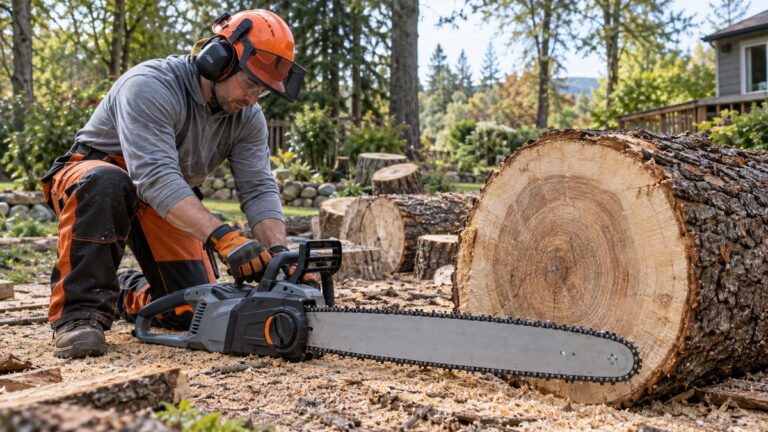
Ohio State lists a full-face shield or safety goggles with side shields against flying chips and sawdust, hearing protection, high-top boots, and lightweight leather gloves against cuts, splinters and abrasion. Mississippi State says earplugs or earmuffs protect hearing, notes that a chainsaw produces about 110 decibels, and says gloves protect the hands and give a better grip. Illinois says PPE must be inspected before each work shift to ensure it is serviceable, and that the listed PPE must be used when hazards make it necessary.
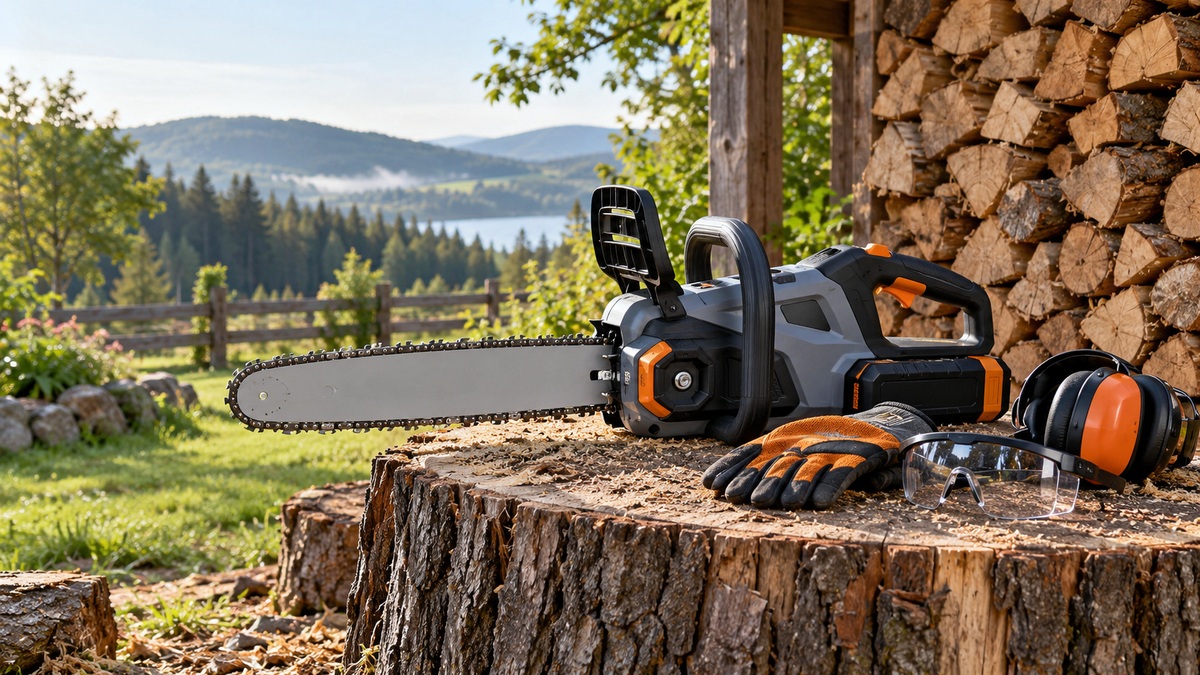
Three picks list goggles and gloves in the box: the DEJUNPIOOL and both Ecarke pole saws. The listings say so. The pages we opened do not say that any of those items meets a standard, so this guide does not claim one.
What the pages do not cover
- None of the pages covers kickback on a battery or corded saw, or on a pole-mounted saw.
- Illinois says “Do not cut directly overhead,” but that page is written for tree felling and logging. We do not apply it to pole saws, because no page we opened covers pole use.
- Cornell’s article is dated July 2, 2018, and the Ohio State sheet was originally posted on May 16, 2019. Check for newer editions before relying on them for a purchase decision.
Pole chainsaws: three picks with a different job
Three picks are pole-mounted chain saws: the Ecarke pole saw for DeWalt, the Ecarke pole saw for Milwaukee and the worksky pole saw. Each has a chain and a guide bar, so it meets the chain-drive rule used in this guide, but the job is different from a handheld saw. The pole adds reach, and the reach figures are the main reason to choose one of these over a handheld model.
Pole saws are a separate category from pole hedge trimmers. If you want to compare pole saws directly, our existing comparisons cover them: Seesii vs Autubin pole saws and DocSmart vs AVADA pole saws. If your job is trimming shrubs rather than cutting wood, see best cordless hedge trimmer with extension pole for that task.
The pages we opened do not cover pole-saw use near overhead work or power lines, so this guide does not give a clearance rule for either.
Picks at a glance
Each card gives a reason drawn from that listing, a skip-if case and at least one limitation. Read the card for the saw you are considering, then check its battery and bar against your job.
1. CRAFTSMAN Electric Chainsaw, 16 Inch, 12 Amp Corded Chain Saw Electric, Ergonomic, Powerful Motor (Only corded pick, no battery to buy)
Pros
- The listing gives a 12-amp motor and a 16-inch low kickback bar and chain
- The listing says the saw auto-oils with no priming needed, and the chain tensions without tools
- The listing gives a 3-year limited warranty
Cons
- The listing does not give a cord length, so reach depends on your outlet
- The listing gives 6.2 pounds and a chain speed of 44 with no unit
Best for: Owners with an outlet near the work who do not want to buy a battery
Skip if: The work area is far from an outlet, or you need a cordless saw
View on Amazon (affiliate link)
2. Cordless Mini Chainsaw Compatible with Dewalt 20V MAX Battery, 1200W 6 Inch & 8 Inch Small Electric (Lightest battery saw, with DeWalt compatibility)
Pros
- The listing gives 2.7 pounds for the tool alone, the lightest figure among the picks
- The listing names DeWalt 20V model numbers and says the battery and charger are not included
- The listing says the saw starts only when a safety lock and a switch lock are pressed together, and it includes goggles and gloves
Cons
- The bullets give 6-inch and 8-inch chains, while the specification field lists an 8-inch chain length, so check which bar fits your work
- The horsepower field reads 1200 watts, so its power is not comparable with other picks
Best for: Light pruning and small limbs for someone who already owns a compatible DeWalt 20V battery
Skip if: You need a bar longer than 8 inches, or you do not own a compatible DeWalt battery
View on Amazon (affiliate link)
3. CRAFTSMAN Mini Chainsaw, 10 inch Mini Chainsaw Cordless, Electric Chain Saw, V20 Battery (Battery and charger in the box)
Pros
- The kit includes a V20 2.0Ah battery, a V20 charger, a bar cover and a wrench
- The listing states it cuts up to 8 inches thick with its 10-inch bar
- The listing names auto-oiling, bolt-lock chain tensioning, and a hook for the VERSATRACK wall system sold separately
Cons
- At 7.9 pounds it is the heaviest of the two 10-inch picks, and the listing does not say whether that includes the battery
- The horsepower field reads 1.5 KW, so its power is not comparable with other picks
Best for: A first battery saw for someone who wants the battery and charger in one box
Skip if: You need a bar longer than 10 inches, or you want a battery platform other than V20
View on Amazon (affiliate link)
4. ReliaRoads 16-Inch 40V Brushless Cordless Chainsaw for DeWalt 20V MAX (Longest battery bar, with a spare chain)
Pros
- The listing describes a 16-inch bar, a brushless motor and a chain speed of 54 feet per second
- It runs on two DeWalt 20V MAX batteries as a 40V system, and includes two chains
- The listing names a chain brake and a safety lock, with a 2-year warranty
Cons
- The batteries and charger are not included, and the listing recommends two 4 to 8Ah batteries
- At about 10.5 pounds (4.77 kg) it is the heaviest pick by listed weight
Best for: Firewood and larger limbs for someone who already owns two DeWalt 20V MAX batteries
Skip if: You own only one battery, or you want a lighter saw
View on Amazon (affiliate link)
5. BLACK+DECKER 20V MAX Chain Saw Cordless Chainsaw, 10-Inch Battery Chainsaw, Tool Only, for Wood (10-inch battery saw with tool-free tensioning)
Pros
- The 10-inch bar is listed with an 8-inch cut capacity, which is 80 percent of bar length
- The listing names tool-free chain tensioning and an oiling system
- The listing gives a 2-year limited warranty
Cons
- The battery and charger are not included, and the listing does not give a run time
- The horsepower field reads 3.5 hp, but the listing does not say how the figure was measured
Best for: Owners of a 20V MAX battery who want a 10-inch bar for smaller cuts
Skip if: You need a DeWalt or Milwaukee battery, or a bar longer than 10 inches
View on Amazon (affiliate link)
6. Ecarke Electric Pole Saw Compatible with Dewalt 20V, 16FT Max Total Reach, 8 Inch Detachable Tree (Pole chainsaw for DeWalt 20V owners)
Pros
- The listing states up to 16 feet of total reach, with a pole that extends from 7 to 10 feet
- It lists compatibility with DeWalt 20V models, including DCB200 and DCB240
- The package includes goggles, gloves, a branch hook, a shoulder strap and a spare chain
Cons
- The 16-foot reach is based on a 6-foot user, so a shorter person will reach less
- The listing gives 6.8 pounds and a chain speed of 26 feet per second, with no conditions
Best for: Overhead branches for someone who already has a DeWalt 20V battery
Skip if: You only need a handheld saw for ground-level cuts, or you own no compatible battery
View on Amazon (affiliate link)
7. 8 Inch Cordless Pole Saw Compatible with Dewalt 20V Battery, Brushless Mini Chainsaw with Extension (Pole saw with a detachable handheld head)
Pros
- The 8-inch cutting head detaches for handheld cutting, and the telescopic pole attaches for reach
- The listing gives a 16,000 rpm no-load speed, a 20 feet per second chain speed and automatic oiling
- The listing names tool-free tensioning and a safety lock that prevents accidental starts, and gives a weight of 6.5 pounds
Cons
- The battery and charger are not included, and compatibility is listed for DeWalt 20V models
- The title gives 14.2 feet of maximum reach, but the bullet gives a 7.8-foot pole, and the listing does not explain the gap
Best for: A DeWalt 20V owner who wants a lighter pole saw that also works as a handheld
Skip if: You need the 14.2-foot reach from the title confirmed, or you need a battery included
View on Amazon (affiliate link)
8. Ecarke Electric Pole Saw Compatible with Milwaukee 18V, 8 Inch Tree Trimmer Cutter, 16FT Max Total (Pole chainsaw for Milwaukee 18V owners)
Pros
- The listing names compatibility with Milwaukee 18V model numbers such as 48-11-1815 and 48-11-1820
- The listing states a 26 feet per second cutting speed, an 8-inch guide bar and up to 16 feet of total reach
- The transparent oil reservoir shows the oil level, and the listing gives a 2-year limited replacement commitment
Cons
- Tool only, and the battery is not included
Best for: Milwaukee 18V owners who want a pole saw for branches above reach
Skip if: You own no Milwaukee 18V battery, or you need a bar longer than 8 inches
View on Amazon (affiliate link)
How we chose
We started from the ten product records in the research list for this keyword. We read each record’s title and specification fields for the saw type and power source. We kept eight. We dropped the Gisam 6-in-1 kit, which bundles a pole saw, an 8-inch chainsaw head, a 16-inch electric hedge trimmer and grass shears, because its main function is a multi-tool kit and not a chainsaw. We dropped the TWRSHE 21V charger, which is an accessory and not a saw. Gas-powered saws are outside this guide.
The eight picks follow four criteria:
- The listing names a chain-driven saw, handheld or on a pole.
- The saw is corded or battery powered.
- The set covers six brands, bar lengths from 6 to 16 inches, one corded saw and seven battery models across four battery platforms.
- The listing gives enough detail to describe the saw on its own specifications.
We did not use marketplace ranking figures. The picks are not ordered by quality.
What we could not verify
- Cutting performance in wood. The listings state features and figures, and the pages we opened do not compare saws.
- Run time. None of the eight listings states one.
- Power and chain speed across brands. The figures use different units and do not state their conditions.
- The cord length of the corded CRAFTSMAN saw, which its listing does not give.
- The worksky reach gap between its title and its pole length.
- Cut capacity for six of the eight picks. Only the two 10-inch saws state one.
- Warranty terms. The listings state a 3-year limited warranty for the corded CRAFTSMAN, a 2-year warranty for the ReliaRoads, a 2-year limited warranty for the BLACK+DECKER, and a 2-year limited replacement commitment for the Ecarke Milwaukee pole saw. The pages we opened do not cover warranties.
- Whether the fuel and engine advice on the extension pages applies to battery or corded saws. The pages were written with gas-powered saws in mind.
- Electrical safety for corded and battery tools. The pages we opened do not cover it, so follow the manual for the cord, plug and charger.
FAQ
Is a battery chainsaw as strong as a corded one?
The listings do not allow a fair comparison. The corded CRAFTSMAN lists 3.5 hp and a 12-amp motor, the BLACK+DECKER lists 3.5 hp, and the ReliaRoads lists 2 hp. The CRAFTSMAN CMCCS610D1 uses kilowatts and the DEJUNPIOOL uses watts, both in the horsepower field. Compare the bar length you need and the battery you own, rather than the power label.
Do I need a chain brake?
The pages we opened treat a chain brake as one of the kickback-reducing features. Cornell says to make sure it works and stops the chain, and warns that wear or debris can reduce its stopping power. Illinois says to engage it when you carry the saw more than 50 feet.
What is kickback?
Cornell also calls it one of the most common ways chainsaw injuries occur.
Can I use a battery I already own?
Only if the listing names your battery platform. Four picks list DeWalt 20V batteries and one lists Milwaukee 18V. Two list their own platform: the BLACK+DECKER lists 20V MAX and the CRAFTSMAN CMCCS610D1 lists V20. The DEJUNPIOOL listing says the battery and charger are not included, and the ReliaRoads needs two batteries. Check the battery model number against the listing before you buy.
Do pole chainsaws follow the same safety points?
The pages we opened describe handheld cutting and tree felling, not pole saws. Read the manual that comes with a pole saw for its own instructions, and do not assume a handheld rule covers a pole.
Do I need protective gear for a short job?
The Illinois page ties protective gear to hazards, not to the length of the job. It says the listed PPE must be used when hazards make it necessary, and that PPE must be inspected before each work shift.
Bottom line
Start with the power source and the battery you already own. If you have an outlet near the work and no battery, the corded CRAFTSMAN is the only pick that needs no battery at all. If you own one of the listed battery platforms, match the platform first, then compare bar lengths against the cuts you need, using the cut capacity the listing gives. Before you buy any of them, check the chain brake and safety features in the listing, because the safety pages say these devices reduce kickback but do not prevent it.
Sources
- University of Illinois Extension, “Cutting Safety” (Firewood series), opened 2026-10-20: https://extension.illinois.edu/firewood/cutting-safety
- Cornell Small Farms Program, “Chainsaw Safety, Part 4: Reducing the Risk of Chainsaw Kickback” (page dated July 2, 2018), opened 2026-10-20: https://smallfarms.cornell.edu/2018/07/chainsaw-safety-part-4-reducing-the-risk-of-chainsaw-kickback-just-say-no-to-kickback/
- Mississippi State University Extension, Publication 2250, “Chain Saw Safety: Tree Felling”, opened 2026-10-20: https://extension.msstate.edu/sites/default/files/publications/P2250_web.pdf
- Ohio State University Extension, “Chain Saw Safety” (Ohioline fact sheet, originally posted May 16, 2019), opened 2026-10-20: https://ohioline.osu.edu/factsheet/aex-59172
- Purdue Extension, S-78 “Chain Saw Safety”, opened 2026-10-20: https://www.extension.purdue.edu/extmedia/S/S-78.html