Best Electric Weed Burner: Six Thermal Models Compared by Heat, Cord and Nozzles
As an Amazon Associate we earn from qualifying purchases. Details
The best electric weed burner for patio joints and driveway cracks is the one whose heat settings, cord and nozzle set match the work you have. We compared six listings from six brands that heat with electricity rather than propane. Four list a low setting of 60°C or 80°C alongside a 650°C high setting, and five state a wattage between 1500W and 2000W. Electric burners are not gas flamers, so the fire guidance here comes from university flame-weeding advice, applied with care, plus electrical safety pages.
Quick answer
- Pick a model with a low setting if you also dry or soften materials. Four of the six listings state one, at 60°C or 80°C.
- Expect a lower peak heat than a gas flamer. UC ANR gives about 2,000°F for gas flamers, and the highest setting in these listings is 650°C, which the listings also state as 1,202°F in two cases.
- Check the cord before you buy. In the bullets we read, only FVPJUXSG names a cord type and length: 1.8 meters of H05RN-F rubber cord.
- Apply the fire rules on every use. That means no use in dry or windy weather, nothing flammable nearby, and a bucket of water within reach.
What the heat figures mean
Five of the six listings give a wattage. Two are rated at 1500W, from NAWESRVA and VAXYOR, and three at 2000W, from ZephPerton, FVPJUXSG and TYXFSMYXGS. The Wlikoci bullets we read give a temperature but no wattage. The listings do not say how a wattage maps to the temperature at the nozzle, and the sources we opened do not say either. A higher wattage tells you what heating element the listing names, not how quickly a weed will respond to it.
The highest setting in all six listings is 650°C. FVPJUXSG and VAXYOR state the same peak as 1,202°F, so the two unit systems agree. UC ANR’s Safety Note describes gas flamers as producing “intense heat (about 2,000 degrees Fahrenheit).” The gap between 1,202°F and about 2,000°F is roughly 800 degrees. That gap is a difference between tool types, not a verdict on either one, and the sources do not measure how the two heat outputs compare on the same weed.
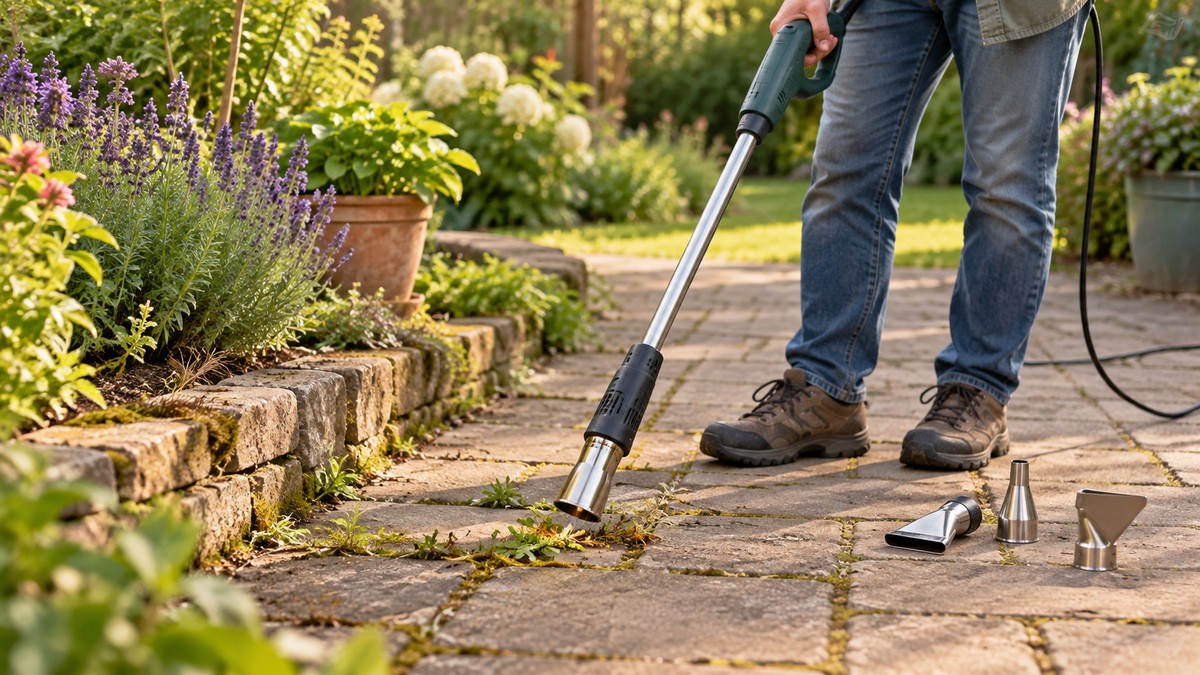
Nozzle counts vary. Four listings state five nozzles: NAWESRVA, FVPJUXSG, VAXYOR and Wlikoci. ZephPerton states two. The TYXFSMYXGS bullets we read do not give a count. A nozzle set matters for a joint or a crack, but the listings do not describe the shape of each tip beyond the count.
Table 1 sets out the figures each listing gives. Where a cell says not stated, the bullets we read did not give the figure, and we did not fill the gap from another listing.
| Brand | Wattage as listed | Top heat as listed | Low setting as listed | Nozzles as listed | Cord detail as listed |
|---|---|---|---|---|---|
| ZephPerton | 2000W | 650°C | 60°C | 2 | Not in the bullets we read |
| NAWESRVA | 1500W | 650°C | 80°C (176°F) | 5 | Not stated |
| FVPJUXSG | 2000W | 1,202°F (650°C) | Not stated | 5 | 1.8 m H05RN-F rubber cord |
| TYXFSMYXGS | 2000W | 650°C | 60°C | Not stated in the bullets we read | Not stated |
| VAXYOR | 1500W | 1,202°F (650°C) | 176°F (80°C) | 5 | Corded; length not stated |
| Wlikoci | Not stated in the bullets we read | 650°C | Not stated | 5 | Not stated |
The low setting and what the bullets say it is for
Four listings give a low setting, and the bullets describe its job in different words. ZephPerton’s bullets call 60°C “gentle heat for drying and softening.” TYXFSMYXGS describes 60°C for “gentle drying.” VAXYOR’s bullets describe its 80°C setting as one for “lighter heating tasks.” NAWESRVA gives 80°C with 176°F but does not name a job for it. The bullets tie the low settings to drying and softening, and they do not claim that the low setting removes weeds.
That split matters for a patio. Softening a crusted joint or drying damp material is a different job from killing a weed, and the listings treat the two as separate uses. If the tool will do both, a model with a low setting gives you the option. If you only need the high setting, the low setting adds nothing to your choice.
Timing and weed size
UC ANR’s advice on timing is the most specific university guidance we opened. Its Safety Note says that “for effective weed control, use flamers in the spring and early summer as perennial weeds emerge.” It also says that “killing larger, mature weeds requires more heat, so save time and fuel by flaming weeds when they are small and young.” Both lines are written for gas flamers. For an electric burner, the listings give a peak temperature but no weed-size guidance, so the timing advice is a reasonable starting point rather than a proven rule for these tools.
Small, young weeds in a joint are the sensible first target. A weed that has grown into a dense clump in a driveway crack is a different job, and the sources we opened do not give pass counts for electric tools. Plan the work in stages rather than trying a whole driveway in one session.
Fire and heat rules that carry over
The UC ANR Safety Note gives the clearest set of fire rules. It says “Never flame weeds during extremely dry periods or windy conditions,” and it adds “Don’t flame with flammable or combustible materials in the vicinity.” It also says to “Have a fire extinguisher or other means available to extinguish an accidental fire,” and to “Wear thick work gloves and work boots when operating flaming equipment.” The note says the operator “must be trained in the proper use of the equipment,” which is a sensible habit for any heat tool.
The University of Vermont Extension piece on flame weeding adds the rules for the work area. It says to “avoid flame weeding near buildings or flammable materials like plastic, mulch, dry plants or plant material.” It also advises “avoiding dry, windy weather, and areas with dried plants or plant matter,” and it says to “keep a bucket of water nearby whenever you flame weed, just in case.” For clothing, the same page says to wear “gloves, closed-toe shoes and clothing that will help prevent you from getting burned.”
The UC ANR note also gives a nozzle distance of about 6 inches for gas flamers. The electric listings give no nozzle distance, so use the distance in your manual, and do not carry the gas figure over. All six listings name a charcoal or BBQ lighting use as well as weeding. That use brings the same fire rules with it, so keep the same extinguisher and water habits when you light a charcoal grill with the tool.
Electrical checks before you plug in
Because every model here plugs into the wall, the electrical checks come first. LSU AgCenter says, “If you are using outdoor electric tools, you should plug them into a GFCI-protected outlet.” It also tells readers to check the amperage before connecting anything, “usually found on a nameplate on the tool or on the box the tool came in.” The burner bullets we read give wattage but not amperage, so the nameplate is the figure to check before you choose a cord.
LSU’s wet-ground advice applies directly to a weed burner used on a damp patio or a lawn edge. It says it is “never a good idea to use electric tools around water,” and it advises to avoid “running extension cords through wet areas.” The Southern Utah University page is a workplace rule, but it applies the same logic to wet locations: “Portable lights or tools used in wet or conductive locations must be protected by GFCIs or operate at 12 volts or less.” It also says workers must visually inspect extension cords daily before use, which is a good habit for a home patio.
Two practical points follow. Plug the burner into a GFCI-protected outlet, and keep the cord out of wet areas, as LSU advises. If you need an extension cord, LSU says to be sure the cord is adequate for your tool.
Where an electric burner fits in the yard
An electric burner suits paving: the listings name patio joints, driveway cracks and walkway edges in their bullets. For weeds growing in planting beds, a sprayer may be the better tool. Our battery garden sprayer guide covers that tool category.
The listings describe the heat as an alternative to chemicals. The Wlikoci bullets say electric heat “eliminates weeds without toxic runoff or propane tanks,” which is the listing’s own claim. The sources we opened do not compare runoff from heat tools and spray tools, so treat the runoff point as the listing’s position rather than a finding. If a bed is being reworked and the weeds are mixed into the soil, the job is closer to soil preparation, and our electric tiller guide covers that side of the work.
For a patio, the choice usually comes down to three things: the low setting if you also dry or soften material, a cord you can route safely from the outlet, and a nozzle set that gives you a tip for the joint width you have. The wattage matters less than those three in a short job, because the listings do not show how wattage changes the result on a given weed.
Reading the listing numbers
Listings mix units, and a few conversions make the comparison easier. The table converts the figures that appear in the bullets we read, and it says which listing gives each one.
| Figure in the listing | Converted | Where it appears |
|---|---|---|
| 60°C | 140°F | ZephPerton and TYXFSMYXGS, as the low setting |
| 80°C | 176°F | NAWESRVA and VAXYOR, which state 176°F themselves |
| 650°C | 1,202°F | Five listings give 650°C; FVPJUXSG and VAXYOR give 1,202°F |
| 1.8 meters | about 5.9 feet | FVPJUXSG, as the cord length |
| 1.13 kilograms | about 2.49 pounds | TYXFSMYXGS, as the body weight |
The cord figure is the one that changes the plan. A 1.8-meter cord reaches about 5.9 feet from the outlet. A patio with twelve joints of 10 feet each comes to 120 feet of joint, so most of that run will need the outlet moved or an extension cord added. LSU’s advice on extension cords applies to that run, and the wet-area rule applies to every foot of it.
The body weight in the TYXFSMYXGS listing is about 2.49 pounds, just above the 2.2-pound specification in the Wlikoci listing. The gap is small, and both weights come from the listings rather than from a scale. Weight matters more on a long job with the tool held at arm’s length, so the difference between these two models is less important than the cord and the low setting.
Which burner for which job
Read the job first, then the listing. Each choice below comes from the bullets or titles, not from a performance claim.
- Mostly drying or softening, with the occasional weed: choose a model that states a low setting. ZephPerton, NAWESRVA, TYXFSMYXGS and VAXYOR all do.
- A long run of joints with a fixed outlet: choose a model that states its cord. Only FVPJUXSG names a cord type and length in the bullets we read.
- Frequent work across different joint widths: choose one of the four listings that state five nozzles. NAWESRVA, FVPJUXSG, VAXYOR and Wlikoci all state five.
- Lighting a grill or a fire pit as well as weeding: every listing names a charcoal or BBQ use, so the choice comes down to the other three rules above.
- Working near a building or in dry, windy weather: the fire rules in this guide apply to every model. None of the listings changes them.
The last point is worth repeating in plain terms. No listing, including the one with the highest wattage, makes dry weather safe for a heat tool. The UC ANR and UVM guidance applies whichever model you buy.
Picks
1. 2000w Electric Thermal Weed Burner, Fast Airflow Garden Grass Remover With 2 Nozzles, 60-650°c Dual (2000W model with 60°C and 650°C settings)
Pros
- The bullets describe a 2000W heating element with 60°C and 650°C settings
- The title names 500 liters per minute of airflow
- The bullets name charcoal lighting as a second use
Cons
- The title names two nozzles, fewer than the five-nozzle listings
- The camera-body entry in its specification table does not describe the burner
Best for: A yard owner who wants a low setting for drying and a high setting for weeds
Skip if: You need five nozzles for cracks and corners
View on Amazon (affiliate link)
2. 1500W Electric Weed Burner & Heat Gun, 3-in-1 Hot Air Wand with 5 Nozzles, 80°C/650°C Dual (1500W model with five nozzles and an 80°C setting)
Pros
- The title names five nozzles and a 1500W heating system
- The specification table gives a weight of 2.87 pounds
- The bullets describe a long-handle design for patio joints and driveways
Cons
- The bullets give 500 L/min airflow but no cord details
- The model number reads 1632-Weed Torches, a generic label
Best for: A patio owner who wants five nozzles at a lower wattage
Skip if: You want a 2000W listing
View on Amazon (affiliate link)
3. 3-in-1 Electric Weed Burner, 2000W Thermal Weeder & Hot Air Gun, 1202℉ Max, 5 Nozzles For Garden (2000W model with a 1202°F ceiling and a stated 1.8-meter cord)
Pros
- The bullets state a 1202°F maximum and a 1.8-meter H05RN-F rubber cord
- The title names five nozzles and a 2000W heater
- The specification table gives a weight of 2.98 pounds
Cons
- The bullets do not give a low setting
- The title names ice melting, which the bullets we read do not describe
Best for: A homeowner who wants a stated cord type and a 1202°F ceiling
Skip if: You need a low heat setting for drying or softening
View on Amazon (affiliate link)
4. 2000W Electric Thermal Weed Burner, 3-in-1 Hot Air Weed Killer with 60-650°… (2000W model with 60°C and 650°C settings and a lighter body)
Pros
- The bullets give 60°C and 650°C settings for drying and weed removal
- The bullets say the body weighs 1.13 kg
- The bullets describe 500 L/min airflow for charcoal ignition
Cons
- The first bullet names a weed puller and a stand-up weeder without describing them in the text we could read
- The nozzle count is not stated in the bullets we read
Best for: A camper or gardener who wants a low setting and charcoal lighting in one tool
Skip if: You want a stated cord length in writing before you buy
View on Amazon (affiliate link)
5. Electric Thermal Weed Burner, Detachable Heavy Duty Blow Torch With 80-650°… (1500W corded model with five nozzles and a stand-up wand)
Pros
- The bullets state 1500W with 1202°F and 176°F settings
- The bullets describe a long-handle wand for standing use
- The bullets name five interchangeable nozzles that shape the airflow
Cons
- The bullets call it corded but give no cord length
- The unit and component fields in the specification table do not match a single burner
Best for: A stand-up user who wants a corded tool with a low setting
Skip if: You want a stated cord length before you buy
View on Amazon (affiliate link)
6. Electric Weed Burner & Hot Air Gun with 5 Nozzles for Weeding | 3-in-1 Thermal Weeding Wand, BBQ (Compact 3-in-1 burner with a 650°C heat output)
Pros
- The bullets describe a 3-in-1 design for weeds, BBQ lighting and hot air
- The specification table gives a weight of 2.2 pounds, the lightest in the set
- The title names five nozzles and a 650°C heat output
Cons
- The color field reads Black while the title reads Green
- The bullets give no wattage and no cord length
Best for: A small-space user who wants one compact tool for weeds and grilling
Skip if: You need a stated wattage before you buy
View on Amazon (affiliate link)
How we chose
We searched Amazon for “best electric weed burner” in Chrome on 21 October 2026, and we read the first two results pages. We kept electric thermal weeders and hot air heat guns whose listings name a weed-burning use. We dropped propane torches, which made up many of the results, and we dropped listings whose brand reads Generic, because a generic label gives no maker to compare.
Six listings came from six named brands: ZephPerton, NAWESRVA, FVPJUXSG, TYXFSMYXGS, VAXYOR and Wlikoci. ZephPerton had three listings on the results pages, and we kept one because the other two appear to be color variants with the same bullets. FVPJUXSG also had three listings, and we kept one for the same reason. A reader who wants a particular color can check the variants on Amazon, though the bullets we read did not change between them.
The order in the picks follows the low setting, the nozzle count and the cord detail, not a score. We did not rank the listings on any figure that the sources do not explain.
What we could not verify
- The temperature at the nozzle and how quickly the tip heats. The listings give setting temperatures, and the sources we opened do not give a measured surface temperature for electric tools.
- Whether a given weed species or grass type responds to heat. The sources we opened cover timing and weed size for gas flamers, not species for electric burners.
- Cord length for four of the six listings, and a cord rating for all but one. Only FVPJUXSG names a cord type in the bullets we read.
- Whether any listing carries a safety certification mark. None of the bullets we read names one.
- The airflow figures of 500 liters per minute in three listings. No measured source supports them, and the listings do not say how they were derived.
- Amperage for all six listings. The bullets we read give wattage only, and wattage for the Wlikoci listing is not stated.
- Several specification fields do not match the product. The ZephPerton and VAXYOR tables list a 72-count unit figure and a camera body as the included component, and the Wlikoci table gives a black color against a green title. We did not use those fields.
- How long a burner can run before it needs a rest. The listings do not give a duty cycle.
- Whether the heat from an electric burner marks or damages paver sand, painted surfaces or plastic edging. The sources do not cover that.
FAQ
Is an electric weed burner safer than a propane torch?
The sources we opened do not compare the two directly. The electric models add the cord and outlet checks covered above, which a propane torch does not need. Both need the fire rules for dry and windy weather, and both need a clear area free of flammable material.
Can I use it on dry grass?
No. UC ANR says to “never flame weeds during extremely dry periods or windy conditions,” and UVM advises “avoiding dry, windy weather, and areas with dried plants or plant matter.” Those rules were written for flaming, but they are the most specific university guidance we opened for heat tools used on weeds.
How close should the nozzle be to the weed?
UC ANR gives about 6 inches for gas flamers. The electric listings give no nozzle distance, so follow the distance in your manual. The sources we opened do not give a distance for electric tools.
What does the low setting do?
The bullets tie the low setting to drying and softening. ZephPerton’s bullets call 60°C “gentle heat for drying and softening,” and VAXYOR describes its 80°C setting for lighter heating tasks. None of the bullets we read says the low setting removes weeds.
What should I check before I plug it in?
Check that the outlet has GFCI protection, that the cord has no damage, and that the amperage or wattage on the nameplate matches your plan. LSU says to check the amperage rating, and the Southern Utah University workplace rule requires cords to be inspected daily before use.
Bottom line
Choose the model whose low setting, nozzle set and cord suit the joints you have to clear, and treat the fire rules as the first step on every use. If a listing gives no cord length or outlet plan, check that point before you buy.
Sources
- University of California Agriculture and Natural Resources, Risk and Safety Services, Safety Note 197, “Flame Weeding Safety”: https://ucanr.edu/sites/default/files/2019-02/298701.pdf
- University of Vermont Extension, “Flame weeding”: https://www.uvm.edu/extension/news/flame-weeding
- LSU AgCenter, “Safety With Electric Tools”: https://www.lsuagcenter.com/articles/connected/safety-with-electric-tools
- Southern Utah University, Environmental Health and Safety, “Working Outdoors and Extension Cords”: https://www.suu.edu/erm/eohs/electrical-safety/outdoors-and-extension-cords.html