Best Blade Style for Lawn Mowers: Rotary, Mulching, Reel or Flail
As an Amazon Associate we earn from qualifying purchases. Details
If you are looking for the best blade style for lawn mowers, the short answer from the extension sources we opened is a sharp rotary blade for most home lawns. Reel blades cut more cleanly, but they suit low, closely cut turf. Mulching rotary blades suit people who want clippings to stay on the lawn. This guide explains the blade styles the sources name, how cutting height decides between them, and what sharpening and safety rules apply to each.
Quick answer
- For most lawns, start with a sharp rotary blade. Oregon State University Extension says a sharp rotary mower “will produce just as good of grass as a reel mower.”
- Reel blades fit low, closely cut turf. The University of Arizona publication AZ1681 pairs reel mowers with short cutting heights and rotary mowers with taller grass.
- Mulching blades cut finer clippings and are typically more expensive. Oregon State notes that they make it easier to leave clippings on the lawn.
- Sharpness matters more than the label. New Mexico State University’s guide H-505 says “The key to a quality mowing job is a sharp blade.”
- Set the cutting height first. The one-third rule in H-505 means you mow when the grass is about 1.5 times the height you want to keep.
The three blade styles the sources name
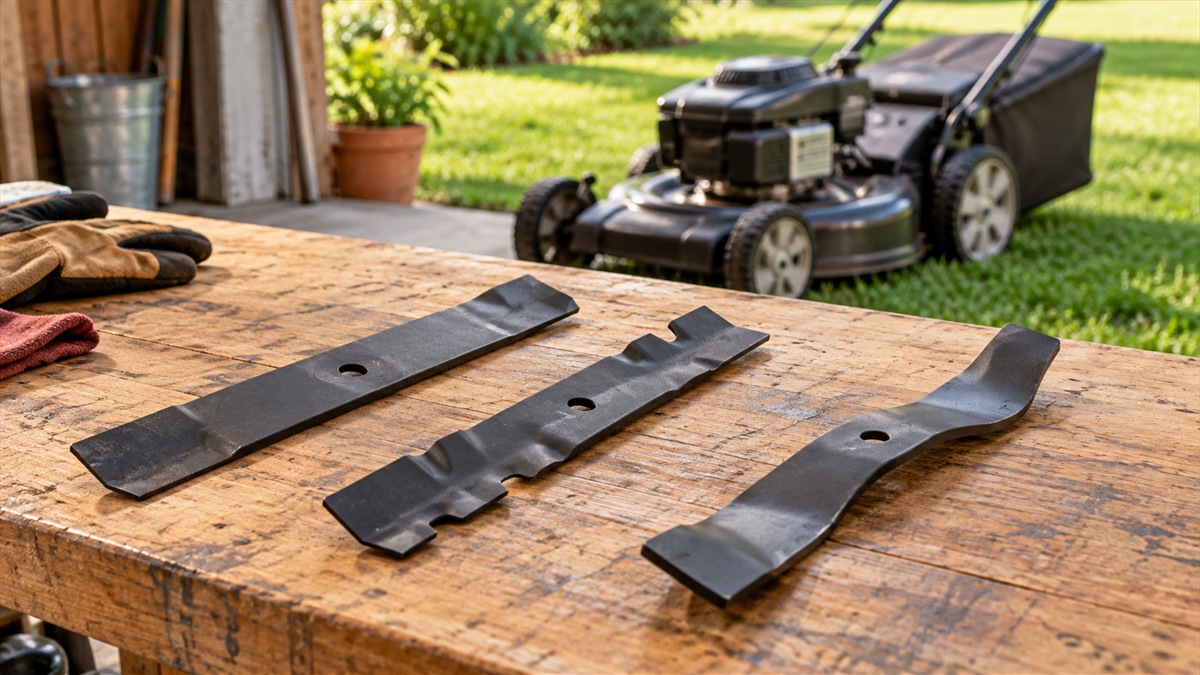
New Mexico State University’s Guide H-505 says that “Three types of mowers are commonly used” for turfgrass: flail, reel and rotary. Most home buyers compare the rotary and reel designs first, so this guide covers those two in the most detail, then explains where mulching blades and flail designs fit. The differences come down to how each design cuts the grass, how the blade is maintained, and how much height the lawn needs.
Rotary blades
Oregon State describes rotary and electric mowers as using a single spinning blade. The same publication lists the rotary mower’s strengths as durability, the ability to handle leaves and small twigs, quick mowing, and suitability for large areas. Its main maintenance advantage is simple: “Rotary blades are easier to maintain because they detach.” A detachable blade is easier to take off for sharpening or replacement than a blade that is fixed in place.
Arizona’s publication AZ1681 gives the height logic for rotary mowers. It says that “Rotary mowers can be used on lower maintenance turfgrasses that grow taller and often have an inherently wider leaf blade when mowed less frequently.” In practical terms, a rotary blade is the normal choice when the lawn is kept at a moderate height and mowed on a regular schedule, which describes most ordinary yards.
The cut quality of a rotary blade depends on its edge. Oregon State puts it plainly: “It takes a really dull rotary mower to make much of a difference.” A rotary blade that is kept sharp produces results close to a reel mower for most lawns, and a dull one does the most damage. That is the reason the sharpening advice later in this guide matters so much for this style.
Mulching blades
A mulching blade is a rotary design with a different job. AZ1681 defines it: “Mulching mowers are improved rotary mowers that cut smaller sized clippings that may decompose faster.” Oregon State describes the same idea in homeowner terms. Mulching mowers are “another option. Though typically more expensive, they chop grass into finer pieces, making it easier to leave clippings on the lawn.”
The practical question is whether you want clippings to stay on the lawn. Mulching blades are built to make that easier, but the extension sources do not say how much better a mulching blade performs than a standard rotary blade on any particular lawn. The advice is about the whole process: mow often enough, at the right height, and the clippings can stay. Oregon State says that “any mower can leave clippings behind effectively if the lawn is mowed frequently and kept at the proper height,” which means the mowing schedule matters as much as the blade.
Reel blades
A reel mower works on a different principle. Oregon State explains that “Reel (push) mowers use two blades that slide past each other like scissors.” That scissor action is the reason reel mowers have a reputation for a clean, even cut. Oregon State says that “The reel mower is going to be a cleaner cut,” and it adds a useful caveat: “But that doesn’t have that big of an effect on grass.”
The limit of a reel blade is height. AZ1681 tells readers to use reel-type mowers for cutting heights of about 1.5 inches or lower, and to use rotary mowers for taller cuts. Oregon State gives a homeowner example of where reel blades make sense: “Older lawns with colonial or creeping bentgrass, however, can be mowed lower, making reel mowers a good choice for those.”
Maintenance is the trade-off. Oregon State warns that “Reel mower blades are not removable and must be professionally sharpened.” A reel blade that goes dull is therefore a bigger job than a rotary blade that goes dull, and that cost should be counted when comparing styles.
Flail blades
The third type in the H-505 list is the flail mower. NMSU says that flail mowers have a “rather low” mowing quality and that their action can be compared to the “chopping of an axe.” A flail design is a poor match for a lawn that needs a clean, even cut. The extension sources do not tie flail mowers to ordinary home lawns in the way they tie rotary and reel mowers to them, so this guide treats flail designs as outside the main decision.
Cutting height decides which blade makes sense
Blade style is only half of the decision. The height of the grass sets how often you mow and how much the blade removes at each pass. NMSU’s guide H-505 calls its core rule the “one-third rule,” and Table 2 of the guide turns it into specific numbers for two desired turf heights.
| Desired turf height (in) | Height at which to mow (in) | Grass removed per mowing (in) |
|---|---|---|
| 1.0 | 1.5 | 0.5 |
| 2.0 | 3.0 | 1.0 |
The table values are from NMSU Guide H-505, Table 2. The pattern behind them is a simple calculation. The height at which to mow equals the desired height times 1.5, and the amount removed is half of the desired height. For a 2 inch target, the table gives a mowing point of 3 inches and a removal of 1 inch, so each pass takes off about a third of the grass.
The height rule matters for blade choice because heavy removal damages grass. NMSU says that “Removing more than 40% of the turf” in one mowing “can cause scalping.” Arizona describes the same damage as scalping that gives the turf a “burned” appearance. A dull blade makes the problem worse, because it tears the leaves rather than cutting them cleanly.
Oregon State gives a height range for common lawns. It says that in Western Oregon, the most common lawn grasses “thrive when kept 2 to 3 inches tall, which also helps suppress weeds.” That is a higher cut than a reel blade is built for. A homeowner who keeps a standard lawn at that height will get the best results from a rotary blade, and the reel style only makes sense if the lawn is kept much lower.
The table gives a simple test for your own lawn. Decide the height you want to keep, then mow when the grass reaches the height in the second column. If you want a 2 inch lawn, you mow when the grass reaches about 3 inches. If you want a 1 inch lawn, you mow when it reaches about 1.5 inches. A lower target means mowing more often, and more frequent mowing means the blade sees more grass, which raises the value of a sharp edge.
Sharpness and blade maintenance
Every extension source in this guide returns to sharpness. NMSU opens its discussion of mowing with the line “The key to a quality mowing job is a sharp blade.” The guide explains that dull blades leave “frayed edges” and give the lawn “a whitish cast to the lawn.” NMSU also says that sharp blades improve the energy efficiency of mowing, because they cut more cleanly and quickly with less power.
Oregon State makes the point for every style: “The key, he emphasized, is to keep mower blades sharp, no matter what type you use.” The advice applies to a rotary blade as much as a reel blade. The difference is who does the work. A rotary blade can be detached and sharpened at home, while a reel blade needs a professional. Arizona’s extension advice is short: “Always keep the blades sharpened and adjusted properly.”
NMSU also addresses who should sharpen the blade. Because most households do not have the tools needed for correct sharpening, the guide says that sharpening should be “done by a professional.” That recommendation applies strongly to reel blades, where Oregon State says professional sharpening is required, and it is a sensible default for rotary blades as well.
Dull blades show up in the lawn itself. Arizona warns that “Using a mower with dull blades can cause scalping, torn or shredded leaves, and a damaged appearance to the turf.” If the tips of the grass look shredded or brown after mowing, the blade is a likely cause, and that is a cheaper problem to fix than a thin, stressed lawn.
Safety around a rotating blade
Every rotary mower has a blade that spins at speed, and the federal standard for walk-behind power lawn mowers is built around that hazard. The U.S. Consumer Product Safety Commission rule at 16 CFR 1205.1 states that “The standard is intended to reduce the risk of injury to consumers caused by contact, primarily of the foot and hand, with the rotating blade of the mower.” The same section says the labeling requirements apply to both rotary and reel-type mowers, so the rule is not limited to one blade style.
For the blade choice, the practical takeaway is that the rule names the rotating blade as the hazard. The extension sources in this guide do not give a blade-change procedure or a list of safety steps for each blade style. Follow the operator’s manual for your model when you inspect, remove, or change a blade.
Which blade fits which lawn
The table below compares the blade styles against the lawn conditions the sources describe. It is a summary of the quoted guidance, not a ranking of brands or models.
| Lawn situation | Blade style the sources point to | Where the sources say it |
|---|---|---|
| Taller grass, mowed on a regular schedule | Rotary | AZ1681 on rotary mowers for taller, lower-maintenance turf |
| Cut at about 1.5 inches or lower | Reel | AZ1681 on reel mowers for short cuts |
| Older lawns with bentgrass that are mowed low | Reel | Oregon State on reel mowers for low-cut older lawns |
| Clippings to be left on the lawn | Mulching rotary | Oregon State and AZ1681 on mulching mowers |
Most ordinary yards fall into the first and fourth rows. A reel blade is a specialist choice for low, carefully kept turf. A mulching rotary blade is a good match when the homeowner wants clippings to go back into the lawn, although the sources also say that clippings should be collected in some conditions, such as when they are unusually heavy or when the turf is diseased.
How we chose
The sources in this guide are university extension publications and a federal safety rule. We opened each page and quoted only sentences that appear in the page text, or attributed a plain-language summary to the named source. We did not use retail product pages for any claim in this guide, and no product cards are included because this guide does not select models.
We kept the focus on the blade decision. Blade style interacts with cutting height, sharpening and the grass species, so each section ties the blade to one of those factors. Where a source covers only one blade style, the text says so.
What we could not verify
- The sources do not compare blade materials or shapes for individual mower models, so this guide cannot say which blade a particular machine uses or which replacement blade fits it.
- The sources do not say how long a blade lasts or how often a specific blade should be sharpened. NMSU gives an annual sharpening guideline, but the passage in the text layer we opened is split across columns, so we did not quote it.
- The sources do not compare cut quality or noise for mulching blades against standard rotary blades on the same lawn.
- The sources do not give a blade-change procedure. Use the operator’s manual for your model.
- Whether a flail design suits any homeowner lawn is not covered by the sources we opened.
Related guides
For a model-specific blade question, the Black and Decker lawn mower blade guide covers that ground. For the broader choice between mower types, see the pros and cons of electric mowers.
FAQ
Is a rotary blade or a reel blade better for a home lawn?
For most home lawns, a sharp rotary blade is the practical choice. Oregon State says a sharp rotary mower produces grass that is just as good as a reel mower’s, and a reel blade is built for short, closely kept turf. If your lawn is kept between about 2 and 3 inches, a rotary blade is the match that the sources support.
Do mulching blades cut better than standard rotary blades?
The sources do not say that mulching blades cut better. They say mulching blades chop clippings into finer pieces, which makes it easier to leave clippings on the lawn. The choice depends on whether you want clippings to stay on the grass or go into a bag, and the extension sources treat that as a separate decision from cut quality.
How high should I set my mower blade?
The right height depends on the grass species and how often you mow. NMSU’s Table 2 gives two examples: a 1 inch target is mowed at about 1.5 inches, and a 2 inch target is mowed at about 3 inches. Oregon State says common lawn grasses in Western Oregon thrive at 2 to 3 inches. Pick a height from your grass type, then mow before the grass gets far above it.
How often should a mower blade be sharpened?
The sources agree that a blade should be kept sharp, but we could not confirm a specific interval from the pages we opened in a clean text layer. Check the blade after mowing for dullness. Arizona warns that a dull blade causes scalping, torn leaves and a damaged appearance, so a blade that tears the tips of the grass is due for service.
Can a reel mower blade be sharpened at home?
Oregon State says reel mower blades are not removable and must be professionally sharpened. A rotary blade is easier to service, because it detaches. If you own a reel mower, plan for a professional sharpening service rather than a home file.
Is a flail mower a good choice for a lawn?
NMSU rates flail mowers’ mowing quality as rather low and compares their action to chopping. The sources do not present flail mowers as a common choice for a clean home lawn, so most homeowners will do better with a rotary or reel design.
Bottom line
Set the cutting height first, keep the blade sharp, and choose a rotary blade for most lawns. Reel blades belong on low, closely cut turf, and mulching rotary blades belong on lawns where you want clippings to stay in place.
Sources
- Oregon State University Extension, Choose the right lawn mower for your yard: rotary, reel and mulching blade descriptions, sharpening advice and clipping guidance.
- University of Arizona Cooperative Extension, AZ1681 Mowing Turfgrasses in the Desert (2015): reel and rotary height rules, the mulching mower definition and the dull blade damage.
- New Mexico State University Cooperative Extension, Guide H-505 Mowing Your Lawn: mower types, the one-third rule and Table 2, sharpening advice and scalping.
- U.S. Consumer Product Safety Commission rule, 16 CFR 1205.1 (via Cornell Legal Information Institute): purpose of the walk-behind mower standard and the rotating blade hazard.