How to Use a Pole Saw Safely
As an Amazon Associate we earn from qualifying purchases.
Knowing how to use pole saw safely starts before the saw starts. Husqvarna’s US pole saw page says that using a pole saw correctly and safely requires proper training and experience. The safety pages below cover the basics: protect your eyes, ears and head, stand on firm footing, work from the ground, check the cutting area for wires, and stay clear of overhead power lines. This guide does not go beyond what those safety pages state.
Quick answer
- Get training before you use the saw. The Husqvarna US page treats proper training and experience as a requirement.
- Wear a safety helmet, goggles and hearing protection. Husqvarna’s New Zealand page lists these, and OSHA’s landscape guidance also lists goggles and ear protection.
- Work from the ground on firm, fixed, level footing. Do not operate the saw from within a tree or from a shaky ladder.
- Stay clear of overhead power lines. OSHA says to maintain proper distance from them unless they are de-energized and visibly grounded, and to contact the utility company.
What a pole saw changes about the risk
A pole saw puts the cutting head at the end of a long pole, so the operator stays farther from the tree. Husqvarna’s US page says a pole saw increases the distance between the operator and the tree. It adds that distance matters most when a tree or branch is under tension or when the escape route is difficult.
The same US page says pole saws come as hand-operated, petrol-powered and battery-powered models. The sources here do not say whether the safety points differ between those types, so this guide treats the points as general. Check the manual for your model before you use the saw.
Why the ladder matters
Husqvarna’s New Zealand page names the main threats when people trim from a ladder: “From unstable ladders and high-powered equipment, accidental cuts, falls and being hit by branches from a height are among the biggest threats to be aware of.” The same page says the most apparent safety benefit of a pole saw is not having to climb a ladder or the tree to prune high up branches.
That benefit depends on footing. The page says to keep your feet firmly on the ground rather than on a shaky ladder, which gives you better control. A pole saw does not remove the need for good footing, so the footing steps later in this guide apply.
Safety before you cut
The points below come from the pages listed at the end of this guide. Training and protective gear come first, then the site check, then the cut itself. The steps further down follow the same order.
- Training. Husqvarna’s US page says using a pole saw correctly and safely requires the proper training and experience. It also says “Safety first – always!”
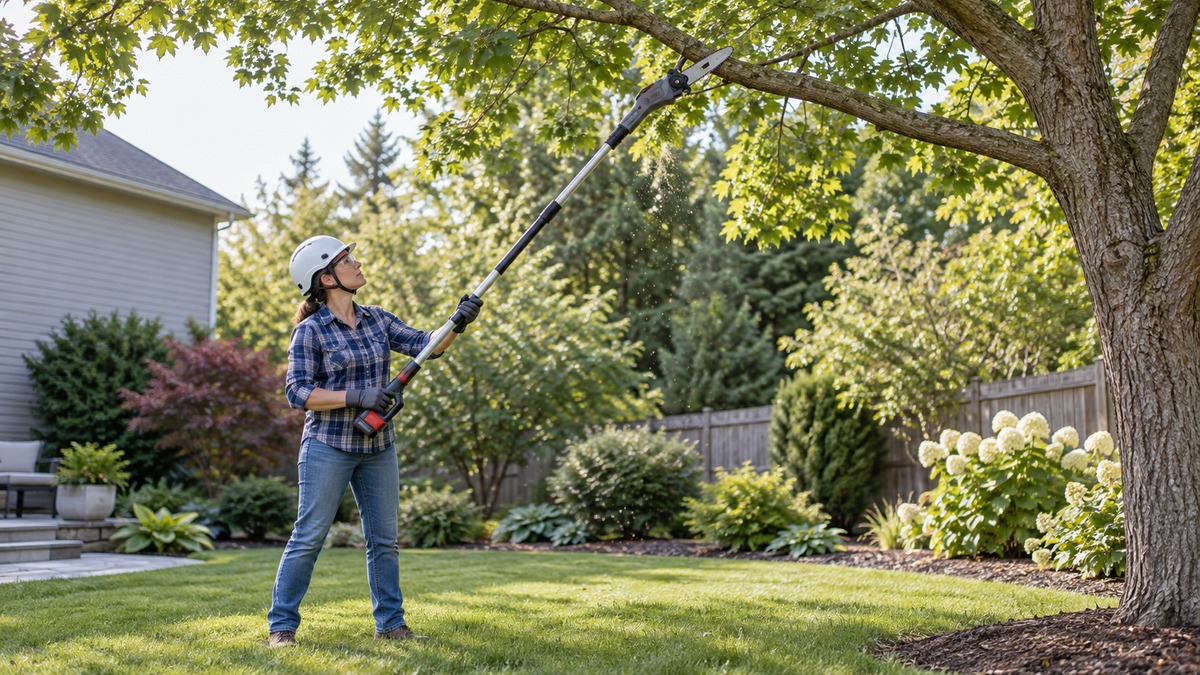
- Protective gear. Husqvarna’s New Zealand page says to wear PPE, including a safety helmet, goggles and hearing protection. OSHA’s landscape hazards page says “Wear safety goggles.” It also says “Wear ear protection when using power equipment.” and “Wear gloves.” Its solutions list adds “Use PPE (eg, hard hat)/know drop zone.”
- The cutting area. Husqvarna’s New Zealand page says to make sure the area is free from nails, metal and wires before cutting. It also says to scan the area around the tree and move anything that could be damaged.
Protective gear is the one area where the sources give specific items. The pages do not say which glove type to use, and this guide does not name one.
Overhead power lines
OSHA’s tree trimming guidance treats electrical lines as dangerous until proven otherwise. It says to assume that electrical lines are energized until proven otherwise. It also says to consider all electrical power conductors to be energized, and not to touch them directly or indirectly, including through tools, branches or other equipment. A pole saw is a tool, so that rule applies to it.
OSHA also says to closely inspect trees for electrical conductors within reach of workers before tree work begins. Unless the lines are de-energized and visibly grounded, it says to maintain proper distance from overhead electrical power lines. Where a utility line may pose a hazard, it says to contact the utility company to help locate, mark, and shut off the line before work begins.
OSHA’s guidance on clearing electrical lines adds that tree trimming work to clear those lines must be done only by qualified line-clearance tree trimmers. This guide does not give distances or other advice about cutting near lines. If a branch or the saw is near a line, stay clear and contact the utility company.
Step-by-step: a safer pole saw cut
These steps combine the pages in this guide. Each step names its source. They are general steps, not model instructions.
- Train and read the manual. Husqvarna’s US page calls for proper training and experience before use. Read the manual for your model before you start, because the pages opened for this guide do not describe model-specific controls.
- Put on protective gear. Wear a safety helmet, goggles and hearing protection, as Husqvarna’s New Zealand page lists. OSHA’s landscape page also says to wear gloves and to use PPE such as a hard hat where the work calls for it.
- Check the cutting area. Make sure the area is free from nails, metal and wires. Scan around the tree and move anything that could be damaged, as the New Zealand page advises.
- Check for overhead and downed lines. Before tree work, look for electrical conductors within reach of the work. Inspect the work area for downed conductors and do not go near, drive over, or come in contact with them. If a line is involved, stay clear and contact the utility company.
- Stand on firm footing. The New Zealand page says to stand on a firm, fixed and level surface to minimise the risk of slipping, and to keep your feet on the ground rather than on a ladder.
- Hold the pole saw with both hands. The same page says to hold the pole saw with one hand on the front handle and one on the rear.
- Work from the ground only. The New Zealand page says to operate a pole saw only from the ground, not from within a tree.
- Cut in sections. The same page says to shorten branches in sections rather than all at once. It says this helps reduce the risk of tearing, and it stops large, heavy branches from crashing down and damaging fences, walls or windows.
- Watch for springing wood. OSHA’s tree trimming guidance says that young trees other trees have fallen against act like spring poles and can propel back. The source describes that hazard, so watch for it while you cut.
Hazards and protection by source
The table lists the points each page covers. A cell that says “not stated” means the page did not cover that point for a pole saw.
| Point | What the source states | Source |
|---|---|---|
| Training | Using a pole saw correctly and safely requires the proper training and experience | Husqvarna US pole saw page |
| Helmet, goggles and hearing | Wear PPE, including a safety helmet, goggles and hearing protection | Husqvarna New Zealand page |
| Eye protection | Wear safety goggles | OSHA landscape hazards page |
| Ear protection | Wear ear protection when using power equipment | OSHA landscape hazards page |
| Gloves and hard hat | Wear gloves; use PPE such as a hard hat | OSHA landscape hazards page |
| Cutting area | Make sure the area is free from nails, metal and wires | Husqvarna New Zealand page |
| Footing | Stand on a firm, fixed and level surface | Husqvarna New Zealand page |
| Position | Operate only from the ground, not from within a tree | Husqvarna New Zealand page |
| Grip | One hand on the front handle, one on the rear | Husqvarna New Zealand page |
| Cut order | Shorten branches in sections rather than all at once | Husqvarna New Zealand page |
| Overhead lines | Maintain proper distance unless de-energized and visibly grounded; contact the utility company | OSHA eTool, tree trimming |
| Spring-pole branches | Young trees fallen against other trees can propel back | OSHA eTool, tree trimming |
| Footing, position and grip on the US page | Not stated | Husqvarna US pole saw page |
The table shows where the sources differ. The US pole saw page covers training and distance, while the New Zealand page covers the gear, grip, footing and cut order. Only the OSHA pages cover overhead lines. The OSHA pages state a clearance figure for tree work near energized lines. This guide does not repeat that figure or apply it to pole saws.
If you are comparing models, this site has published comparisons of EGO Power+ and Autubin pole saws and Seesii and EGO Power+ pole saws. The steps above are general and do not describe any one model.
How we chose
We opened five pages on 2026-10-22 that we cite: three OSHA pages, one Husqvarna US pole saw page, and one Husqvarna New Zealand page. We also opened a Husqvarna US chain saw safety page and a Husqvarna Ireland pole saw page, and neither is cited. The OSHA pages supply the overhead line, tree work and landscape PPE points, and the US Husqvarna page supplies the training point. The New Zealand Husqvarna page is not a US page. It supplies the gear, grip, footing, cutting area and cut order points, because the US pages we opened do not state those points for a pole saw. Each source is cited only for a point its text states.
We also opened two Ryobi pole saw support pages. Both returned HTTP 403, so they do not count as sources and are not cited. The EGO pole saw manual we found is a PDF file, which this tool cannot open, so this guide does not quote it. We did not rank the sources.
What we could not verify
Without a manual for a specific pole saw, this guide cannot confirm model-specific controls, start-up steps, or the safety labels on a particular saw. The pages opened for this guide describe training, gear and footing in general terms.
The sources do not give a pole saw distance from overhead lines. The OSHA pages state a clearance figure for tree work near energized lines, and this guide leaves that figure out. The sources also do not say how far a pole saw can reach safely, or how to handle a branch that binds in the cut.
The New Zealand page’s cut-order advice comes from one arborist’s tips, quoted on a manufacturer’s website. Treat it as one professional’s method rather than a standard.
What the sources do not say
- Distances from overhead lines for pole saw work. The OSHA figures are for tree work and are not repeated here.
- How to hold the saw for a cut above shoulder height, or whether a platform is safe. The pages opened do not cover those cases.
- Chain and bar maintenance for a pole saw. OSHA’s tree trimming page describes chain saw kickback, but the page is about chain saws, and this guide does not apply it to pole saws.
- Whether battery and petrol pole saws need different protective gear. The pages do not compare them.
- Which glove type to wear, or whether a hard hat is required for ground workers. The sources say to use PPE such as a hard hat, without a rule for when.
FAQ
Do I need training before I use a pole saw?
Husqvarna’s US pole saw page says that using a pole saw correctly and safely requires the proper training and experience. The page does not say what that training should cover, so this guide does not list a course or a number of hours.
What should I wear when using a pole saw?
Husqvarna’s New Zealand page lists PPE as a safety helmet, goggles and hearing protection. OSHA’s landscape hazards page lists safety goggles, ear protection for power equipment, gloves, and PPE such as a hard hat. Both sources name eye and ear protection, and the New Zealand page adds a helmet. The pages do not say which glove type to use.
Can I stand on a ladder to use a pole saw?
Husqvarna’s New Zealand page advises against it. It says to keep your feet firmly on the ground rather than on a shaky ladder, and to operate a pole saw only from the ground, not from within a tree. It also names falls from a height as one of the biggest threats when people trim from a ladder.
What should I do if a branch is near an overhead power line?
Stay clear of the line and contact the utility company. OSHA says to maintain proper distance from overhead electrical power lines unless they are de-energized and visibly grounded, and to contact the utility company to help locate, mark, and shut off a line that may pose a hazard. OSHA also says that work to clear electrical lines must be done only by qualified line-clearance tree trimmers. This guide does not give further advice about cutting near lines.
Why can a branch hit me after the cut?
OSHA’s tree trimming guidance describes young trees that other trees have fallen against as spring poles, which can propel back. The New Zealand page recommends shortening branches in sections rather than all at once. It says that large, heavy branches can crash down and damage fences, walls or windows, and that the approach helps reduce tearing. Keep your footing firm while you cut, as that page advises.
Do I need eye protection for a pole saw?
Yes. OSHA’s landscape hazards page says “Wear safety goggles.” Husqvarna’s New Zealand page says to wear a safety helmet, goggles and hearing protection. Both pages name goggles, so this guide treats eye protection as required.
Do I need a helper for pole saw work?
The pages opened for this guide do not say whether a helper is needed for ordinary pole saw work. OSHA’s eTool says that tree trimming to clear electrical lines must be done only by qualified line-clearance tree trimmers, and this guide does not give further advice about lines. If work is near a line, stay clear and contact the utility company, as the OSHA pages advise.
Bottom line
Get trained, wear eye, ear and head protection, stand on firm ground, check the area for nails, metal and wires, and treat any overhead power line as a reason to stay clear and contact the utility company.
Sources
- OSHA: Tree Care Industry – Hazards and Solutions (opened 2026-10-22)
- OSHA: Landscape and Horticultural Services – Hazards and Solutions (opened 2026-10-22)
- OSHA: eTool, Waste debris removal and reduction: Tree Trimming (opened 2026-10-22)
- Husqvarna US: Pole saw (opened 2026-10-22)
- Husqvarna NZ: How To Safely Trim Branches Without Needing A Ladder (opened 2026-10-22)