How to Store a Cordless Leaf Blower for Winter
As an Amazon Associate we earn from qualifying purchases.
The short answer to how to store cordless leaf blower for winter is to clean out the leaves, dust and debris, remove the battery, and keep the battery and the blower in dry places that stay away from extreme temperatures. Most of these steps come from the Husqvarna page for battery-powered blowers. The battery makers and extension pages we opened add charging and temperature points, but none of them gives a temperature range in degrees or a charge percentage for a cordless blower battery.
Quick answer
- Clean out leaves, dust and debris, and give extra attention to the air intake, the cooling vents and the housing.
- Remove the battery, store it separately in a cool, dry place, and keep it out of direct sunlight, away from heaters, and out of freezing conditions.
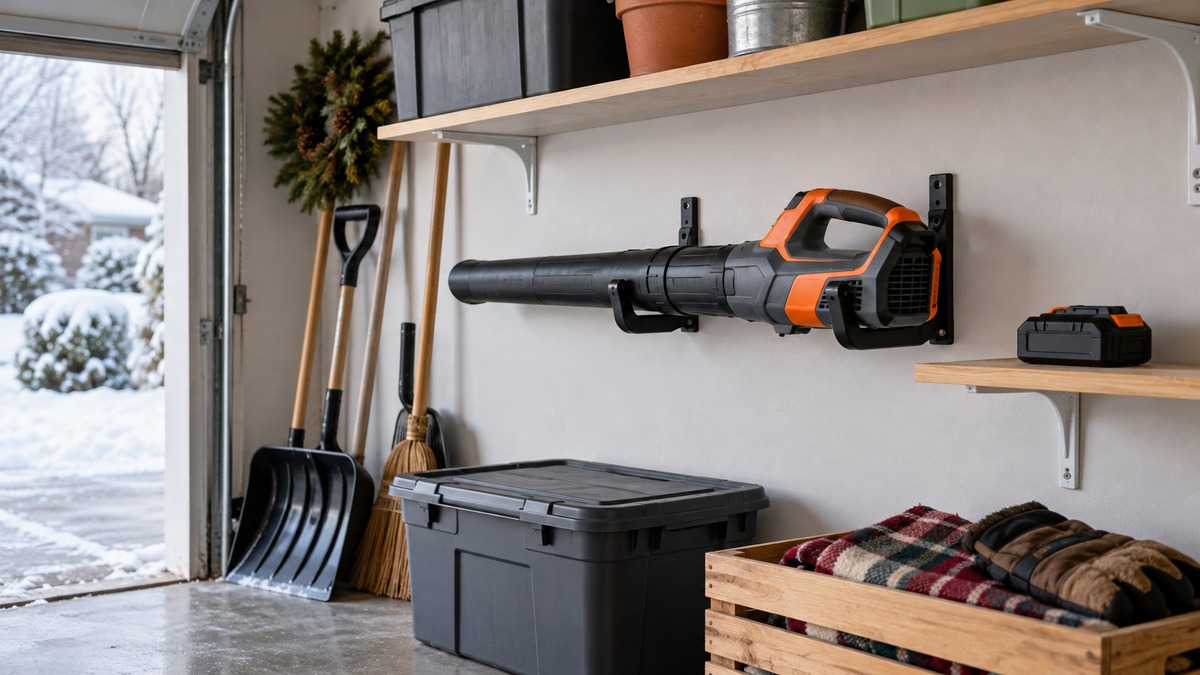
- Keep the blower in a dry, protected place, indoors if possible, and away from moisture.
- Charge the battery indoors in a dry location, use only the charger made for its battery platform, and follow the owner’s manual for charging frequency.
What this guide covers
This guide covers cordless, battery-powered leaf blowers, their batteries and their chargers. The Husqvarna page we opened covers petrol blowers as well as battery models. Its petrol steps, such as removing old fuel, do not apply to a battery tool, so this guide uses only the battery steps from that page. Mower battery storage is a separate topic, and this guide does not repeat those steps. If you are still choosing a blower, see the cordless leaf blower buying guide first.
Safety before you put the blower away
Start with the battery, because the sources give the most safety points for battery handling. The Husqvarna page says to remove the battery on battery-powered models before storage. The DeWalt page says to disengage the battery from the tool before placing it into storage for an extended period. The same DeWalt page says to avoid exposing batteries to liquids, oils, or extreme temperatures, so keep the pack away from liquids and oils while you work on the blower.
Lithium-ion packs also need care when they look damaged. The EPA says a battery that has swollen is damaged and is a potential fire hazard. It says to store a damaged battery in a safe location, away from flammable materials, until a proper disposal option is identified. It also says to contact the manufacturer of the product, the retailer where it was purchased, or a local waste program for direction. This guide gives no repair steps for a battery, because the sources we opened do not describe any.
Step by step: clean and store the blower
The sources do not give one fixed order for these tasks. The steps below start with the battery, because both the Husqvarna and DeWalt pages treat battery removal as part of storage.
- Remove the battery. The Husqvarna page lists removing the battery as a storage step for battery-powered blowers. Keep the pack away from liquids and oils while you work, as the DeWalt page advises.
- Clear out leaves, dust and debris. The Husqvarna page says to remove leaves, dust and debris before storage. Its blower section singles out the air intake, the cooling vents and the exterior housing. It also says dirt and moisture can cause corrosion over time.
- Check for worn or damaged parts. The Husqvarna page says to check worn or damaged components before storage.
- Store the battery separately. Keep it in a cool, dry place, away from direct sunlight, heaters and freezing conditions, as the Husqvarna page lists. The EPA says room temperature is the best place for a lithium-ion battery.
- Store the blower in a dry, protected place. The Husqvarna page says indoors if possible and lists a dry garage or shed as an option. Keep the blower away from moisture and direct sunlight.
The blower section of the Husqvarna page does not name a cleaning tool or a cleaning method. Use the steps above for what the sources do say, and do not assume a method they do not describe.
Battery and charger storage in detail
Where the battery should be kept
The battery pages we opened agree on the basics: a dry place, away from extremes of heat and cold. The Husqvarna page says to store the battery separately in a cool, dry place and to avoid extreme temperatures. It lists three places not to store batteries: direct sunlight, near heaters, and in freezing conditions. The DeWalt page says to store and charge batteries in a cool, dry location. The EPA says it is best to store lithium-ion batteries at room temperature, that there is no need to place them in a refrigerator, and that long periods of extreme cold or heat can damage them.
The Snow Joe guide says lithium-ion batteries are sensitive to extreme temperatures. It says batteries that are very cold or hot may not charge or operate. For a battery that has been too cold or too hot, it advises a rest indoors of 30 to 60 minutes before charging or using it.
Charge level before storage
Among the pages we opened, only the DeWalt page gives a storage charge instruction. It says to fully charge the battery before storing it for an extended period, which it defines as longer than six months. The Husqvarna blower section does not state a charge level. It does list leaving the battery installed during storage as a common mistake. The Illinois Extension post names forgetting to charge a battery at the end of the season as the most common problem, and it tells readers to check the owner’s manual for charging frequency. For more on battery voltage, see the lawn and garden battery voltage guide.
The charger
The Snow Joe guide says to use only the charger designed for your battery platform, to charge batteries indoors in a dry location, and that batteries do not need to be fully discharged before charging. The Illinois Extension post says the owner’s manual shows whether a specific charger is needed. The sources we opened do not say whether a battery should stay on its charger through the winter. If you are matching a battery to a DeWalt blower, see the guide to batteries for DeWalt leaf blowers.
Worked example: when a cold or hot battery can be used again
The Snow Joe guide gives one time figure for batteries that have been too cold or too hot: a rest of 30 to 60 minutes indoors before charging or using them. That figure comes from the Snow Joe and Sun Joe guide, so it may not match another brand’s battery. The formula is simple:
Earliest time to charge or use = time the battery came indoors + 30 minutes. Latest end of the rest = time the battery came indoors + 60 minutes.
Example: if you bring the battery in at 4:00 p.m., the earliest time to charge or use it is 4:30 p.m., and the longest rest in the guide ends at 5:00 p.m. The guide does not say how cold is too cold or how hot is too hot, so you have to judge that from the conditions where the battery was kept.
Storage statements by source
The table below lists what each page we opened says about battery and blower storage. Where a page gives no figure or instruction for an item, the cell says not stated.
| Source | What it covers | Storage place | Temperature figure | Charge before storage | Charger |
|---|---|---|---|---|---|
| Husqvarna US, off-season article (battery blower section) | Husqvarna battery-powered blowers | Cool, dry place, stored separately | not stated | not stated | not stated |
| DeWalt, lithium-ion storage and safety tips | DeWalt lithium-ion batteries | Cool, dry location | not stated | Fully charge before storage longer than 6 months | not stated |
| Shop Joe, Snow Joe and Sun Joe battery guide | Snow Joe and Sun Joe batteries | Charge indoors in a dry location | not stated; very cold or hot packs may not charge or operate | not stated | Use only the charger designed for your battery platform |
| Illinois Extension, 2018 yard equipment post | Yard tools in general, not blowers | not stated | not stated | Keep the battery charged; no level given | Owner’s manual says whether a specific charger is needed |
| US EPA, lithium-ion battery FAQ | Lithium-ion batteries in general | Room temperature | not stated | not stated | not stated |
Before you use the blower again
Before the next season, the Husqvarna page says to inspect the blower for damage. Bring the battery indoors and charge it there, in a dry location, with the charger made for its battery platform. If it has been too cold or too hot, allow it to rest indoors for 30 to 60 minutes first, as the Snow Joe guide advises. Then follow the owner’s manual for charging frequency, as the Illinois Extension post suggests.
How we chose
We looked for pages from the tool and battery makers that cover storage, plus university extension pages and a US EPA page that cover lithium-ion batteries. We did not use retail listings, blog posts or review sites, and we left out Consumer Reports for this topic. Some brand pages we found were product listings or PDF manuals, and they did not give storage steps for a cordless blower battery, so we did not use them. Forum answers on brand community sites were not used either, because they are individual questions rather than published guidance.
We opened seven pages in total and cite five. The two we did not cite are an Iowa State Extension FAQ on hand garden tools, which covers dry storage for hand tools but not batteries or blowers, and a 2022 Illinois Extension post on gas and electric tools, which has no storage steps. Each cited page was opened on 2026-10-22, and the quotes in this post are copied from the text of those pages.
What we could not verify
We could not verify that the Husqvarna blower steps apply to blowers from other brands, or that the battery advice on the DeWalt, Snow Joe and EPA pages applies to the battery in your garage. Each page covers a specific brand or lithium-ion batteries in general.
The DeWalt page text we opened does not show a publication date, only a copyright year in its footer, so we could not confirm how current its advice is. The Illinois Extension post is from 2018, and its advice is general yard tool advice rather than blower-specific.
We could not verify a runtime after winter storage. None of the pages we opened gives one, and this guide does not estimate one.
What the sources do not say
The pages we opened leave out several points a reader might expect. None of them gives a temperature range in degrees for a cordless blower battery. None gives a charge percentage for storage. The only storage charge instruction is the DeWalt advice to fully charge a battery stored for longer than six months, and that page covers DeWalt batteries only.
The blower section of the Husqvarna page does not name a cleaning tool or a cleaning method, and it does not say how long a battery can sit before it needs charging. The EPA page does not give a storage duration either. The sources we opened do not say whether a battery should stay on its charger over the winter.
No page we opened says whether one brand’s battery fits another brand’s blower, and this guide does not claim that any battery fits any blower. The Husqvarna and DeWalt pages each cover only their own products, and the Snow Joe guide covers only Snow Joe and Sun Joe batteries.
FAQ
Should I take the battery out of a cordless leaf blower for winter?
Yes, according to the pages we opened. The Husqvarna page lists removing the battery as a storage step for battery-powered blowers, and it lists leaving the battery installed during storage as a common mistake. The DeWalt page also says the battery should be disengaged from the tool before extended storage.
Where should I keep the battery during the cold months?
The Husqvarna page lists a cool, dry place, away from direct sunlight, heaters and freezing conditions. The EPA says room temperature is best for lithium-ion batteries and that long exposure to extreme cold or heat can damage them. None of the pages gives a temperature range in degrees.
Should I leave the battery on the charger all winter?
The sources we opened do not answer this directly. The Illinois Extension post says the owner’s manual covers charging frequency and whether a specific charger is needed. The Snow Joe guide says to use only the charger designed for your battery platform. Check the manual for your battery before you leave it on a charger.
What charge level should the battery be at before storage?
Among the pages we opened, only the DeWalt page gives a storage charge instruction: fully charge the battery before storing it for longer than six months. None of the pages gives a charge percentage for a cordless blower battery, so the owner’s manual is the place to check any other level.
Can I keep the blower in a garage or shed?
The Husqvarna page lists a dry garage or shed as a place to store a battery-powered blower, and it says indoors if possible. It also says to avoid damp environments. The same page lists freezing conditions as a place not to store the battery, so a garage or shed may suit the blower while the battery needs the cool, dry place described above. The sources we opened do not say whether an unheated shed is safe for the battery.
What if the battery looks swollen?
The EPA says a swollen battery shows damage and is a potential fire hazard. It says to store the battery in a safe location away from flammable materials until a proper disposal option is identified, and to contact the manufacturer of the product, the retailer where it was purchased, or a waste program for direction. We give no repair steps here, since none of the pages we opened describes one.
Bottom line
Take the battery out, store it in a cool, dry place away from heat and freezing, keep the blower dry and indoors if possible, and let the owner’s manual set the charging schedule.
Sources
- Husqvarna: Storing a leaf blower | Husqvarna US (opened 2026-10-22)
- DEWALT: Top 10 Lithium Ion Battery Storage & Safety Tips | DEWALT (opened 2026-10-22)
- Illinois Extension: Yard Equipment Maintenance Tips | Over the Garden Fence | Illinois Extension | Illinois (opened 2026-10-22)
- Shop Joe: Snow Joe + Sun Joe® Battery Guide – Shop Joe (opened 2026-10-22)
- US EPA: Frequent Questions on Lithium-Ion Batteries | US EPA (opened 2026-10-22)