How to Store an Electric Snow Blower Off Season
As an Amazon Associate we earn from qualifying purchases.
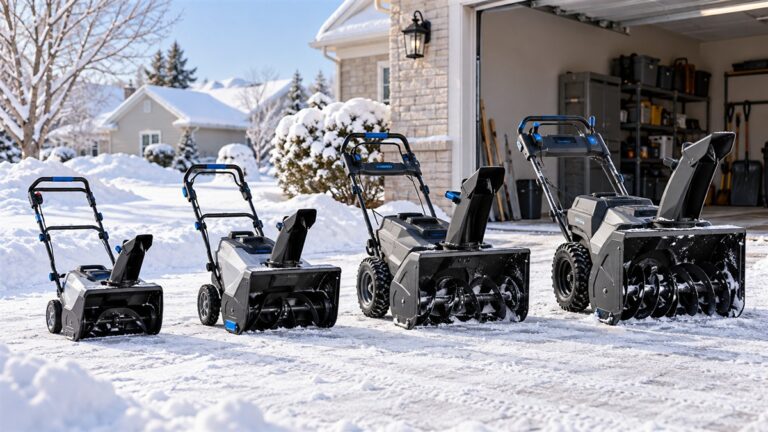
If you need to know how to store electric snow blower equipment for the off season, the steps depend on the power source. A corded unit needs its extension cord disconnected and inspected. A battery unit needs its pack removed, stored in a dry place and charged to the level its manual gives. Both need a clean, dry, enclosed place out of reach of children. The sources below are a corded Snow Joe storage article, two Toro 60V battery snowthrower manuals, a Snow Joe battery guide and an Illinois Extension article.
Quick answer
- Clean the unit, tighten loose screws and check for damage before you put it away.
- For a corded model, disconnect the extension cord, inspect it, and store the unit in a locked, dry place.
- For a battery model, take the pack out before storage, keep the pack and charger in an enclosed, clean, dry area, and charge the pack to the level your manual states.
- Keep the machine and its battery away from garden chemicals and de-icing salts.
Corded or battery: check which one you own
The Snow Joe storage article covers a corded electric snow blower. It tells you to “Disconnect the extension cord from the snow thrower.” The two Toro manuals we opened cover battery snowthrowers, which use a removable pack and a charger. The two types share the same rules for dryness and location, but they differ on the cord, the battery and the charge level.
Check the manual for your model before you start. If the unit runs from a wall outlet or an extension cord, follow the corded steps. If it runs on a removable pack, follow the battery steps and use the charge level from your manual.
Clean, inspect and tighten before storage
Start with the machine itself. The Toro e24 manual says to “Clean all foreign material from the product.” The Snow Joe article gives the same order of work: inspect the thrower, then tighten what needs it.
- Stop the machine before you clean it. The Toro e24 manual says to “remove the battery pack(s) from the machine before adjusting, servicing, cleaning, or storing the machine.” On a corded unit, disconnect the cord first, as the Snow Joe article says.
- Clean all foreign material from the product, including snow and debris left in the machine.
- Inspect the thrower carefully. Snow Joe says to “Inspect the snow thrower carefully for worn, loose, or damaged parts.”
- Check the fasteners. Snow Joe says to “Check connections and screws and tighten if necessary.” Toro’s e24 manual says to “Tighten all loose screws, bolts, and locknuts.”
- Treat exposed metal. The e24 manual says to “use a rust preventative to prevent the metal parts from rusting.”
- Check the tires if the unit has them. The e24 manual lists this under its yearly or before-storage checks and says to “Check the air pressure in the tires and inflate them to 116 to 137 kPa (17 to 20 psi).”
Storing a corded electric snow blower
For a corded unit, the cord is the first item to handle. The Snow Joe article’s steps are short. Disconnect the extension cord from the snow thrower, then “Inspect the extension cord closely for signs of wear or damage.” If the cord is worn or damaged, the article says to “Replace it if it is worn or damaged.”
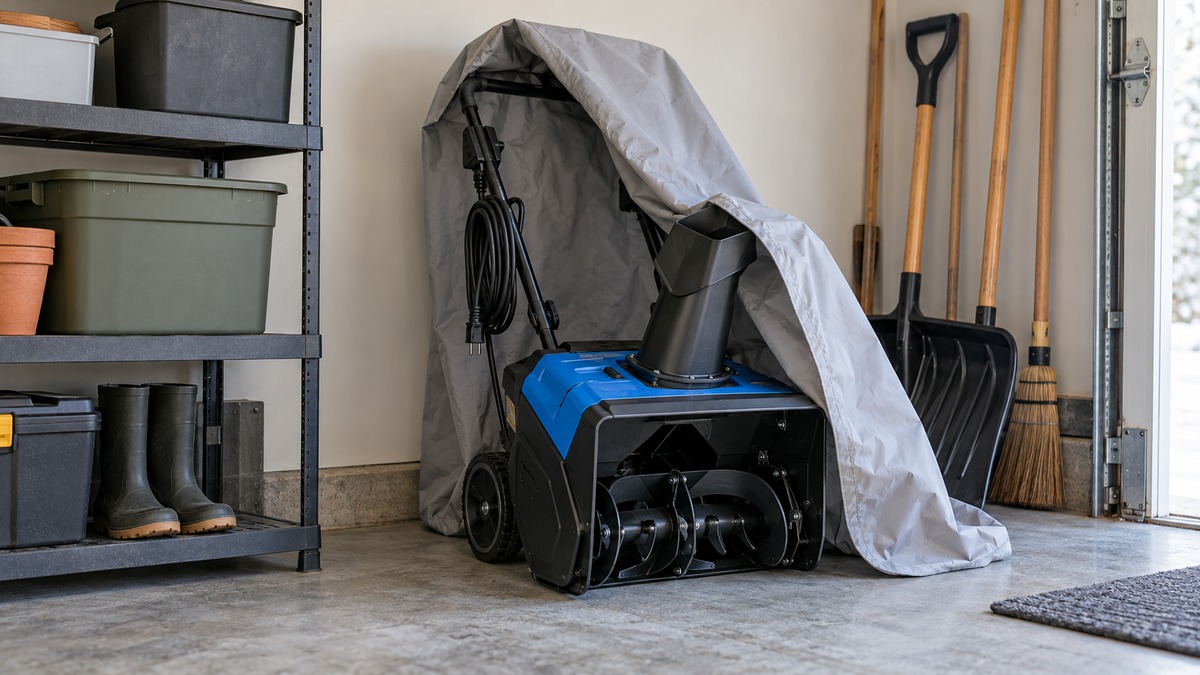
Store the cord with the unit. The article says to “Store the unit, along with the disconnected extension cord, in a locked, dry place out of the reach of children to prevent unauthorized use or damage.” The same article adds that you should “Cover loosely with a tarp for added protection.” It does not describe a plastic cover, so a loose tarp is the cover the article itself describes.
The article’s first sentence says to “Allow the engine to cool completely before cleaning, storing, or transporting the snow thrower.” The lines we opened do not say whether that step applies to a battery or corded electric model, so do not assume it applies to yours. Check your manual.
If you want a corded model of this type to compare, the Snow Joe 22-inch 15-amp electric snow blower picks cover that category. For battery models, the cordless snow blower and shovel picks are the closer match.
Storing a battery electric snow blower
For a battery unit, the pack needs most of the attention. The Toro 31853 manual says “Do not store the tool with the battery pack installed.” The Toro e24 manual gives the same rule in a longer form: “Stop the machine, remove the electric-start key, wait for all movement to stop, and remove the battery pack(s) from the machine before adjusting, servicing, cleaning, or storing the machine.”
Remove the pack and cover its terminals
Once the pack is out, handle it as the manual directs. The 31853 manual’s recycling section says “Upon removal, cover the terminals of the battery pack with heavy-duty adhesive tape.” That instruction appears under recycling rather than storage, but it applies whenever a pack is out of the machine. Store the pack in the same enclosed, clean, dry area as the machine and the charger, as the Toro manuals say.
Off-season charge level: the two Toro manuals disagree
The two Toro manuals we opened give different off-season charge levels, and both are manufacturer instructions. The 31853 manual says “charge it until 1 or 2 LED indicators turn green on the battery.” The e24 manual says “charge it until 2 or 3 LED indicators turn green on the battery.” Both say “Do not store a fully charged or fully depleted battery.”
Because the two figures disagree, use the one in the manual for your own model. The lines we opened do not settle which figure is right for every pack, so do not pick one on your own. Snow Joe’s battery guide says the number of indicator lights “varies by battery model,” and it shows both 3-stage and 4-stage displays. The guide does not give a storage charge level for a snow blower battery.
Temperature and where to charge
Both Toro manuals give the same temperature range for the battery pack. The 31853 table lists “Charge/store the battery pack at 5°C (41°F) to 40°C (104°F),” and the e24 table gives the same range. Keep the pack inside a building that stays within that range.
Snow Joe’s battery guide says to “Charge batteries indoors in a dry location,” and it adds that “Batteries do not need to be fully discharged before charging.” It also says “Lithium-ion batteries are sensitive to extreme temperatures.” If a pack has been in very cold or hot conditions, the guide says “Batteries that are very cold or hot may not charge or operate,” and it advises you to “Allow the battery to rest indoors for 30–60 minutes before charging or using.”
Match the platform if you store a spare pack
If you keep a spare pack, make sure it matches the machine. The Snow Joe guide says “battery platforms are not interchangeable,” and that rule covers any replacement or second pack. The sources we opened do not say what a mismatched pack does to the machine, so the safe course is to store only the pack your manual names.
Shelter: where to put the machine
The Toro 31853 manual says “When you are not using the machine, store it indoors in a dry, secure place out of the reach of children.” The e24 manual says “Store the machine, battery pack, key, and battery charger in an enclosed clean, dry area.” Those two rules are the core of the shelter advice.
Keep the machine away from corrosive materials. The Toro manuals say to “Keep the machine, battery pack, and battery charger away from corrosive agents, such as garden chemicals and de-icing salts.” If your ice melt is on the same shelf as the snow blower, move one of them.
The Snow Joe article’s storage line uses the same locked, dry standard: store the unit “in a locked, dry place out of the reach of children to prevent unauthorized use or damage.”
Safety when you store the machine and battery
The storage rules are also safety rules. The battery should never sit outdoors or in a vehicle, and the machine should be out of reach of children. The Toro 31853 manual says “To reduce the risk of serious personal injury, do not store the battery pack outside or in vehicles.” The Snow Joe article’s storage line says to keep the unit “out of the reach of children to prevent unauthorized use or damage.”
On a battery model, the e24 preparation step includes “remove the electric-start key” along with removing the pack. Disconnecting the machine from its power source comes first. The 31853 manual says to “Disconnect the product from the power supply (i.e., remove the plug from the power supply or the battery pack) and check for damage after use.”
Storage checklist by model type
The table brings the sourced steps together. Cells marked not stated are not on the lines we opened for that model or article.
| Storage task | Corded model (Snow Joe article) | Battery model (Toro 31853) | Battery model (Toro e24) | Source |
|---|---|---|---|---|
| Disconnect power | Disconnect the extension cord | Remove the plug or the battery pack, then check for damage after use | Remove the battery pack and the electric-start key | Snow Joe article; Toro manuals |
| Inspect cord or pack | Inspect the cord and replace it if worn | Check for damage after use | Check for damage after use | Snow Joe article; Toro manuals |
| Storage place | Locked, dry place out of reach of children | Enclosed clean, dry area | Enclosed clean, dry area | Snow Joe article; Toro manuals |
| Battery charge level for off season | Not applicable | 1 or 2 LED indicators green | 2 or 3 LED indicators green | Toro manuals (the two disagree) |
| Battery temperature for storage and charging | Not stated | 5°C (41°F) to 40°C (104°F) | 5°C (41°F) to 40°C (104°F) | Toro manuals |
| Fasteners and surfaces | Tighten screws if needed | Not stated | Tighten loose screws; rust preventative | Snow Joe article; Toro e24 |
| Shear pins | Not stated | Not stated | Not stated | Not in the sources we opened |
How we chose
We chose sources that give storage steps from a manufacturer. We opened five pages on 2026-10-22: Snow Joe’s storage article for a corded electric snow blower, two Toro operator manuals for 60V battery snowthrowers, Snow Joe’s battery guide, and an Illinois Extension article on yard equipment care. The Toro manuals are the source for the battery charge levels and temperature ranges. The Snow Joe article is the source for the corded steps. Illinois Extension supports the general point that battery tools need their charge kept up over the season.
We did not use retail listings or review sites for any storage step. Where a page covered a different type of machine, the text says so rather than applying its steps to every electric snow blower.
What we could not verify
We could not verify storage steps for battery snow blowers from brands other than Toro and Snow Joe. The steps here cover those two brands only.
We could not verify the off-season charge level for your pack. The two Toro manuals disagree, and the Snow Joe guide does not give a storage level.
We could not verify a storage temperature range for the corded Snow Joe model. Its article does not give one.
What the sources do not say
The sources we opened do not mention shear pins for any of the machines. If your model uses shear pins, its manual is the only place to check the replacement steps.
The Snow Joe article’s first sentence refers to letting the engine cool. The lines we opened do not say whether that applies to the electric models in this guide. The sources also do not give a number of months a battery can sit unused before it needs a top-up.
The Illinois Extension article says owners should refer to the manual for charging frequency and the correct charger. It does not give a number of days or weeks for the charge interval.
FAQ
Should I take the battery out of my electric snow blower for the summer?
Yes, for the battery models in this guide. The Toro 31853 manual says “Do not store the tool with the battery pack installed,” and the e24 manual says to remove the battery pack before storing the machine. Store the pack in an enclosed clean, dry area with the charger.
What charge should the battery be at before storage?
Use the level in your own manual. The Toro 31853 manual says to charge the pack until one or two LED indicators turn green, and the e24 manual says two or three. The two manuals disagree, so the one for your model is the one to follow. Both say not to store the pack fully charged or fully depleted.
Can I leave the snow blower in the garage over winter?
The sources we opened say to store the machine in an enclosed, clean, dry area, and the Snow Joe article says a locked, dry place. A garage can meet that description if it is dry and clear of corrosive materials. The sources also say to keep the machine away from de-icing salts and garden chemicals, so check where those products sit.
Do I need to cover the snow blower?
The Snow Joe article says to “Cover loosely with a tarp for added protection.” It does not describe a plastic cover, so a loose tarp is the cover the article describes.
What do I do with the cord before storage?
Disconnect the extension cord from the snow thrower, inspect the cord for wear or damage, and replace it if it is worn or damaged. Store it with the unit in a locked, dry place. The Snow Joe article’s steps do not mention a cord length or a gauge.
What do I check before next season?
Check the fasteners and the surfaces. The Toro e24 manual says to tighten loose screws, bolts and locknuts, to apply a rust preventative to metal parts, and to check tire pressure when the unit has tires. Snow Joe says to inspect the thrower for worn, loose or damaged parts.
Bottom line
Before you put the machine away, disconnect the cord or remove the battery pack, and store the unit in a dry, enclosed place. For a battery model, charge the pack to the level in your own manual, because the two Toro manuals we opened give different figures.
Sources
- Shop Joe: How should I store my Electric Snow Blower in the off-season? (opened 2026-10-22)
- Toro: Flex-Force Power System 60V MAX Snowthrower, model 31853 operator manual (opened 2026-10-22)
- Toro: Power Max e24 60V Snowthrower, model 39924 operator manual (opened 2026-10-22)
- Shop Joe: Snow Joe + Sun Joe Battery Guide (opened 2026-10-22)
- Illinois Extension: Yard Equipment Maintenance Tips (opened 2026-10-22)