Leaf Blower vs Leaf Vacuum: What Each Does
As an Amazon Associate we earn from qualifying purchases.
If you are weighing a leaf blower vs leaf vacuum, the short answer is that a blower moves leaves with air, while a leaf vacuum pulls them in and collects them in a bag. A leaf vacuum mulcher is a vacuum that also shreds what it collects. The manufacturer pages we opened describe these jobs in similar terms, but they do not compare the tools head to head.
Quick answer
- A leaf blower moves leaves across a surface or into a pile. Troy-Bilt’s leaf page describes blowing leaves into a pile on a tarp.
- A leaf vacuum collects leaves into a bag. Troy-Bilt describes a chipper shredder vacuum as a device that vacuums and shreds leaves and other small debris into a bag.
- A vacuum mulcher adds shredding. EGO states a 16:1 mulching ratio for its LV5005, and Toro says the metal impeller blades shred leaves into fine mulch on model 51619.
What a leaf blower does
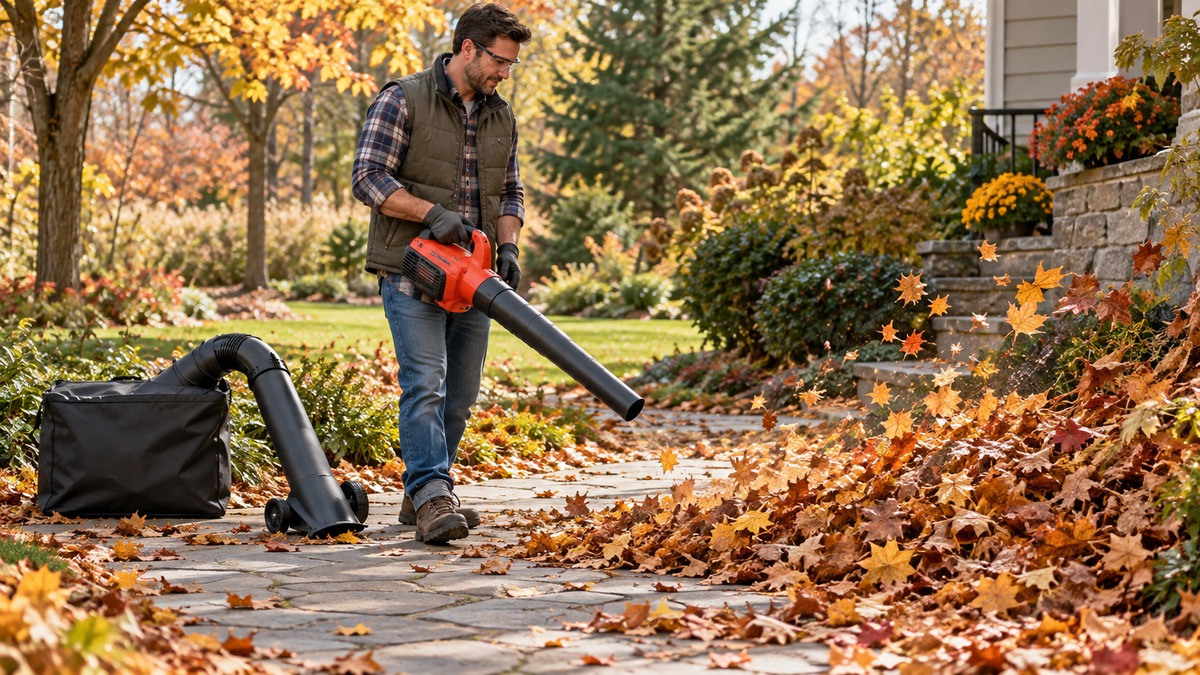
A leaf blower uses an air stream to push leaves, grass clippings and light debris along a surface. Troy-Bilt shows the common yard method: place a tarp on the lawn, blow the leaves into a pile on the tarp, gather up the corners, and carry the bundle to the curb or a compost pile. The page makes the blower the tool that moves the leaves, and it does not present the blower as a tool that collects them.
Troy-Bilt also ties blower size to yard size. The page says that “As a rule of thumb, small- to medium-sized yards call for handheld leaf blowers.” It adds that “These types of blowers can vary in power, but are useful for clearing leaves from tight areas around the yard.” For bigger properties, the same page says “Larger yards tend to call for backpack blowers or wheeled leaf blowers as they produce greater power for heavy duty cleanup jobs.”
Toro’s YardCare guide describes battery blowers in a similar way. It says “Battery-powered leaf blowers are a great choice if you’re using it to clear sidewalks or decks.” For a battery model, Toro says a battery blower is “perfect for small to medium yards where a cord just won’t reach.”
What a leaf vacuum does
A leaf vacuum reverses the air flow. It draws debris into a tube and deposits it in a bag. Troy-Bilt puts it this way: “A chipper shredder vacuum is exactly what it sounds like, a device that vacuums and shreds leaves and other small debris into a bag.” The bag is the part that makes this tool a collector, and it is also the part that needs attention.
Toro’s operator manual for model 51619 makes the bag a rule for vacuum use. It says “Do not operate the vacuum without the bag installed or with the bag zipper open.” The same manual says the vacuum is “intended for residential use only” and tells you to “Use it outdoors to collect debris as needed.”
STIHL describes its shredder vacs as units that “collect leaves, grass clippings, and debris, then reduce the volume using integrated shredding components.” That wording places the volume reduction after collection, which is the feature that sets a shredder vac apart in these descriptions.
What a leaf vacuum mulcher adds
A leaf vacuum mulcher is the same idea with a shredding feature added. STIHL says that “STIHL shredder vacs make cleanup even more efficient by combining vacuuming and mulching in one tool.” EGO’s LV5005 page uses the heading “3-IN-1 LEAF VACUUM, MULCHER, AND BLOWER” and calls the three functions one tool. The product description says “3-in-1 Vacuum, Mulcher, and Blower combines multiple functions into one tool with a 40L heavy-duty, easy-to-empty leaf collection bag included.”
The mulching part is where the manufacturers give numbers. EGO says “Six metal tines finely mulch leaves and debris with a 16:1 mulching ratio, reducing 16 bags of leaves down to one in leaf mulcher mode.” Toro’s product page for model 51619 says “The metal blades on the impeller shred leaves and debris into fine mulch.” It also lists “Leaf Shredding Reduction Up to 88%” in its specification table.
The vacuum mulcher is therefore a vacuum that also shreds, not a separate category of tool. When a page says a model is a leaf vacuum and mulcher, the shredding claim is the feature to check. When a page only says leaf vacuum, the lines we opened do not say whether it shreds.
Side-by-side: what the manufacturer pages list
The table below uses only the figures and features that the pages state. Where a page does not state a value, the cell says not stated. The table is not a ranking, and the figures are the manufacturers’ own numbers.
| Product as the manufacturer names it | Blow airflow | Vacuum airflow | Shredding claim | Bag | Source |
|---|---|---|---|---|---|
| Toro Ultra Blower/Vac, model 51619 (corded) | 340 CFM | 405 CFM | Leaf Shredding Reduction up to 88% | Vacuum bag (operator manual) | Toro product page and Toro manual |
| EGO POWER+ Leaf Vacuum and Mulcher, LV5005 (battery) | 500 CFM (stated in the page title) | Not stated | 16:1 mulching ratio | 40L bag included | EGO product page |
| STIHL shredder vac (model not named on the page) | Select models switch to blower mode | Not stated | Integrated shredding components | Not stated | STIHL category page |
| Troy-Bilt chipper shredder vacuum (definition only) | Not stated | Vacuums leaves | Shreds leaves and small debris | Into a bag | Troy-Bilt leaf removal page |
Calculation: how much volume the shredding claims leave
The formula is volume left = starting volume x (1 minus the stated reduction). For the Toro 51619, the page states a reduction of up to 88%. With 100 units of leaves going in, the calculation is 100 x (1 – 0.88) = 12 units left. For the EGO LV5005, the page states that 16 bags of leaves become one bag. The calculation is 16 bags / 16 = 1 bag left.
These results rest only on the manufacturers’ figures. The Toro page marks its figure with an asterisk, and the lines we opened do not state the conditions behind it. The EGO page does not state the leaf type or moisture behind its ratio. Treat both results as the manufacturer’s claim, not as a measured result.
Which tool fits which job
Choose the tool by the job you have. A blower fits open ground, decks, sidewalks and the moving of leaves into a pile. A vacuum fits collection, and a vacuum mulcher fits collection when you also want the debris reduced before it goes into the bag. The sources do not rank these for every yard, so the choice rests on what you need the tool to do.
Clearing sidewalks, decks and open ground
Toro’s YardCare guide points to battery blowers for sidewalks and decks, and Troy-Bilt’s tarp method describes blowing leaves across the yard. In both cases the tool moves the leaves rather than storing them. If your goal is to clear the surface and leave the leaves in a pile for pickup or a compost pile, a blower-only model matches the job as the manufacturers describe it.
If you are looking only at the vacuum side, the Black and Decker cordless leaf vacuum guide covers that category. For a model that switches between the two modes, the cordless leaf blower and vacuum combo picks show how the two functions are packaged.
Beds, borders and tight spots
Troy-Bilt says handheld blowers are useful for “clearing leaves from tight areas around the yard.” STIHL says select models switch between the two modes to help clear debris from tight or hard-to-reach spaces before collecting it. The Toro product page says the quick-release latch “lets you convert your blower into a vacuum in seconds without tools,” which means a single machine can cover both jobs without a separate tool.
The Toro product page also says “Match the air speed to the task in both blower and vacuum modes with the infinitely variable knob.” That is a feature claim for model 51619, and it means the speed setting is a choice you make for each job.
Larger yards
Troy-Bilt’s guidance is that “Larger yards tend to call for backpack blowers or wheeled leaf blowers.” For a larger property, the weight and the power of the unit become the first questions. The Toro product page gives a weight of “11 lbs / 5 kg” for model 51619, which is a figure you can compare against the weight of other models you are considering. The sources do not give weights for the EGO or STIHL models we opened.
For a blower-only model, the cordless leaf blower buying guide covers the options on this site. Check the battery platform and the included battery on each listing before you compare runtime claims.
Safety notes for blowers and vacuums
Both modes throw debris, and the manufacturer manual treats that as the main risk. Toro’s manual for model 51619 says “Using the appliance as a blower can throw debris, possibly causing serious personal injury to you or bystanders.” The same warning appears for vacuum use: “Using the appliance as a vacuum can throw debris, possibly causing serious personal injury to you or bystanders.”
The manual gives these rules for blower use and vacuum use:
- “Do not blow hard objects such as nails, bolts, or rocks.”
- “Do not operate the blower near bystanders or pets.”
- “Wear safety goggles or other suitable eye protection, long pants, and shoes.”
- “Do not vacuum sharp, pointed, or hard objects that could be thrown through the fabric of the bag, such as wires, staples, nails, or rocks.”
- “Do not operate the vacuum without the bag installed or with the bag zipper open.”
Those rules come from one manufacturer manual for one corded model. They come from one manual, so the manual that ships with your tool is the document that controls.
How we chose
The criteria were narrow. Each source had to be a manufacturer page or an operator manual that describes what a blower, a vacuum or a vacuum mulcher does, and each had to say something specific about that function. We opened six pages on 2026-10-22: Toro’s YardCare guide, Troy-Bilt’s leaf removal page, STIHL’s blower and shredder vac page, EGO’s LV5005 product page, Toro’s product page for model 51619, and Toro’s operator manual for the same model. Each claim in this post is taken from one of those pages.
We did not rely on retail listings for descriptions, and we did not use review sites. We did not find a university extension page that defines these three tools, so the definitions here come from the manufacturers. That is a limit of the sources, and it is stated again below.
What we could not verify
We could not verify how any blower or vacuum performs on a given lawn. The airflow and shredding figures are manufacturer claims, and the lines we opened do not give the conditions behind them.
We could not verify whether every leaf vacuum sold has a shredding feature. The Toro page for model 51619 lists one, and the Troy-Bilt definition describes a shredder vacuum, but the lines we opened for other models do not say.
We could not verify the bag size for the Toro model. The page and manual we opened do not state a bag capacity, only that a vacuum bag is required.
What the sources do not say
The sources we opened do not compare the tools on price per unit of power, and they do not give a head-to-head result for any two models. They also do not say which tool clears leaves faster, because no page we opened gives that measurement.
The Toro product page for model 51619 says “Leaf Shredding Reduction Up to 88%” and the lines we opened do not state the conditions behind that number. The EGO page gives a 16:1 ratio without saying which leaves were used. The STIHL page does not name a model, so its shredding description cannot be matched to a specific product.
FAQ
Is a leaf vacuum the same as a leaf blower?
No. A leaf blower moves leaves with air, and a leaf vacuum draws them in and collects them in a bag. Troy-Bilt uses the term chipper shredder vacuum for a unit that vacuums and shreds leaves into a bag.
What is a leaf vacuum mulcher?
It is a leaf vacuum that also shreds what it collects. STIHL says its shredder vacs combine vacuuming and mulching in one tool, and EGO describes its LV5005 as a three-in-one vacuum, mulcher and blower.
Can one tool do both blowing and vacuuming?
Some can. Toro’s model 51619 page says the quick-release latch converts the blower into a vacuum without tools. STIHL says select models switch between vacuum and blower modes, and EGO says its tool lets you easily switch between vacuuming and blowing.
Which is better for a small yard?
Troy-Bilt says small- to medium-sized yards call for handheld leaf blowers. The lines we opened do not rank a blower against a vacuum for a given yard size. The better choice depends on whether you need the leaves collected or only moved.
Do I need a bag to run a leaf vacuum?
Yes, according to Toro’s manual for model 51619. The manual says not to operate the vacuum without the bag installed or with the bag zipper open.
Bottom line
Use a blower when the job is moving leaves across open ground, and use a vacuum when you need them collected in a bag. Choose a vacuum mulcher only when you also want the debris shredded, and check the manufacturer’s stated reduction and bag size on that model’s page before you buy.
Sources
- Toro YardCare: What To Look For in A Leaf Blower (opened 2026-10-22)
- Troy-Bilt: Leaf Removal Tips (opened 2026-10-22)
- EGO POWER+: Leaf Vacuum and Mulcher with 500 CFM Blower (LV5005) (opened 2026-10-22)
- Toro: Ultra Corded Electric Leaf Blower/Vac, model 51619 (opened 2026-10-22)
- STIHL USA: Battery Blowers, Backpack Blowers and Vacuum Shredders (opened 2026-10-22)
- Toro: Ultra Blower/Vacuum operator manual, model 51619 (opened 2026-10-22)