Spring Startup Checklist for an Electric Mower
As an Amazon Associate we earn from qualifying purchases.
This spring startup checklist for electric mower covers five things: read the owner’s manual, charge the battery, remove the battery before any blade or deck work, clean the deck, and check the blade. Several university extension pages and one tool maker’s support page cover parts of this list. None gives one schedule for every model, so the steps below follow the order the pages describe and point out where they differ.
Quick answer
- Read the owner’s manual for your model first. Blade bolt torque and service details should come from it.
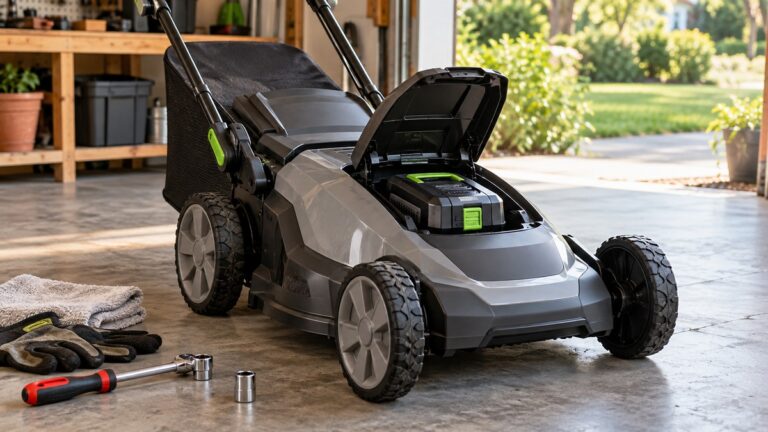
- Remove the battery before any blade work, and before any cleaning that puts your hand near the blade or under the deck.
- Charge the battery and double-check the charge before the first cut.
- Clean the deck, check the blade for wear, and sharpen or replace it at the start of each season.
Safety steps before any blade or deck work
Battery removal comes first. The Illinois Extension mower maintenance page says that for an electric mower you should remove the battery before removing the blades, so the blade cannot engage by accident. The same page places a second rule right after its advice to scrape the underside of the deck: whenever your hand goes near the blades, remove the battery on an electric mower. That rule applies to cleaning as well as to blade removal.
The Oklahoma State University teen safety guide says cordless electric mowers pose most of the same hazards as gasoline mowers. Iowa State Extension’s Yard and Garden page describes blade removal on an electric mower: wear heavy leather gloves, remove the battery, and brace the blade with a short 2×4 so it cannot turn.
The sources do not give a waiting time after removing the battery before you reach in, so none is given here.
Spring checklist, step by step
Work through these steps in order. Each step names the page it comes from.
- Read the owner’s manual for your model. Illinois Extension says to consult the equipment’s user manual before maintenance or operating. The same page says to tighten a blade bolt with a torque wrench to the specification in the manual. The pages we opened do not give a torque value.
- Charge the battery and check the charge. Oklahoma State University says to double-check that the battery of a cordless electric mower is properly charged before using it. DeWalt’s battery page advises storing and charging batteries in a cool, dry location.
- Remove the battery. Do this before any step below that puts your hands near the blade or under the deck.
- Look at the battery terminals. North Carolina State Extension says dead batteries are common in spring. It advises checking the terminals for corrosion where the wires connect, and cleaning any buildup with a wire brush or a battery terminal cleaner.
- Clear old clippings, leaves and dirt from the deck. NC State says a clean deck prevents clogging and allows better airflow and cutting. University of Maryland Extension says to clean debris out of the mower base to reduce wear on the blades and limit the spread of disease.
- Pick a cleaning method. The pages differ on water. Iowa State describes a strong stream of water with a putty knife. UMD says to avoid water when possible, because it may contribute to rust, and suggests brushing or scraping the material away or using a pressure washer. Illinois Extension recommends a leaf blower or air compressor and warns to be careful of wiring and hoses. Illinois also notes that some mowers have a garden hose port, and says to follow the manual for it.
- Look at the blade for wear. UMD says worn blades cause torn, brown, dried-out grass tips. NC State says dull blades tear grass rather than cutting it cleanly, which leaves it open to disease and insect damage.
- Sharpen or replace the blade at the start of the season. UMD advises sharpening at the beginning of each mowing season or replacing the blades once a year. Its rule of thumb is to sharpen after about 10 cumulative hours of use.
- Put the blade back and tighten the bolt to the manual’s torque. This is the same torque specification from step 1.
- Clear grass that could clog the blade. Oklahoma State says that if grass is too tall, very thick or too wet, the cut leaves can tangle around the blade and slow it or nearly stop it. For wet spring grass, see running an electric lawn mower in wet grass.
- Store the battery indoors when you are not mowing. Oklahoma State says to keep batteries stored indoors in a dry, climate-controlled area, if possible.
Blade check and sharpening
How often to sharpen
University of Maryland Extension gives two timing rules: sharpen at the beginning of each mowing season, or replace the blade once a year. Its rule of thumb is about 10 cumulative hours of use. North Carolina State Extension, writing for Sampson County, says sandy soils wear blades down quickly and recommends sharpening or replacing them every year. The two rules measure different things, time and use. None of the pages we opened gives a sharpening interval written for electric mower blades specifically, so check the manual for the blade your mower takes.
Signs that a blade needs attention
Worn blades produce torn, brown, dried-out grass tips, according to the University of Maryland page. NC State says dull blades leave grass open to disease and insect damage. If you see these signs, the blade is due for sharpening or replacement under the timing rules above.
If your mower is a Black and Decker model, see the guide to Black and Decker lawn mower blades for more on the blade side of the job.
Cleaning the deck and underside
Clippings stuck under the deck hold water, and that water can make the metal rust, which shortens the life of the mower, according to Illinois Extension. NC State adds that a clean deck prevents clogging and helps airflow. Iowa State says the time to clean the deck is while the blade is out, because the blade is already off for sharpening.
Water or air: what the pages say
Iowa State Extension describes a strong stream of water and a putty knife to remove built-up debris from the underside of the deck. UMD says to avoid water when possible, since it may contribute to rust. Illinois Extension suggests a leaf blower or air compressor and warns to be careful of wiring and hoses. The pages do not agree on water, so read the manual for your model before you use a hose, and keep the battery removed while you work under the deck, as the safety section above describes.
Battery checks for spring
Charge before the first cut
Oklahoma State University says to double-check that the battery is charged before using a cordless electric mower. NC State notes that dead batteries are common in spring. If a battery will not take a charge at all, read the guide to a lawn mower battery that will not charge before you decide what to do next.
Storage between mowing sessions
DeWalt advises storing and charging batteries in a cool, dry place and keeping them away from liquids, oils and extreme temperatures. Oklahoma State says to keep batteries indoors in a dry, climate-controlled area when possible. DeWalt’s page does not give a temperature in degrees, so the words “cool” and “extreme” are not defined there.
For storage longer than six months, DeWalt says to disengage the battery from the tool and fully charge it before storing it. Those points are general DeWalt battery guidance, not mower-specific.
Service and repair
DeWalt says to visit a service center for help with a battery, and says not to attempt repair or service yourself. The same page says a battery that no longer holds a charge should go to a service center for disposal.
Battery fit is a separate question. The pages we opened do not say which battery fits which mower. Use the battery named in your mower’s manual, and do not assume a battery from another brand will fit.
Spring checks at a glance
The table lists each check, what the pages we opened say about it, and the page that says it. Where a page gives no figure, the cell says “not stated.”
| Check | What the sources say | Source |
|---|---|---|
| Owner’s manual | Consult it before maintenance or operating | Illinois Extension |
| Battery removal for blade work | Remove the battery on an electric mower before blade removal, or whenever your hand goes near the blades | Illinois Extension; Iowa State Extension |
| Battery charge | Double-check that a cordless electric mower’s battery is charged before use | Oklahoma State University |
| Battery terminals | Check for corrosion at the wire connections; clean buildup with a wire brush or terminal cleaner | NC State Extension |
| Deck cleaning | Remove old clippings and dirt; a clean deck prevents clogging and helps airflow | NC State Extension; Illinois Extension |
| Water on the deck | Iowa State: strong stream of water with a putty knife. UMD: avoid water when possible | Iowa State Extension; University of Maryland Extension |
| Blade sharpening interval | At the start of each mowing season or once a year; about 10 cumulative hours of use as a rule of thumb | University of Maryland Extension |
| Signs of a worn blade | Torn, brown, dried-out grass tips | University of Maryland Extension |
| Blade bolt torque | Tighten to the manual’s specification; value not stated | Illinois Extension |
| Battery storage temperature | Avoid extreme temperatures; a figure in degrees is not stated | DeWalt |
| Spring battery charge level | not stated | All pages opened |
How we chose
We opened six pages on 2026-10-22: five university extension pages and one tool maker’s battery support page. We kept the lines that covered blade care, deck cleaning, battery charging or storage, and the manual check, and limited them to electric mowers or general lawn-mower maintenance. The North Carolina article also covers gasoline engines, so we left out its oil, filter and fuel steps. The Iowa State page is written for winter, so only its general service and blade lines are used. We did not rank products or compare brands, and no product appears in this guide.
What we could not verify
The steps above are general. The pages we opened do not cover any single electric mower model’s service list, so a model-specific schedule is not in this guide. The ten-hour sharpening rule comes from one extension page and is not checked against a battery mower maker’s manual. The DeWalt page covers DeWalt tools in general and does not describe a mower. The NC State article is written for one North Carolina county, so its sharpening advice is local. We could not confirm a spring charge level or charging time from any page we opened.
What the sources do not say
- A blade bolt torque value for any electric mower.
- How long to wait after removing the battery before reaching in.
- When to put the battery back in after blade work. The pages say to remove it before blade work and do not say when to reinsert it.
- Which cleaner to use on battery terminals.
- Battery voltage, amp-hour or charging time figures for spring.
- Whether a garden hose is safe for every electric deck. The pages differ on water.
Common mistakes to avoid
- Working under the deck with the battery connected. Illinois Extension says to remove the battery whenever your hand goes near the blades, and places that rule in its cleaning section.
- Leaving a dull or worn blade in place. UMD ties worn blades to torn, brown grass tips, and NC State ties dull blades to disease and insect damage.
- Skipping the manual. Illinois Extension says to consult the user manual before maintenance, and the torque figure belongs to the manual.
- Using a hose without checking the manual. Illinois Extension says some mowers have a hose port with its own instructions, and UMD warns that water may contribute to rust.
- Assuming a battery from another brand will fit. None of the pages we opened covers battery-to-mower fit.
FAQ
Do I need to remove the battery before cleaning under the deck?
Yes. The Illinois Extension page says that whenever your hand goes near the blades, an electric mower’s battery should be removed. It places that rule right after its advice to scrape the underside of the deck, so cleaning under the deck is covered. The Iowa State page says the time to clean the deck is while the blade is out, which means the battery should already be removed for that work.
How often should I sharpen an electric mower blade?
University of Maryland Extension advises sharpening at the beginning of each mowing season or replacing the blade once a year, with a rule of thumb of about 10 cumulative hours of use. NC State says sandy soils wear blades quickly and recommends sharpening or replacing them every year. The pages do not give a schedule written for electric blades specifically, so the manual is the place to check.
Should I hose off the deck in spring?
The pages differ. Iowa State recommends a strong water stream and a putty knife. UMD says to avoid water when possible, because it may contribute to rust. Illinois Extension recommends a leaf blower or air compressor, warns about wiring and hoses, and says some mowers have a garden hose port, with the manual as the guide for using it. If you use water, follow the manual and take care around wiring and hoses, as Illinois Extension advises.
What should I do if the battery is dead in spring?
North Carolina State Extension says dead batteries are common in spring, and advises checking the battery terminals for corrosion and cleaning off any buildup with a wire brush or terminal cleaner. The pages we opened do not explain why a particular battery fails. DeWalt says not to attempt repair or service a battery yourself, and says a battery that no longer holds a charge should go to a service center for disposal.
Where should I keep the battery between sessions?
Oklahoma State University says to keep batteries indoors in a dry, climate-controlled area when possible. DeWalt advises a cool, dry location and keeping batteries away from liquids, oils and extreme temperatures. Neither page gives a temperature range in degrees, so the sources do not say what cool or climate-controlled means in numbers.
Do I need a torque wrench for the blade bolt?
Illinois Extension says to use a torque wrench and tighten the blade bolt to the specification in your mower’s user manual. The page does not give a number, and none of the pages we opened states a torque value for an electric mower, so the manual figure is the one to use.
Bottom line
If a task puts your hand near the blade or under the deck, remove the battery first, and confirm the charge before the first cut.
Sources
- Illinois Extension: Mower Maintenance (opened 2026-10-22)
- NC State Extension, Sampson County Center: From the Vine: Don’t Let Mower Trouble Stall Your Spring (opened 2026-10-22)
- DEWALT: Top 10 Lithium Ion Battery Storage & Safety Tips (opened 2026-10-22)
- University of Maryland Extension: Maintaining an Established Lawn (opened 2026-10-22)
- Oklahoma State University: Lawn Care Safety and Basic Maintenance Tips for Teens (opened 2026-10-22)
- Iowa State University Extension and Outreach: Winter Garden Tasks (opened 2026-10-22)