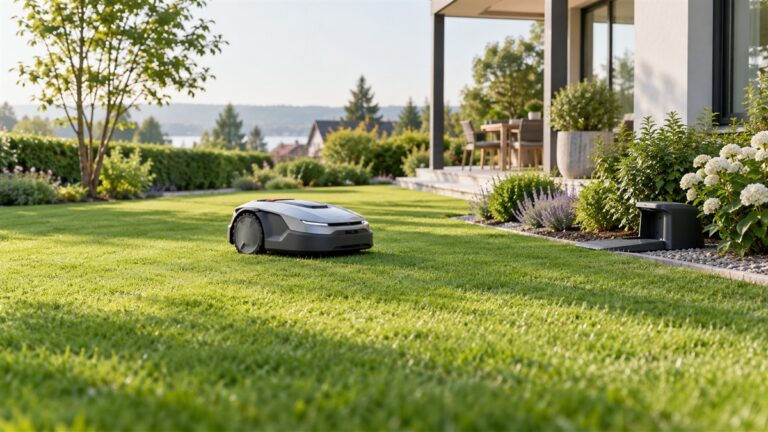
Best Robot Lawn Mower Without Perimeter Wire: Eight Wire-Free Models Compared
As an Amazon Associate we earn from qualifying purchases. Details
If you are looking for the best robot lawn mower without perimeter wire, the first question is how the mower learns where your lawn ends. A wired model needs a boundary cable laid around the yard. A wire-free model relies on satellite positioning with RTK, laser scanning with LiDAR, cameras, or a mix of these. Each method changes how the mower copes with trees, slopes, obstacles and tight corners. This guide compares eight wire-free robot mowers using their listing text and the university and manufacturer pages we opened, and it sets out what each listing claims and where those claims stop.
Quick answer
- For a lawn up to 0.15 acre, the ANTHBOT M5 is the pick to start with. Its listing caps mowing at that size and adds a dual camera system.
- For a quarter-acre lawn, five picks list that size. Two use LiDAR (the ECOVACS GOAT O1000 LiDAR PRO and the MOVA LiDAX Ultra 1000), and three use RTK with vision (the ECOVACS GOAT O1000 RTK, the WORX WR341 and the NovorikX X3).
- For half an acre, the MOVA LiDAX Ultra 2000 and the WORX WO7145 both list that size. The WO7145 has the heaviest listed weight in the set, at 44.5 pounds.
- For steep ground, the WORX WR341 lists slopes up to 84 percent, roughly 40 degrees. That is well beyond the 45 percent that five other picks list.
What replaces the boundary wire
The University of Florida IFAS Extension guide on autonomous mowers names the two key parts of these machines: a navigation system that defines the mowing area, and a charging station where the mower docks. For the navigation system, it names a boundary wire or GPS/RTK. That guide is written for Florida lawns, so we limit it to general points about layout, obstacles and upkeep.
The wire-free picks in this set fall into two navigation groups, based on their listings.
- RTK with vision. The ANTHBOT M5 pairs RTK positioning with a dual camera vision system, and its package includes an RTK reference station. The two WORX Vision Cloud models, the WR341 and the WO7145, use RTK cloud positioning that their listings say needs no local antenna. The NovorikX X3 pairs RTK with two front-facing vision sensors. The ECOVACS GOAT O1000 RTK pairs RTK with vision and 3D time-of-flight sensing.
- LiDAR. The ECOVACS GOAT O1000 LiDAR PRO and the two MOVA LiDAX models build their maps with laser scanning. The MOVA listings describe their setup as RTK-free. The ECOVACS listing says its LiDAR PRO needs no perimeter wire or RTK antenna.
The ECOVACS manufacturer page says the LiDAR PRO can map and remember boundaries without physical wires, and that its AI vision and 3D time-of-flight sensors avoid more than 200 types of obstacles. That is ECOVACS’s own claim about its own model, and we do not apply it to any other brand.
Camera-based obstacle avoidance also has an outside check. A University of Georgia Cooperative Extension turfgrass specialist, speaking to House Beautiful and reported by UGA Today, said robotic mowers can run in light rain and use onboard cameras to avoid wildlife, pets and most toys. That describes camera mowers in general, not any one model in this set.
The eight picks side by side
Every figure in the table comes from a listing’s title, bullet or specification field. Where a field is blank, we write “not listed” and do not estimate it.
| Pick | Navigation, as the listing describes it | Listed lot size | Listed cutting width | Listed maximum slope | Listed weight |
|---|---|---|---|---|---|
| ANTHBOT M5 | Dual AI vision with NRTK | Up to 0.15 acre | 7.9 in | 45% | 12 kg |
| ECOVACS GOAT O1000 LiDAR PRO | LiDAR, no perimeter wire or RTK antenna | Up to 1/4 acre | 8.66 in | 45% (24°) | Not listed |
| ECOVACS GOAT O1000 RTK | RTK, vision and 3D ToF | Up to 1/4 acre | 8.66 in | 45% (24°) | 23.6 lb |
| WORX WR341 | RTK Cloud with V-SLAM and Vision AI | 1/4 acre | 8.7 in | 84% (about 40°) | Not listed |
| NovorikX X3 | RTK and dual front vision | 1/4 acre | 7.1 in | 35% | 20.7 lb |
| MOVA LiDAX Ultra 1000 | 360° 3D LiDAR and AI vision, RTK-free | 1/4 acre | 8 in | 45% | 30 lb |
| MOVA LiDAX Ultra 2000 | 360° 3D LiDAR and AI vision, no RTK | 0.5 acre | 8 in | 45% | 30 lb |
| WORX WO7145 | RTK Cloud and Vision AI, with RadioLink | 1/2 acre | 8.7 in | 30% | 44.5 lb |
The table records what the listings state. It does not show how any of these mowers performs in a particular yard.
Slope, lot size, weight and run-time arithmetic
Slope. A slope percentage is the rise divided by the run, and the angle is the arctangent of that ratio. Two listings give both forms, and the figures agree. A 45 percent slope is an angle of about 24.2 degrees, which matches the 24 degrees in the ECOVACS listing. An 84 percent slope is about 40.0 degrees, which matches the figure in the WORX WR341 listing. Using the same formula, a 35 percent slope is about 19.3 degrees and a 30 percent slope is about 16.7 degrees. On a 30 percent slope, the mower climbs 30 feet for every 100 feet it covers.
Lot size. One acre is 43,560 square feet. A quarter acre is 0.25 × 43,560 = 10,890 square feet, which matches the figure in the ECOVACS GOAT O1000 RTK listing. Half an acre is 0.5 × 43,560 = 21,780 square feet. A quarter acre is also about 1,012 square meters (10,890 × 0.0929).
Weight. The ANTHBOT listing gives 12 kg. At 2.2046 pounds per kilogram, that is about 26.5 pounds, which sits between the 23.6-pound ECOVACS RTK and the 30-pound MOVA models. The WORX WO7145 at 44.5 pounds weighs 44.5 ÷ 20.7 ≈ 2.15 times as much as the NovorikX X3 at 20.7 pounds.
Run time. The ECOVACS LiDAR PRO page gives 90 minutes of mowing per charge and an efficient-mode rate of about 180 square meters per hour. A quarter acre is about 1,012 square meters, so 1,012 ÷ 180 ≈ 5.6 hours, or about 337 minutes, of mowing. Divided by the 90-minute charge, that is 337 ÷ 90 ≈ 3.7 charges, so a quarter acre needs at least four charge cycles on that figure. The arithmetic assumes no overlapping passes, so real mowing time will be longer.
Where wire-free mowers struggle
The UF/IFAS guide lists several limits that bear directly on which model fits a yard.
- Obstacle-heavy yards. The guide says autonomous mowers may struggle in complex landscapes with many obstacles, and it lists very large or complex landscapes as less suitable.
- Raised beds and borders. These can block the mower and leave taller grass along the edges, which then needs string trimming. Lowering those edges lets the mower reach them, so part of the fix is in the yard.
- Irrigation heads. Sprinkler heads can destabilize the mower, stop it or damage it.
- Lightning and fire ants. The guide flags lightning as a risk to docking stations, and fire ant activity near electrical parts.
- Theft. The guide lists theft as a concern. The security features below come from the listings alone.
- Upkeep. Blades dull with use. The guide advises replacing them every six to eight weeks during the growing season, and it lists regular battery checks as routine.
Grass height is a separate limit. The guide says most autonomous mowers were designed for cool-season grasses, which are typically mowed below about 2.5 inches. For St. Augustinegrass, which the guide says needs 2.5 to 4 inches, the required height may exceed what some robotic models allow. Against that standard, the NovorikX X3 lists a maximum of 2.36 inches, which is below the 2.5-inch lower bound. The ANTHBOT M5 lists 2.7 inches, which reaches only into the bottom of the range. The other six picks list maximums of 3.1 inches or more. If your lawn is a warm-season grass, check the listed maximum before anything else.
Edges and hand trimming
Wire-free mowers do not remove every trimming job. A University of Georgia Extension specialist notes that owners still do string trimming around the drive and edging around garden beds, shrubs and trees by hand.
Two picks claim to narrow that gap. The ECOVACS LiDAR PRO listing describes a built-in trimmer for the edges, and says it reduces the string trimming needed after mowing. The same listing adds that occasional manual trimming may still be needed in complex corners, narrow gaps or at raised edges. The WORX WR341 listing says its Cut-to-Zero offset blade trims closer to fixed borders and significantly reduces manual string trimming. Both listings describe a reduction, not an end to hand trimming.
Security and tracking features
Theft is one of the operating concerns the UF/IFAS guide lists, so the security features matter for a mower that will sit outside all day.
- The WORX WR341 listing describes GPS tracking and cellular connectivity that let you locate the mower even when it is powered off, plus a way to lock it remotely.
- The MOVA LiDAX listings describe anti-theft protection with real-time tracking and alerts if the mower leaves the mapped area. That tracking works through a link module, and the listing does not say the module is included.
- The DREAME listings in this family add a 4G module and an HDR camera for monitoring. We did not carry the DREAME models as picks, so that is noted here only for comparison.
Setup time
Setup claims come from the listings and the manufacturer page, so treat them as the maker’s figures. The ECOVACS GOAT O1000 RTK listing says it is ready in about five minutes. The ANTHBOT M5 listing says it builds a virtual map in about ten minutes without a manual walk-around. The ECOVACS page for the LiDAR PRO says its HoloScope system gets the mower started in about one minute. The listings do not say how long it takes to place a charging station or an RTK reference station.
Which picks fit which yard
- Up to 0.15 acre: The ANTHBOT M5 is the smallest lot in the picks. Its listing gives 0.15 acre as the maximum and adds a camera system and a reference station.
- A quarter acre with trees or shade: The ECOVACS LiDAR PRO listing says it works under trees and in shade where GPS mowers lose signal. The WORX WR341 listing describes V-SLAM sensor fusion for shaded areas. The pages we opened do not cover dense canopy, so treat both as listing claims and check your own yard before buying.
- Steep ground: The WR341 lists the steepest slope in the set. The ECOVACS, MOVA and ANTHBOT listings each give 45 percent. The NovorikX X3 lists 35 percent, and the WO7145 lists 30 percent.
- Half an acre: The MOVA LiDAX Ultra 2000 lists 0.5 acre and up to 150 managed zones. The WORX WO7145 lists half an acre and adds RadioLink for connectivity on larger lawns.
If you are new to the category, the robotic lawn mower pros and cons guide covers the trade-offs first. For a side-by-side of two wire-free brands, see WORX vs MOVA robotic lawn mowers. For smaller yards, see best robot lawn mowers for small lawns.
How we chose
We started from the twelve listings that the keyword matched to robot mowers. We read the title and bullets of each one. Every one of the twelve states in its title or bullets that it runs without a perimeter or boundary wire, so all twelve passed that check. We then chose eight to cover three lot sizes (up to 0.15 acre, a quarter acre and half an acre), both navigation groups, and a spread of slopes and weights. Marketplace ranking figures were not used.
We left four of the twelve out of the cards.
- WORX WR310 shares the Vision Cloud platform with the WR341 and lists the same quarter-acre size. It lists a 30 percent slope, and its listing comparison table says it lacks the Cut-to-Zero blade and Find My Landroid tracking. We carded the WR341 as the version that has both.
- DREAME A3 AWD 1000 lists 0.25 to 0.5 acre and an 80 percent (38.7°) incline. It is the next pick for a half-acre lawn with steep ground. We stopped at eight cards.
- DREAME A3 AWD Pro 3500 lists 0.87 acre, the largest lot in the set. Its title says 250 zones, but a bullet gives 100 zones, 100 no-go areas and 50 paths. We left it out until the listing is consistent.
- DWALE lists 0.12 acre and a wire-free title. Its bullet gives a 16 cm cutting width, while its specification table gives 12.99 inches. We did not carry it while the width is unclear.
Picks at a glance
Each card gives a reason drawn from that listing, a skip-if case and at least one limitation.
1. ANTHBOT M5 Robot Lawn Mower 1/8 Acre, Dual Vision+Full-Band RTK Robotic Lawnmower, No Perimeter (Smallest lot size among the picks)
Pros
- The listing caps mowing at 0.15 acre and describes the mower for small to medium yards
- It pairs RTK positioning with a dual camera vision system, and the package includes an RTK reference station
- The listing says it builds a virtual map in about 10 minutes without a manual walk-around
Cons
- The title says 1/8 acre while a bullet gives 0.15 acre, so plan around the lower figure
- The listing says the items ship in several separate packages
Best for: Small to medium yards up to 0.15 acre where camera-based navigation appeals
Skip if: Your lawn is larger than 0.15 acre, which the listing sets as the maximum
View on Amazon (affiliate link)
2. ECOVACS Goat O1000 LiDAR PRO Robot Lawn Mower, Wire-Free Mapping with LiDAR Navigation, AI Obstacle (LiDAR navigation with a built-in edge trimmer)
Pros
- The listing says the mower needs no perimeter wire or RTK antenna
- A built-in trimmer cuts the edges, and the listing says this reduces the string trimming needed after mowing
- The listing says the mower can pass through paths as narrow as 0.8 m
Cons
- The listing says occasional manual trimming may still be needed in complex corners, narrow gaps or at raised edges
- The listing gives no weight, and its product dimension field cannot describe the mower, so its size is hard to judge
Best for: A quarter-acre lawn with trees, fences or shade where you want the mower to cut the edges
Skip if: Your lawn is larger than a quarter acre, or you need a single confirmed cutting-height maximum
View on Amazon (affiliate link)
3. ECOVACS Goat O1000 RTK Robot Lawn Mower, Wire-Free Robotic Lawnmower for Up to 1/4 Acre, RTK + (RTK with vision and a short setup claim)
Pros
- The title says no boundary wire, and the listing says setup takes about five minutes
- The listing describes RTK paired with vision and 3D ToF sensing, with a 45 percent slope limit
- At 23.6 pounds it weighs about 21 pounds less than the WORX WO7145 listing
Cons
- The listing gives 65 minutes as the average battery life, so longer sessions will need a recharge
- The listing does not say how the RTK signal performs under dense tree cover
Best for: Quarter-acre open lawns where a short setup matters
Skip if: Your lawn is larger than a quarter acre, which the listing sets as its limit
View on Amazon (affiliate link)
4. WORX Robot Lawn Mower 4WD for 1/4 Acre, No Perimeter Wire, WR341 (All-wheel drive for steep ground)
Pros
- The listing states slopes up to 84 percent, about 40 degrees, the steepest in this set
- Find My Landroid uses GPS tracking and cellular connectivity to locate the mower, and lets you lock it remotely
- The Cut-to-Zero offset blade is listed to trim closer to fixed borders, which the listing says reduces manual string trimming
Cons
- The listing gives 41 minutes as the average battery life, the shortest figure among the picks that list one
- The listing does not state a weight
Best for: Quarter-acre yards with steep ground, or owners who want the mower tracked if it goes missing
Skip if: Your slopes are gentle and you do not need GPS tracking
View on Amazon (affiliate link)
5. NovorikX X3 Robot Lawn Mower with RTK+Dual AI Vision,Wire-Free 1/4 Acre Robotic Lawnmower,Zero-Edge (Lightest quarter-acre pick with dual vision)
Pros
- The listing describes RTK positioning with dual front-facing vision sensors that recognize over 200 object types
- The listing says it returns to the dock at low battery and when rain begins, and it carries IPX6 water resistance
- At 20.7 pounds it has the lightest listed weight among the quarter-acre picks
Cons
- The title lists a 35 percent slope, below the 45 percent that the ANTHBOT, ECOVACS and MOVA listings give
- The listed maximum cutting height is 2.36 inches, below the 2.5-inch lower bound the UF/IFAS guide gives for St. Augustinegrass
Best for: Quarter-acre cool-season lawns with toys, pets and garden furniture to work around
Skip if: Your grass is St. Augustinegrass or another warm-season type that needs a taller cut
View on Amazon (affiliate link)
6. MOVA LiDAX Ultra 1000 Robot Lawn Mower Wire Free for 1/4 Acre, RTK-Free+360° 3D LiDAR+AI Vision (LiDAR only, with two separate maps)
Pros
- The listing says it is wireless and RTK-free, using 360-degree 3D LiDAR and AI vision for automatic mapping
- It manages up to two independent maps, which the listing suggests for separate front and back yards
- The listing says the cutting height adjusts from 1.2 to 3.9 inches in the MOVAhome app
Cons
- The listing says anti-theft tracking works with a link module and does not state whether the module is included
- At 30 pounds it is heavier than the RTK-based ECOVACS and NovorikX listings
Best for: Quarter-acre lawns where you want LiDAR mapping and separate maps for front and back yards
Skip if: Your lawn is larger than a quarter acre, or you need a mower under 25 pounds
View on Amazon (affiliate link)
7. MOVA LiDAX Ultra 2000 Robot Lawn Mower with 4G for 0.5 Acre, No Wire No RTK+360° 3D LiDAR+AI Vision (Half-acre LiDAR mower with 4G)
Pros
- The listing sets 0.5 acre as the size and says it manages up to 150 zones
- The listing says the UltraTrim cutter reaches within 2 inches of walls, hedges and raised edges
- The package includes a charging tower, and the listing states a three-year warranty
Cons
- The title names 4G, but the listing does not say whether service is included or how long it lasts
- The listing gives a 60-minute average battery life, so a half-acre lawn needs several charge cycles
Best for: Half-acre lawns with uneven terrain where a LiDAR map and tracking are the priority
Skip if: Your lawn is smaller than half an acre, or you do not want a 4G-connected mower
View on Amazon (affiliate link)
8. WORX Robot Lawn Mower for 1/2 Acre, Wire-Free with Blades (Half-acre lawn with extended-range connectivity)
Pros
- The title gives 1/2 acre as the size, and the listing describes RTK Cloud navigation with vision AI
- The listing says RadioLink extends connectivity beyond standard Wi-Fi range on larger lawns
- The box includes a charging station and spare blade kits, according to the listing
Cons
- At 44.5 pounds it is the heaviest model in this set with a listed weight
- The listing gives 30 percent as its slope limit, the lowest slope figure among the picks
Best for: Half-acre lawns with gentle slopes where a heavier mower is acceptable
Skip if: You need to lift or carry the mower, or your slopes are steeper than 30 percent
View on Amazon (affiliate link)
What we could not verify
- Performance under dense tree cover, in shade, near fences or on wet grass. The pages we opened do not cover these conditions, so any claim about them is a listing claim.
- Measured run times. The battery figures are listing averages, and the pages we opened do not give run times for these models.
- Warranty and service terms. Several listings state a three-year warranty, but the pages we opened do not confirm those terms.
- The 4G service on the MOVA LiDAX Ultra 2000. The listing names 4G in the title. It does not say whether service comes with the mower or how long it lasts.
- Whether the link module for the MOVA anti-theft tracking is in the box. The listing does not say.
- Cutting height on the ECOVACS LiDAR PRO. Its manufacturer page gives a range of 1.2 to 3.1 inches, while the listing specification gives a maximum of 3.6 inches, so we do not state a maximum for that model.
- Size and weight of the ECOVACS LiDAR PRO. Its listing gives no weight, and its product dimension field, 1.95 by 1.56 by 0.58 inches, cannot describe the mower, so we do not use it.
- Weight of the WORX WR341. The listing does not state one.
- The lot size for the ANTHBOT M5. Its title says 1/8 acre and a bullet says 0.15 acre. We use the 0.15-acre figure as the upper limit.
- Whether the UF/IFAS points, written for Florida lawns, apply to the grass in your area.
FAQ
Do wire-free robot mowers still need a charging station?
Yes. The UF/IFAS guide names a charging station, where the mower docks automatically, as one of the two core parts of an autonomous mower. The guide also flags lightning as a risk to docking stations, so choose the spot with that in mind.
Do I still need to trim the edges by hand?
Often, yes. The UGA specialist says owners still do string trimming around the drive and edging around garden beds, shrubs and trees. The ECOVACS LiDAR PRO and the WORX WR341 both claim built-in edge cutting, and both listings describe a reduction in hand trimming, not a complete end to it.
Will a wire-free mower work under trees?
The ECOVACS LiDAR PRO listing says it can work under trees and in shade where GPS mowers lose signal, and the WR341 listing describes sensor fusion for shaded areas. The pages we opened do not cover dense canopy, so treat those statements as listing claims and check your yard’s cover before you buy.
How should I dispose of a worn-out lithium-ion battery?
Keep it out of household trash and recycling. The EPA says lithium-ion batteries belong at separate recycling or household hazardous waste collection points. To prevent fires, tape the terminals or place each battery in its own plastic bag. If a battery is damaged, follow the battery or device manufacturer’s handling guidance. The ECOVACS LiDAR PRO page lists a lithium-ion battery, and the same rules are the safe default for the other picks.
Are the cutting heights enough for warm-season grass?
Check before you buy. The UF/IFAS guide says St. Augustinegrass needs 2.5 to 4 inches, and most autonomous mowers are built for cool-season grass cut below about 2.5 inches. The NovorikX X3 lists a maximum of 2.36 inches, below that range.
Bottom line
Start with lot size and slope, since those two figures rule out the most models. Then choose the navigation group that suits your yard, and compare the LiDAR and RTK listing claims about shade and tree cover if those conditions apply to you. Before you buy, check the maximum cutting height against your grass type, because most autonomous mowers are built for cool-season lawns.
Sources
- University of Florida IFAS Extension, “Autonomous or Robotic Mower Use on Florida Lawns” (ENH1402/EP667), opened 2026-10-20: https://ask.ifas.ufl.edu/publication/EP667
- University of Georgia, UGA Today, “Extension specialist discusses advantages of robotic mowers”, opened 2026-10-20: https://news.uga.edu/?p=90922
- ECOVACS US, GOAT O1000 LiDAR PRO product page, opened 2026-10-20: https://www.ecovacs.com/us/shop/goat-robotic-lawn-mower/goat-o1000-lidar-pro
- U.S. EPA, “Used Lithium-Ion Batteries”, opened 2026-10-20: https://www.epa.gov/recycle/used-lithium-ion-batteries