Best Electric Dethatcher
As an Amazon Associate we earn from qualifying purchases. Details
The best electric dethatcher for most lawns is a corded 2-in-1 unit with a 16 inch path, a clear depth adjustment and a collection bag, run from an outdoor-rated cord on a GFCI-protected outlet. This guide compares six electric dethatcher and scarifier listings from six brands, using the title and first bullet points on each Amazon page. Every listing in the set combines a dethatching head and a scarifying head. The figures are the sellers’ own, and the cord and outlet advice comes from university and workplace safety guides.
Quick answer
- Compare the depth settings before the motor. The listings give five-position or 14-position adjustments with different ranges, so the depth scale matters for matching the tool to your lawn.
- Read the motor and the path together. Five listings state a 16 inch path, and the amp ratings run from 13 to 15.5 amps.
- Match the cord to the tool and the run. LSU AgCenter says the tool’s amp rating and the cord length decide the wire size, and that longer runs need heavier wire.
- Plug into a GFCI outlet and inspect the cord before each use. Southern Utah University requires GFCI protection for outdoor 120-volt receptacles that are not permanent wiring, and daily cord inspection for workers.
What a dethatcher does
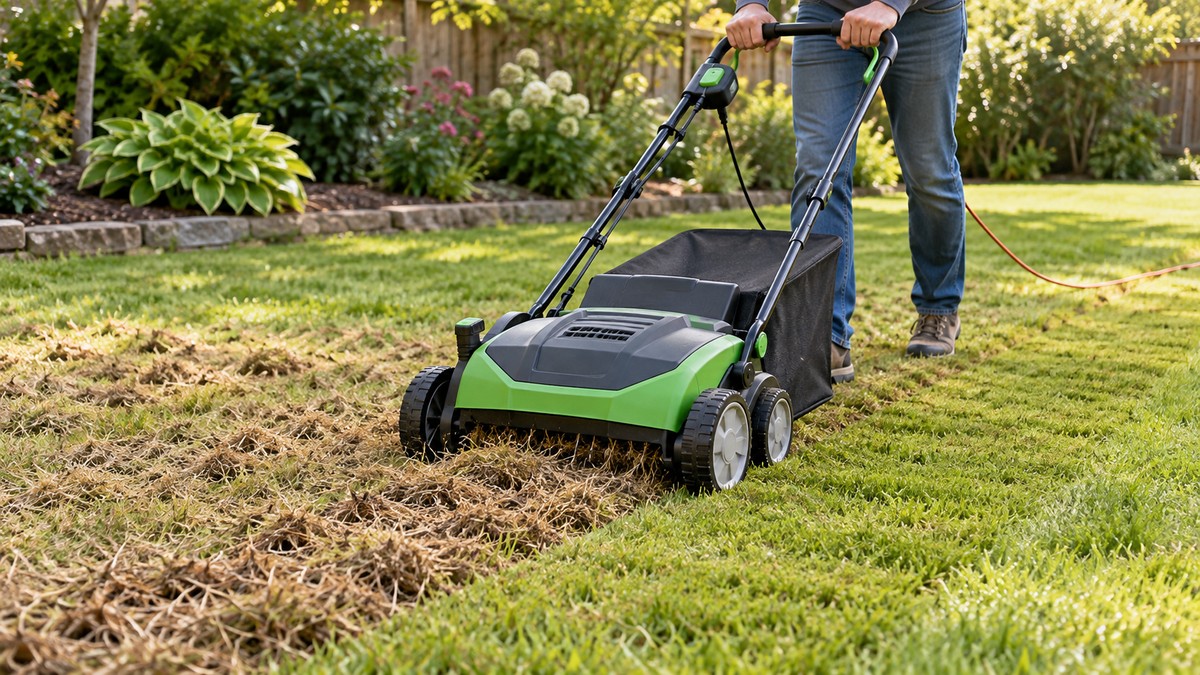
A dethatcher pulls thatch, the layer of dead grass and debris that builds up between the grass and the soil, out of the lawn. A scarifier cuts shallow grooves into the turf to loosen the soil and open the lawn to air and water. Most of the listings in this set give both functions in one unit, and each one uses a removable blade or roller set to switch between the two. The listings describe the goal in similar terms: remove thick thatch, loosen the soil and let water and air reach the roots.
The listings do not say when to run the tool in a given season, and the sources we opened do not cover timing either. Treat the timing question as one to answer for your own grass, and do not run a dethatcher on a lawn you have not inspected.
Electrical safety first
Every listing in this set is corded, so the electrical details matter more than the brand. The Southern Utah University outdoor cord guidance says that 120-volt, 15 or 20 amp receptacles that are not part of permanent wiring must be protected by GFCIs when used outdoors. That page is written for workplaces, but the same protection makes sense for a homeowner with a corded lawn tool. It also says cords must be inspected before each use and that damaged cords should be taken out of service.
The UC Irvine electrical safety guide treats extension cords as temporary equipment, not a permanent wiring solution. It warns against daisy-chaining cords or plugging power strips into each other, and it describes a GFCI as a fast-acting breaker that cuts power within a fraction of a second after it detects a current imbalance. That speed is the reason the GFCI outlet is the first protection to check.
The LSU AgCenter article on electric tools gives the wire size guidance. It advises plugging outdoor electric tools into a GFCI-protected outlet, notes that most building codes now require GFCI outlets at outdoor locations, and says the wire size depends on the tool’s amperage and the cord’s length. Longer cords need heavier wire to limit voltage drop and overheating. Check the tool’s nameplate for its amp rating, then choose a cord to match the length you will use.
The six listings compared
The table below uses the figures from each listing’s title and first bullet points. Where a listing gives no figure, the table says so.
| Listing | Motor and speed | Working path | Depth settings | Bag, weight and extras |
|---|---|---|---|---|
| LawnMaster GVB1316 | 13 amp, up to 3700 RPM | 16 inch | 14 height positions | 12 gallon bag |
| WEN DT1516 | 15 amp, up to 3300 RPM | 16 inch | 5 positions | Detachable bag, overload shutdown, two-year warranty |
| BILT HARD 16 inch | 15 amp copper motor, up to 3300 RPM | 16 inch | 5 positions | 14.5 gallon removable bag |
| Sun Joe AJ805E | 13 amp | 15 inch (title) | 5 positions | Removable bag, four wheels |
| TaskStar 16 inch | 15 amp, 3500 RPM | 16 inch | 5 positions | 14.5 gallon bag, 28 lbs, bonus thatch rake |
| TIECTOWN 16 inch | 15 A, peak 15.5 A, 3600 RPM | 16 inch | 5 positions | 30 lbs, cord clip, cord holder |
The LawnMaster’s 13 amp motor is 2 amps below the WEN’s 15 amp rating, and the LawnMaster’s 3700 RPM is the highest speed in the set. The TIECTOWN’s 30 lb weight is 2 lb heavier than the TaskStar’s 28 lb, and it is the heaviest unit that states a weight. Amp rating and RPM are separate figures, and the sources we opened do not say which one predicts how well a unit clears thatch, so read both.
The Sun Joe is the one listing whose path width is stated only in the title, as 15 inches, rather than as a 16 inch path in the bullets. Check the path width on the product page if the lawn edge matters to you.
Reading the depth settings
Depth settings are where the listings differ most, and they are easy to misread. The LawnMaster lists 14 positions, with scarify settings from -0.35 to 0.19 inch and dethatch settings from -0.19 to 0.35 inch. The WEN lists five positions, from a 1/4 inch rake depth to a half inch below. The TaskStar lists five positions from -1/2 inch to +1/4 inch, and its bullets tell the buyer to mow taller grass first. The TIECTOWN lists five positions, with scarify settings from -0.47 to 0.24 inch and dethatch settings from -0.32 to 0.39 inch. The BILT HARD and Sun Joe list five positions each, without the full range in the captured bullets.
Negative and positive values in these ranges describe the seller’s depth scale, and the sources we opened do not define the sign convention. Read the product manual for the zero point before you set the depth on a real lawn. A scale with a finer step, such as the LawnMaster’s 14 positions, gives more choice, but the sources do not say that a finer step makes a better result.
Scarify and dethatch heads
Each unit uses a different head design. The WEN lists a 20-blade scarifying head and a dethatching head with 24 steel tines. The BILT HARD uses a scarifying roller with 16 blades and a dethatching roller with 20 spring steel tines. The TIECTOWN describes a quick-release blade system for the two heads. The TaskStar uses scarifying and dethatching cylinders and includes a bonus thatch rake for tight corners. The Sun Joe uses a blade reel described in the title. The LawnMaster is a 2-in-1 unit with a dethatching and a scarifying function, and its bullets say the scarify setting cuts grooves that improve water and air movement.
These head designs are the seller’s descriptions. The sources we opened do not compare blade types or tine counts, so the head design is a feature to check on the product page rather than a verified advantage.
Bags, weight and handling
Four listings give a bag size, and the bag is the part that decides how often you empty the machine. The LawnMaster gives a 12 gallon bag, the BILT HARD and the TaskStar each give a 14.5 gallon removable bag, and the WEN bag is detachable. The Sun Joe bag is removable, but its capacity is not in the captured text. The bullets for the WEN also describe automatic overload shutdown to protect the motor, which is a listing claim we did not check.
Weight matters when you carry the unit to a lawn or a storage shelf. The TaskStar is 28 lbs and folds at the handle, while the TIECTOWN is 30 lbs and also folds. Neither weight is a limit, but both are heavier than a basic handheld tool. The BILT HARD lists 7 inch front and 6 inch rear flat-free wheels, which affects how the unit rolls over uneven ground.
Cord and outlet checklist
Use this checklist before the first run. Check the tool’s amp rating on its nameplate and match the cord’s wire size to the length you will use, as the LSU guidance advises. Plug the tool into a GFCI-protected outdoor outlet, or use a portable GFCI between the outlet and the tool’s plug, which the LSU guidance also describes. Keep the cord run as short as the job allows, and never daisy-chain cords together, which the UC Irvine guide warns against.
Inspect the cord and plug each time before use, and remove any cord that is cut, cracked or heavily worn from service, as the Southern Utah University guidance requires. Keep the cord clear of the blades and the tines, since a cord in the path of a spinning head is the kind of damage that makes a cord unsafe. The TIECTOWN bullets mention a waterproof plug and a cord clip, which help with organization, but the sources we opened do not confirm their weather performance.
Mistakes to avoid
- Running the tool on a cord that is too light for the length. The LSU guidance says longer runs need heavier wire.
- Plugging into a receptacle that is not GFCI-protected outdoors. The LSU and Southern Utah University guidance both point to GFCI protection.
- Daisy-chaining extension cords or power strips to reach the lawn. The UC Irvine guide warns against both.
- Using a damaged cord. Southern Utah University says damaged cords must be removed from service.
- Setting the depth without reading the scale. The listings use different ranges and sign conventions, so check the manual before the first pass.
Choosing by lawn and budget
The right unit depends on the lawn’s size, the amount of thatch and how much cord you can run. A 13 amp unit such as the LawnMaster or the Sun Joe is the lower-amp choice in this set, and a 15 amp unit such as the WEN, the BILT HARD or the TaskStar gives the higher amp rating for the same class. The TIECTOWN gives a higher listed motor speed than most of the set, but it is also the heaviest unit that states a weight. Choose the unit whose depth settings and bag size fit the job, then plan the cord and the outlet before you buy.
How we chose
We searched Amazon.com in Chrome for the keyword on 21 October 2026 and read the first results page. We kept corded electric dethatchers and scarifiers. We set aside cordless models and a unit that the search listed as a garden tiller, and we left out listings that were accessories, such as cord holders and replacement parts.
We read each listing’s title and first bullet points. We chose one listing per brand, so the set includes six brands. The Westinghouse 13 inch listing and a 17 inch listing from an unnamed brand were left out to keep one listing per brand. The TIECTOWN and Westinghouse models both have separate single-model reviews on this site, which are linked below.
Our criteria were the motor and speed stated in the bullets, the path width, the depth settings, the bag and the stated weight. We did not rank by price, customer rating or sales figures, because those were not captured from the pages.
What we could not verify
- How well any listed amp rating or RPM predicts real thatch removal, since the sources we opened do not test dethatchers.
- The depth sign convention and the zero point on each scale, which the manuals should define.
- The capacity of each bag beyond the figures in the bullets, and whether the bags empty easily.
- The two-year warranty on the WEN and its terms, which are not in the captured text.
- The bonus thatch rake on the TaskStar and the waterproof plug on the TIECTOWN, which are seller claims.
- Whether any cord is included with a unit, since the captured bullets do not say.
- Price, stock, delivery and ratings. None of these was captured from the pages.
- Anything below the first bullet points. Several bullets were cut off at capture.
Setting up before the first pass
Start with the cord, not the machine. Route the cord so that it stays behind you and clear of the blades and tines, then plug into the GFCI-protected outlet before you set the depth. Look over the cord from the plug to the tool for cuts, cracks or heavy wear. If you need an extension, choose one heavy enough for the tool’s amp rating and the length you need, as the LSU guidance describes, and keep the run as short as the lawn allows.
Set the depth on a small, open area of lawn before you commit to the whole yard. Read the depth scale on your model and find its zero point in the manual, because the listings’ negative and positive ranges do not show where zero sits on each machine. Empty the bag before it fills, and plan the emptying around the lawn size. The LawnMaster’s 12 gallon bag is 2.5 gallons smaller than the BILT HARD’s 14.5 gallon bag, so the LawnMaster will need emptying sooner on a large job.
FAQ
Should I buy a 13 amp or a 15 amp electric dethatcher?
The amp rating tells you the motor’s listed draw, and the LSU guidance says the amp rating also sets the wire size you need for the cord. The sources we opened do not say that a higher amp rating always clears thatch better, so compare the rating with the depth settings and the bag.
What extension cord should I use with an electric dethatcher?
Check the tool’s amp rating on its nameplate, then choose a cord that matches both the amp rating and the length you need. The LSU guidance says longer cords need heavier wire, and the UC Irvine guide treats extension cords as temporary use only. Use a cord rated for outdoor use, inspect it before each use, and replace it if it is damaged.
Do I need a GFCI outlet for an electric dethatcher?
Yes, for outdoor use. Southern Utah University requires GFCI protection for outdoor 120-volt receptacles that are not part of permanent wiring, and the LSU guidance advises a GFCI-protected outlet for outdoor electric tools. If the outlet is not GFCI-protected, a portable GFCI between the outlet and the tool’s plug is the fallback the LSU article describes.
Can I run the dethatcher on a long extension cord?
Keep the run as short as the job allows. The UC Irvine guide treats extension cords as temporary use only, and the LSU guidance says longer runs need heavier wire and can overheat if the wire is too light. Do not daisy-chain cords together.
Which brand is better, the WEN or the TIECTOWN?
The sources we opened do not compare these brands. Compare the listed motor, path, depth settings, bag and weight, and choose the unit whose figures suit your lawn and the cord you can run.
Bottom line
Choose the unit whose depth settings, bag and path suit the lawn, run it from a cord sized for the tool and the length, and plug it into a GFCI-protected outlet. Inspect the cord before each use, and do not daisy-chain cords to reach the lawn.
For single-model reviews on this site, see our TIECTOWN dethatcher review and our Westinghouse dethatcher review. For cord length and outlet guidance for electric lawn tools, see our extension cord guide.
1. LawnMaster GVB1316 Electric 16 Inch 13 Amp Dethatcher and Scarifier with 12 Gallon Collection Bag (13 amp 2-in-1 with a 14-position height adjustment and 12 gallon bag)
Specs from the listing (checked ):
- Motor: 13 Amp (bullet)
- Speed: up to 3700 RPM (bullet)
- Height settings: 14 positions; -0.35 to 0.19 inch (scarify), -0.19 to 0.35 inch (dethatch) (bullet)
- Collection bag: 12 gallon (title and bullet)
Pros
- The bullets give a 14-position height adjustment for both scarify and dethatch settings
- The bullets state a 12 gallon collection bag
Cons
- The 13 amp motor is one of the two lowest amp ratings in the set
- The captured bullets give no weight for the unit
Best for: An owner who wants fine height steps and a large bag
Skip if: You want the highest amp rating in the set
View on Amazon (affiliate link)
2. WEN DT1516 16-Inch 15-Amp 2-in-1 Electric Dethatcher and Scarifier with Collection Bag, Black (15 amp 2-in-1 with 24 steel tines and a two-year warranty)
Specs from the listing (checked ):
- Motor: 15 amp (bullet)
- Speed: up to 3300 RPM (bullet)
- Path: 16 inch (bullet)
- Depth: 5 positions, from +1/4 to -1/2 inch (bullet)
- Tines: 24 steel tines on dethatching head (bullet)
- Warranty: two-year (bullet)
Pros
- The bullets give a 15 amp motor, up to 3300 RPM and a 16 inch path
- The bullets list a 20-blade scarifying head and 24 steel tines on the dethatching head
Cons
- The bullets state a two-year warranty, but its terms are not in the captured text
- The bullets describe automatic overload shutdown without a restart time
Best for: An owner who wants a detachable bag and both heads in one unit
Skip if: You need a finer height step than five positions
View on Amazon (affiliate link)
3. BILT HARD 16 Inch Dethatcher Scarifier Electric Powered, 15 Amp Copper Motor, 5-Position Depth (15 amp copper motor with a 14.5 gallon removable bag)
Specs from the listing (checked ):
- Motor: 15 amp copper motor (bullet)
- Speed: up to 3300 RPM (bullet)
- Path: 16 inch (bullet)
- Scarifying roller: 16 blades (bullet)
- Dethatching roller: 20 spring steel tines (bullet)
- Bag: 14.5-gallon removable (bullet)
Pros
- The bullets describe a 15 amp copper motor and a 16 inch raking path
- The bullets give a 14.5 gallon removable bag and 7 inch and 6 inch wheels
Cons
- The bullets describe separate scarifying and dethatching rollers, so the head changes by swapping parts
- The depth range uses negative values, and the sign convention is not defined in the captured text
Best for: An owner who wants a large removable bag and separate rollers
Skip if: You want a single blade reel system
View on Amazon (affiliate link)
4. Sun Joe 15-Inch Lawn Dethatcher with Scarifier Blade Reel, AJ805E and Collection Bag – 13-Amp (13 amp corded unit with a removable bag and four wheels)
Specs from the listing (checked ):
- Motor: 13 amp (bullet)
- Width: 15 inch (title)
- Depth: 5-position depth control (bullet)
- Bag: removable collection bag (bullet)
Pros
- The bullets describe a 13 amp motor, a removable collection bag and 5 depth positions
- The bullets describe four easy-glide wheels for moving the unit
Cons
- The 15 inch width is given in the title, not as a path in the bullets
- The bullets state that it is corded, so the cord plan applies
Best for: An owner who wants a bagged unit with five depth positions
Skip if: You need the path width stated in the bullets before you order
View on Amazon (affiliate link)
5. TaskStar Dethatcher and Scarifier, 16 Inch Lawn Dethatcher with Thatch Rake (16 inch 2-in-1 with a bonus thatch rake and 28 lb weight)
Specs from the listing (checked ):
- Motor: 15 amp (bullet)
- Speed: 3500 RPM (bullet)
- Path: 16 inch (bullet)
- Weight: 28 lbs (bullet)
- Bag: 14.5-gallon (bullet)
- Depth: 5 positions, -1/2 to +1/4 inch (bullet)
Pros
- The bullets give a 15 amp motor at 3500 RPM across a 16 inch path
- The bullets include a bonus adjustable thatch rake and a 14.5 gallon collection bag
Cons
- The bullets tell the buyer to mow taller grass before use, which adds a step
- The bonus rake is a seller claim that the sources we opened do not cover
Best for: An owner who wants a bag and a separate rake in one kit
Skip if: You want a machine lighter than 28 pounds
View on Amazon (affiliate link)
6. TIECTOWN 2026 Upgrade 16-Inch 15.5A Electric Dethatcher & Scarifier, Orange (16 inch 15.5 A dethatcher with a 30 lb frame and cord management)
Specs from the listing (checked ):
- Motor: 15 A (bullet; peak 15.5 A)
- Speed: 3600 RPM (bullet)
- Path: 16 inch (bullet)
- Weight: 30 lbs (bullet)
- Depth: 5-position control; scarify -0.47 to 0.24 inch, dethatch -0.32 to 0.39 inch (bullet)
Pros
- The bullets give a 15 A motor with 15.5 A peak and 3600 RPM on a 16 inch path
- The bullets list a waterproof plug, a cord clip and an extension cord holder
Cons
- The 30 lb weight is the heaviest figure among the listings that state one
- The depth ranges use negative values, and the sign convention is not defined in the captured text
Best for: An owner who wants cord management features and a fast motor
Skip if: You want the lightest machine or a finer height step
View on Amazon (affiliate link)
Sources
- Southern Utah University, Working Outdoors and Extension Cords: https://www.suu.edu/erm/eohs/electrical-safety/outdoors-and-extension-cords.html
- UC Irvine Environmental Health and Safety, Electrical Safety Reference Guide: https://ehs.uci.edu/safety/_pdf/electrical-safety-reference-guide.pdf
- LSU AgCenter, Safety With Electric Tools: https://www.lsuagcenter.com/articles/connected/safety-with-electric-tools