Brushless vs Brushed Motors on Yard Tools
As an Amazon Associate we earn from qualifying purchases.
Brushless vs brushed motors on cordless yard tools is mostly a question of how the motor switches current. A brushed motor sends power to its spinning part through carbon brushes that slide on a commutator. A brushless motor replaces those brushes with electronic control and position sensors. The pages cited here agree on that construction and on the wear point. They say little about runtime and cost for any specific tool, and runtime claims on product pages come from the manufacturer.
Quick answer
- A brushed motor passes current to its spinning part through brushes that slide on a commutator. The cited pages say those brushes and the commutator wear and need replacing or cleaning.
- A brushless motor generally has a permanent magnet on the rotor and windings on the stator. Electronic controls switch the current, so there are no brushes to replace.
- The cited pages say brushless designs are more efficient and have less wear. They also say brushless motors usually cost more, because they need electronic controllers.
- Runtime and torque claims on product pages are manufacturer statements. Real runtime changes with grass, cutting height and terrain.
How a brushed motor works
A brushed motor has a stationary part and a spinning part. The Clemson brushed page calls the stator the larger stationary part and the rotor the smaller part that spins on an axis inside it. The armature, which is the rotor, is made up of electric windings around armature arms. Current has to reach those windings while the rotor turns, and the brushed design does that with brushes.
The brushes make contact with a commutator on the shaft. The Clemson page describes the commutator as a segmented sleeve, usually made of copper, mounted on the rotating shaft. It also describes a mechanical sliding contact between the brushes and the commutator collar. The DeWalt support article puts it more simply: a brushed motor uses brushes and a commutator to supply electricity to the magnetic coils of the armature.
The University of Florida course page calls the brushed type the simplest type of electric DC motor. It explains that the voltage polarity is reversed through the commutator and brushes, which keeps the armature turning.
How a brushless motor works
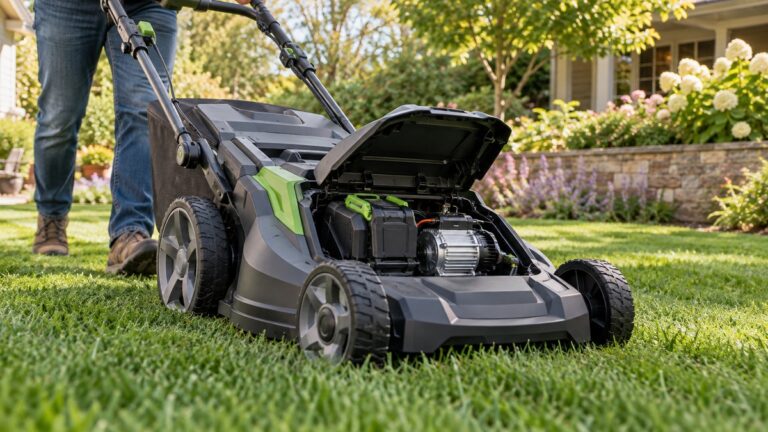
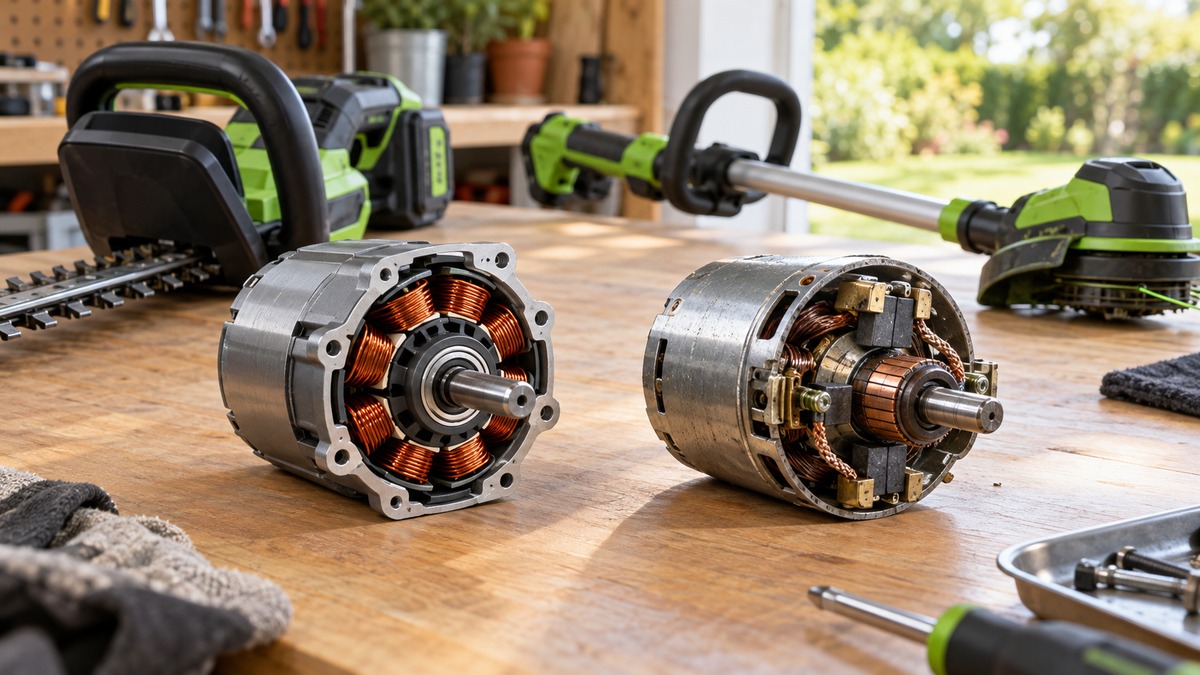
A brushless motor reverses the roles of the magnets and the coils. The Clemson brushless page says that, unlike brushed DC motors, brushless DC motors generally employ a permanent magnet on the rotor, and the windings are on the stator. Electronic controls change the polarity of the current in the windings.
Because the windings stay fixed, the brushes are not needed to carry current into a spinning part. The University of Florida page says that with a fixed electromagnet part, the problem of connecting current to a moving armature is eliminated. Its brushless electronic speed control reads rotor position with magnetic sensors and the Hall-effect. The Clemson brushless page says sensors monitor the position of the rotor and feed that information back to the electronic controls.
The Toro guide gives a simple picture of the two layouts. It says a brushed DC motor has coils in its center that rotate around permanent magnets, and that in a brushless motor the magnet is in the center while the coils circle around it.
Efficiency and runtime on cordless tools
Efficiency is where the cited pages agree most. The Clemson brushless page lists higher efficiency as an advantage of brushless motors. The University of Florida page says brushless motors are often more efficient at converting electricity into mechanical power, and it ties that gain to the absence of electrical and friction losses due to brushes.
The same page adds two limits. The efficiency gain is greatest at no-load and low-load, and under high mechanical loads brushless motors and high-quality brushed motors are comparable in efficiency. The sources we opened do not say which yard tasks count as high-load or low-load, so a reader cannot match that limit to a specific task from these pages alone.
Runtime is where the manufacturers make their claims. Toro says brushless motors use less power and have a longer run time. DeWalt lists longer runtime from the same battery among the benefits of brushless motors. Husqvarna says the brushless motor in its 530iB leaf blower maximizes energy conversion and delivers extended battery runtimes compared with brushed alternatives. These are manufacturer statements, and none of the three pages gives a runtime figure or the conditions behind one.
Grass type, cutting height and terrain all change how long a charge lasts, so read a runtime claim as a starting point rather than a result for your yard.
Wear, maintenance and heat
Wear is where the cited pages agree most strongly. The Clemson brushed page says the brushes and the spring carrying the current need replacing from time to time, and that the commutator needs periodic cleaning or replacement. The University of Florida page lists the brushes causing friction and electrical resistance at the brush-to-commutator interface as drawbacks of the brush and commutator mechanism.
Brushless designs remove that contact. DeWalt lists less maintenance, with no brushes that need to be replaced, as a benefit. Husqvarna says that because its brushless 530iB has no carbon brushes that wear out over time, the motor needs virtually zero mechanical maintenance. The Clemson brushless page lists no mechanical wear of the commutator assembly as an advantage. Husqvarna’s statement covers one leaf blower, not every brushless tool.
Heat is the other difference the sources name. DeWalt says the friction at the brush contact creates heat and loss of energy, and it describes brushless operation as a more efficient, cooler motor with longer motor life. The University of Florida page lists longer lifetime, with no brush and commutator erosion, as a brushless advantage.
Torque and power claims
The University of Florida page lists more torque per weight as a brushless advantage. Toro lists more torque at startup and more efficient speed control among the advantages of a brushless motor, and Husqvarna says its brushless motor delivers higher torque. Toro and Husqvarna are the manufacturers, so those are their statements. None of the cited pages puts a torque or power number on a specific brushed or brushless yard tool. For a brushless example from a different tool, see the DeWalt 20V MAX brushless weed trimmer guide.
Cost and speed control
Cost is the trade-off the sources name most clearly. The Toro guide says brushed motors are typically less expensive, since producing them is simpler than producing brushless motors, and it calls the brushed motor the traditional choice for battery-powered lawn tools. The University of Florida page says the primary disadvantage of brushless motors is higher cost, due to the complex electronic speed controllers they need.
Speed control works differently. The University of Florida page says brushed motors can be regulated by comparatively simple controllers, such as variable resistors, but that this reduces efficiency because power is wasted. Brushless motors depend on electronic controllers to switch the windings, which is part of why they cost more. Battery voltage is a separate question, and the lawn and garden battery voltage guide covers those terms.
The cited pages do not all point to the same motor for the same job. Toro says a brushed motor is sufficient for most jobs. The University of Florida page says manufacturers use brush-type motors when low system cost is a priority, and brushless motors to fulfill requirements such as maintenance-free operation and high speeds.
Safety notes on sparking and brush wear
This explainer gives no blade, deck, chain or bar steps, so the battery-removal and blade-safety steps do not apply here. The safety points the cited pages make concern sparking and brush wear, and they are general motor points rather than yard-tool instructions.
The University of Florida page says the mechanical switching of the armature current results in sparking. It also says manufacturers choose brushless motors for operation in explosive environments where sparking could be hazardous. The Clemson brushless page lists no sparks as an advantage of brushless motors. None of the cited pages says how much sparking a brushed yard tool produces, or whether that matters at home.
The cited pages do not cover charging or storage steps for these tools. Follow the manual that came with your tool for those steps.
Brushed vs brushless at a glance
The table lists only what the cited pages state. Where a page does not cover a point, the cell says not stated.
| Point | Brushed motor | Brushless motor | Source |
|---|---|---|---|
| How current reaches the spinning part | Through brushes sliding on a commutator | Electronic controller switches the windings, using rotor position sensors | Clemson brushed page; Clemson brushless page; University of Florida page |
| Part that wears | Brushes and commutator | No brushes or commutator to wear | DeWalt support article; Clemson brushed page; Clemson brushless page |
| Maintenance | Brushes and spring need replacing from time to time; commutator needs cleaning or replacement | Less maintenance (DeWalt); virtually zero mechanical maintenance (Husqvarna, manufacturer statement) | Clemson brushed page; DeWalt support article; Husqvarna US page |
| Efficiency | Brush friction and electrical losses; comparable to brushless under high mechanical load | Higher efficiency; greatest gain at no-load and low-load | Clemson brushless page; University of Florida page |
| Heat | Friction and heat at the brush contact | Cooler operation (DeWalt statement) | DeWalt support article |
| Runtime | Not stated as a runtime figure | Manufacturer states longer run time and extended battery runtimes; no figures or conditions given | Toro guide; DeWalt support article; Husqvarna US page |
| Torque and power | Not stated in a brushed-versus-brushless comparison | More torque per weight (University of Florida); more torque at startup (Toro statement); higher torque (Husqvarna statement) | University of Florida page; Toro guide; Husqvarna US page |
| Cost | Typically less expensive (Toro); low system cost (University of Florida) | Higher cost due to electronic controllers | Toro guide; University of Florida page |
| Speed control | Simple controllers such as variable resistors, which reduce efficiency | Electronic speed controller required | University of Florida page |
| Sparking | Mechanical switching of the armature current results in sparking | Listed as an advantage: no sparks | University of Florida page; Clemson brushless page |
How we chose
We looked for pages that define brushed and brushless motors in plain terms, with a preference for manufacturer pages from the US locale and for university pages. We opened six pages on 2026-10-22: a Toro buying guide, a DeWalt support article, two Clemson University lab pages on brushed and brushless DC motors, a University of Florida course background page, and a Husqvarna US product page for a leaf blower.
Retail listings, third-party blogs and Wikipedia were not used for definitions. Manufacturer pages are cited only for what each manufacturer states, and the text labels those statements as such. The Clemson pages sit in an automotive actuator section, and the University of Florida page was written for a robotics lab kit, so neither is a yard-tool source. We did not rank or compare any product models.
What we could not verify
We could not verify any runtime, power, torque or cost figure for a specific cordless yard tool from the pages we opened. The manufacturer statements in this post are reported as statements, and the pages do not give the conditions behind them. We also could not verify that the brushless advantages listed here apply in the same way to mowers, trimmers, edgers and blowers, because the pages are general motor pages, one leaf blower page and lab pages.
Several points rest on a single source. The Husqvarna statement about virtually zero maintenance covers one leaf blower. The Toro statement that a brushed motor is sufficient for most jobs is a manufacturer’s view, not an independent comparison.
What the sources do not say
- None of the cited pages compares a brushed and a brushless version of the same yard tool.
- None gives a runtime in minutes or hours, or a price, for a brushed or brushless yard tool.
- None says whether a brushless battery works in another brand’s tool, or whether brushed and brushless tools share a battery platform.
- The Husqvarna page does not name the brushed model it compares with.
- The University of Florida page says brushless motors cannot be used with its course project, because the course robotic controllers lack sophisticated electronic speed controllers. That is a limit of that lab kit, not a finding about yard tools.
- None says which yard tasks are high-load and which are low-load, or how long brushes last in hours of use.
- None says how much sparking a brushed yard tool produces at home.
FAQ
Is a brushless motor always better on a yard tool?
The pages do not say always. They agree that brushless motors have no brushes to replace and that they are often more efficient. The University of Florida page adds that under high mechanical loads, brushless and high-quality brushed motors are comparable in efficiency.
Brushless motors also cost more, as the Toro guide and the University of Florida page both indicate. Whether that trade is worth it depends on how much you value less upkeep and the efficiency gain, which the cited pages cannot weigh for you.
What wears out in a brushed motor?
The Clemson brushed page says the brushes need replacing from time to time, along with the spring that carries the current. It also lists periodic cleaning or replacement for the commutator. The University of Florida page adds that the brushes cause friction and that there is electrical resistance at the brush-to-commutator interface.
The pages do not give a service interval for any of these parts.
Does a brushless tool run longer on one charge?
Manufacturers say so. Toro lists less power use and a longer run time for brushless motors. DeWalt names longer runtime from the same battery as a benefit. Husqvarna says its 530iB leaf blower has extended battery runtimes compared with brushed alternatives.
None of these pages gives a number or the conditions behind it, and real runtime varies with grass, cutting height and terrain.
Does motor type tell me whether a battery fits my tool?
No. The pages we opened do not address battery compatibility between brands, so motor type cannot answer that question from these sources. Check the battery platform named in the listing and in the manual before you buy a battery. For the voltage and amp-hour terms that listings use, see the lawn mower battery voltage and amp-hour guide.
Why do brushed motors spark, and does it matter for yard tools?
The University of Florida page links sparking to the commutator’s mechanical switching of the armature current. It also lists elimination of sparks from the commutator as a brushless advantage, and the Clemson brushless page lists no sparks in the same way.
None of the pages says whether sparking matters for a yard tool used at home, so this post does not draw that conclusion.
Do brushless motors need less maintenance on every yard tool?
The pages do not say that for every tool. DeWalt lists less maintenance as a brushless benefit, and Husqvarna says its brushless 530iB has virtually zero mechanical maintenance. Both are manufacturer statements. The Clemson brushless page includes freedom from commutator wear among its listed advantages.
The pages do not say how often any tool needs other upkeep.
Bottom line
Pick brushed when price is the main limit. Pick brushless when you want no brushes to replace and can pay more for that and for the efficiency gain the cited pages describe.
Sources
- Toro YardCare: Choosing the Right Electric & Battery Powered Lawn Tools (opened 2026-10-22)
- DEWALT Support: What are the benefits of a brushless motor? (opened 2026-10-22)
- Clemson Vehicular Electronics Laboratory: Brushed DC Motors (opened 2026-10-22)
- Clemson Vehicular Electronics Laboratory: Brushless DC Motors (opened 2026-10-22)
- University of Florida EML2322L: Electric DC Motors (opened 2026-10-22)
- Husqvarna US: 530iB Leaf Blower (opened 2026-10-22)