Brush Cutter vs String Trimmer: Which Does What
As an Amazon Associate we earn from qualifying purchases.
A brush cutter vs string trimmer decision turns on one question: what growth do you need to cut? A string trimmer uses nylon line and suits edges, hard-to-reach lawn areas and finishing work. A brushcutter is built for dense weeds, fibrous grass and thick vegetation, and it is more likely to use a blade. The manufacturer and extension pages below describe both tools, but they do not give a general blade size or cutting capacity, so this page explains the differences they do state and what they leave out.
Quick answer
- A string trimmer cuts with nylon line and suits edges, hard-to-reach areas and finishing work.
- A brushcutter takes on dense weeds, fibrous grass and thick vegetation, and it is much more likely to use a blade than line.
- A stronger brushcutter is also heavier, according to Husqvarna’s Australian buying guide, so bigger is not always better for long jobs.
- For edges, the trimmer is the better fit. A brushcutter can trim edges, but the sources say it is harder to get a crisp line.
What a string trimmer is for
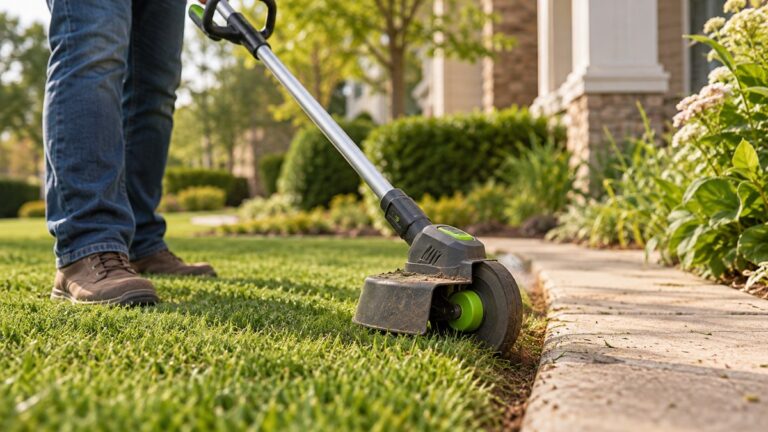
Husqvarna’s New Zealand guide describes the trimmer in simple terms: a grass trimmer is suited to trimming edges, hard to reach lawn areas, and providing finishing touches to lawns. The same page says that when you maintain lawn edges, under and around garden furniture, along fences and walls and down narrow areas, a grass trimmer is the best fit.
The line is the cutting element, and it has a limit. The guide explains that grass trimmers typically use a nylon line to cut back grass, so anything tougher leads to increased line breakage. That is why the trimmer suits light grassy work.
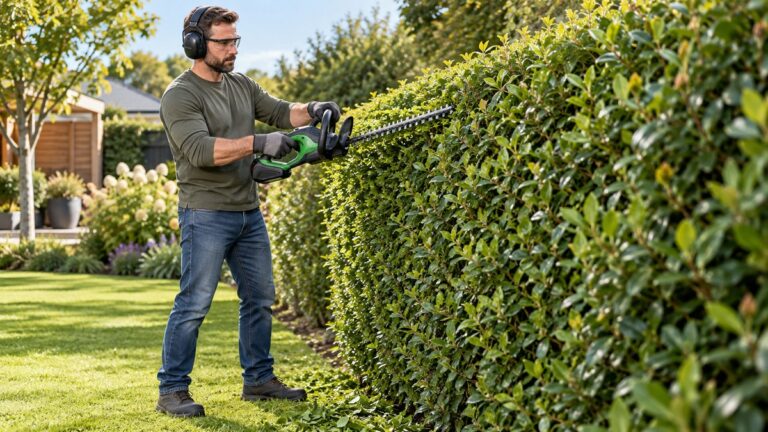
Oklahoma State University’s extension column makes the same split in practical terms. It advises wearing protective clothing when operating a weeder, edger or trimmer.
What a brushcutter is for
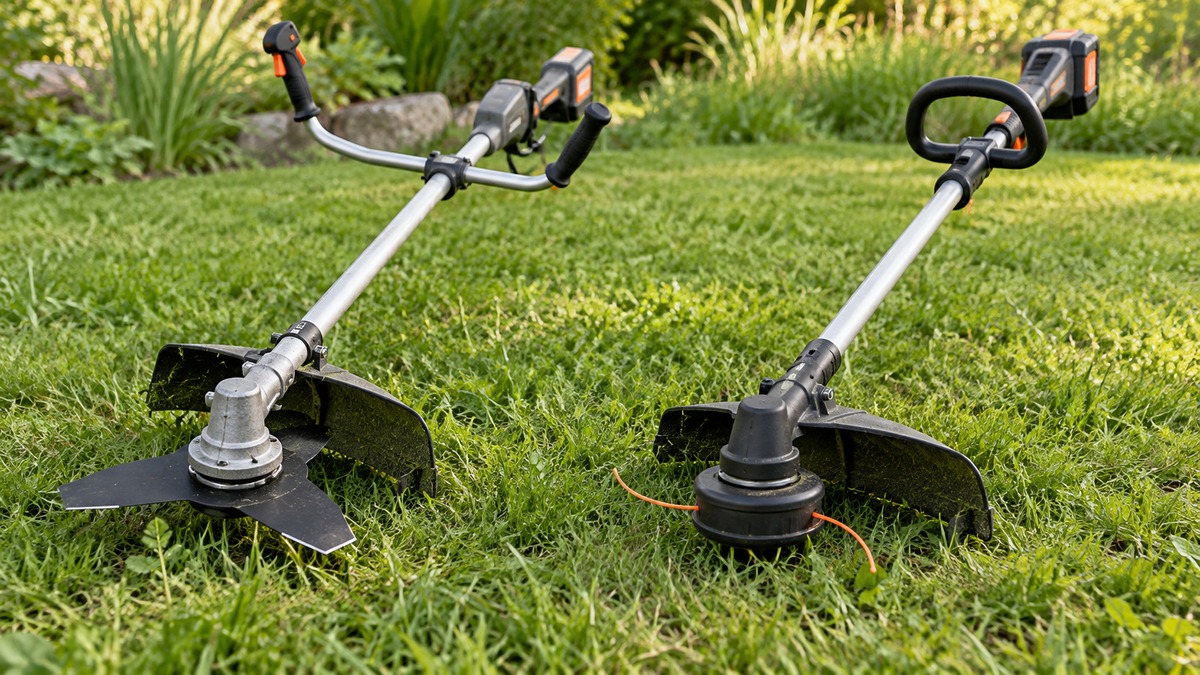
The same Husqvarna guide says brushcutters are designed to take on dense weeds, fibrous grass and areas of thick vegetation that a grass trimmer would struggle to cut. It adds that a brushcutter is much more likely to use blades than trimmer line, which is the design difference the guide puts first.
Husqvarna’s Australian buying guide ties the brushcutter to larger jobs. It says brushcutters are a great help for land and forest owners, and it describes a medium range brushcutter as perfect for the job when the work is on a small or medium estate, or a rural garden with bushes, hedges and small trees. The guide’s point is the job, not a fixed size: the right choice depends on the growth you cut.
STIHL’s US catalog uses the same split in its labels. It describes a powerful gas brushcutter or clearing saw for large areas, which tells you the manufacturer positions that class of tool for large areas. The catalog page is a product index, so it gives no comparison text of its own.
Cutting element: line or blade
The blade is the main difference. The Husqvarna guide says a brushcutter is much more likely to use blades instead of trimmer line. A trimmer relies on line, and the line can break when it meets tough material, as noted above.
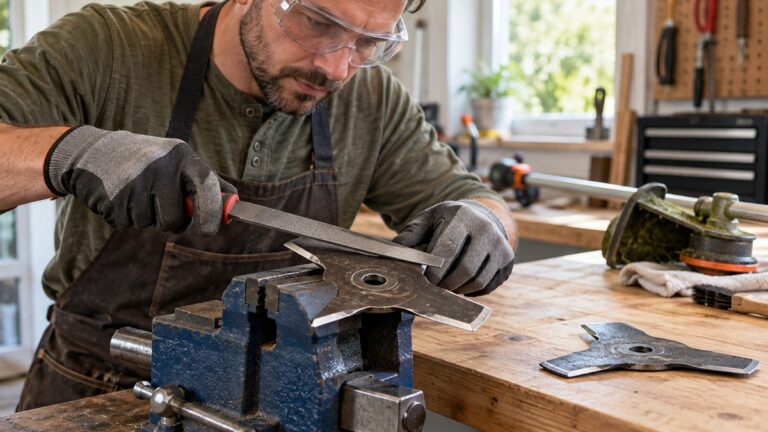
The blade choice also depends on what you cut. Husqvarna’s accessory notes name a Scarlett saw blade as the accessory for brushcutters dealing with woody growth. Its three-tooth grass blade is described as ideal for working in areas with dense and heavy grass and foliage without woody growth. Its tri-cut trimmer head uses replaceable plastic flails, and the guide says those flails take care of dense and coarse grass and areas with stones.
Husqvarna’s Australian guide advises that when you choose a brushcutter, you should also consider how easy it is to change cutting blades and trimmer heads.
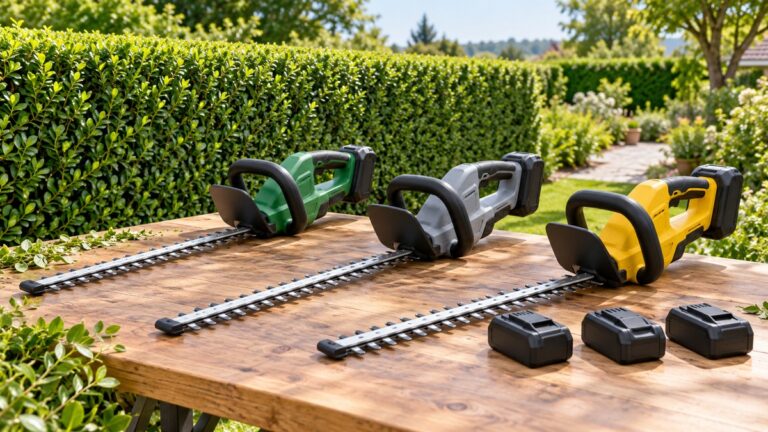
Some kits combine both cutting elements. Ryobi’s 40V kit page describes a 2-in-1 design with a brush cutter blade and a string trimmer head. It says the brush cutter blade is for cutting tough weeds and brush, and the string trimmer head is for trimming in tighter areas like along a fence or wall. The kit also includes a reel easy bump-feed string trimmer head, so one package covers both jobs.
Weight and power
Husqvarna’s Australian guide says a strong engine will help you cut through tougher vegetation more easily, but a stronger machine is also heavier. It warns against picking a machine that is unnecessarily heavy if you are working long days.
Ryobi’s kit page makes a power claim: its brush cutter delivers 30% more power than a string trimmer. That is a manufacturer claim for one kit, and it is not a general rule for every brand. The calculation below shows what the claim means in numbers.
Formula: brush cutter power = string trimmer power × (1 + 0.30). Inputs: the 30% figure from Ryobi’s kit page, applied to the same kit. Result: brush cutter power = string trimmer power × 1.30. In plain terms, the claim says the brush cutter is 1.30 times the string trimmer’s power in that kit, and the page does not say how that power was judged.
Both tool types are available as battery-powered models, according to Husqvarna’s New Zealand guide. The guide’s battery mention is general, so check the model you are considering for its own battery and charger details.
Edging: why the trimmer usually wins
The trimmer is the better fit for edges. Husqvarna’s New Zealand guide says that although it is possible to trim edges with a brushcutter, it is much harder ergonomically to achieve the same crisp edges that can be achieved with a trimmer. The same guide names edges, borders and narrow areas as the trimmer’s work.
If you want a single tool for edges and heavier clearing, look at a combo kit instead of a brushcutter used for edging. For more on that, see the cordless trimmer and edger combos page, and for electric models in general, the electric string trimmers roundup.
Accessories and fit
Do not assume a brushcutter blade fits your trimmer. Husqvarna’s New Zealand guide says fitting a brushcutter blade on a trimmer is only possible with select models. The same guide says it is always best to use the recommended and approved accessories for each individual machine.
The guide also warns that using accessories not intended for use on your trimmer could potentially cause damage to the tool, the operator and surrounding property. Check the accessory list for your exact model before you fit anything new.
Safety notes for both tools
Oklahoma State University Extension says the major hazard with string trimmers and edgers is two-fold. Objects can be launched outward by the trimmer string or edger blade, and the line or blade can break and fly out. Wearing long pants and long sleeves will help protect you from injury, according to the same fact sheet.
The extension column adds two habits: wear protective clothing when operating a weeder, edger or trimmer, and make sure children and pets are not in the area before beginning. The fact sheet also says to make sure children and pets are not in the area before beginning.
The Oklahoma State pages name trimmers and edgers, but not brushcutters. None of the pages we opened gives brushcutter-specific safety steps, so this article gives none. Apply the general rules above, and read the owner’s manual for the brushcutter you own.
Brush cutter vs string trimmer at a glance
The table lists only what the opened pages state. “Not stated” means the page does not give that point.
| Source | Point | String trimmer | Brush cutter |
|---|---|---|---|
| Husqvarna NZ guide | Typical job | Edges, hard to reach lawn areas, finishing touches | Dense weeds, fibrous grass, thick vegetation |
| Husqvarna NZ guide | Cutting element | Nylon line | Much more likely to use blades |
| Husqvarna NZ guide | Edging | Best fit | Possible, but harder to get crisp edges |
| Husqvarna AU guide | Weight | Not stated | A stronger machine is also heavier |
| Ryobi kit page | Power, as the manufacturer states it | Baseline for the kit | 30% more power, per Ryobi, for its own kit |
| STIHL US catalog | Label used for the product class | Line trimmer, for use in large areas (gas) | Brushcutter or clearing saw, for large areas |
| Husqvarna NZ guide | Battery models | Available | Available |
| Husqvarna NZ guide | Blade diameter for a general comparison | Not stated | Not stated |
How we chose
We chose pages from manufacturers and extension services that describe the two tools side by side or describe one of them with a clear job statement. We opened six pages on 2026-10-22. Two are Husqvarna guides, one from New Zealand and one from Australia, which are non-US locales. The US Husqvarna category pages we opened are index pages with no comparison text, so the NZ and AU guides were the only Husqvarna sources used for the comparison. The Ryobi page is a US product page, and the STIHL page is a catalog page on stihl.com without a country path. Two Oklahoma State University pages cover the safety points. Retail listings, blogs and review sites were not used for any claim here. This article ranks no tools and does not claim any experience with either one.
What we could not verify
- Blade diameters and cutting capacities for a general brushcutter or trimmer. The sources give none for the tools in general, so this article gives none.
- Whether the 30% power figure from Ryobi applies to any other brand or kit. It is the manufacturer’s claim for its own kit.
- Brushcutter-specific safety rules, including guard, blade and head-change points. The extension pages name string trimmers and edgers only.
- Whether a brushcutter’s weight stated as a relation to engine strength translates into a specific kilogram figure. The sources state the relation only.
- Which tool is faster or lasts longer on a given job. None of the pages opened compares them on speed or durability.
What the sources do not say
The sources do not give weights, blade sizes or cutting widths for either tool in general. They do not say how much growth either tool can cut before it needs a different tool, beyond the descriptions above. They also do not give a single rule for choosing a brushcutter over a trimmer for every yard, because the Husqvarna guide frames the choice by job and the Oklahoma State pages do not compare the two tools at all.
FAQ
Can a brushcutter trim edges?
Yes, but the Husqvarna New Zealand guide says it is harder to get crisp edges with one than with a trimmer. It says it is possible to trim edges with a brushcutter, but much harder ergonomically to get the same crisp edges. For clean lawn edges, the trimmer is the better fit according to that guide.
Can a string trimmer cut thick brush?
The guide says that grass trimmers typically use a nylon line to cut back grass, so anything tougher leads to increased line breakage. The guide therefore places dense weeds and thick vegetation with the brushcutter.
Are brushcutters heavier than string trimmers?
Husqvarna’s Australian buying guide says a stronger machine is also heavier, and it warns against picking an unnecessarily heavy machine if you work long days. The guide does not give a weight for either tool, so compare the weight in the listing for the model you are considering.
Is a brushcutter just a trimmer with a blade?
Not exactly. The main difference is the cutting element and the job it is meant for. Some combo kits carry both a brush cutter blade and a string trimmer head, such as Ryobi’s 2-in-1 design, so one package can cover both uses. The Ryobi page does not describe how the two heads are swapped.
Which safety rules apply to both tools?
The Oklahoma State pages name string trimmers and edgers, and they advise long pants and long sleeves, protective clothing, and keeping children and pets away from the work area. They do not name brushcutters, so apply the same habits and read the owner’s manual for the brushcutter you own.
Which one should I buy for a small lawn?
The sources do not rank the tools for any lawn size. They describe jobs, not yard sizes. Match the tool to the work you do most: the Husqvarna guide says the choice depends on whether you are doing lighter work and cleaning up edges, or larger thick patches and dense shrubbery.
Bottom line
Decision rule: if most of your work is lighter edging and grass, buy a string trimmer; if the growth is dense weeds, fibrous grass or thick vegetation, buy a brushcutter.
Sources
- Husqvarna NZ: What’s the difference between a Grass Trimmer and a Brushcutter (opened 2026-10-22)
- Husqvarna AU: Buying guide for brushcutters (opened 2026-10-22)
- Ryobi: 40V HP Brushless Brush Cutter/String Trimmer (opened 2026-10-22)
- STIHL: String Trimmers, Grass Eaters, Brushcutters and Clearing Saws (opened 2026-10-22)
- Oklahoma State University Extension: Lawn Care Safety and Basic Maintenance Tips for Teens (opened 2026-10-22)
- Oklahoma State University Extension: Beyond The Mower: Safe Use Of Trimmers, Edgers And Blowers (opened 2026-10-22)