Electric Chainsaw Kickback: Safe Use Basics
As an Amazon Associate we earn from qualifying purchases.
Electric chainsaw kickback safe use basics come down to one fact: kickback is the saw being thrown back toward you when the tip of the bar touches something or the wood closes on the chain. This page explains what the manufacturers and OSHA say about kickback and the handling rules they give to reduce it. The sources we opened describe chainsaws in general, and several of them name gasoline or petrol saws. None of them has a section on electric models, so the rules below are the ones the sources state for chainsaws in general.
Quick answer
- Kickback is a sudden reaction: the saw is driven back toward the operator when the upper nose of the bar touches something, or when wood pinches the chain.
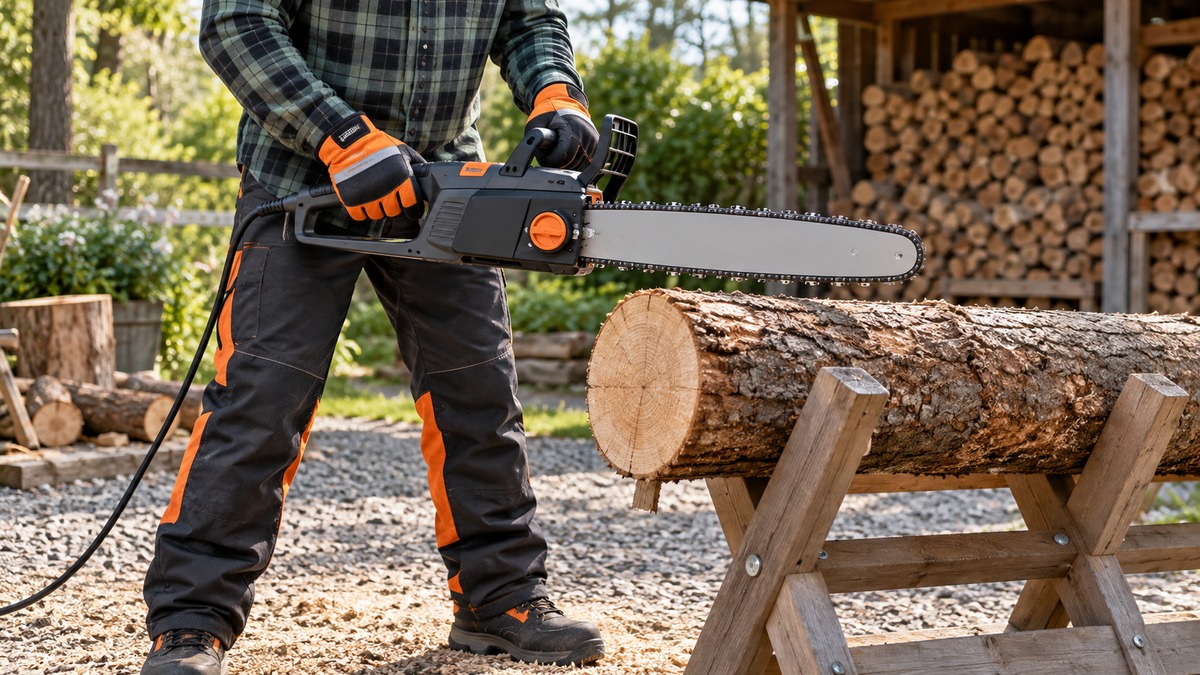
- Hold the saw with both hands, thumbs and fingers wrapped around the handles, and feet planted shoulder-width apart.
- Do not cut above shoulder height, and keep the bar nose away from logs, stumps, branches and the wood you are cutting.
- Keep the chain sharp and properly tensioned, and engage the chain brake before you start the saw.
What kickback is
Penn State Extension says kickback occurs when the tip of the chainsaw blade comes into contact with an object or is suddenly stopped. It calls kickback a leading cause of chainsaw-related injuries, and says it can happen unexpectedly, especially when cutting overhead.
Extension’s agricultural safety guidance places kickback among the reaction forces. It says violent reaction forces occur when the teeth of a chainsaw catch on something or when wood closes in and pinches the saw chain. Those forces can cause the chainsaw to be pulled away from the operator. The guidance calls kickback the most dangerous of them, because the blade is usually thrown into the head, neck, or shoulder area of the operator, resulting in serious or fatal injury.
Where kickback starts
The most important part of the bar is the top of the nose. Husqvarna’s UK guidance defines the kickback zone as the upper part of the nose of the guide bar. In the event of kickback, the chain will grip the timber with the kickback zone first. The same guidance notes that the nose of the guide bar can hit underlying logs, stumps, hidden branches and ends of logs, causing kickback, so limbing calls for extra care.
Common triggers
Two triggers appear across the sources. The first is bar contact. Husqvarna’s US support page says kickback usually happens when the bar nose hits a solid object or when the chain is too loose. The second is pinching, where wood closes in on the chain. A dull chain adds to the risk, because Penn State says a dull chain requires more force to cut and is more likely to cause kickbacks. Chain tension matters as well. Penn State says the chain should not be too loose or too tight, and the Extension guidance says a loose chain could come off and a tight chain could bind and overheat.
Safety rules for kickback
The rules in this section come from the pages in the source list at the end of this page. Each one is a point a source states. Where a source does not state a point, this article says so rather than filling the gap.
Grip and footing
Both hands stay on the saw. Husqvarna’s US support page says to always hold the chainsaw firmly with both hands. Penn State describes the left hand gripping the front handle and the right hand on the rear handle, with both hands always firmly on the chainsaw. Husqvarna’s UK page says thumbs and fingers must be completely wrapped around the handles, and that you should keep your left thumb under the front handle to help catch the saw in case of kickback.
Stance follows the same logic. Penn State says operators should stand with their feet shoulder-width apart, ensuring stability and balance, and it adds that leaning or overreaching can destabilize your stance. OSHA’s logging eTool says to keep hands on the handles and maintain secure footing while operating the chainsaw.
Cutting height and reach
Do not cut above shoulder height. Penn State says overhead cutting increases the risk of kickback and recoil. Husqvarna’s UK page says never saw above shoulder height, and Husqvarna’s US page says to refrain from cutting anything that is above shoulder length. OSHA’s logging eTool says do not cut directly overhead. The pages agree on the rule but word the limit differently, so the simplest working rule is to keep the cut below shoulder height.
Keep the bar nose clear
Extension’s guidance says do not cut limbs or brush with the nose of the guide bar, and to be aware of where the nose is at all times when starting or operating the saw. Husqvarna’s UK page says you can avoid the biggest risk of kickback simply by never putting the nose of the guide bar directly against the wood. For pruning, the same page advises cutting with a pulling chain.
Chain brake, hand guard and chain condition
Extension’s guidance says to always engage the chain brake before attempting to start the chainsaw. It adds that the chain brake is usually activated by contact with the front hand guard, though a sudden jerk of the saw can also set it. The front hand guard, the same page explains, stops the operator’s left hand from coming in contact with the chain if the hand slips off the handle. Extension also says chain brakes reduce the risk of injury, if activated, by stopping the chain if kickback occurs, and it calls them a feature of gas chainsaws.
OSHA’s parts eTool lists a chain brake to stop the chain if kickback occurs. Husqvarna’s US page says to make sure the chain brake is activated. Penn State says not to use an older saw without a chain brake. Extension notes that a loose chain could come off and a tight chain could bind and overheat.
Basic steps for a safer cut
These steps combine the rules above. None of them asks you to sharpen, replace or adjust a chain or blade. Each step rests on a quoted source.
- Check the saw before you cut. OSHA says to check controls, chain tension, and all bolts and handles to ensure they are functioning properly. Penn State advises against running an older saw that lacks a chain brake.
- Engage the chain brake and start on firm ground. Extension says to engage the chain brake before attempting to start the chainsaw. OSHA says to start the saw with the chain brake engaged and with the chainsaw on the ground or otherwise firmly supported.
- Grip with both hands. Hold the saw firmly with both hands using an encircling grip. Husqvarna’s UK page says to keep your left thumb under the front handle to help catch the saw if kickback occurs.
- Set your feet before the cut. Stand with your feet shoulder-width apart, and avoid leaning or overreaching.
- Keep the nose clear. Do not cut limbs or brush with the nose of the guide bar, and never put the nose directly against the wood.
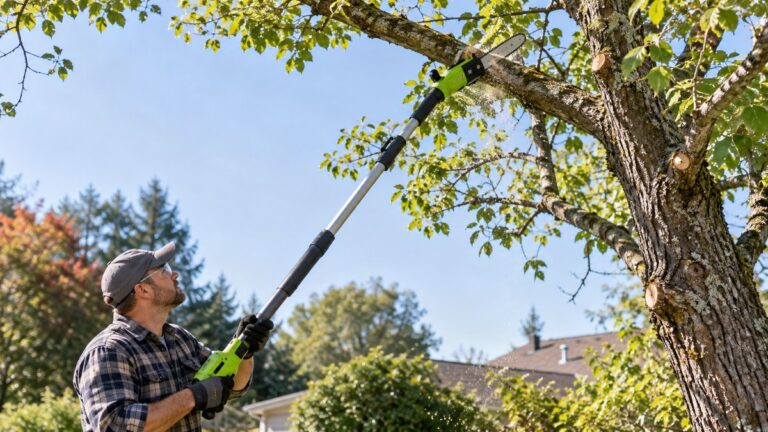
- Stay below shoulder height. Do not cut above shoulder height, and do not cut directly overhead.
- Keep the chain sharp and in tension. Penn State says a dull chain is more likely to cause kickbacks, and says the chain should not be too loose or too tight.
Electric chainsaws: what the sources do and do not say
None of the six pages we opened has a section on electric chainsaws. Husqvarna’s UK page mentions battery and electric saws only in a product menu. Other pages name petrol or gasoline saws. OSHA’s parts eTool ties its chain brake requirement to gasoline-powered saws, and says that chain saws placed into service after February 9, 1995 must also meet the requirements of ANSI B175.1-1991, Safety Requirements for Gasoline Powered Chain Saws. Extension’s guidance calls chain brakes a feature of gas chainsaws.
That leaves a limited answer. The sources do not say whether an electric chainsaw kicks back the same way a gasoline saw does. They do not say whether every electric model has a chain brake, or how the brake engages on a battery or corded model. The rules above are general chainsaw rules, so check the manual for your model to confirm how its chain brake, guard and controls work before you cut.
If you are comparing electric models, see the chainsaw buying guide and the guide to electric chainsaws for large trees.
Maintenance that affects kickback
The sources raise two maintenance points: chain sharpness and chain tension. Penn State says a dull chain requires more force to cut and is more likely to cause kickbacks. Extension’s guidance says proper chain tension during operation matters, because a loose chain could come off and a tight chain could bind and overheat. This article does not give sharpening or chain replacement steps. For sharpening tools, see the electric chainsaw sharpener guide.
Source coverage at a glance
The table lists what each opened page states on the points above. “Not stated” means the page does not say it. Every entry comes from the opened text, and no entry comes from memory.
| Source | Saw type named | Kickback cause stated | Hand position stated | Shoulder height or overhead rule | Chain brake point |
|---|---|---|---|---|---|
| Penn State Extension (extension.psu.edu) | Chainsaws, no power source named | Tip contact or sudden stop | Both hands, left on front handle, right on rear | Avoid cutting above shoulder height | Do not use an older saw without a chain brake |
| Extension agricultural safety (ag-safety.extension.org) | Chainsaws; chain brake called a gas-saw feature | Wood pinching the chain; bar nose contact | Firm grip with both hands, encircling grip | Not stated | Engage before starting; activated by front hand guard contact or a jerk |
| OSHA safe operation eTool (osha.gov) | Chain saws, logging practice | Not stated | Keep hands on the handles | Do not cut directly overhead | Start with chain brake engaged |
| OSHA parts eTool (osha.gov) | Gasoline-powered chain saws | Chain brake stops the chain if kickback occurs | Not stated | Not stated | Listed as a required part |
| Husqvarna US support (us-support.husqvarna.com) | Petrol chainsaw | Bar nose hits a solid object; chain too loose | Always hold firmly with both hands | Refrain from cutting above shoulder length | Make sure the chain brake is activated |
| Husqvarna UK (husqvarna.com/uk) | Chainsaw, power source not stated | Upper nose of the guide bar | Thumbs and fingers wrapped; left thumb under front handle | Never saw above shoulder height | Always use a chainsaw with a working chain brake |
How we chose
We chose pages that describe kickback itself and the handling rules that go with it. The criteria were an extension, OSHA or manufacturer page from the United States wherever one covers the point, and a non-US manufacturer page only where no US page gave the point. We opened six pages on 2026-10-22. Two are Extension pages, two are OSHA eTool pages, one is a US Husqvarna support page, and one is a Husqvarna UK page used for the kickback zone definition, which the US support page does not give. Retail listings, blogs and review sites were not used for any safety or procedure point. This article ranks no tools and makes no claim about any saw.
What we could not verify
- Whether an electric chainsaw kicks back in the same way as a gasoline or petrol saw. None of the pages we opened compares them.
- Whether a given electric model has a chain brake or hand guard, and how it engages. The pages describe these parts for chainsaws in general or for gasoline and petrol saws.
- Model-specific settings, such as the chain tension a particular saw needs or a brake check for one model. The pages give general rules only.
- Any measured kickback force or reaction speed. None of the pages gives one, so this article gives none.
- Whether the manuals for electric models repeat these rules. The manuals we found were PDF files, and the method used here cannot read PDFs.
What the sources do not say
The pages do not describe chain sharpening, chain replacement or bar replacement, so this article gives no steps for those jobs. None of the pages gives a kickback force, a reaction speed or a model-specific brake check, so none appears here. The pages also do not separate electric models from gasoline models on kickback, which is the main gap for a post with this title.
FAQ
Is kickback the same on an electric chainsaw?
The sources we opened do not say. They describe kickback for chainsaws in general and, in several places, for petrol or gasoline saws. None of the pages has a section on electric models, so this article does not claim the mechanism is identical. Check the manual for the model you own.
What is the most common cause of kickback?
The sources name two main causes. The first is the upper nose of the bar meeting an object, and the Husqvarna US page also links kickback to a loose chain. The second is wood closing on the chain and pinching it, which Extension’s guidance groups with other violent reaction forces. A dull chain also raises the risk, because it needs more force to cut.
Should I ever cut above shoulder height?
The sources say no. Penn State says overhead cutting increases the risk of kickback and recoil, Husqvarna’s UK page says never saw above shoulder height, and OSHA’s logging eTool says not to cut directly overhead. None of the pages describes an exception, so this article does not give one.
What does the chain brake do?
Extension’s guidance says chain brakes reduce the risk of injury, if activated, by stopping the chain if kickback occurs. The OSHA parts page lists a chain brake for saws placed into service after February 9, 1995, and says it stops the chain if kickback occurs. Husqvarna’s US support page says to make sure the chain brake is activated. The same Extension page calls chain brakes a feature of gas chainsaws, so confirm in the manual that your electric model has one.
Is a guard enough, or do I still need both hands?
Keep both hands on the saw. Husqvarna’s US support page says modern chainsaws come with a protective guard in front of the handle to prevent injury from kickback, and the same page says to always hold the chainsaw firmly with both hands. The sources list the guard and the two-handed grip as separate points, so do not treat one as a replacement for the other.
Where do I find rules for my own saw?
The pages we opened give general rules, so they do not list settings for a particular saw. For a specific model, the manual that came with the saw is the place to check its chain brake, guard, handle layout and any starting procedure. Use the general rules here as a starting point, not as a substitute for those instructions.
Bottom line
Decision rule: if the top of the bar nose would touch a log, a stump, a branch or the wood you are about to cut, stop and reposition the saw before you start the cut. Extension’s guidance gives the same rule in plain words: do not cut limbs or brush with the nose of the guide bar.
Sources
- Penn State Extension: The Dangers of Using Chainsaws (opened 2026-10-22)
- Extension Ag Safety: Chainsaw Safety – Safety, Health and Wellness in Agriculture (opened 2026-10-22)
- OSHA: eTool: Logging: Chain Saw – Safe Operation of a Chain Saw (opened 2026-10-22)
- OSHA: eTool: Logging: Chain Saw – Parts of a Chain Saw (opened 2026-10-22)
- Husqvarna US Support: Working with Chainsaws – a Beginners Guide (opened 2026-10-22)
- Husqvarna UK: Work tasks with risk of kickback – chainsaw safety (opened 2026-10-22)