Eye and Ear Protection for Yard Power Tools
As an Amazon Associate we earn from qualifying purchases.
Eye and ear protection for yard power tools means impact-resistant eye protection with side coverage, plus a hearing protection device whenever a tool runs. The sources we opened agree that string trimmers and similar tools throw debris, so your eyes need protection even on a short job. For hearing, the sources name earplugs and earmuffs, and they say music headphones do not count. This guide sets out what each source says and where the sources stop.
Quick answer
- Wear impact-resistant glasses or sunglasses with side protection whenever a tool throws debris.
- Add a face shield if you want more coverage for a string trimmer, but keep your glasses on under it.
- Use earplugs or earmuffs when a tool runs. Music headphones are not hearing protection.
- Add the rest of the gear the Toro manual lists: long pants, slip-resistant footwear and gloves.
Eye protection: glasses, side shields and face shields
Illinois Extension recommends impact-resistant safety glasses or sunglasses for yard work. Its reason is the debris. For mowing, the page says debris ejects at high speeds from beneath the mower. For string trimmers, it says plainly that they fling lots of debris. A pair of glasses is the baseline the extension page assumes, and it is the piece you should not skip.
The same page treats the face shield as an extra. It says face shields are especially useful for string trimmers and for mowing where objects may ricochet, but that they provide basic protection and are not a substitute for safety glasses. In practice, that means a face shield goes over glasses, not in place of them. Use the shield for extra coverage, and keep the glasses on under it.
OSHA’s eye and face protection standard, 29 CFR 1910.133, treats side coverage as a separate point. It says employers must make sure each worker uses eye protection that provides side protection where there is a hazard from flying objects. It adds that detachable side protectors, such as clip-on or slide-on side shields, can meet that requirement. OSHA’s rule is written for employers, so it does not apply to a homeowner as written. It still gives a useful checklist: glasses with side shields are the standard’s expectation where objects fly.
OSHA’s standard also covers people who wear prescription glasses. It says the employer must make sure a worker who wears prescription lenses has eye protection that either incorporates the prescription in its design or can be worn over the prescription lenses without disturbing them. The rule is written for workers, but its point is that protection should work with prescription eyewear.
OSHA’s standard for portable powered tools, 29 CFR 1910.243, takes a similar line. It says that operators and assistants using tools shall be safeguarded by means of eye protection, and that head and face protection shall be used as the working conditions require. The rule names operators and assistants, so it covers more than the person holding the tool. Like the eye standard, this is a workplace rule.
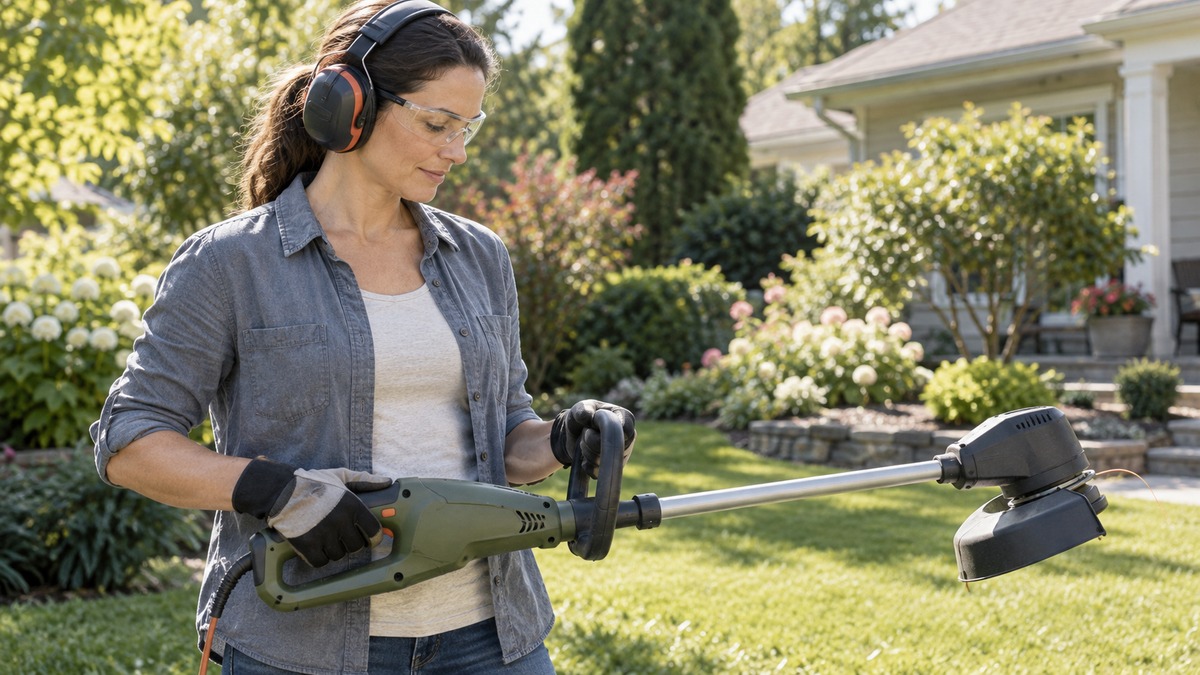
The Toro manual for its 60V string trimmer puts eye protection at the top of its dress list. It says to dress properly, including eye protection, long pants, substantial slip-resistant footwear, rubber gloves and hearing protection. The same manual says to tie back long hair and avoid loose clothing that can get caught in moving parts.
Hearing protection: plugs, earmuffs and headphones
Illinois Extension says that consistent exposure to small engine noise is shown to affect hearing over the long term. Its advice is to wear hearing protection, and it adds a warning that matters for many people: music headphones are not typically designed as hearing protection. Putting on headphones to block the noise of a trimmer does not give you the protection the page describes.
ECHO’s string trimmer guide says ear plugs can reduce the impact of noise on your hearing. The same guide puts ear plugs next to eye protection and gloves in its list of safety measures for maintenance work. It does not give a rating for any plug.
OSHA’s noise page describes earmuffs and plugs as hearing protection devices. It calls them an acceptable but less desirable option than controlling exposure to noise, and it describes them as generally used while other controls are put in place. That is a workplace point. For a homeowner, the useful part is the list of device types, and the page’s statement that proper selection of hearing protection depends on individual fit.
The Toro manual lists hearing protection in its dress list for the battery string trimmer. Hearing protection is therefore part of the manufacturer’s instructions, not only an extension page’s advice.
What to wear, by source
The table lists each piece of gear named in the sources, what the source says about it, and the page it comes from. Where a source says nothing about an item, the cell is left out rather than filled in.
| Item | What the source says | Source |
|---|---|---|
| Impact-resistant glasses or sunglasses | Recommended because debris ejects at high speeds | Illinois Extension |
| Face shield | Especially useful for string trimmers; not a substitute for safety glasses | Illinois Extension |
| Side protection | Required where objects fly; detachable side shields are acceptable | OSHA 1910.133 |
| Prescription eyewear | Protection should incorporate the prescription in its design, or be worn over the prescription lenses | OSHA 1910.133 |
| Eye protection for operators and assistants | Required for operators and assistants using portable tools | OSHA 1910.243 |
| Eye and face protection | Dress properly, including eye protection | Toro 60V string trimmer manual |
| Earplugs | Can reduce the impact of noise on hearing | ECHO string trimmer guide |
| Earmuffs and plugs | Hearing protection devices; fit matters | OSHA noise page |
| Hearing protection | Part of the dress list for battery trimmer use | Toro 60V string trimmer manual |
| Music headphones | Not typically designed as hearing protection | Illinois Extension |
| Gloves | Wear gloves during maintenance; rubber gloves in the dress list | ECHO; Toro |
| Long pants and footwear | Long pants and substantial, slip-resistant footwear | Toro 60V string trimmer manual |
The table shows that the eye and hearing points come from several sources, while the detailed rules for side shields and prescription lenses come only from OSHA. Use the table as a checklist, not as a list of approved products. None of the sources names a brand or a model of glasses or plugs.
Why both matter for yard tools
ECHO’s guide says that wearing gloves and eye protection helps shield you from flying debris that may result in cuts and abrasions. Illinois Extension makes a second point: string trimmers fling debris, and passersby, such as people or pets, are at increased risk of being hit by launched debris. Your eye and ear gear protects you. It does not protect people standing close by, which is why the same page says to pause when anyone gets close.
The shield on a string trimmer also protects the operator, and Illinois Extension says it is still no substitute for proper personal protective equipment. That line is the thread running through the sources: the tool’s own guard helps, but it does not replace glasses, hearing protection or clothing.
Safety: set up your gear before the job
Use this order before you start a yard tool. The sources do not give a fixed timing, so the order is a practical sequence built from their advice.
- Put on eye protection first. The Toro dress list puts eye protection first, and OSHA’s portable tool rule applies the same idea to operators and assistants.
- Check side coverage. Use glasses with side protection, or add detachable side shields where the objects can come from the side.
- Add a face shield if you want more coverage. Keep the glasses on under it. Illinois Extension calls the shield basic protection, not a replacement.
- Put in earplugs or earmuffs. Pick the type that fits. OSHA says proper selection depends on individual fit. Music headphones do not count.
- Dress for the job. Wear long pants, slip-resistant footwear and gloves. Tie back long hair, and do not wear loose clothing that can catch in moving parts.
- Clear the area. Illinois Extension advises you to keep an eye out for nearby targets and to pause string trimming when anyone gets close.
How we chose
We looked for pages that name eye or hearing protection for powered yard tools. We chose OSHA because it is the main US workplace regulator, a university extension service for home use, and two manufacturer pages for string trimmers, one from ECHO and one from Toro. We opened six pages on 2026-10-22: three OSHA pages, the Illinois Extension page, the ECHO guide and one Toro manual.
The NIOSH noise pages sit on cdc.gov, which the batch brief lists as refusing requests, so we did not count them. Some other pages could not be opened either. We did not rank the sources, and we did not choose a single best product. Each quote in this guide comes from the saved text of the page it cites.
What we could not verify
- Whether OSHA’s workplace rules apply to a homeowner’s yard work. The OSHA pages describe employer duties, and we have not checked how they apply at home.
- Which hearing protector reduces noise enough for a given tool. The sources we opened do not give a rating for any plug or earmuff.
- How long to wear hearing protection in one session. The pages do not give a time limit.
- Whether a face shield meets any standard when used alone on a yard tool. The pages do not set one for that use.
What the sources do not say
None of the six pages gives a decibel level, a noise rating or a noise figure for a string trimmer, a blower, a mower or a hedge trimmer. This guide therefore does not state one. The OSHA noise page sets workplace exposure rules, and those rules are for employers, not for a yard job at home.
None of the pages covers leaf blowers or pole saws in detail. Illinois Extension and the ECHO guide cover string trimmers and mowing in general terms, and the Toro manual covers one 60V string trimmer.
If you are choosing a string trimmer as well as the gear, this site has a Greenworks and EGO Power+ string trimmer comparison and a Black and Decker cordless weed eater post.
FAQ
Do I need eye protection for a string trimmer?
Yes. Illinois Extension says string trimmers fling lots of debris, and ECHO says eye protection helps shield you from flying debris. The Toro manual for its 60V string trimmer lists eye protection in its dress list. The Illinois page adds that a face shield is not a substitute for glasses.
If you already wear glasses, OSHA’s workplace eye standard expects protection with side coverage where objects fly, and it expects the protection to work with a prescription if you need one.
Are safety glasses enough, or do I need a face shield too?
Glasses are the baseline in the Illinois Extension page. A face shield adds coverage, and it is especially suggested for string trimmers, but the same page says it is not a substitute for safety glasses. Wear the shield over the glasses if you use one.
The OSHA eye standard also accepts detachable side shields as side protection, so a pair of glasses without side coverage can be improved with clip-on or slide-on shields.
Do I need hearing protection for a battery string trimmer?
The Toro manual for its battery 60V string trimmer lists hearing protection in its dress list. ECHO says ear plugs can reduce the impact of noise on your hearing. Illinois Extension says consistent exposure to small engine noise affects hearing over the long term, and it recommends hearing protection.
The sources we opened do not say whether a battery tool needs less protection than a gas tool, so the safe reading is to use hearing protection whenever the tool runs.
Are headphones enough to protect my hearing?
No. Illinois Extension says music headphones are not typically designed as hearing protection. Use earplugs or earmuffs instead, and choose the type that fits, because OSHA says proper selection depends on individual fit.
What kind of hearing protection should I use?
OSHA’s noise page lists earmuffs and plugs as examples of hearing protection devices. ECHO refers to ear plugs. Choose the one that fits your ear. The pages we opened do not rank earplugs against earmuffs, so the choice is yours within the fit rule.
How loud is a string trimmer?
None of the six pages gives a decibel figure for a string trimmer or any other yard tool. This guide does not give one either. The OSHA noise page covers workplace exposure, which is a different question from the noise a trimmer makes in your yard.
Bottom line
Whenever a yard tool throws debris or runs, wear eye protection with side coverage and a hearing protection device that fits. If your manual lists more gear, such as gloves, long pants or footwear, follow the manual for your model.
Sources
- OSHA: 1910.243 – Guarding of portable powered tools (opened 2026-10-22)
- OSHA: 1910.133 – Eye and face protection (opened 2026-10-22)
- OSHA: Occupational Noise Exposure – Overview (opened 2026-10-22)
- University of Illinois Extension: Maintaining Lawn Equipment (opened 2026-10-22)
- ECHO: String Trimmer Maintenance Guide (opened 2026-10-22)
- Toro: Interactive Manual, Flex-Force Power System 13in or 15in 60V MAX String Trimmer (opened 2026-10-22)