How to Clear Leaves With a Leaf Blower
As an Amazon Associate we earn from qualifying purchases.
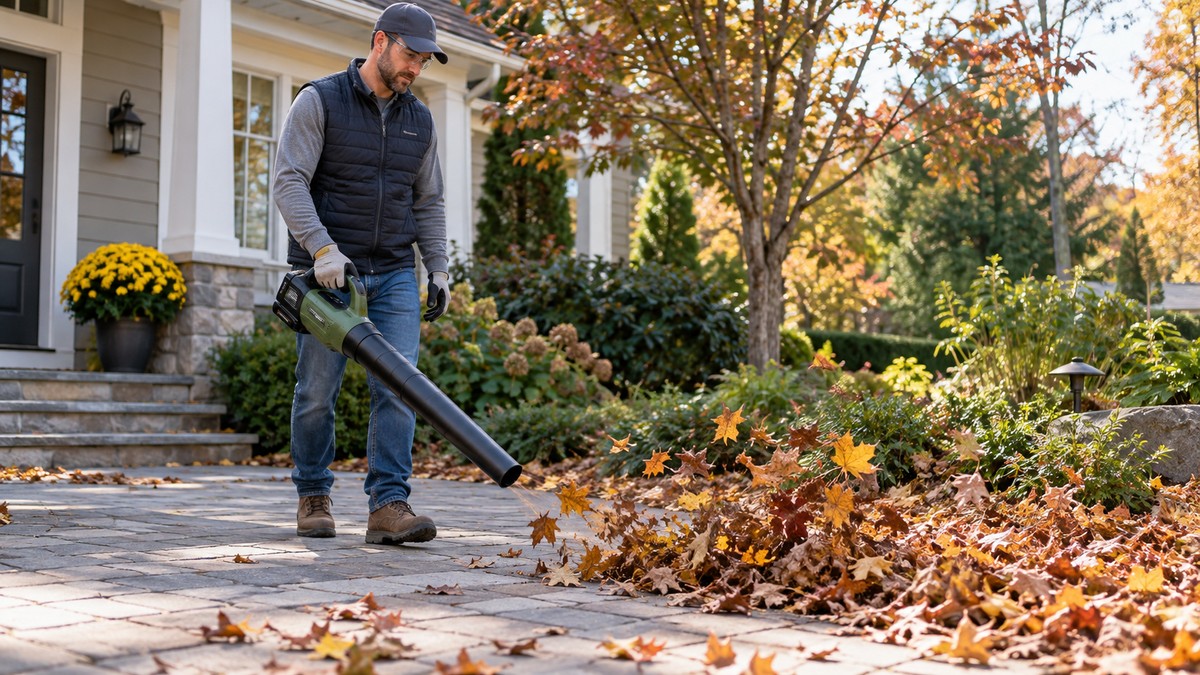
If you searched for how to clear leaves with a leaf blower, the job is mostly about order, not force. Wait for dry leaves, keep people and pets out of the debris path, point the nozzle low and downward, start at one edge, and blow the leaves into small piles that you can move in batches. The extension and manufacturer pages we opened agree on those basics. They say much less about wet leaves and thick layers, so this guide stays within what those pages state.
This article covers clearing lawn, beds and paths with a blower. It does not compare blowers with vacuums or cover vacuum mulching, which are separate topics.
Quick answer
- Wait for dry leaves, because wet leaves stick together and are harder to move.
- Start at one edge, blow the leaves into small piles, and work in batches rather than all at once.
- Keep the nozzle low and pointed down, and keep bystanders and pets out of the path of the debris.
- Move the piles onto a tarp or old sheet, then take them to a bin or compost heap.
How the depth of the leaf layer changes the job
Not every leaf cover is the same problem. Iowa State University Extension says a layer where little or no grass is visible needs to be managed. It lists raking, blowing, and using a mower’s collection bag as ways to collect leaves, and it says collected leaves can go to a compost pile or a composting facility.
Illinois Extension describes a lighter cover differently. If only about 10 to 20 percent of a lawn is covered, the leaves can be left where they are, because they are unlikely to smother the turf. The same source warns that a layer that is too thick can smother and kill the grass. It does not give a figure above 20 percent, so the thick-layer threshold is not stated.
That means a blower is one way to collect leaves, not a way to remove a thick mat in one pass. Decide first whether the leaves should be collected at all, and only then choose the blowing pattern.
Safety before you start the blower
Bystanders are the main risk. Oklahoma State University Extension describes the primary hazard of a leaf blower as debris, such as small rocks, sticks and nuts, being propelled toward bystanders, where it can strike people, pets and plants. Before you start, check that people and pets are out of the area the air will push debris toward.
On a petrol model, Husqvarna’s US support page warns that air is released as soon as the engine starts, even when it is idle. It advises that no one should stand close to the blower or its tube. That warning covers petrol starting. The page does not address cordless units, so do not apply it to a battery model without checking the owner’s manual.
Dust is the second concern. The Husqvarna New Zealand guide says dust, dirt and other debris could pose a hazard, and it advises keeping the blower close to the ground so dust is not lifted up. The same guide advises against blowing leaves right after fertilizer, herbicide or pesticide applications, because the chemicals can be scattered into the air and breathed in.
The sources we opened do not give eye or face protection rules for blowers, and they do not give a distance to keep bystanders back. This article does not state either one.
Step-by-step: clear leaves with a blower
The steps below use the technique each source gives. Where a step is a safety point, the note sits inside the step.
- Wait for dry conditions. Husqvarna NZ advises waiting until the leaves are dry, because wet leaves are much harder to move than dry ones.
- Clear the area first. Move people and pets away from the work area. Oklahoma State describes the hazard of debris flying toward bystanders, so check the direction of the air before you start the blower.
- Work with the wind. Husqvarna NZ advises working with the wind, because a breeze at your back moves leaves with less effort and saves power.
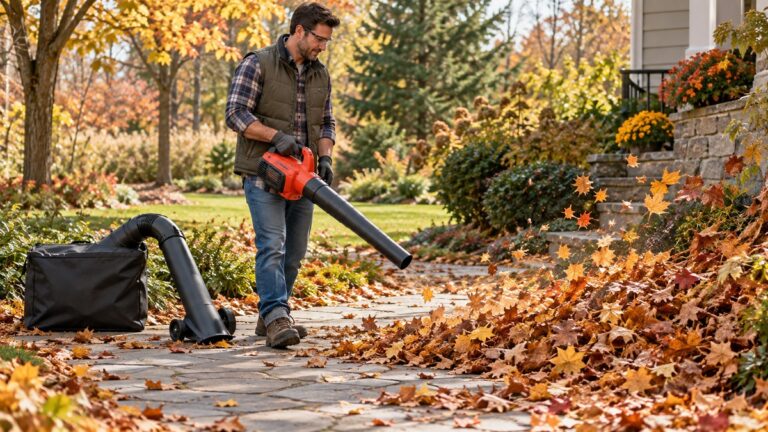
- Start at one edge. Begin at one edge of the area and blow the leaves into a small pile. The same guide says to target harder-to-reach spots, such as bushes, shrubs and trees, as well.
- Keep the nozzle low and pointed down. Husqvarna NZ says the tip should always point down, because the air is concentrated into a smaller area and gives more control. A shallow angle moves leaves forward instead of up. Keeping the blower close to the ground also keeps dust from being blown upward.
- Work in small batches. Do not try to blow the whole area at once. Husqvarna NZ says a large mound can be scattered by the tiniest breeze, so several small piles are easier to control.
- Use corners for piles. The Husqvarna NZ guide suggests blowing the leaves into small piles on each corner of the area.
- Slow down on gravel and patios. Husqvarna NZ says blowing from gravel is different from blowing from a lawn, and that debris can damage a hard surface. Slow down on hard ground, as the guide advises.
- Pick up sticks and branches. Husqvarna US says to pick up sticks and branches that fall with the leaves. It warns that letting them sit on turf over winter could kill the grass.
- Move the leaves out. Blow the piles onto a tarp or an old sheet, which makes them easier to carry to a bin or a compost heap, as Husqvarna NZ advises.
Leaf clearing choices side by side
The table lists each choice as the source states it. The sources do not all address the same situation, so each row names its own source.
| Choice | What the source states | Source |
|---|---|---|
| Gather with a backpack or handheld blower | Collects fallen leaves into one spot for pickup | Husqvarna US fall lawn care |
| Mow with a mulching mower | Mow when the leaves are dry so they do not clump or clog the mower | University of Illinois Extension, 2026 |
| Leave a thin layer | Leaves covering about 10 to 20 percent of the lawn can be left in place | University of Illinois Extension, 2026 |
| Rake, blow or bag | Leaves can be collected by any of these methods | Iowa State University Extension |
| Blow onto a tarp | Makes the piles easier to move to a bin or compost heap | Husqvarna NZ |
| Blow wet leaves | Wet leaves are harder to move, so wait for dry conditions | Husqvarna NZ |
Worked calculation: the lawn share a thin layer can cover
Formula: fraction of the lawn covered = covered percentage divided by 100. At 10 percent, the fraction is 10 divided by 100, which is one-tenth. At 20 percent, the fraction is 20 divided by 100, which is one-fifth. The Illinois range therefore covers one-tenth to one-fifth of the lawn. The source gives no figure for coverage above that range, so this calculation does not extend it.
Wet leaves, thick layers and when to stop
Wet leaves are the most common reason a blower job goes poorly. Husqvarna NZ says it is very easy to blow dry leaves and not so easy to blow wet ones, and the same guide advises waiting until the leaves have dried. Illinois Extension recommends mowing leaves when they are dry, because clumped leaves are harder to chop and can clog mowers.
For a thick layer, the sources agree that the grass can be harmed. Iowa State University Extension says a layer where little or no grass is visible needs to be managed, and it lists collecting and mowing as ways to do that. Illinois Extension says a layer that is too thick can smother and kill grass. The pages we opened do not give one figure for when to switch from blowing to raking, so judge the layer by how much grass you can still see.
The sources we opened also do not give a rate of progress or a time per square foot for clearing leaves with a blower, so this article does not give one.
If you are choosing a blower for this job, see the cordless leaf blower guide. If you would rather gather leaves into a bag than push them into piles, the Black and Decker cordless leaf vacuum article covers that tool.
How we chose
We looked for extension pages on leaf management, because the question is about clearing leaves from a lawn and beds, not about one brand. We looked for manufacturer pages on how to use a blower, and we did not rank products or compare blower models. We opened eight pages on 2026-10-22 and cite six. The cited pages are the Iowa State University Extension leaf FAQ, the University of Illinois Extension post from 2026, the Husqvarna US fall lawn care page, the Husqvarna US petrol start page, the Husqvarna NZ guide, and the Oklahoma State University Extension blower safety column. The Ask Extension lawn answer and an OSHA eye protection page were opened but are not cited. The Husqvarna NZ guide is a non-US locale page. The Husqvarna NZ guide was chosen because the US Husqvarna pages we opened do not describe the nozzle angle or the pile method.
What we could not verify
The sources we opened do not say how much leaf cover a blower can clear in one pass, or how long a lawn takes. They also do not tie any clearing step to a blower’s airflow figure, so this article does not link technique to a model’s airflow.
We could not confirm how the wet-leaf rule applies to leaves under trees or in beds, because the pages we opened address lawns and general garden leaves. The start-up warning we cite is for petrol models, and we did not find an equivalent warning for cordless units in the pages we opened.
What the sources do not say
- The sources we opened give no distance to keep bystanders back, and they do not give eye or face protection rules for blowers.
- They do not give a pile size or a number of piles for a given area.
- They do not give a threshold above which a thick layer must be removed, beyond the statement that a thick layer can smother grass.
- They do not say whether leaves should be cleared before or after mowing.
FAQ
Should I blow leaves when they are wet?
No. Husqvarna NZ says wet leaves are much harder to move than dry leaves, and it advises waiting until the leaves are dry. Illinois Extension gives the same dry-leaf rule for mowing, because wet leaves clump and can clog mowers. Wait for a dry day if you can.
How do I keep leaves from blowing back toward me?
Work with the wind rather than against it, according to Husqvarna NZ. Keep the nozzle low and pointed down so the air stays in a smaller area. Blow leaves in small piles rather than trying to move the whole area at once, because large mounds can be scattered by a light breeze.
Can I leave leaves on the lawn instead of blowing them up?
Illinois Extension says a light cover of about 10 to 20 percent of the lawn can be left in place, because it is unlikely to smother the turf. A thick layer can smother and kill grass, so it needs to be managed. The sources do not give a figure above 20 percent.
Is a leaf blower safe around children and pets?
Oklahoma State University Extension says the primary hazard of a leaf blower is debris thrown toward bystanders, which can strike people, pets and plants. Keep children and pets out of the area before you start. The sources we opened do not give a distance to keep them back.
What should I do with leaves on gravel or a patio?
Husqvarna NZ says blowing from gravel is not the same as blowing from a lawn, and that debris can damage a hard surface. Slow down and reduce the force on hard ground. Husqvarna NZ also advises keeping the nozzle pointed down, because that gives more control.
What do I do with the leaves after I gather them?
Iowa State University Extension says collected leaves can go to a compost pile or to a composting facility. Husqvarna NZ suggests blowing the piles onto a tarp or old sheet, which makes them easier to carry to a bin or compost heap.
Bottom line
If the leaves are dry and the cover is thin, gather them in small piles from one edge, keeping the nozzle low and pointed down. If the layer is thick enough to hide the grass, collect it first and do not expect a blower to clear the whole lawn in one pass.
Sources
- Iowa State University Extension: Do I need to remove the leaves on my lawn? (opened 2026-10-22)
- University of Illinois Extension: Put your leaves to work this fall (opened 2026-10-22)
- Husqvarna US: 9 simple tips for your fall lawn care (opened 2026-10-22)
- Husqvarna NZ: 5 ways for using your leaf blower like a pro (opened 2026-10-22)
- Husqvarna US: How to start a leaf blower | Petrol-powered Leaf Blower (opened 2026-10-22)
- Oklahoma State University Extension: Beyond The Mower: Safe Use Of Trimmers, Edgers And Blowers (opened 2026-10-22)