How to Clean Hedge Trimmer Blades
As an Amazon Associate we earn from qualifying purchases.
If you want to know how to clean hedge trimmer blades, stop the motor and remove the battery first. Then brush off leaves, twigs and sap, wipe the cutting edges with a damp cloth, and dry them thoroughly. Do this after every session, because dried sap is hard to remove. This guide covers cleaning only. Sharpening and storage are separate jobs. The steps come from manufacturer manuals and one university extension page, and the sources disagree about water, so this guide flags where they differ.
Quick answer
- Stop the motor and remove the battery pack before you clean. On petrol models, disconnect the spark plug instead.
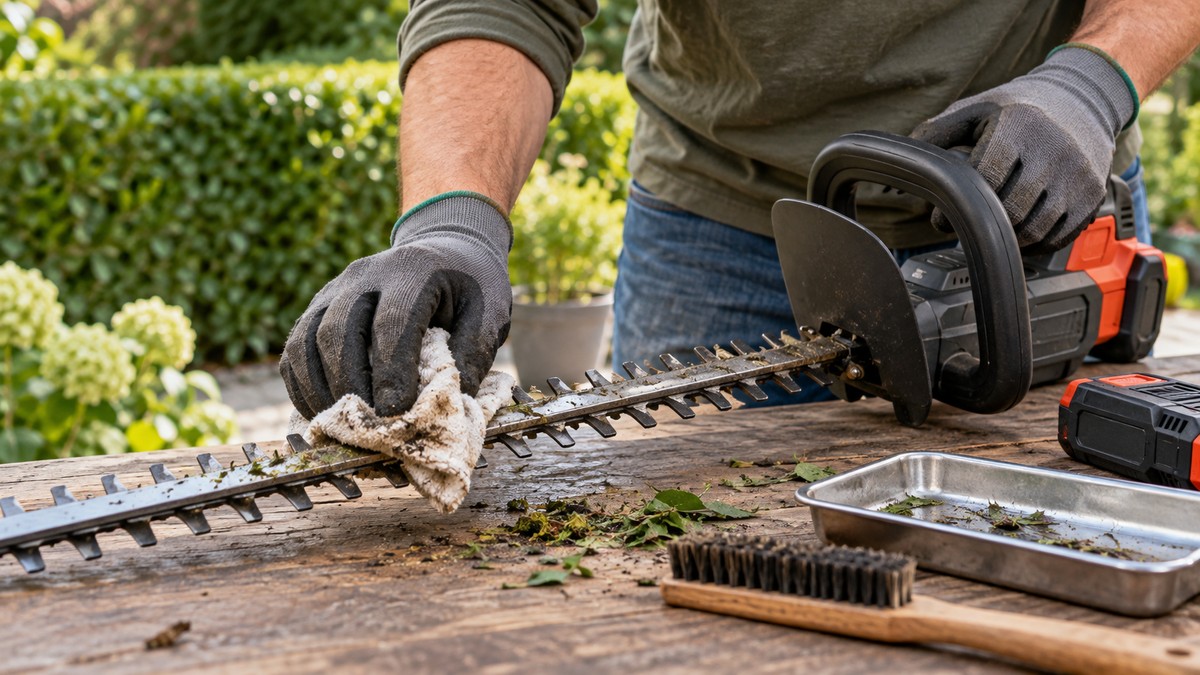
- Brush off leaves, twigs and dirt, then scrub off sap with a soft cloth.
- Wipe the blades with a damp cloth. Husqvarna’s maintenance guide allows water or blade cleaner if needed, while the 60V Toro manual says not to hose or submerge the trimmer.
- Dry the blades thoroughly and clean them after each use. The sources name no sap remover for cleaning.
Safety before you clean the blades
Cleaning the blades is blade work, so the power-off and cut-risk points apply. Husqvarna’s maintenance guide lists “Disconnect power (battery, or spark plug)” among its safety checks, and its battery support page gives the same step before cleaning. Toro’s 60V manual states “Remove the battery pack from the trimmer before maintaining or cleaning.” Two more points come from the same pages. Husqvarna says “Wear protective gloves,” and its support page adds “Work on a stable surface.” Treat the blades as a cutting hazard, because Toro states “The hedge trimmer blades can cause cuts or amputation.”
Husqvarna’s support page also lists “Cleaning while the trimmer is connected to power” as a common mistake. Every step below starts with the power-off step for that reason.
Step-by-step: clean the blades after use
These steps combine what the manufacturer pages say. Where a source names a model or a cleaner, the step says so.
- Stop the motor and remove the battery. Toro’s 22in manual says “Stop the motor and remove the battery.” Its 60V manual gives a longer order: “Shut off the trimmer, remove the battery pack, and place the trimmer on a flat surface.” According to Husqvarna, petrol models use the spark plug as the disconnect instead.
- Put on gloves and set the trimmer on a stable surface. Husqvarna’s support page lists “Wear protective gloves” and “Work on a stable surface” in its before-cleaning checks.
- Brush off loose debris. Husqvarna’s support page says “Brush off leaves, twigs and dirt from the blades.” Its maintenance guide also names sap in the same job: “Remove dirt, leaves, and sap from blades.”
- Scrub off the sap. Husqvarna’s support page says “Scrub off sap and residue.” STIHL’s guide says “plant sap and resin accumulate on the cutting apparatus” and advises “Remove this dirt with a soft cloth.” Use a soft cloth. The sources do not name a remover for battery trimmers.
- Wipe with a damp cloth. Toro’s 60V manual says “Wipe the trimmer clean with a damp cloth any time there is an accumulation of debris.” The 22in Toro manual adds a mild detergent for the body. Husqvarna’s support page says “Use a cloth with warm soapy water or cleaner,” and its maintenance guide says “Clean with water or blade cleaner if needed.” Use soapy water on the blades only if the manual for your model allows it.
- Keep liquid off the body. The 60V Toro manual says not to hose or submerge the trimmer. Keep detergent mild: the 22in manual warns against strong detergents on the plastic parts.
- Dry the blades thoroughly. Husqvarna’s support page says “Dry thoroughly” and adds “Moisture left on the blades can lead to corrosion.” Its maintenance guide says “Clean blades cut better and reduce strain on the engine.”
- Clean again after each use. Husqvarna’s maintenance guide says “Clean blades after each use.” Its support page also says to clean when blades feel sticky or cut poorly.
Cleaning steps by source
The table lines up what each page says on the points that matter for blade cleaning. “Not stated” means the page does not cover that point for cleaning.
| Source | Power off first | Sap and debris | Water or cleaner | Liquid on the body |
|---|---|---|---|---|
| Husqvarna US maintenance guide | Disconnect power (battery, or spark plug) | Remove dirt, leaves, and sap from blades | Water or blade cleaner if needed | Not stated |
| Husqvarna battery support page (KA-70224) | Disconnect power (battery or spark plug) | Brush off debris; scrub off sap and residue | Warm soapy water or cleaner, on a cloth | Not stated |
| Toro 60V manual (model 51855T) | Remove the battery pack before cleaning | Brush or damp cloth with mild detergent | Damp cloth | Do not hose down or submerge |
| Toro 22in manual (model 51494) | Stop the motor and remove the battery | Damp cloth with mild detergent, body only | Damp cloth with mild detergent | No strong detergents on housing or handle |
| STIHL sharpening page (UK locale) | Not stated for cleaning | Soft cloth for plant sap and resin | Not stated for cleaning | Not stated |
On water, the two Husqvarna pages are the only ones in the table that allow water or cleaner on the blades. Both Toro manuals call for a damp cloth, and the 60V manual rules out hosing or submerging the trimmer. If you are still choosing a battery model, these guides cover specific trimmers: cordless hedge trimmers with an extension pole, Stihl HSA 45 cordless hedge trimmer guide, and cordless grass shear and hedge trimmer guide.
Sap, resin and solvents: what the sources say
Sap is the part of blade cleaning that the sources treat most seriously. Husqvarna’s support page says “Sap, dirt and debris can build up quickly, causing the blades to stick, cut poorly, or wear faster.” It also says dried sap is hard to remove, which is why the cleaning should happen soon after each session. Penn State Extension covers pruning tools in a different setting, plant disease, and says “If sap or resin builds up on the tool, scrub this off with a rag that is kept in the disinfectant.” That rag method belongs to disinfecting, so it is not a cleaning step for a battery trimmer.
Three solvent names appear in these sources, and they do not mean the same thing.
- Disinfectants (Penn State). For disinfecting pruning tools, Penn State lists 70% alcohol and a sodium hypochlorite mix. For alcohol it says “Dip or swab the object and let it dry. Do not rinse.” For the hypochlorite mix it gives “Mix 1 gallon in 9 gallons of water.” and says “Rinse metal objects to prevent corrosion.” It also tells you to read the product label before you rinse.
- Resin solvent (STIHL). STIHL’s sharpening steps say to “spray the cutting apparatus with STIHL resin solvent” after filing, and they say “Apply resin solvent to restore the corrosion protection.” STIHL does not present the solvent as a step for cleaning sap. This page refers to UK dealers, so it is not a US source.
- Kerosene and strong detergents (Toro). The 22in manual says “Do not use any strong detergents on the plastic housing or the handle.” It adds that those parts can be damaged by solvents such as kerosene. The other pages in this guide give no comparable warning.
For the blades themselves, the only solvent these sources apply to the cutting apparatus is STIHL’s resin solvent, and it belongs to the sharpening routine, which this guide does not cover. Alcohol and the hypochlorite mix appear only in the disinfecting context. The reading the sources support is a damp cloth on the blades, with soapy water only where your model’s manual allows it.
How we chose
We opened six pages on 2026-10-22 with a plain HTTP request and quoted only sentences that appear in the saved text. Candidate pages came from manufacturer index pages and search results, and each one was opened before use. Retail pages were not used. The set has four manufacturer pages for battery hedge trimmers: two Husqvarna pages, a US maintenance guide and a battery support article, and two Toro interactive manuals for a 60V model and a 22in cordless model. It also has one university extension page on disinfecting pruning tools and one STIHL page.
The STIHL page is a UK-locale page. No US page in this set names a resin solvent, so the STIHL page is cited for that one point only. The criteria were simple: a manufacturer or extension page that opens, a sentence that covers power-off, cleaning or solvents, and a battery or cordless model where the page covers one. We did not rank the sources or pick a best product.
What we could not verify
- Whether any blade cleaner other than a damp cloth, mild detergent or warm soapy water is safe for a given model. The sources name no cleaner brand or formula for battery hedge trimmers.
- How often a battery trimmer needs cleaning in hours of use. The Husqvarna pages give the interval as after each use and give no hour count.
- How long sap can sit before it causes a problem. Husqvarna says dried sap is hard to remove, but it gives no time.
- Whether the Husqvarna and Toro steps can be swapped. They are different brands and models, so check each step against the manual for your own trimmer.
- Petrol-model cleaning beyond the spark plug step. The steps here are written for battery trimmers, and the spark plug appears only where a source names it.
What the sources do not say
- Which sap remover works on hedge trimmer blades. None of the cleaning steps names one, and the only named solvent, STIHL’s resin solvent, sits in the sharpening steps.
- Whether alcohol or a sodium hypochlorite mix is safe on the blades, the housing or the battery contacts of a battery hedge trimmer. Penn State covers disinfecting pruning tools against plant disease, not power tools.
- Whether the blades can be cleaned with the battery still in the tool. The Toro manuals say to remove it first, so this guide does not describe any other case.
- Whether a pressure washer is safe on any blade. No source in this set covers pressure washers, and the 60V Toro manual rules out hosing the trimmer down.
- How oiling fits with cleaning. Husqvarna’s support page says to apply lubricant after cleaning, and the 22in Toro manual gives its own oiling routine. Oiling is outside this cleaning post.
FAQ
Do I have to remove the battery before I clean hedge trimmer blades?
Yes. The 60V Toro manual says to remove the battery pack before maintaining or cleaning the trimmer. Husqvarna’s maintenance guide lists disconnecting power (battery, or spark plug) among its safety checks before cleaning.
On petrol models, the spark plug is the disconnect step instead, according to Husqvarna. Whichever you use, do not start the blade cleaning while the trimmer can still run.
Can I hose off hedge trimmer blades?
The sources disagree. Husqvarna’s maintenance guide allows water or blade cleaner on the blades if needed. The 60V Toro manual rules out hosing the trimmer down or putting it under water.
This guide follows the stricter line for the whole tool. Use a damp cloth, and use soapy water on the blades only where your model’s manual allows it.
How do I get dried sap off hedge trimmer blades?
Clean the blades soon after use, because Husqvarna says dried sap is hard to remove. Scrub with a soft cloth, as STIHL advises for plant sap and resin, and use warm soapy water on the blades only if your manual allows it.
The sources do not name a sap remover for battery trimmers. The one named solvent, STIHL’s resin solvent, appears only in the sharpening steps, so it is not a cleaning answer.
Is rubbing alcohol safe for cleaning hedge trimmer blades?
The sources do not say so for trimmers. Penn State lists 70% alcohol as a disinfectant for pruning tools, with the instruction “Dip or swab the object and let it dry. Do not rinse.” That guidance is about plant disease.
None of the Husqvarna or Toro pages names alcohol, and none says whether it is safe on blade coatings or on a battery tool’s housing. This guide does not recommend it.
How often should I clean hedge trimmer blades?
Husqvarna’s maintenance guide says “Clean blades after each use.” Its support page adds that you should also clean when blades feel sticky or cut poorly.
If the blades still cut poorly after cleaning, the same support page says they may need sharpening instead. Sharpening is a separate job and is not covered here.
Do I need to oil the blades after cleaning?
Some sources include oiling in the same routine, but this guide covers cleaning only. Husqvarna’s support page says to apply lubricant after cleaning, and the 22in Toro manual says the blade should be oiled before and after each use.
Follow the oiling step in your model’s manual. Storage and sharpening are separate topics and are not covered here.
Bottom line
Remove the battery first, then clean the blades with a damp cloth, brush off sap soon after use, and dry them thoroughly. Use soapy water on the blades only when your model’s manual allows it.
Sources
- Husqvarna US: Maintenance of a hedge trimmer (opened 2026-10-22)
- Husqvarna Help Center US: How to clean and oil hedge trimmer blades (opened 2026-10-22)
- Toro: Interactive manual, 24in 60V hedge trimmer, Model No. 51855T (opened 2026-10-22)
- Toro: Interactive manual, 22in cordless hedge trimmer, Model No. 51494 (opened 2026-10-22)
- Penn State Extension: Disinfecting Tools, Equipment, Pots, Flats and Benches (opened 2026-10-22)
- STIHL: Sharpening hedge trimmers correctly (opened 2026-10-22)