WORX 12 Amp Turbine Electric Leaf Blower for Daily Leaf Removal Review
As an Amazon Associate we earn from qualifying purchases. Details
Nothing here reflects product testing, and no sales figures are included.
Leaf cleanup is rarely a one-time job. On a yard under mature trees, the same driveway and patio collect debris every few days through fall, and the tool you pick has to start without fuss every time. The WORX WG520 is a corded electric turbine blower built for that routine: a handheld unit with 600 CFM of airflow, no fuel, and a standard 120-volt plug. The question for most buyers is less about peak power and more about whether an outlet, a cord, and a light tool will fit the way they clean.
Who this blower suits, and who should skip it
The WG520 fits a homeowner who has an outdoor outlet within reasonable reach of the work area, a driveway, patio, deck, or walkway that collects leaves on a regular schedule, and a preference for a tool that needs no gasoline, no oil mix, and no pull-starting. It also suits anyone who wants a light handheld tool. The listed weight is 6.4 pounds, and that difference becomes noticeable during a longer session. For a cordless comparison, see the cordless leaf blower picks and the Black+Decker 18V leaf blower guide.
Skip it if your yard is far from any outlet and you do not want to manage a long extension cord. Skip it if you need a battery-powered tool you can carry anywhere, or if you expect a vacuum or mulching function, since neither is described. The package contains only the blower, so any accessory you want has to be sourced separately.
Specifications translated into what you will notice
- 600 CFM airflow. CFM measures how much air the blower moves each minute. Higher volume helps move dry leaves and loose clippings across a lawn or driveway in fewer passes. The page does not say how it handles wet or matted leaves, so treat that as an open question.
- 110 MPH top speed. This figure describes air velocity at the outlet. It appears twice, once as maximum speed and once as speed, with the same value in both places, so the page is consistent on this point.
- 12-amp motor. Amperage is the current the motor draws. Twelve amps is a substantial load on a standard household circuit, so the circuit you plug into matters more here than it would for a light trimmer.
- 120 V AC, corded electric. There is no battery to charge and no battery to replace over the tool’s life. The trade-off is that the tool is only as mobile as its cord.
- 6.4 lb weight. For a tool you hold and sweep with, the gap between 6 and 8 pounds shows up within a few minutes. At this weight the blower stays manageable for one-hand operation, which the page also lists as a feature.
- 40 x 9.5 x 10.9 inch dimensions. The 40-inch overall length is the number to check against your storage space, such as a garage shelf, a shed hook, or the back of a car.
- ABS housing. Acrylonitrile butadiene styrene is a common plastic for tool housings. It is the material the page lists, and it is lightweight, which fits the weight figure above.
- Variable speed control. The page describes the control as variable speed in one place. A lower setting gives gentler airflow near planting beds, mulch, and loose soil, while a higher setting suits bulk leaves on pavement.
Power, cord, and setup
A corded blower removes the battery-charging routine and the gas-refill routine. What it replaces is the reach question. Measure the path from your outlet to the farthest corner of the yard before you buy, then plan the cord around that path rather than around the middle of the lawn.
- Outlet and circuit: A 12-amp load is best run on a circuit that is not sharing heavy loads at the same time. Avoid running it alongside a space heater, a second large power tool, or a freezer on the same circuit.
- Extension cord: Use an outdoor-rated extension cord and match its wire gauge to its length. Longer runs need heavier wire to limit voltage drop, which can make a motor work harder.
- Ground-fault protection: Plug outdoor use into a GFCI-protected outlet, and keep the cord clear of standing water and the path of the blower’s airflow.
Assume you will need an extension cord for most yards and confirm the length you need before ordering.
The package includes the blower alone, so there is no tube or nozzle to attach and no nozzle shape to change for different jobs.
Storage follows from the same design. Because the motor is electric, there is no fuel to drain before a season off, which removes one common maintenance step. Hang the cord loosely rather than wrapping it tightly around the handle, and store the tool somewhere dry so the plastic and the electrical parts stay in good condition.
Everyday uses where the specifications help
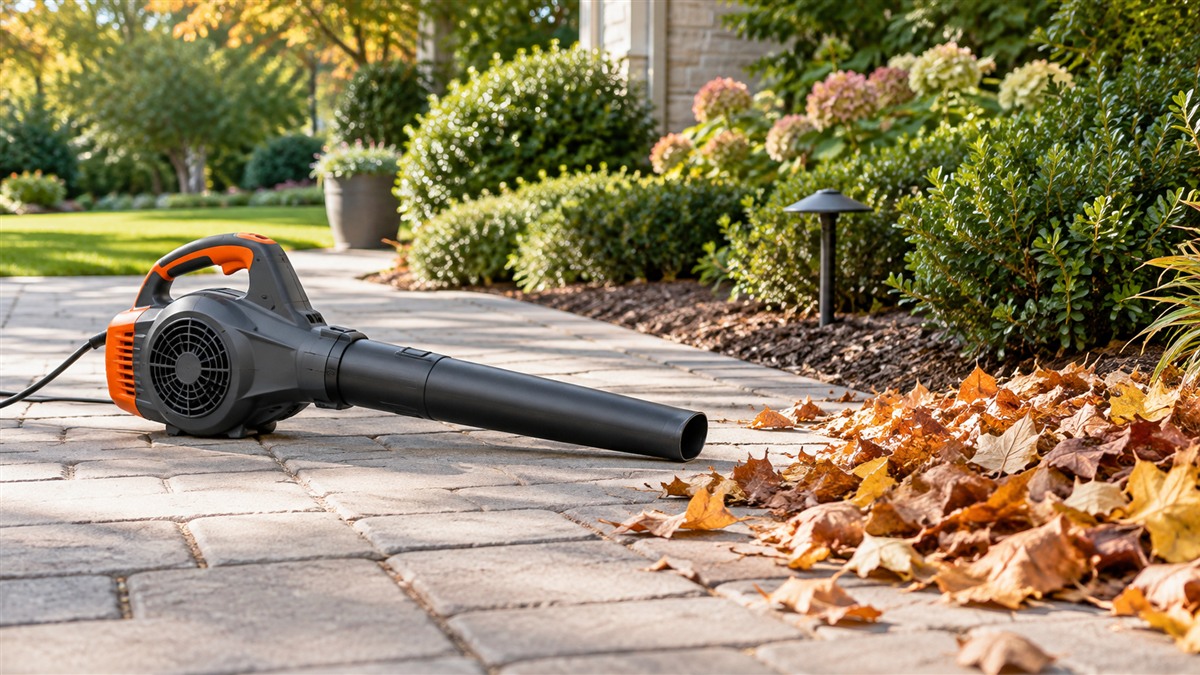
- Driveway clearing. Hard, flat surfaces are where a high-volume blower earns its keep. You can push leaves into a line or a pile in a few passes, then clear the pile with a broom or a rake. The 600 CFM figure is the main reason to pick this model for the job.
- Patio and deck sweep-offs. Variable speed lets you drop to a gentler setting near furniture, planters, and screens, then raise it for the open sections.
- Walkways and lawn edges. The handheld form and light weight make it practical along edges, beds, and steps, where a larger machine would be awkward.
- After-mowing cleanup. Blowing clippings off paving and back onto the lawn is a routine task. The page lists home as the recommended use, which matches this kind of residential work.
Technique matters more than the spec sheet on hard surfaces. Work with the wind, sweep in long even passes, and keep the nozzle low and angled toward the pile. Start on a lower setting and move up only if the debris does not budge. That approach uses the variable control instead of running full power all the time.
Strengths the specifications support
- No fuel handling. There is no gas to buy, no mixing, no fumes, and no pull-start. There is no fuel to store or mix before early-season cleanup.
- Continuous power. A corded tool does not run down partway through a job, so the session length is set by you rather than by a charge level.
- Manageable weight. At 6.4 pounds the blower is light enough for one-hand operation, which the page lists as a feature. Lighter tools are easier to aim, which helps when you need to clear a corner or a gutter line.
- Clear, short parts list. The package is one blower. Fewer parts in the box means less to lose or misplace.
- Warranty length. The page lists a 3-year manufacturer limited warranty. Warranty terms should always be read in full, but the length is useful when you compare this tool with cordless options in the same category.
Limitations and when to choose something else
- Reach is set by the cord. Large yards, side yards, and detached areas may need multiple outlets or a cordless tool.
- No cordless operation. The page describes corded power only. If you want to clean a car or a garage floor away from the house, a battery tool will be easier.
- Accessory options are limited in the listing. Only the blower is listed as included, and no additional nozzles or tubes are described.
- Wet leaves are not addressed. The page does not say how the blower handles damp or matted debris. Dry, loose leaves are the reasonable assumption until you have better information.
- Circuit limits. A 12-amp draw can trip a weak or shared circuit. If you already run other tools on that circuit, the blower is not a good fit for it.
How it compares within the category
Other products in the same category research show the trade-offs clearly. These figures belong to those other models and are shown only to frame the choice, not as specifications of the WG520.
- GREENFURY Cordless String Trimmer and Leaf Blower Combo for Dewalt 20V: battery powered, 6.6 pounds, marketed with a 150 MPH blower, and a 1-year warranty. A battery combo suits a yard where an outlet is not handy, but you accept a charging routine and a shorter warranty.
- RYAHT Leaf Blower Cordless: 3.4 pounds, 20 volts, two selectable wind speed modes, and two 2.0Ah batteries with a fast charger included. A light cordless model suits people who need to move around freely more than they need a sustained, corded airflow.
The simplest rule is this. If an outlet sits within easy reach of most of your yard, corded power is the lower-maintenance choice. If most of your work is away from an outlet, a battery model with a charging routine is the better fit.
Buying checklist: check these before you order
- Map the distance from the nearest outdoor GFCI outlet to the farthest point you clear, and compare it with the cord you will need.
- Confirm that the circuit can carry a 12-amp tool alongside your other loads.
- Decide whether a blower-only package covers your work, since no tube or nozzle is listed.
- Hold the blower’s 6.4-pound weight against the length of your typical cleanup session.
- Check the 40-inch overall length against your storage location.
- Read the manufacturer’s 3-year limited warranty terms before purchase.
- Decide how important wet-leaf performance is, since the page does not cover it.
When the checklist works out, the blower is available here: WORX WG520 Corded Leaf Blower on Amazon.
Frequently asked questions
Is this meant for daily use or occasional cleanup? The page frames it for routine yard cleanup. Corded power has no battery cycles to manage, which suits frequent use, but the cord itself still needs care on every session.
How should I choose a speed setting? Start low for mulch, planting beds, and loose soil, then move up for bulk leaves on pavement. The page does not publish airflow values for each setting, so find your own starting point on a small area first.
Plan around dry, loose leaves unless you confirm otherwise.
What is the difference between CFM and MPH? CFM is volume: how much air moves each minute. MPH is speed: how fast the air leaves the outlet. A blower needs both to move debris well. Volume gets a pile moving across the surface, while speed helps lift and push lighter debris, so the two figures describe different parts of the job.
Do I need a special extension cord? Not a special type, but an outdoor-rated cord in a gauge that suits its length. A 12-amp load on a thin or long cord can run warm and lose power at the tool, so match the cord to the run rather than picking the cheapest one on hand.
What should I check before the first use? Inspect the cord and plug for damage, confirm the outlet has ground-fault protection for outdoor use, and clear the intake of any debris that could block airflow.
Final verdict
The WORX WG520 is a straightforward pick for a homeowner who has an outlet close to the yard and wants a gas-free, light blower for regular cleanup. Its 600 CFM and 110 MPH figures, variable speed control, 6.4-pound weight, and 3-year limited warranty are the points to weigh. Its open questions are cord length, noise, wet-leaf performance, and whether a single-blower package covers your work. Answer those before you buy and the decision becomes simple. For a corded yard, it is a practical tool. For a yard that is far from any outlet, look at a battery model instead.