Best Battery Powered Spreader: Seven Handheld Models Compared by Battery, Hopper and Coverage
As an Amazon Associate we earn from qualifying purchases. Details
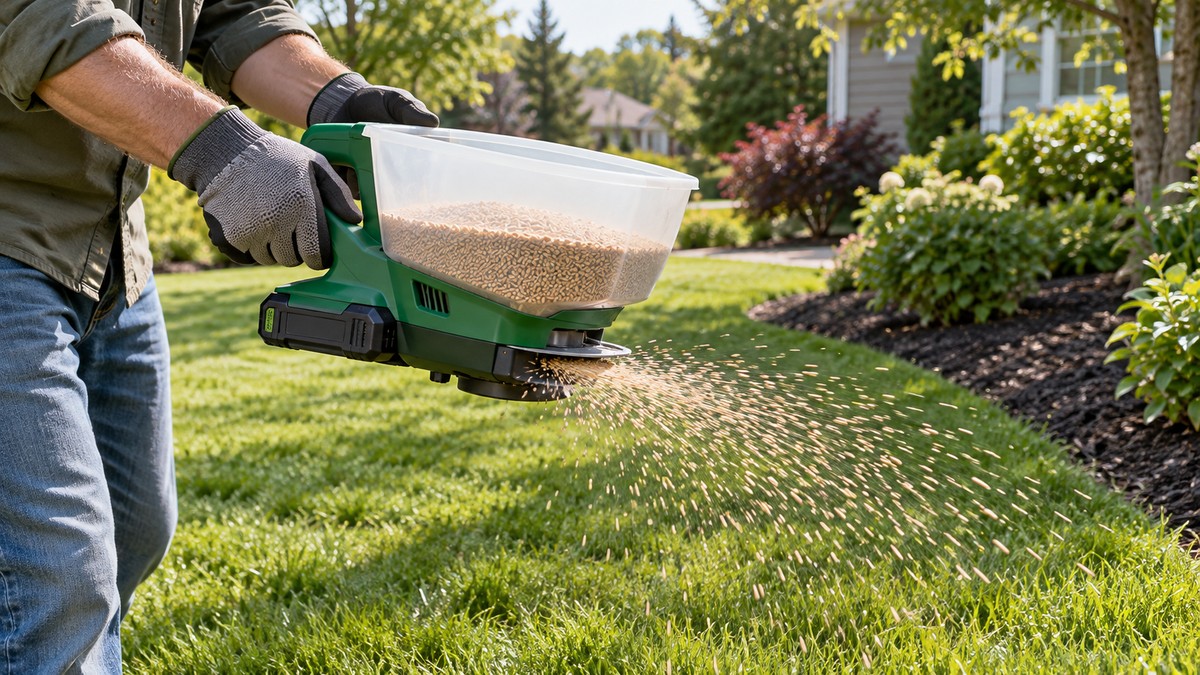
The person typing best battery powered spreader wants a spreader that runs on a battery they already own, so they can seed, feed or salt a lawn without a cord or a gas engine. For most small and mid-sized lawns, the right pick is a handheld spreader whose battery platform matches a tool in the garage, with a hopper large enough to finish a pass in a few fills. This guide compares seven handheld listings from seven brands. Every figure comes from the listing’s own title, bullets or specification table, and the guide shows how to turn those figures into a fill count for your yard.
Quick answer
- Match the battery first. Four listings are built for a DeWalt pack, one for a Craftsman V20 pack, and two use their own 7.2V lithium cell. Check the pack you already own before you compare anything else.
- Check whether the battery is in the box. The GARCARE bullets describe a rechargeable battery inside the spreader. Three listings say the battery is not included, and the CRAFTSMAN title says tool only. The SHALL bullets and specification table disagree, so confirm that one before you buy.
- Count refills with the hopper size, not the headline coverage. The coverage figures use different units and assumptions, and the listings do not say how they were measured.
What the buyer is deciding
The buyer is usually choosing among listings that look alike. Five criteria separate them, and they are listed here in the order that should decide the purchase.
- The battery platform. A spreader is a real option only if its pack fits a battery you own or are willing to buy for it. Four of the seven picks are built for DeWalt packs, so a DeWalt owner has the widest choice in this set.
- The battery in the box. A tool-only listing makes sense only when you already own the pack. Without a matching pack, the spreader cannot run on the first day.
- The hopper volume. The hopper sets how often you stop to refill. The listed hoppers run from 3 liters to 3.9 liters, and CRAFTSMAN lists a 1.2 gallon tub.
- The setting range. Fine grass seed needs a small opening and a slow speed, while coarse salt needs a larger opening and a faster one. The SHALL bullets split its eight settings into three groups: grades 1 to 3 for fine grass seed, grades 4 to 6 for medium fertilizers, and grades 7 to 8 for heavy rock salt.
- The coverage claim and its unit. The listings use square feet, square meters and “per tub”, so convert them to one unit before you compare them.
The seven listings at a glance
The table below uses only what each listing states in its title, bullets or specification table. A blank cell means the text we read did not state that figure.
| Pick | Battery named in the listing | Hopper or tank | Coverage stated | Battery in the box |
|---|---|---|---|---|
| Uniqwamo | DeWalt 20V/60V (compatible) | 3 L | 700 m2 | No, per the bullets |
| SHALL | 7.2V lithium, 2.0Ah per the bullets | 3.3 L | Up to 6,458 sq ft (title) | Conflicting: bullets and specification table disagree |
| Rozlchar | DeWalt 20V/60V (compatible) | Not stated | 5,000 sq ft (title) | No, per the bullets |
| CRAFTSMAN | Craftsman V20 | 1.2 gal | Up to 5,000 sq ft per tub | No, the title says tool only |
| GARCARE | 7.2V, built-in 2.0Ah | 3.3 L | Up to 600 m2 | Built in, per the bullets |
| Byutrcfuy | DeWalt 20V MAX and 60V (compatible) | 3.9 L | Not stated | Not included, per the first bullet |
| WeToolGoo | DeWalt 20V/60V (compatible) | 3 L | Up to 1,400 sq ft | Not clear in the text we read |
Uniqwamo and Rozlchar each had a second listing on the first results page, built for a Milwaukee 18V pack. We kept the DeWalt version of each, so the set has one listing per brand.
Turning coverage into a fill count
Coverage claims are the figures most easily misread, so this section shows the arithmetic and labels every estimate as our planning estimate.
Start with the lawn area. For a 5,000 square foot lawn, our planning estimate for the WeToolGoo listing is 5,000 ÷ 1,400 = 3.57 fills. Round up, so plan for four full hopper loads. Four fills of the 3 L hopper add up to 4 times 3 = 12 liters of hopper capacity across the lawn.
The CRAFTSMAN listing gives coverage per tub rather than per fill. If one tub equals one full hopper, our planning estimate for the same lawn is 5,000 ÷ 5,000 = 1 tub. The listing does not say whether a tub is one hopper load, so treat that result as an estimate and not a rule.
Units matter as well. The Uniqwamo bullet gives 700 m2. Our planning estimate is that 700 times 10.764 is 7,534.8 square feet, which is more than the 5,000 square feet named in the Rozlchar title. The GARCARE bullet gives 600 m2, and 600 times 10.764 is 6,458.4 square feet, which matches the 6,458 square feet in the SHALL title once rounded.
None of the listings says which setting or walking pace produced its coverage figure. Use these numbers to compare the size of each claim, not as a promise for your lawn. To run the same check on your own yard, measure the area in square feet, divide by the coverage the listing gives for one load, and round up. Label the result as your own planning estimate.
Two more worked examples
Larger lawns change the answer, so the same method works at other sizes. Our planning estimate for a 10,000 square foot lawn with the WeToolGoo figure is 10,000 ÷ 1,400 = 7.14 fills, so plan on eight full fills. Eight fills of the 3 L hopper add up to 8 times 3 = 24 liters of hopper capacity over the job.
The liter-rated hoppers in this set run from 3 L to 3.9 L. Our planning estimate is that the Byutrcfuy hopper holds 3.9 minus 3 = 0.9 liters more per fill than the WeToolGoo hopper. Over eight fills, that gap adds up to fewer stops, but the listings do not say how much product each fill delivers, so the gap is a planning figure only.
The GARCARE coverage figure can also be read against a 5,000 square foot lawn. Our planning estimate is 5,000 ÷ 6,458.4 = 0.77, so one full load would cover about three quarters of that lawn. The listing does not say whether 600 m2 describes one full hopper or a longer run, so read it as the listing’s claim and not as a rule.
A short buying routine
- Write down the battery platform you own, including the voltage and the pack number if you know it.
- Drop any listing that does not match that platform. If you own no matching pack, keep only the listings whose bullets describe a battery in the box.
- Compare hopper size first, then the setting range, then the coverage claim converted to one unit.
- Work out the fill count for your lawn with the arithmetic above, and label the result as your planning estimate.
- Read the product label for any fertilizer, herbicide or salt before the first pass, then calibrate with that same product.
For how a pack’s voltage and amp-hour figures compare across tools, see our lawn mower battery voltage and amps guide. If you also plan spring work on the lawn, our electric dethatcher guide covers a different tool.
Battery safety before you spread
Battery handling is a separate job from spreading, and the EPA’s guidance on used lithium-ion packs applies to the lithium-ion packs in this set. The agency says even used batteries can have enough energy to injure or start fires. Before you store or discard a pack, tape its terminals and place it in a separate plastic bag, as the EPA advises. If a pack is damaged, the EPA says to contact the battery or device manufacturer for specific handling information.
Fertilizer, herbicide and deicing salt all come in the same hopper, so the product label controls how you handle the product. The EPA says to read the label first and follow its directions to the letter, including all precautions and restrictions. When the label calls for protective gear, the EPA lists impermeable gloves, long pants and long-sleeve shirts as examples, and it advises changing clothes and washing your hands immediately after applying a pesticide.
Before you spread, clear the area. The EPA says to remove children, toys and pets from the area and keep them away until the product has dried or for as long as the label recommends.
Calibrate before you spread
Penn State Extension says that spreaders must be properly calibrated to deliver granular fertilizers and pesticides to turf at correct rates. If calibration is done incorrectly, too much or too little of the product reaches the turf, so the calibration step is not optional. The extension page also says that each spreader is slightly different from all others, even when two units look identical, so calibrate each unit you own.
The same page advises calibrating for each granular product, because density, size, active ingredient and nutrient content all vary between products. A spreader set correctly for one bag may be off for the next.
Penn State’s method starts with a tape measure and a scale that can weigh small amounts accurately. It recommends measuring a 50 or 100 foot strip in a turf area where striping or burning from the product does not matter. For coverage, the page describes splitting the application rate in half and making two passes at right angles, which reduces the streaking caused by skips and overlaps.
Mistakes to avoid
- Choosing on the coverage claim alone. The units differ, and the listings do not give the setting behind each figure.
- Assuming a DeWalt label fits your pack. Several listings name specific pack numbers, such as DCB203 or DCB206. Match your pack’s number against the list before you buy.
- Using a fine-seed setting for salt. The SHALL bullets place heavy rock salt in grades 7 and 8, not in the fine-seed range.
- Forcing a jammed spreader. The SHALL bullets say seeds can get stuck under the dispersing wheel and advise using tools to remove them, rather than forcing the width paddle.
- Skipping calibration. Penn State says each spreader and each product needs its own check, and a setting from the box is a starting point only.
How we chose
We searched Amazon.com in a browser on 2026-10-21 for best battery powered spreader and read the first results page. We kept listings of the exact product type, which here means handheld, battery-powered broadcast spreaders for seed, fertilizer or salt. All twelve results on that page were spreaders of that type, so none were dropped on product type. Sponsored placements were not used.
We opened nine listings and read each title, its first bullets and its specification table. From those, we kept one listing per brand. Uniqwamo and Rozlchar each had a Milwaukee listing on the page as well as a DeWalt listing, and we kept the DeWalt version of each. The seven picks come from seven different brands.
We did not open three further listings on the page, so we cannot say whether their brands differ from the seven. They are not picks.
What we could not verify
- The battery status for WeToolGoo. Its first bullet names the battery and charger, but the part that says whether they are included is cut off in the text we read.
- The SHALL battery. The bullets describe a 2.0Ah lithium battery, while the specification table lists AAA batteries and says they are included. We could not resolve that difference from the listing.
- The conditions behind each coverage figure. No listing says the setting, walking pace or grass type that produced its number. We did not compare the figures on a common basis beyond the unit conversion above.
- Hopper size for Rozlchar. Its bullets give no hopper capacity, so that listing cannot be compared on fills.
- Runtime. Only the GARCARE bullets give a runtime, up to 2.5 hours. The other picks do not state one in the text we read.
- Pack numbers. The bullets name specific DeWalt pack numbers, and we did not check those against a DeWalt list.
- The rest of Byutrcfuy’s first bullet, which is cut off after the words “Battery Not Inc” in the text we read.
- The three listings on the first page that we did not open.
- Clogging with damp or wet fertilizer. The listings do not say how their hoppers behave in damp product, and the sources we opened do not cover it.
FAQ
Can one battery spreader handle grass seed and rock salt?
Some can, if its settings cover both ranges. The SHALL bullets divide eight settings into fine grass seed, medium fertilizers and heavy rock salt, so that listing is built for all three. The WeToolGoo listing offers eight seeding levels and a 125 degree opening, but its bullets do not mention salt. Check the setting chart in the product manual before you use a fine-seed setting for salt, and expect a different opening size on each model.
Do I need a battery in the box?
Only if you do not already own a compatible pack. Tool-only listings leave the battery to you. If you already run DeWalt or Craftsman V20 tools, a tool-only spreader lets one battery serve all of them. If you do not, the GARCARE listing is the one whose bullets describe a rechargeable battery inside the unit.
How many hopper fills does a 5,000 square foot lawn need?
For the WeToolGoo listing, 5,000 ÷ 1,400 = 3.57, so plan on four full fills. That figure depends on the listing’s own coverage claim, and the claim does not state a setting or walking pace. Your real count will depend on the setting you choose and how much product each pass puts down. Run a measured strip first, as the Penn State method describes, so the count matches your own setup.
Does a handheld spreader suit a large yard?
Every listing in this set is handheld, and the hoppers run from about 1.2 gallons to 3.9 liters. On a large yard the number of refills climbs quickly, so a walk-behind spreader may save time. This set does not include walk-behind units, and the sources we opened do not compare the two styles, so the choice for a big lawn is a separate decision.
Should I calibrate a battery spreader?
Yes. Penn State Extension says that each spreader is slightly different from all others, and that you should calibrate for each granular product because density, size, active ingredient and nutrient content vary. Use the method in the calibration section, and repeat it whenever you switch to a different bag.
Bottom line
Choose the handheld spreader whose battery you already own and whose hopper gives you the fewest refills for your lawn. If the battery is not in the box and you have no matching pack, skip that listing. Read the product label before the first pass, and calibrate with the same product you will spread.
1. Handheld Power Spreader Compatible for Dewalt 20V/60V Battery (DeWalt-compatible handheld spreader with a 3 L hopper, tool only)
Pros
- The bullets describe a 3L large capacity hopper with a maximum coverage area of 700m2
- The bullets list 6 speed settings and an 8-speed control of sowing volume
- The bullets say the handheld design avoids pinching hands or hooking clothes
Cons
- The bullets say the device does not include the battery and charger
- The bullets describe a 125 degree opening but give no spread width
Best for: A DeWalt 20V owner who wants a small handheld spreader for a lawn or garden bed
Skip if: You need a battery included in the box
View on Amazon (affiliate link)
2. SHALL Battery Powered Fertilizer Spreader, 7.2V Rechargeable Seed Spreader for Salt, De-Icer, Earth (Rechargeable 7.2V spreader with 8 settings for seed to rock salt)
Pros
- The bullets split eight settings into fine seed, medium fertilizer and heavy rock salt grades
- The bullets describe a 3.3L hopper designed for grass seed and fertilizer
- The bullets say the motor runs between 900 and 2200 rpm for different materials
Cons
- The bullets warn that seeds can get stuck under the dispersing wheel
- The specification table lists AAA batteries, which conflicts with the 2.0Ah battery in the bullets
Best for: A homeowner who wants one rechargeable spreader for seed, fertilizer and salt
Skip if: You need the battery type confirmed in one place before you buy
View on Amazon (affiliate link)
3. Power Spreader Compatible for Dewalt 20V/60V, Covers 5,000 sq. ft. (DeWalt 20V and 60V spreader with a 180-degree swath)
Pros
- The title says the spreader covers up to 5,000 sq. ft. for lawns
- The bullets describe 8 settings and 6 speed adjustments for spreading
- The bullets describe a 180-degree swath for a wide coverage pattern
Cons
- The bullets say the battery and charger are not included
- The bullets do not state a hopper capacity in the text we read
Best for: A DeWalt owner who wants a 20V or 60V battery spreader for a mid-sized lawn
Skip if: You need a hopper size or a battery in the box stated in the listing
View on Amazon (affiliate link)
4. Craftsman V20 Four Season Seed Spreader Handheld, 1.2 Gal, 6 Speed, Fertilizer Spreader, Salt, Ice (Craftsman V20 handheld spreader with a 1.2 gallon tub, tool only)
Pros
- The bullets describe up to 5,000 square feet distributed per tub
- The bullets describe 6 speed settings and 36 spreader combinations for fertilizer, seed and salt
- The bullets give an adjustable swath of 4.5 to 5.7 inches
Cons
- The title says tool only, so the V20 battery is not included
- The bullets do not state a battery runtime
Best for: A Craftsman V20 owner who wants a 1.2 gallon handheld spreader for seed and salt
Skip if: You do not already own a Craftsman V20 battery
View on Amazon (affiliate link)
5. GARCARE 7.2V Cordless Seed Spreader with 3.3L Large Hopper 2.0Ah Battery (Built-in battery spreader with 8 flow levels and USB charging)
Pros
- The bullets describe 8 flow levels from fine seeds to heavy salt
- The bullets describe a 3.3L tank with 6 speeds from 900 to 2200 rpm
- The bullets say the spreader charges by a USB cable included in the set
Cons
- The bullets give 2.5 hours as the upper runtime, which is a short run for a large lawn
- The bullets describe the battery as inside the unit, with no replacement pack named
Best for: An owner who wants no separate battery pack to manage
Skip if: You need a spare battery to swap during a long job
View on Amazon (affiliate link)
6. Electric Grass Seed Spreader for Dewalt 20V 60V Battery, Handheld Fertilizer Spreader for Lawn (Lightweight handheld spreader for DeWalt packs with a 140 degree spread angle)
Pros
- The bullets describe a 5-position slide gate and a 140-degree spread angle
- The bullets say the spreader handles fertilizer, granular herbicide, grass seed and deicing salt
- The bullets describe a built-in 30W motor and an internal agitator
Cons
- The first bullet says the battery is not included, so a DeWalt pack is needed
- The bullets do not state a coverage figure or a runtime
Best for: A DeWalt owner who wants a light handheld spreader for granular products
Skip if: You need a coverage figure or a battery in the box
View on Amazon (affiliate link)
7. Handheld Power Seed Spreader Compatible with Dewalt 20V Battery, Fertilizer Spreader with 3L (DeWalt 20V spreader with a brushless motor and a 3L hopper)
Pros
- The bullets describe a brushless motor for long-term outdoor use
- The bullets describe a 3L hopper with coverage of up to 1400 square feet
- The bullets describe an ergonomic gravity balance grip that reduces fatigue
Cons
- The first bullet names DeWalt packs and a charger, but the battery status is cut off in the text we read
- The specification table gives a 3.85 pound weight, the heaviest spreader in this set
Best for: A DeWalt 20V owner who wants a brushless handheld spreader for a garden
Skip if: You need the battery and charger included in the box
View on Amazon (affiliate link)
Sources
- Penn State Extension, Calibrating Your Fertilizer Spreader: https://extension.psu.edu/calibrating-your-fertilizer-spreader
- U.S. EPA, Used Lithium-Ion Batteries: https://www.epa.gov/recycle/used-lithium-ion-batteries
- U.S. EPA, Pesticide Safety Tips: https://www.epa.gov/pesticide-incidents/pesticide-safety-tips