Gardena SILENO minimo Robotic Lawnmower: 250 m² and 500 m² Specs
As an Amazon Associate we earn from qualifying purchases. Details
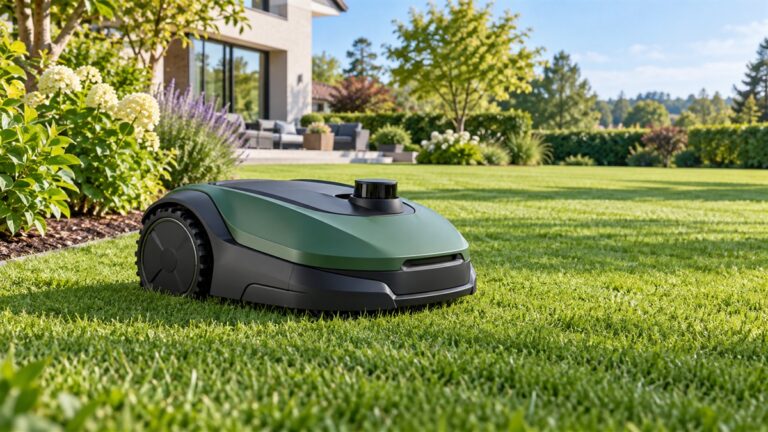
The Gardena SILENO minimo robotic lawnmower is a boundary-wire robot mower sold in two sizes, a 250 m² model and a 500 m² model. Gardena’s product pages list both with a 16 cm cutting width, a 57 dB(A) sound level, a 6.1 kg weight and a 25 percent maximum slope inside the installation. The two sizes differ on charge time, mow time and energy use, and the pages give different article numbers for the smaller one. This guide covers what the manufacturer and two university extension sources state, how to use those figures, and what they leave out.
Quick answer
- Choose the size by lawn area first. The 250 m² page lists a working area capacity of 250 m² with a plus or minus 20 tolerance. The 500 m² page lists 500 m².
- Run time per charge differs. The 250 m² page lists 60 minutes to charge and 70 minutes of mowing on one charge. The 500 m² page lists 75 minutes and 65 minutes.
- The slope limit is 25 percent inside the installation and 10 percent at the boundary on both product pages.
- Passage width and charging station placement decide whether the mower can reach every corner. Gardena’s support page sets a 60 cm minimum between boundary cables and uses a guide wire for narrow passages.
Which SILENO minimo this guide covers
The name covers two machines. Gardena’s support page lists the smaller one as 15201-20 and the larger one as 15202-20. The UK product page for the 250 m² model gives its commercial reference as 15201-28, and the international page for the 500 m² model gives 15202-20. The pages opened for this guide do not explain the difference between the -20 and -28 suffixes. Match the article number on your box or label to the page you are reading before you compare figures.
Side-by-side specifications
| Item | 250 m² model | 500 m² model |
|---|---|---|
| Stated area | 250 m² working area capacity, with a plus or minus 20 tolerance | 500 m² area capacity |
| Commercial reference | 15201-28 (UK product page) | 15202-20 (international product page) |
| Typical charging time | 60 min | 75 min |
| Typical mow time on one charge | 70 min | 65 min |
| Mean energy use per month at maximum use | 2.1 kWh | 3.5 kWh |
| Daily active time required (mowing and charging) | 5.5 h for maximum area capacity | 12 h for maximum area capacity |
| Maximum slope inside installation | 25 % | 25 % |
| Maximum slope at boundary | 10 % | 10 % |
| Cutting width | 16 cm | 16 cm |
| Cutting height | 20 mm to 45 mm | 20 mm to 45 mm |
| Sound level | 57 dB(A) | 57 dB(A) |
| Weight | 6.1 kg | 6.1 kg |
| Protection rating | IPX5 | IPX5 |
| Boundary type | Physical wire | Physical wire |
| Lift sensor / PIN code / alarm | Yes / Yes / No | Yes / Yes / No |
| Installation accessories listed | 150 m loop wire, 3 m low voltage cable, 150 stakes | 150 m loop wire, 3 m low voltage cable, 150 stakes |
Every figure in the table is copied from the Gardena page named in the source list. The table shows what the pages state. The sources do not include measured performance, so the table cannot tell you how either model does on a real lawn.
What the time figures add up to
Each page gives a charge time and a mow time. Combined, they show how much of each charge cycle the mower spends cutting:
Mowing share = mow time / (mow time + charge time)
For the 250 m² model: 70 / (70 + 60) = 70 / 130 = 0.54, so about 54 percent of each cycle is mowing.
For the 500 m² model: 65 / (65 + 75) = 65 / 140 = 0.46, so about 46 percent of each cycle is mowing.
The smaller model spends the larger share of its cycle cutting. This comes from the listed numbers, which Gardena calls typical. The pages do not say how the time is split when the mower works a real lawn with narrow passages or slopes.
The energy line is given for maximum use, so dividing it by the listed area gives a rough index, not a measured consumption figure:
Energy index = mean monthly energy at maximum use / listed area
For the 250 m² model: 2.1 kWh / 250 m² = 0.0084 kWh per m² per month.
For the 500 m² model: 3.5 kWh / 500 m² = 0.0070 kWh per m² per month.
On this index the larger model uses less energy per square metre at its own maximum. The gap is small, and the index only compares two listed figures. It does not estimate a bill.
Slope: what 25 percent means on a lawn
Both pages state a maximum slope of 25 percent inside the installation and 10 percent at the boundary. The 250 m² page says the mower can handle “scaling slopes or inclines of up to 25 percent.” A slope in percent is rise divided by run, so 25 percent rises 25 cm for every 100 cm across. The angle is the arctan of 0.25:
Angle = arctan(25 / 100) = arctan(0.25) = about 14 degrees
Measure the steepest line across your lawn with a straight board, a tape and a spirit level. Do not average across the whole lawn, because a flat average hides the steep section. The boundary figure is lower, at 10 percent. The pages list it as a separate number but do not explain how the mower behaves there, so check any steep edge along a path or driveway against that figure.
The University of Georgia extension bulletin sets a limit for riding mowers, not robot mowers, of 15 degrees or 27 percent slope. It is a comparison point only. The extension sources do not give a robot-specific slope rule, so the Gardena figure is a manufacturer statement.
How the mower stays inside its area
The SILENO minimo works inside a physical boundary wire. Both pages list the boundary type as physical wire, with 150 m of loop wire, 3 m of low voltage cable and 150 stakes in the accessories. The boundary wire marks the edge of the mowing area and tells the mower where it may go.
The support page also covers narrow passages. Long passages 60 cm wide, measured boundary cable to boundary cable, “can be mowed by the CorridorCut function easily,” provided a guide wire is installed. The product page describes CorridorCut as mowing between boundary wires with a width of just 60 centimetres.
The 60 cm number is a minimum for the gap between boundary cables, and the support page says the minimum width also depends on what sits beside the passage. The rule is that “the minimum distance between the boundary cables must be 60 cm,” and the distance to an obstacle is added on each side. The page’s example, for the SILENO city model, adds 35 cm + 60 cm + 35 cm = 130 cm for a passage between two house walls. Use it as the method and take the exact distances for your model from the operation manual.
Here is a worked case that is not from any Gardena page. A fence sits 25 cm from one boundary cable and a bed edge 40 cm from the other. The method gives 25 cm + 60 cm + 40 cm = 125 cm. This assumes the cable positions stated, which the listing does not give for your passage.
For long passages without an installed guide wire, the support page says the passage should be at least 1.5 m wide. So a passage between 60 cm and 1.5 m wide is only covered by the page’s rule if the guide wire is installed.
Installation and the charging station
The support page says the charging station can generally sit outside the working area, then warns that “the area in front of the charging station is a high traffic location.” It also explains the cost of a poor position: “If the charging station is placed in a passage or outside the working area, it comes to a lot of turning processes, which causes a worn and flatted lawn.”
The page says the mower should be able to start in any direction and return to the station from any direction. Plan the station position with that in mind, and keep it out of the route the mower uses most.
On schedule, the page recommends running the mower five days a week, and says the mower is designed to mow continuously. The time it needs “depends on the size and the complexity of your garden,” so area alone does not set the schedule. The pages list a daily active time of 12 h for maximum area capacity on the 500 m² model and 5.5 h on the 250 m² model. These describe the scale of each model, not a schedule for your lawn.
Safety: what the manufacturer says
The 500 m² page states that “highly responsive collision sensors make sure the mower operates safely with no accidents or damage to your garden.” It also says that when the tool is lifted, “another set of sensors make the blades stop immediately, thus preventing injuries.” The sensors and lift stop are the manufacturer’s safety claims. The pages opened for this guide do not name a certification standard for them, and they do not say how fast the blades stop.
On weather, the 500 m² page says “the SILENO minimo works under all weather conditions, rain, or sunshine, on small and complex lawns”. The 250 m² page says the mower waits when the ground is frozen or too frosty. The University of Georgia bulletin takes a different line for lawn mowers in general and advises against operating them “if there are strong winds, thunderstorms or fog in the area.” That bulletin is written for mowers generally, and the Gardena pages do not reconcile the two. Check the manual’s weather rules before you schedule mowing in wind, storms or fog.
Safety: what the extension sources say
The University of Arkansas fact sheet FSA1005 lists robotic lawn mowers among the less common mower types, “namely robotic lawn mowers and hover mowers.” Its prevention advice is written for motorized mowers, so it gives no robot-specific rule. Its general advice still applies to the working area. It says mower injuries “can be easily prevented if safety precautions are followed.”
The sheet’s main warning is about thrown objects: “a mower blade can pick up and throw objects with a force sufficient to seriously injure or kill.” For a robot, that means clearing the lawn before every run. The sheet says to “Clear the lawn of sticks, stones, toys, bones and other objects” before mowing, and it says to keep people and pets away from the mowing area.
The sheet also says to make sure protective devices are in place before starting a mower, and it warns against defeating stop features: “This safety feature should never be bypassed.” For a robot, the equivalent check is that the lift sensor and the blade housing are in their factory state and that no one has disabled a stop.
The University of Georgia Cooperative Extension Bulletin 1415 is a safety checklist for landscape crews. It gives a working distance of “at least 45 ft. (15 m.) from people, animals, or property (this includes vehicles driving on roads).” The Gardena pages give no distance for the SILENO minimo, so treat the 45 ft figure as a general mowing guideline, not a Gardena specification. The same bulletin says to pick up objects “such as stones, bottles, pinecones and sticks, which can be thrown by the mower.”
How to choose between the two sizes
Start from the measured lawn area in square metres, not from the name on the box. Then check the shape. A lawn near 250 m² with many beds and narrow passages should be checked against the 500 m² figures, because the support page ties the time needed to the complexity of the garden. A lawn near the top of the 250 m² range also sits close to the edge of the stated tolerance. The 250 m² page does not say how its plus or minus 20 tolerance applies to a given lawn.
Use this order:
- Measure the lawn area, adding beds and paths the mower will cross and subtracting areas it must never enter.
- Measure the narrowest passage, cable to cable, and add the obstacle distances on each side.
- Measure the steepest slope and compare it with 25 percent inside the installation and 10 percent at the boundary.
- Choose a station position out of passages and high traffic spots.
- Only then compare charge and mow times, using the mowing share above.
If the lawn sits well inside the 250 m² figure and has simple shapes, the smaller model’s higher mowing share fits. If the lawn is larger, or its shape pushes the work toward the top of the range, the 500 m² model is the one with the larger stated capacity. The pages do not say that either model is better on a given lawn.
Mistakes to avoid
Buying by area alone. The support page says the time needed depends on the size and complexity of the garden.
Placing the charging station in a passage. The support page calls the area in front of the station a high traffic location and links a poor position to a worn, flattened lawn.
Ignoring the 60 cm rule. A passage narrower than the boundary cable minimum cannot be mowed as planned. Measure cable to cable, then add the obstacle distances.
Using the boundary figure as the slope figure. The 25 percent number applies inside the installation. The boundary figure is 10 percent.
Skipping the manual. The support page says the exact model-specific distances are in the operation manual, and its worked example is for a different model.
Buying checklist
- Confirm the article number on the box or label: 15201-20 or 15202-20 on the support page, 15201-28 on the UK page for the 250 m² model.
- Write down the lawn area in square metres, the narrowest passage and the steepest slope you measured.
- Pick a charging station position away from passages and the most used path.
- Compare charge and mow times using the mowing share formula.
- Check the PIN and alarm settings. Both pages list a PIN code as Yes and the alarm as No.
- Clear the lawn of sticks, stones, toys and bones before the first run.
What we could not verify
The sources used here do not include independent measurements of run time, cut quality or noise on a lawn. The figures are typical values from the manufacturer, and the sound level does not state its measurement conditions.
We could not verify how the plus or minus 20 tolerance on the 250 m² capacity applies to a given lawn, or what the -20 and -28 suffixes mean.
The battery type, battery warranty and charger details are not stated in the pages opened for this guide.
The pages do not describe how the mower behaves at the 10 percent boundary slope, or how fast the blades stop.
No robot-specific extension bulletin was found among the sources opened. The two fact sheets used here are written for mowers in general.
The manufacturer’s weather claim and the extension advice on wind, storms and fog do not match, and the sources used here do not settle which rule applies to this model.
How we chose
Each figure comes from a Gardena page or an extension source named in the source list, and each figure is attributed to the page it came from. The guide covers both sizes because the keyword does not name one. It does not rank the SILENO minimo against other robot mowers.
Sources were ranked in this order: the manufacturer’s product and support pages for specifications, and university extension fact sheets for safety rules. Wikipedia was not used for any safety or procedure claim. Retailer listings appeared in search results, but none of their figures was used, because they differed from the manufacturer pages.
The research folder has no product data file for this keyword, so the post includes no product cards and no product links.
Related guides
If you are comparing this model with other robot mowers, start with the Honda Miimo robotic lawn mower guide. For what robot mowers do well and where they fall short, read the pros and cons of robotic lawn mowers. For a smaller lawn, the robot lawn mower for a small lawn guide covers the same size question from another angle.
FAQ
Is the Gardena SILENO minimo a 250 m² or a 500 m² mower?
It is sold as both. The Gardena pages list a 250 m² model with a plus or minus 20 tolerance and a 500 m² model. Match the article number on the box to the page you are reading before you compare the figures.
How long does the SILENO minimo take to charge and mow?
The 250 m² UK product page lists a typical charging time of 60 minutes and a typical mow time on one charge of 70 minutes. The 500 m² international product page lists 75 minutes to charge and 65 minutes of mowing. These are typical manufacturer figures, not results measured on your lawn.
Can the SILENO minimo handle a 25 percent slope?
Both product pages list a maximum slope of 25 percent inside the installation and 10 percent at the boundary. A 25 percent slope is about 14 degrees. Measure the steepest line across your lawn before you rely on the figure, and check the boundary separately.
Does the SILENO minimo need a boundary wire?
Yes. Both pages list a physical wire boundary, and the installation accessories include 150 m of loop wire, 3 m of low voltage cable and 150 stakes. Plan the wire route before you install the charging station.
Does the SILENO minimo have an alarm?
Both product pages list the alarm as No, and both list a PIN code as Yes. The pages opened for this guide do not describe any other anti-theft feature.
Is the SILENO minimo safe around children and pets?
The pages list collision sensors and a lift sensor that stops the blades when the mower is lifted. The Arkansas fact sheet advises keeping all persons and pets away from the mowing area, and the sensors do not replace that rule. Clear the lawn before every run, and keep children and pets well away while the mower works.
Bottom line
Choose the size from the measured lawn area, the narrowest passage and the steepest slope before you choose by name. If your lawn sits near 250 m² or has narrow passages, read the support page and the operation manual’s distance table before you buy.
Sources
- Gardena, robotic mower SILENO minimo 500 m² product page: the 500 m² specifications, charge and mow times, energy figure, slope and boundary limits, sensors and installation accessories.
- Gardena, robotic mower SILENO minimo 250 m² product page (UK): the 250 m² capacity, commercial reference, charge and mow times, energy figure, slope rating and sensors.
- Gardena, Robotic Lawnmowers information page (support): the article numbers for both models, passage width rules, charging station placement and the schedule recommendation.
- University of Arkansas System Division of Agriculture, FSA1005 Lawn Mower Safety: the mower types list, thrown-object risk, keep-away advice, guard check and the rule on bypassing safety stops.
- University of Georgia Cooperative Extension, Bulletin 1415 Lawn Mower Safety: the working distance rule, object pickup rule, wind and fog advice and the riding-mower slope limit.