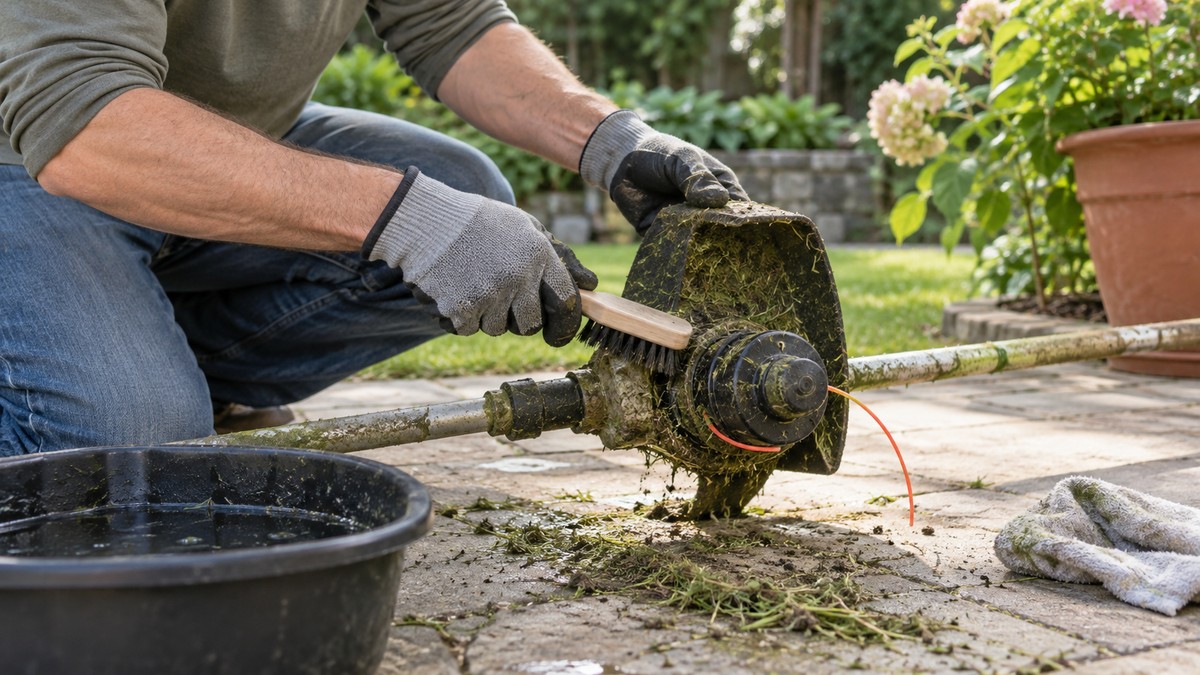
How to Clean a String Trimmer Head and Shaft
As an Amazon Associate we earn from qualifying purchases.
To learn how to clean string trimmer head parts safely, start by removing the battery. The manuals and support pages we opened agree on that first step. After that, clear grass and debris from the cutting head area, wipe the body, and keep water off the tool. The sources do not agree on whether the body should be wiped with a damp cloth or a dry one, so this guide shows both instructions and asks you to follow your own model’s manual when they differ.
Quick answer
- Remove the battery before cleaning. Toro lists this as the first step after each use.
- Clear grass and debris from the cutting head area and from under the grass shield.
- Wipe the body clean, but never hose or submerge the trimmer. Toro says to use a damp cloth; Husqvarna says a dry cloth.
- Do not clean the deflector blade with your hands. The manufacturer calls it sharp.
Why the battery comes first
Toro’s maintenance list for its 60V string trimmers starts with the words “After each use of the trimmer, complete the following,” and the first item is to remove the battery from the trimmer. Echo’s string trimmer guide makes the same point for battery tools: for battery-powered tools it is always a good idea to remove the battery or unplug it from the charger. Husqvarna’s checklist for a battery-powered grass trimmer opens its maintenance section with a warning to remove the battery before you perform any maintenance.
Safety checks before you clean the head
Three safety points come up across the sources. First, the battery comes out before any cleaning. Second, the deflector blade is sharp. Toro’s manual says the line cutoff blade on the deflector is sharp and can cut you, and it tells you not to use your hands to clean the deflector shield and blade. Third, keep water off the tool. Toro says not to hose the trimmer down or submerge it in water, and Husqvarna says to use no water on the external parts.
Echo’s maintenance guidance adds that gloves and eye protection help shield you from flying debris during maintenance. Husqvarna’s daily checks include making sure the screws and nuts are tight. Toro’s manual adds a general rule for maintenance: check and tighten all fasteners, and if any part is damaged or lost, repair or replace it.
Step-by-step: cleaning the cutting head and shaft
Each step below names the sources it comes from. Where a step uses one manufacturer’s model, the source says so. Check your own manual for the model-specific details.
- Take the battery out. Toro’s after-use list begins with removing the battery, and Husqvarna’s warning comes first in its battery trimmer checklist. Do this before you touch the head. Toro and Echo say the same thing for battery tools.
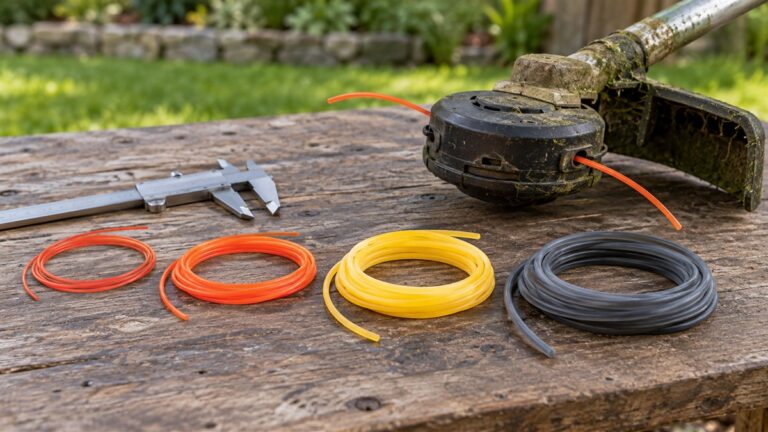
- Clear grass and debris tangled on the head. Husqvarna’s head page for a petrol trimmer says to turn the product off and remove “any grass, weeds, or debris tangled around the trimmer head.” That page is for a petrol model, so use it for the head step only, not the battery step.
- Wipe or scrape the cutting head area. Toro says to wipe or scrape clean the cutting head area any time there is an accumulation of debris.
- Clean debris from under the grass shield and in the bump head housing. Toro’s troubleshooting table lists debris under the grass shield or in the bump head housing as a cause when the bump head does not advance the line, and it says to clean that debris away.
- Clean debris from the head while you replace the line. Toro’s string replacement section says to remove the battery pack and clean any debris from the trimmer head. For Ryobi One+ string options, see the Ryobi One+ weed eater string guide.
- Wipe the body. Toro says to wipe the trimmer clean with a damp cloth and not to hose it down or submerge it. Husqvarna says to clean the external parts of the product with a dry cloth and to use no water. See the section on cloth choice below.
- Keep the handles dry and free of oil and grease. Husqvarna’s checklist includes this item among its daily checks.
- Brush debris from the air vents. Toro says to brush debris away from the air intake vents and exhaust on the motor housing to prevent the motor from overheating.
- Check the cutting attachment and fasteners. Husqvarna says to make sure the cutting attachment is not damaged and to replace it if you see any cracks or damage. Echo says to briefly inspect the tool for damage, including cracks, worn parts, or loose fasteners.
What about the shaft?
None of the five pages we opened gives a separate step for the drive shaft. Toro’s instruction to wipe the trimmer clean covers the whole tool, and Husqvarna’s instruction covers the external parts. Neither page describes grass wound around the shaft. If your model’s manual has a shaft step, follow it,
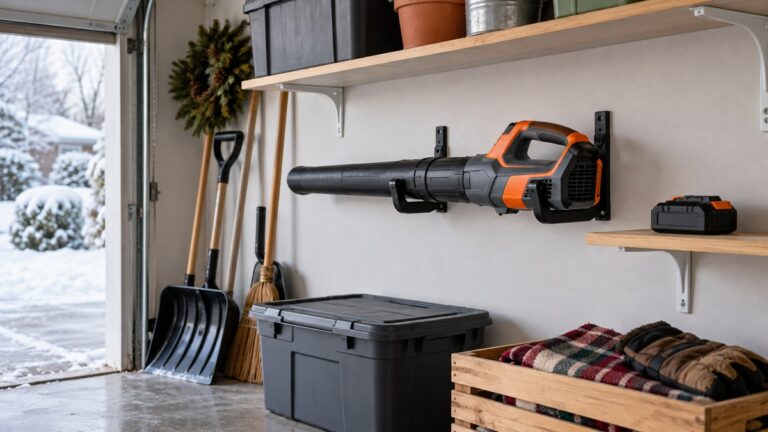
The shaft also has a practical link to storage. Echo advises storing the trimmer in a clean, dry, well-ventilated area that is not in direct sunlight or exposed to excessive moisture, and it suggests storing the trimmer off the ground on a shelf hook to prevent moisture buildup. That advice is about storage, not cleaning.
Cloth choice: where the sources disagree
This is the one point on which the sources give opposite instructions. Toro’s two 60V string trimmer manuals say to wipe the trimmer clean with a damp cloth and not to hose it or submerge it in water. Husqvarna’s battery grass trimmer checklist says to clean the external parts with a dry cloth and says not to use water. Echo’s guide says to thoroughly clean the trimmer after each use to remove dirt, grass, and debris, but it does not name a cloth type.
This guide shows both instructions rather than picking one. Toro and Husqvarna agree on two points: remove the battery before cleaning, and do not use water on the body. The disagreement is only about whether a damp cloth is acceptable. If your manual names a cloth, follow the manual. If it does not, the sources we opened do not settle the question.
Cleaning tasks and intervals from the sources
The table below lists each cleaning or check task and the interval that each source gives. Where a source gives no interval, the cell says not stated.
| Task | Interval stated | Source |
|---|---|---|
| Remove the battery before cleaning | After each use (Toro); before any maintenance (Husqvarna) | Toro 226979 and 255142; Husqvarna KA-70169 |
| Wipe the trimmer body | After each use (Toro, damp cloth); daily (Husqvarna, dry cloth) | Toro 226979 and 255142; Husqvarna KA-70169 |
| Clean the cutting head area | When debris builds up | Toro 226979 and 255142 |
| Clear debris under the grass shield or in the bump head housing | Not stated as an interval; listed as a troubleshooting step | Toro 226979 and 255142 |
| Brush debris from air intake vents and exhaust | Not stated | Toro 226979 |
| Make sure screws and nuts are tight | Daily (Husqvarna) | Husqvarna KA-70169 |
| Check couplings and connections | Weekly (Husqvarna) | Husqvarna KA-70169 |
| Check connections between battery and product | Monthly (Husqvarna) | Husqvarna KA-70169 |
| Thoroughly clean to remove dirt, grass, and debris | After each use (Echo, in its storage tips) | Echo string trimmer maintenance guide |
The Toro pages and the Husqvarna pages do not use the same schedule, so do not mix the intervals. The Toro list is written as an after-use routine. The Husqvarna list is split into daily, weekly and monthly checks, and the weekly and monthly items are checks of couplings and battery connections rather than of the head itself.
What each source says, side by side
The table compares the five pages on the four points that matter for cleaning the head. Each cell is taken from the page named in the first column.
| Source | Battery step | Body wipe | Water | Head or debris |
|---|---|---|---|---|
| Toro 60V string trimmer manual (13in or 15in), manuals.toro.com/226979 | Remove the battery pack after each use | Damp cloth | Do not hose or submerge | Wipe or scrape the cutting head area when debris builds up |
| Toro Revolution 60V string trimmer manual, manuals.toro.com/255142 | Remove the battery pack after each use | Damp cloth | Do not hose or submerge | Wipe or scrape the cutting head area when debris builds up |
| Husqvarna battery grass trimmer checklist, KA-70169 | Remove the battery before any maintenance | Dry cloth on external parts | Do not use water | Check the cutting attachment for damage; not stated for debris |
| Echo string trimmer maintenance guide | Remove the battery or unplug it from the charger | Not stated | Not stated | Clean after each use to remove dirt, grass, and debris |
| Husqvarna trimmer head page, petrol model | Not stated | Not stated | Not stated | Turn off the product and remove grass, weeds, or debris from the head |
The comparison shows that the battery step is the one point that all battery-tool sources state. The water and cloth rules come from the manufacturer pages only, and the petrol head page is the only one that addresses grass tangled on the head.
How we chose
We looked for manufacturer pages that describe cleaning or maintenance of a string trimmer, in a form the tool could open as text. We opened five pages on 2026-10-22: two Toro interactive manuals for 60V string trimmers, the Husqvarna US page for a battery-powered grass trimmer checklist, the Echo string trimmer maintenance guide, and the Husqvarna US page on a trimmer head that does not spin freely. The two Toro manuals are for different models, and they give the same cleaning steps.
Several manufacturer manuals were PDFs, which this tool cannot open, so they are not used. Some pages could not be opened, and those pages are not counted. We did not rank the sources, and we did not pick the best cleaning method. Each quote in this guide comes from the saved text of the page it cites.
What we could not verify
- Whether the steps match your model. The two Toro pages cover 60V string trimmers. The Husqvarna pages cover a petrol brushcutter and a petrol trimmer, and the Echo guide is general.
- Whether a damp cloth or a dry cloth is right for your trimmer. The sources disagree, and only the manual for your model can settle that.
- How often to clean the head in heavy, wet or dusty grass. The sources say after each use or when debris builds up, but none gives a number of hours or a number of cuts.
- Whether a given cleaning product is safe for the plastic housing. None of the pages we opened names a cleaning product.
What the sources do not say
No page we opened gives a separate step for cleaning the drive shaft, and none describes grass wrapped around the shaft. The shaft appears only in the general instruction to wipe the trimmer clean.
The Husqvarna head page does not mention the battery. It is a petrol-powered trimmer page, so its instruction to turn the product off is the only power step it gives. Use the battery instruction from the battery checklist, not from the head page.
The pages do not give a cleaning interval in hours, and they do not say how long to wait after cleaning before you use the trimmer again. The sources also do not compare head designs between brands. If you are weighing a new head or accessory, see the EGO Power+ and WORX trimmer accessories comparison.
FAQ
Do I need to remove the battery before I clean a string trimmer head?
Yes, according to every battery-tool source we opened. Toro’s manuals list removing the battery pack after each use, Husqvarna’s battery trimmer checklist opens with a warning to remove the battery before maintenance, and Echo says it is always a good idea to remove the battery or unplug it from the charger on battery tools.
The Husqvarna head page for a petrol trimmer does not mention a battery, because it covers a different power type. Do not read that page as permission to clean with the power connected.
Can I rinse my string trimmer with a hose?
No, according to the two Toro manuals. They say not to hose the trimmer down or submerge it in water. Husqvarna’s checklist says to use no water on the external parts and to clean them with a dry cloth. None of the pages describes a rinse as a cleaning method.
Should I use a damp cloth or a dry cloth on the body?
The sources disagree. Toro says to use a damp cloth, and Husqvarna says to use a dry cloth. Follow the instruction in your own manual. If the manual does not name a cloth type, the pages we opened do not settle the question, and you should keep water away from the tool either way.
What parts of the head should I clean?
Clear any grass, weeds, or debris tangled around the trimmer head. Wipe or scrape the cutting head area when debris builds up. Clean debris from under the grass shield and in the bump head housing, because Toro’s troubleshooting lists debris in those places as a cause when the bump head does not advance the line.
Can I clean the deflector blade by hand?
No. Toro says not to use your hands on the deflector shield and blade, because the line cutoff blade is sharp. The sources do not say what tool to use for that job, so check the manual for your model before you clean the deflector.
How often should I clean my string trimmer head?
Toro’s guidance is to wipe the trimmer clean after each use and to clean the cutting head area whenever debris builds up. Echo says to thoroughly clean the trimmer after each use to remove dirt, grass, and debris. Husqvarna’s checklist adds daily checks of the screws and nuts and the cutting attachment, and weekly and monthly checks of the connections.
Bottom line
Remove the battery first, clear the head, and then wipe the body with the cloth type your own manual names. Never hose the trimmer down. When a manual and this guide disagree, the manual for your model wins.
Sources
- Toro: Interactive Manual, Flex-Force 13in or 15in 60V MAX String Trimmer (opened 2026-10-22)
- Toro: Interactive Manual, Revolution 60V String Trimmer (opened 2026-10-22)
- Husqvarna US: Maintenance for a grass trimmer (opened 2026-10-22)
- ECHO: String Trimmer Maintenance Guide (opened 2026-10-22)
- Husqvarna US: Trimmer head does not spin freely (opened 2026-10-22)