How to Sharpen Grass Trimmer Blades
As an Amazon Associate we earn from qualifying purchases.
To sharpen a grass blade, stop the tool and let the cutting attachment stop completely. Battery models need the battery removed first, and petrol models need the spark plug disconnected. Then file each cutting edge with a single-cut flat file, keeping every edge equal so the blade stays balanced. This guide explains how to sharpen grass trimmer blades on the grass blades that Husqvarna describes for its brushcutters, and when a blade has to be replaced instead of filed.
Quick answer
- Stop the tool and let the cutting attachment stop completely. Remove the battery on battery models, or disconnect the spark plug on petrol models.
- File each cutting edge with a single-cut flat file, in smooth, straight strokes, following the original bevel. Sharpen all edges equally.
- Replace the blade instead if it is cracked, bent, twisted, or missing material. Never straighten it.
- The cited pages give no grinder method, no vise method, and no sharpening interval.
Which trimmers take a metal blade
The Husqvarna pages cited here describe a grass blade fitted to a Husqvarna brushcutter. Husqvarna’s maintenance page for a battery-powered grass trimmer asks for a similar check on the cutting attachment: make sure the guard or blade is not damaged, and make sure the locknut is tightened correctly. The cited pages do not state what material the grass blade is made from, so do not assume a material from these pages.
Trimmers that take line instead
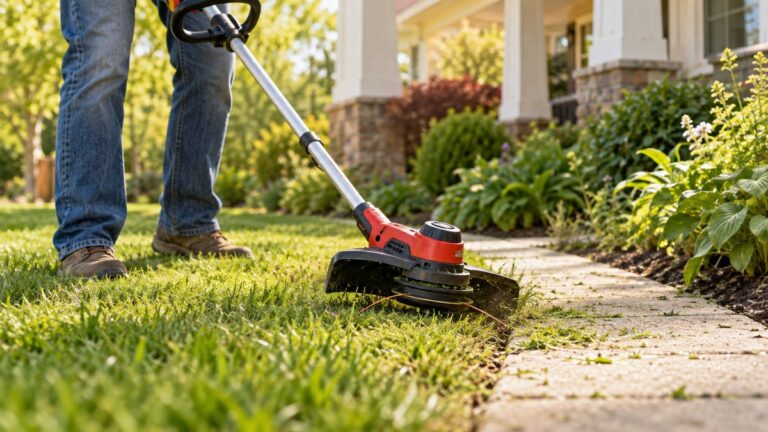
A string trimmer head uses line, so the filing steps below apply only to a metal blade. DeWalt’s support page answers the question directly: it says DeWalt does not offer a blade, adapter, or accessory that changes its string system into a blade system. For a DeWalt string trimmer, see DeWalt FlexVolt 60V Max string trimmer options. If your head takes line, see Ryobi One+ weed eater string options for the line side of the choice.
When a grass blade needs sharpening
Husqvarna ties sharpening to what the cutting shows, not to a calendar. Its brushcutter guide says that a dull blade makes the machine work harder, and that the cutting results may become uneven. The same guide says to sharpen the grass blade if you notice poor cutting performance, torn or uneven grass, increased effort when cutting, or more engine load than usual.
A second list on the same page covers the blade itself. Sharpen the blade when cutting performance decreases, when grass looks torn rather than cleanly cut, when you notice increased vibration caused by an uneven edge, or when the blade becomes visibly dull. Each of these signs is a reason to inspect the blade before you decide to file it.
The maintenance page for a battery-powered grass trimmer puts a blade check under daily maintenance. The check asks you to make sure the blade is correctly centred, is sharp, and is not damaged. None of the cited pages gives a fixed interval in hours, weeks, or cuts.
Safety before you touch the blade
Blade work starts with the power source. Each step below comes from a cited page, and each one applies before the blade is handled.
- Stop the tool and let it come to rest. Husqvarna’s switching guide tells the reader to switch off the engine and to allow all moving parts to stop completely before work on the cutting attachment.
- Remove the battery on battery models, or disconnect the spark plug cap on petrol models. The maintenance page warns: remove the battery before you perform any maintenance.
- Wear protective gloves. The Husqvarna sharpening page carries the warning to stop the engine and use protective gloves.
- Secure the brushcutter on a stable surface before you start filing.
OSHA’s construction guidance on electric tools is more general. It says to disconnect tools before servicing, and when changing accessories such as blades. That page is written for electric tools on construction work, so treat it as general support for cutting power before blade work, not as a brushcutter manual.
OSHA’s landscaping hazards page lists keeping clear of rotating mower and brush-cutting blades as a solution, and it lists wearing gloves as well. Those two lines are general, but they match the Husqvarna steps on gloves and on keeping clear of the blade.
Sharpening procedure, step by step
- Stop and disconnect. Let the cutting attachment stop completely. Then disconnect the spark plug cap on a petrol model, or remove the battery on a battery-powered model. Put on protective gloves before you touch the blade.
- Secure the tool. Place the brushcutter on a stable surface. The cited pages do not describe a holding method for the blade itself, so do not clamp it unless your manual says to.
- Inspect the whole blade. Check the entire blade for cracks and bent sections. The Husqvarna page is direct on this point: do not sharpen a damaged blade, and replace it instead. If the blade is damaged, stop here and follow the replacement section below.
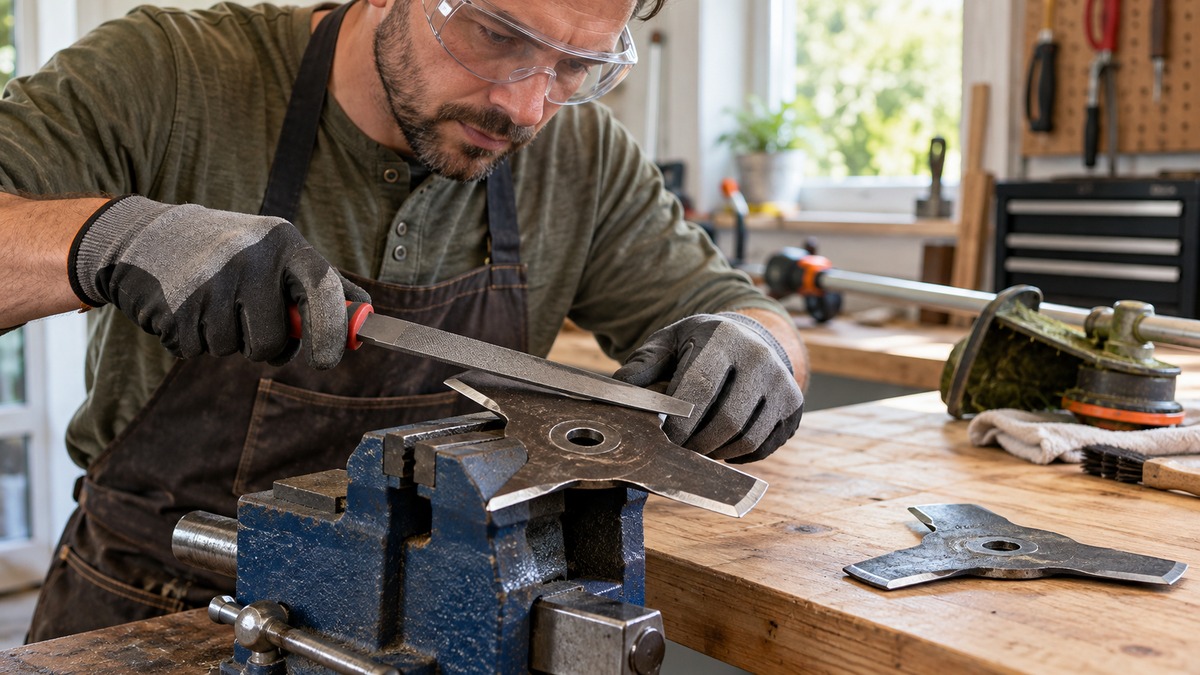
- File each cutting edge. Use a single-cut flat file. Work in smooth, straight strokes and follow the original bevel on the blade. Remove only the amount of material needed to restore the cutting edge.
- Keep every edge matched. Sharpen every cutting edge equally, then check that the cutting edges are smooth and even. Do not put more metal off one side than the other.
- Clear the filings. Remove any filings and debris before reinstalling the blade.
- Reinstall and check. Refer to the instructions that come with the cutting attachment. Fit the locking nut and tighten it according to the instructions in your operator’s manual. Check that all parts are correctly fitted and that the blade is securely fastened before use, and make sure the blade is correctly centred.
Keeping the blade balanced
Balance explains most of the filing rules. The Husqvarna page says that removing more material from one side than the other can create an unbalanced blade, and that the result is vibration and poor performance. That is why the sources ask for equal filing on every edge, not extra work on the worst edge alone.
The cited pages do not describe a balancer, a balance check, or a number of sharpenings after which the blade should be checked. A blade that is filed evenly and refitted centred is the only balance step the cited pages describe.
When to replace the blade instead
Filing is only for a blade that is dull but undamaged. Husqvarna’s sharpening guide lists four conditions that call for an immediate replacement: a blade that is cracked, bent, twisted, or missing material. The same page then says never to attempt to straighten or repair a damaged blade.
The maintenance page gives the same rule for the cutting attachment and guard: replace if you see any cracks or damage. The switching guide adds that worn or damaged blades should be replaced immediately. Taken together, cracks, bends, twists, and missing material all mean a new blade, and none of the cited pages describes repairing one.
The cited pages do not say which replacement blade fits a given model.
Sharpening checks at a glance
| Check | What the cited pages state | Source |
|---|---|---|
| Power source, battery models | Remove the battery (battery models) or disconnect the spark plug (petrol models) | Husqvarna KA-70171 |
| Moving parts | Allow all moving parts to stop completely | Husqvarna KA-70172 |
| Maintenance on battery trimmer | Remove the battery before you perform any maintenance | Husqvarna KA-70169 |
| Inspection before filing | Check the entire blade for cracks and bent sections; do not sharpen a damaged blade | Husqvarna KA-70171 |
| File type | Single-cut flat file | Husqvarna How-to Sharpen page |
| Filing technique | Smooth, straight strokes; follow the original bevel; remove only the material needed | Husqvarna KA-70171 |
| Edge balance | Sharpen every cutting edge equally | Husqvarna KA-70171 |
| Sharpening interval | Not stated | Not stated |
| Grinder use | Not stated | Not stated |
| Holding the blade in a vise or clamp | Not stated | Not stated |
| Blade material | Not stated | Not stated |
| Replacement triggers | Cracked, bent, twisted, or missing material | Husqvarna KA-70171 |
| Blade check in daily maintenance | Blade correctly centred, sharp, and not damaged | Husqvarna KA-70169 |
| Disconnecting for accessory changes (general) | Disconnect before servicing and when changing accessories such as blades | OSHA construction eTool |
| String trimmers and blades | No blade, adapter, or accessory offered to convert the string system | DEWALT support article |
How we chose
The criteria were narrow. A page had to describe a grass or brush cutter blade, the power-source step before blade work, blade damage, or general OSHA guidance on disconnecting power. Manufacturer support pages came first, then OSHA pages for general safety. Seven pages were opened on 2026-10-22, and each returned HTTP 200: four Husqvarna US support pages, two OSHA pages, and one DEWALT support page. Each quote in this post was checked against the saved text of its page. No ranking was made. Manuals in PDF form were not used, because the fetch method cannot read PDFs. A Ryobi support page opened the same day does not describe blade sharpening, so it is not cited.
What we could not verify
The cited pages cover Husqvarna grass blades and one general DEWALT answer. They do not show whether another brand’s grass blade or trimmer head uses the same steps, so the steps in this post are not confirmed for other brands.
Two details were not verified at all. The first is the bevel angle, because the page says to follow the original bevel without giving a number. The second is the blade material, which the pages do not state.
The battery-removal step is quoted from Husqvarna pages only. The cited pages do not describe a sensor or lockout on the tool, so this post does not claim one.
What the sources do not say
- Grinders. The cited pages do not describe grinding a blade. This post therefore gives no grinder steps, no grinding angle, and no grinder speed.
- Holding the blade. No cited page describes clamping the blade in a vise or any other holding tool. The pages say to secure the machine on a stable surface, which is a different step.
- Interval. No cited page gives a sharpening interval in hours, weeks, or cuts.
- Locknut torque. The cited pages do not give a torque for the blade nut. They refer the reader to the operator’s manual.
- Hedge trimmers. Hedge trimmer blades are outside this post.
- Mower blades. Mower blades are a different tool. For those, see Black and Decker lawn mower blade options.
FAQ
Do I have to remove the battery before I sharpen a blade?
Yes, the cited Husqvarna pages say so. The sharpening guide lists battery removal under its safety step, and the maintenance page for a battery-powered grass trimmer warns that the battery must be removed before any maintenance. Remove the battery first, before you handle the blade.
Can I sharpen a trimmer blade with a grinder?
The cited pages do not say. None of them describes grinding, a grinder speed, or a grinding angle, so this post gives no grinder method. Use the file method the cited pages describe, and refer to the instructions that come with the cutting attachment for anything else.
How do I tell a blade that needs sharpening from one that needs replacing?
Replace the blade if it is cracked, bent, twisted, or missing material. Husqvarna says to replace it immediately in those cases, and says never to straighten or repair a damaged blade. Filing is the step the pages describe only for a blade that is dull but undamaged.
How often should I sharpen the blade?
The cited pages give no interval. They tie sharpening to signs instead: poor cutting performance, torn or uneven grass, increased effort, more engine load than usual, or a blade that looks visibly dull. The maintenance page also includes a check that the blade is sharp and undamaged as part of its daily checks.
Does my string trimmer take a metal blade?
Not necessarily. DEWALT’s support page says the company does not offer a blade, adapter, or accessory that changes its string system into a blade system. For other brands, check the owner’s manual for your model, because the cited pages do not cover them.
Do I need to balance the blade after filing it?
The cited pages do not describe a balance check or a balancer. They do say to file every cutting edge equally, because removing more material from one side can cause vibration and poor performance. Keep the filing even, and make sure the blade is centred when you refit it.
Bottom line
Replace any blade with a crack, bend, twist, or missing material. File the blade only when it is dull and undamaged, with the battery removed or the spark plug disconnected first.
Sources
- Husqvarna US Help Center: How to: Sharpen the grass knife and grass blade (opened 2026-10-22)
- Husqvarna US Help Center: How to sharpen a grass blade on your brushcutter (opened 2026-10-22)
- Husqvarna US Help Center: How to switch from a trimmer line to a grass blade on a brushcutter (opened 2026-10-22)
- Husqvarna US Help Center: Maintenance for a grass trimmer (opened 2026-10-22)
- OSHA: eTool: Construction – Electrical Incidents – Power Tools (opened 2026-10-22)
- OSHA: Landscape and Horticultural Services – Hazards and Solutions (opened 2026-10-22)
- DEWALT Support: Can I use blades instead of spool strings with my DEWALT string trimmers? (opened 2026-10-22)