How to Match an Electric Mower to Your Lawn Size
As an Amazon Associate we earn from qualifying purchases.
If you want to know how to match an electric mower to lawn size, start with the mower type. Husqvarna publishes its yard-size ranges by mower type, not by battery or cord, so the range tells you which type fits your yard. Then check the power side: the battery layout for a battery model, the cord details for a corded model, and the runtime range the maker states as a claim. This guide uses those ranges and one extension example. It names no products.
Quick answer
- Pick the mower type from the yard size first. Husqvarna’s buying guide gives push mowers up to 1/3 acre, self-propelled walk mowers up to 1/2 acre, and robotic mowers up to 1 1/4 acres, with riding and zero-turn mowers at 2 acres or more.
- Those ranges do not split by power source. Check the battery or cord details separately.
- For a battery model, the maker’s battery page states two 36-volt batteries and a runtime range that depends on the area you mow. Treat that runtime as a manufacturer claim.
- The sources we opened do not state a cord length for corded mowers, so this guide gives none.
Yard size ranges by mower type
The Husqvarna US buying guide gives an approximate capacity for each common mower type. The table copies those ranges. The last two rows show what the same page does not give, so you know where the guide stops.
| Mower type | Yard size the source gives | Source |
|---|---|---|
| Push mower | Up to 1/3 acre | Husqvarna buying guide |
| Self-propelled walk mower | Up to 1/2 acre | Husqvarna buying guide |
| Robotic mower | Up to 1 1/4 acres, or more with multiple units | Husqvarna buying guide |
| Riding mower (lawn tractor) | Up to 2 acres or more | Husqvarna buying guide |
| Zero-turn mower | Up to 2 acres or more | Husqvarna buying guide |
| Battery or corded push or self-propelled mower | Not stated by power source | Husqvarna buying guide |
| Square-foot bands for any mower type | Not stated (the guide uses acres) | Husqvarna buying guide |
The guide calls these the approximate capacity of each mower type. It is one manufacturer’s rule of thumb, not an independent comparison. Yard features also count. The guide says that the features in your yard are nearly as important as its size, and it points to trees and slopes as examples of features that change the choice.
Push or self-propelled for your lawn
The Husqvarna push mower buying guide gives a few rules that help at the edge of each range. For a medium-sized to large lawn that is relatively flat, the guide recommends a self-propelled model. For a medium-sized lawn where you want some exercise, it says a push mower may suit you. For a very small lawn, it mentions a manual or reel mower that uses no fuel or oil.
The same guide estimates the walking effort. Each quarter acre you mow means a walk of one to two miles, so a larger lawn on a push mower is a real workout. If your lawn has hills and uneven terrain, the guide recommends an all-wheel drive self-propelled model. For flat ground, the buying guide notes that front-wheel drive mowers can handle the job, while rear-wheel drive mowers perform better on slopes.
Cutting system is a separate choice. The push mower guide says you need to identify the cutting system you need based on the type of lawn you have and how often you mow it. Rear and side discharge suits taller, wilder grass and lawns you cut seldom. Mulching works well if you mow often and want a pristine lawn. Collection gives tidy results and saves raking after you finish. Push mowers and self-propelled walk mowers offer bagging, side-discharge or mulching options, and the buying guide advises a model capable of all three to maximize versatility. Use the lawn size to pick the type, then use the cutting system to pick the model within that type. If a bagging model is on your list, the post on small electric lawn mowers with a bag covers that type.
If you are weighing battery models in particular, the post on the pros and cons of battery-powered lawn mowers sets out the trade-offs. Come back to the ranges in this guide before you compare models.
Battery mowers: what the maker states
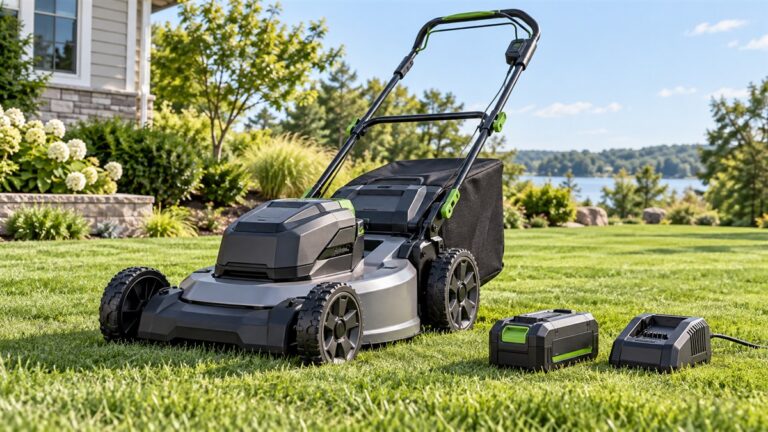
The Husqvarna battery mower page describes a dual-battery layout. It says a battery-powered model features dual battery compartments, and that the two 36-volt lithium-ion batteries deliver between 30 minutes and an hour of cutting time, depending on the area you are mowing. That is a manufacturer statement for one battery layout. It is not a figure for your lawn.
Real runtime changes with grass, cutting height and terrain, and the sources we opened do not give figures for those factors. So a battery model near the top of a mower’s range needs more care. Read the runtime range as a starting point, then check the manual for the battery and charger that come with the model you are considering.
The page does not say what happens to runtime on a larger yard, and it does not say how many batteries a larger yard needs. The dual-battery point is the only battery-layout fact the sources we opened give for sizing.
Corded and robotic models
A corded mower needs a cord that reaches the whole lawn. The sources we opened do not state a cord length or extension cord gauge for any corded mower, so this guide does not give one. Check the owner’s manual for the cord rating and for the reach before you buy or set up the cord run.
Robotic mowers have their own sizing. The buying guide gives up to 1 1/4 acres for a robotic mower, or more with multiple units. It also says that robotic mowers can handle narrow passages and even slopes. The same Husqvarna page gives a grade figure of 26 degrees for one of the maker’s robotic models. That is a single model’s stated figure, not a rule for every robot. The sources we opened do not describe boundary wire layout, so this guide does not describe one.
For a small lawn, a robot can also be the right type, and the post on robot lawn mowers for small lawns looks at that case. Use the same yard-size ranges to decide whether a robot fits your lot before you compare models.
Deck width and time: one worked calculation
Deck width changes how long a fixed area takes to cut. The Penn State Extension example uses a commercial crew, not a home mower, but it states every input: one worker, a steady operating speed of 22 feet per minute, and 1,000 square feet of turf. The source makes the point that the larger the mower, the greater the efficiency gain.
Formula: minutes = area divided by (deck width in feet times operating speed in feet per minute).
Inputs: area = 1,000 square feet. Deck width = 24 inches, which is 2 feet. Operating speed = 22 feet per minute.
Result: 1,000 divided by (2 times 22) = 22.7 minutes. The source rounds this to 23 minutes.
| Deck width | Time to cut 1,000 square feet, as stated | Source |
|---|---|---|
| 24-inch | 23 minutes | Penn State Extension |
| 36-inch | 16 minutes | Penn State Extension |
| 72-inch | 8 minutes | Penn State Extension |
The same formula gives about 15 minutes for the 36-inch case (1,000 divided by (3 times 22), which is 15.2), not the 16 minutes in the source. The source does not explain the difference, so do not read the 36-inch figure as exact. The worked example shows the direction of the effect. It is not a time to plan a home mowing session around, and the source does not give a home mower’s speed.
Safety before you handle the mower
Power has to be off before you clean under a deck or reach near the blades on any mower. The Illinois Extension mower maintenance page says: “Whenever your hand goes near the blades always disconnect the spark plug for gas-powered or remove the battery for electric mowers.” For a battery mower, the Husqvarna support article gives a warning before cleaning: “WARNING: To prevent accidental starts, turn the safety key to 0, remove the battery and wait a minimum of 5 seconds.” The OSHA eTool on power tools gives the general rule: “Disconnect tools when not in use, before servicing, and when changing accessories such as blades, bits, etc.”
This guide gives no blade or deck work steps. The safety points above are the only ones it makes, and they apply whatever size of mower you buy.
How we chose
The seven pages in the sources list are the ones this guide cites, and we opened each one on 2026-10-22. Four of them support the sizing and power points: the Husqvarna US buying guide, the Husqvarna US push mower buying guide, the Husqvarna US battery mower page, and the Penn State Extension example. The other three cover safety: the Illinois Extension mower maintenance page, the Husqvarna US battery mower support article, and the OSHA eTool on power tools.
The Husqvarna pages are one manufacturer’s guidance on yard size and battery layout, so they show a single maker’s view, not a neutral comparison. The Penn State page is the only extension source used for the deck-width example. We quoted each figure word for word from the page text and labelled every maker figure as a manufacturer claim. We did not rank products or name any.
What we could not verify
The yard-size ranges are one manufacturer’s rule of thumb. The sources we opened do not include an independent comparison of those ranges, so we could not check them against one. The runtime figure for the battery layout is a manufacturer claim, and we could not check it for any yard. The Penn State speed is a commercial figure, and we could not confirm a home mower’s speed from any source we opened. The buying guide uses acres, and we did not convert those bands to square feet, because the sources we opened do not give that conversion.
What the sources do not say
The sources we opened do not give square-foot bands for each mower type. They do not split the bands by battery, cord or gas. They do not state a cord length or extension gauge for any corded mower. They do not give boundary wire or slope figures for a robotic mower beyond the one grade figure above. They do not give runtime figures for a larger yard, and they do not say how grass height changes runtime.
FAQ
What lawn size suits a push mower?
The Husqvarna buying guide gives up to 1/3 acre for a push mower. Above that range, the same guide points to self-propelled walk mowers for lawns up to 1/2 acre. Start with those bands before you look at drive type or cutting system.
Do the size ranges apply to battery mowers too?
The guide gives its ranges by mower type. It does not split them by power source, so it gives no separate range for a battery model or a corded model. Check the battery layout, charger and runtime range separately, as the battery section above describes.
How long does a battery mower run?
The Husqvarna battery mower page says that two 36-volt batteries deliver between 30 minutes and an hour of cutting time, depending on the area you mow. That is a manufacturer claim for that layout. Real runtime changes with grass, cutting height and terrain, and the sources we opened give no figures for those.
Should I buy a self-propelled mower for a hilly yard?
The Husqvarna push mower guide says that if your lawn has hills and uneven terrain, an all-wheel drive self-propelled model is recommended. The buying guide adds that rear-wheel drive mowers perform better on slopes than front-wheel drive mowers do.
How long does it take to mow 1,000 square feet?
The Penn State example gives 23 minutes for a 24-inch deck at 22 feet per minute, 16 minutes for a 36-inch deck, and 8 minutes for a 72-inch deck. Those are commercial crew figures. They show how deck width changes the time, but they do not give the time for your mower.
What about a corded electric mower?
The sources we opened do not state a cord length or wire gauge for corded mowers. Check the owner’s manual for the cord rating and the reach. Do not rely on a cord estimate from this guide, because it does not give one.
Bottom line
If your lawn is larger than the push mower range of 1/3 acre, choose a self-propelled model within the mower type that fits your yard, and confirm the battery layout or cord details in the owner’s manual before you buy.
Sources
- Husqvarna US: How to Choose a Lawn Mower & Buying Guide (opened 2026-10-22)
- Husqvarna US: Push Mower Buying Guide (opened 2026-10-22)
- Husqvarna US: Learn About Battery & Electric Lawn Mowers (opened 2026-10-22)
- Penn State Extension: Mowing Grass and Improving Profitability (opened 2026-10-22)
- Illinois Extension: Mower Maintenance (opened 2026-10-22)
- Husqvarna US Help Center: How to clean a battery lawn mower (opened 2026-10-22)
- OSHA: eTool, Construction, Electrical Incidents, Power Tools (opened 2026-10-22)