How to Prune Branches With a Pole Saw
As an Amazon Associate we earn from qualifying purchases.
If you searched for how to prune branches with a pole saw, the short answer is a three-step cut. Make an undercut on the underside of the branch, make a top cut farther out so the limb drops, and finish with a cut just outside the branch collar instead of flush against the trunk. The extension and manufacturer pages we opened describe that same order. They give different distances, so this guide shows each figure next to the page it came from.
This article covers cut technique for smaller branches. It does not cover protective gear, pole saw models or power-line work.
Quick answer
- Make an undercut on the underside first, a set distance from the collar, about a quarter to halfway through the limb.
- Make the top cut farther out, and keep cutting until the branch begins to snap and falls to the undercut.
- Finish just outside the branch collar at about 45 degrees, not flush with the trunk.
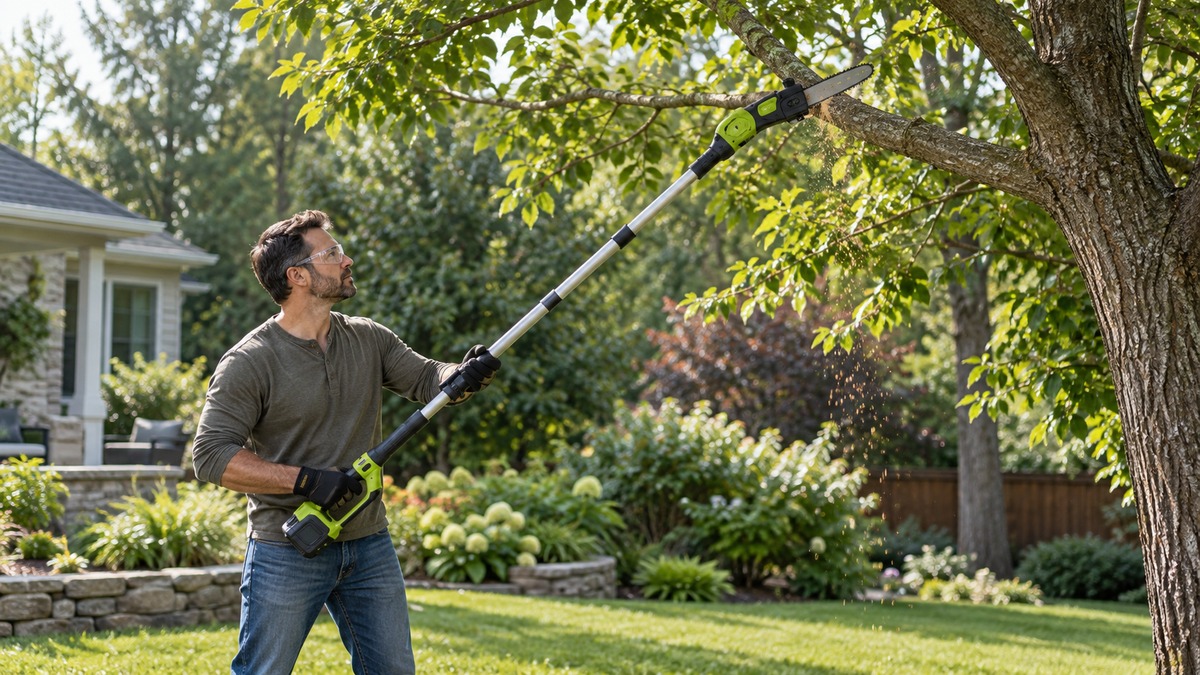
- Operate the pole saw from the ground, not from within the tree.
Why the cut position matters
A pruning cut is a wound, and where you make it decides how well the tree closes that wound. The branch collar is the swollen or raised strip of bark where a branch meets the trunk or a larger limb. The collar helps the tree seal the wound, so the University of Illinois Extension advises keeping the cut just outside it and leaving a smooth finish.
Cutting flush with the trunk does the most damage. Oklahoma State University Extension says a flush cut creates a larger wound and removes the collar tissue that helps the tree recover. UF/IFAS makes the same point: a flush cut cuts into the growth layer of the tree and slows healing.
Stubs are the other common error. A stub is a short piece of branch left past a side branch. Oklahoma State and the University of Wisconsin-Madison Extension both warn that stubs invite decay organisms into the tree. Wisconsin’s advice is to cut back to a side branch or lateral twig instead.
Safety before the first cut
Safety comes first, and the sources we opened treat the ground as the safe place to work. The Husqvarna New Zealand guide says to stand on a firm, fixed and level surface to reduce slipping, and to operate a pole saw from the ground rather than from within the tree. It also advises holding the saw with one hand on the front handle and one on the rear.
Broken limbs in the canopy are a fall risk, and the Illinois Extension release says they should be removed. UF/IFAS lists removing dead, diseased or injured branches as part of healthy pruning. Those are the first limbs to look at before you plan the three cuts.
Scope also matters. UF/IFAS describes minor pruning as the homeowner’s job and recommends an arborist certified by the International Society of Arboriculture for trees taller than about 15 feet. Wisconsin Extension cautions that a limb needing a saw should be removed carefully so the bark is not damaged. This article covers the cut order only. Protective gear and other pole saw safety points are in the owner’s manual for your model.
The three cuts, step by step
The sources describe the undercut-and-top-cut order for heavier limbs, where the weight of the branch can tear the bark as it comes down. The sources we opened do not give a separate sequence for light, small branches. The steps below follow the method as the sources write it. Check your owner’s manual for model-specific limits before you start.
- Pick the cut point. Choose the side branch or lateral twig where the cut will end. Find the branch collar by its wrinkled or rippled bark, and plan to leave that collar in place. Cut back to a lateral twig rather than leaving a stub.
- Make the undercut. Start on the underside of the limb and cut about a quarter to halfway through its thickness. UF/IFAS puts this cut about 12 inches from the branch collar. Oklahoma State puts it about one foot from the trunk, about one-third of the way through. Wisconsin puts it a few inches from the trunk, about one-third of the way into the limb. If the bark begins to tear, the tear should stop at this cut.
- Make the top cut. Cut from above, farther out on the limb than the undercut. Keep cutting until the branch begins to snap and falls down to the undercut. UF/IFAS places this cut about six inches beyond the undercut. Oklahoma State gives about four inches. The Husqvarna KE page describes the top cut as slightly closer to the trunk and gives no distance, so the two placements do not agree.
- Shorten long limbs in sections. Husqvarna NZ advises shortening a branch in sections to reduce its weight before the final cut. The same guide says cutting in sections rather than all at once helps reduce the risk of the bark tearing and leaves cleaner wounds.
- Make the final cut. Cut the remaining stub just outside the branch collar, not flush with the trunk. UF/IFAS advises a 45-degree angle so water does not pool on the wound. Oklahoma State says the final cut should be clean to help the wound seal.
Pole saw stance and cutting pace
Husqvarna NZ says most people find it most comfortable to hold the saw at chest height with the feet wide apart. The same guide notes that a sharp chain needs less force to cut, which reduces fatigue and improves accuracy. Chain sharpening and tension are maintenance tasks, and this article does not cover them. The owner’s manual for your pole saw is the source for those steps.
On pinching, the Husqvarna KE guide says the underside cut first helps avoid getting the bar stuck when you cut thicker branches. The Husqvarna NZ guide adds that some tree species tear more easily than others, so check the species before you cut.
Distances from the sources
The table lists each measure as the source states it. Where a page gives no figure, the cell says not stated. All pages were opened on 2026-10-22.
| Measure | Source | What the source states |
|---|---|---|
| Undercut distance | UF/IFAS | About 12 inches from the branch collar |
| Undercut depth | UF/IFAS | A quarter to halfway through the limb |
| Top cut distance | UF/IFAS | About six inches beyond the undercut |
| Final cut angle | UF/IFAS | About 45 degrees |
| Undercut distance | Oklahoma State University Extension | About one foot from the trunk |
| Undercut depth | Oklahoma State University Extension | About one-third of the way through the branch |
| Top cut distance | Oklahoma State University Extension | About 4 inches farther out on the limb |
| Final cut angle | Oklahoma State University Extension | Not stated |
| Undercut distance | University of Wisconsin-Madison Extension | A few inches from the trunk |
| Undercut depth | University of Wisconsin-Madison Extension | About one-third of the way into the limb |
| Final cut position | University of Illinois Extension | Just outside the branch bark collar |
| Top cut position | Husqvarna KE | Slightly closer to the trunk; no distance stated |
Worked calculation: where the top cut lands
Formula: top cut distance from the reference point = undercut distance from that point + the top-cut offset the same source gives. With UF/IFAS, 12 inches from the collar plus about 6 inches gives about 18 inches from the collar. With Oklahoma State, about 12 inches from the trunk plus about 4 inches gives about 16 inches from the trunk. The two results use different reference points, so they are not a direct comparison. Neither page states the branch diameter behind these figures, so treat the results as a rough scale only.
Common mistakes to avoid
- Flush cuts. Cutting at the trunk removes the collar and leaves a larger wound, according to Oklahoma State and UF/IFAS.
- Stubs. A stub past the side branch invites decay, according to Oklahoma State and Wisconsin.
- Top cut only. UF/IFAS warns that a heavy limb cut only from the top can peel bark away from the trunk.
- Wrong tool for the size. Wisconsin says to match the tool to the branch size, choosing pruning shears, loppers or pruning saws. A pole saw belongs in the saw range, but the sources do not say where the cutoff is.
If you are choosing a pole saw for this work, see the EGO Power+ and Autubin pole saw comparison. If your work is shrub shaping rather than limbs, the guide to cordless hedge trimmers with an extension pole covers a different tool.
What the sources do not say
- The sources we opened give no maximum branch diameter for pole saw cuts.
- They do not give the angle of the saw shaft to the branch, and they do not give model-specific cutting angles.
- They do not say whether a light, small branch needs the undercut, or how the distances change with branch size.
- They do not reconcile the top cut placement. UF/IFAS and Oklahoma State put it farther out from the undercut, while the Husqvarna KE page says slightly closer to the trunk.
- They do not give distances for any particular species, though Husqvarna NZ notes that some species tear more easily.
What we could not verify
The sources we opened do not cover owner’s manual steps for any specific pole saw model. The manufacturer pages we opened are not model manuals. Manufacturer manuals in PDF form did not open with the tools used for this article, so their cut instructions are not used here.
We could not confirm the exact distances for small branches, or how well the reference figures scale to a cut at the top of a pole saw’s reach. The figures are starting points, not rules, because wood species and branch shape change how the bark behaves.
How we chose
We looked for university extension pages and manufacturer pages that describe the cut sequence in plain terms, and we did not rank them or compare products. We opened seven pages on 2026-10-22 and cite six. The cited pages are UF/IFAS, the University of Illinois Extension release, Oklahoma State University Extension, the University of Wisconsin-Madison Extension, and two Husqvarna pages. The seventh page is a 2016 Illinois Extension post that repeats the stub rule, and it is not cited. The two Husqvarna pages are New Zealand and Kenya locale pages. The two Husqvarna pages were chosen because the US Husqvarna results that came up in search did not cover the pole saw cut order.
FAQ
How far from the trunk should the undercut go?
The sources do not agree on one number. UF/IFAS puts the undercut about 12 inches from the branch collar, Oklahoma State puts it about one foot from the trunk, and Wisconsin puts it a few inches from the trunk. The reference points differ, so the figures are not one exact answer. Use the table in this article as a starting point, and keep the undercut well out from the collar as UF/IFAS describes.
Do I need the three-cut method for small branches?
The sources we opened describe the three-cut method for heavier limbs, where the weight of the branch can tear the bark as it falls. They do not give a separate sequence for light, small branches, and they do not say whether an undercut can be skipped on a light branch. Check your owner’s manual before you change the sequence.
How do I find the branch collar?
Look where the branch joins the trunk or a larger limb. Oklahoma State describes the collar area by its wrinkled or rippled bark. The Illinois Extension release describes it as a swollen or raised strip of bark. Make the final cut just outside that strip, and leave the collar in place.
Why not cut the branch flush with the trunk?
A flush cut makes a larger wound and removes the collar tissue that helps the tree seal the wound, according to Oklahoma State. UF/IFAS says a flush cut cuts into the growth layer and prevents proper healing. Cut just outside the collar instead.
What should I do if the bark starts to tear?
Oklahoma State says the undercut acts as a stopping point, so a tear that starts while the bulk of the branch comes off should stop at the undercut. Wisconsin Extension says to use caution with a limb that needs a saw so the bark is not damaged. The sources we opened do not say how to repair a tear that goes past the undercut.
When should I call a professional?
UF/IFAS describes minor pruning as the homeowner’s task and recommends an arborist certified by the International Society of Arboriculture for trees taller than about 15 feet. The Illinois Extension release says broken limbs in the canopy pose a fall risk and should be removed. The sources do not give a limb-size limit for pole saw work beyond that tree height.
Bottom line
If a limb is heavy enough that its weight could tear the bark, make the undercut first, and finish just outside the branch collar, never flush with the trunk. For lighter branches, check your owner’s manual before you change the sequence.
Sources
- UF/IFAS Gardening Solutions: Pruning in Three Steps (opened 2026-10-22)
- University of Illinois Extension: Cutting back branches leaves trees with healthier outlook (opened 2026-10-22)
- Oklahoma State University Extension: March 1, 2020 storm season (opened 2026-10-22)
- University of Wisconsin-Madison Extension: Dormant Tree Pruning Guidelines (opened 2026-10-22)
- Husqvarna NZ: How To Safely Trim Branches Without Needing A Ladder (opened 2026-10-22)
- Husqvarna KE: How to avoid the pole saw bar getting stuck when pruning a tree (opened 2026-10-22)