How to Mulch Leaves With a Lawn Mower
As an Amazon Associate we earn from qualifying purchases.
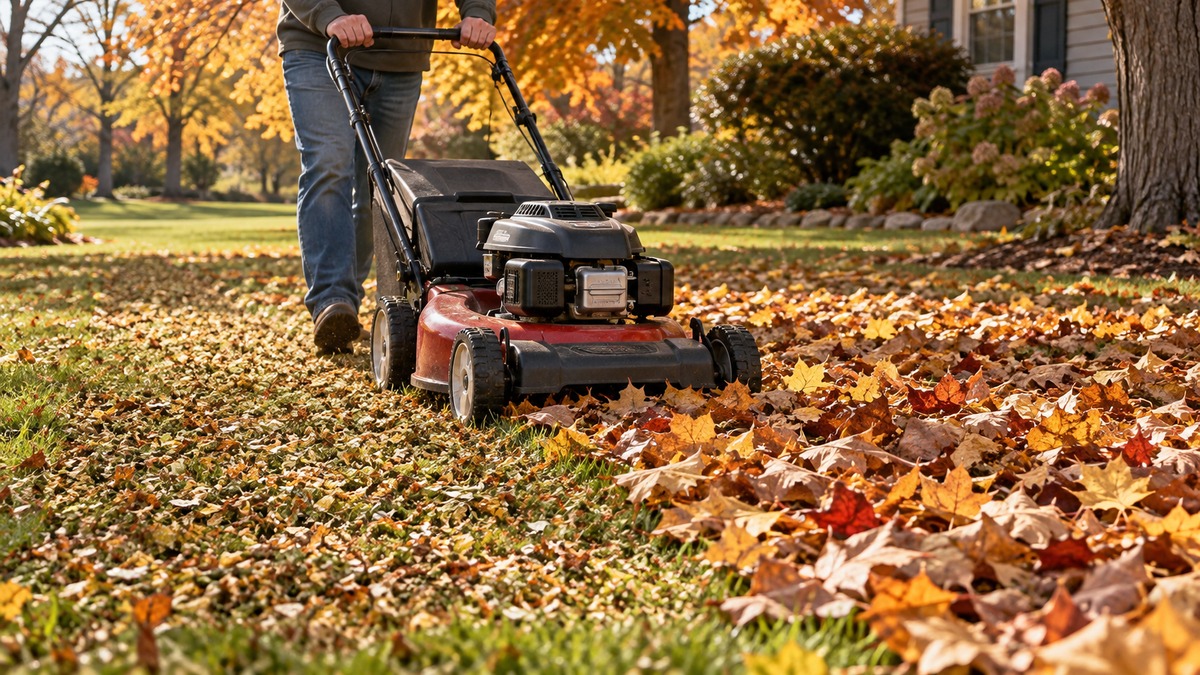
If you want to know how to mulch leaves with lawn mower blades, the core step is simple: run the mower over the leaves, and the pieces settle into the lawn. Extension sources agree that this works for a light covering. A thick layer can smother the grass, so the sources say to rake, blow or bag the excess. This guide covers when mulching works, how to set up the mower and the lawn, and what the sources say about nutrients, wildlife and new grass.
Quick answer
- Run the mower over a light covering of leaves. Illinois Extension says the leaves “will decompose, adding nutrients and organic matter to your lawn.”
- Keep the leaf cover under about 60 percent of the lawn. Ask Extension says “You don’t want more than 60% of the lawn covered/shaded,” and the rest should be raked or bagged.
- Use a mulching blade if you can, and never a raking blade on new grass.
- Clear debris first, and do not mow leaves with an electric mower while the grass is wet.
Safety before you mow leaves
Clear the area first. Ohio State Extension says: “Before mowing remove debris from lawn.” It also warns: “Foreign objects can fly from the mower, so make sure the mowing area is clear of people, animals, litter, and debris.” Walk the lawn before you start and remove debris, as Ohio State Extension advises.
Keep the work dry. Ohio State Extension says: “Never use an electric mower on wet grass.” The sources do not address wet leaves on their own, so wait until both the leaves and the grass are dry before you mow them.
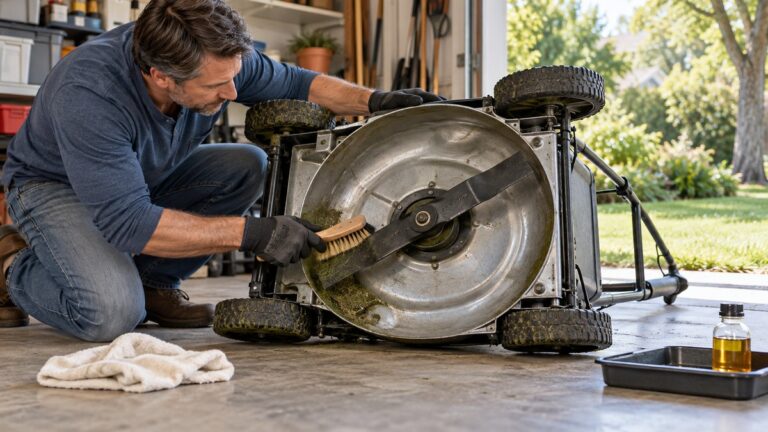
Turn the battery off before any work on the deck or the collector. Husqvarna’s cleaning guide says: “WARNING: To prevent accidental starts, turn the safety key to 0, remove the battery and wait a minimum of 5 seconds.” The same page adds: “Remove and empty the collector and the mulch plug if the lawn mower is equipped with them.” Check whether your mower has a mulch plug before you assume it does.
Choosing the blade and the setup
The table lists what each source says about blades and setups.
| Setup | What the source says | Source |
|---|---|---|
| Mulching blade | “Mulching blades on a lawn mower will chop the leaves multiple times to make even smaller particles.” | Illinois Extension, So MANY Leaves! (2020) |
| Purpose-built mulching mower | “Mulching mowers create even finer clippings, recycling the nutrients more often as the smaller clippings decay faster.” | Illinois Extension, Mowing Your Lawn |
| Side-discharge mower converted to mulching | “conventional side-discharged mowers can be converted to a mulching mower” | Illinois Extension, Mowing Your Lawn |
| Raking blade | “Do NOT mulch with a raking blade on your mower because it will tear the new grass out of the ground.” | Ask Extension, Mulching leaves? (888873) |
| Bagger, for the excess | “rake or use a bagger to remove some” | Ask Extension, Mulch leaves on the lawn? (922211) |
A mulching mower also depends on the lawn. Illinois Extension says “Mulching mowers do not perform at peak efficiency if the lawn is too tall (removing more than one-third of the grass blade) or if the lawn is wet.” The one-third limit in that sentence applies to the grass blade, so cut the grass first if the lawn is too tall. If you want to think about a machine built for leaves, see the battery-powered leaf vacuum mulcher post. For a dedicated machine for heavy cover, see the 19-inch electric mulching mower post.
Step by step: mulching a light layer of leaves
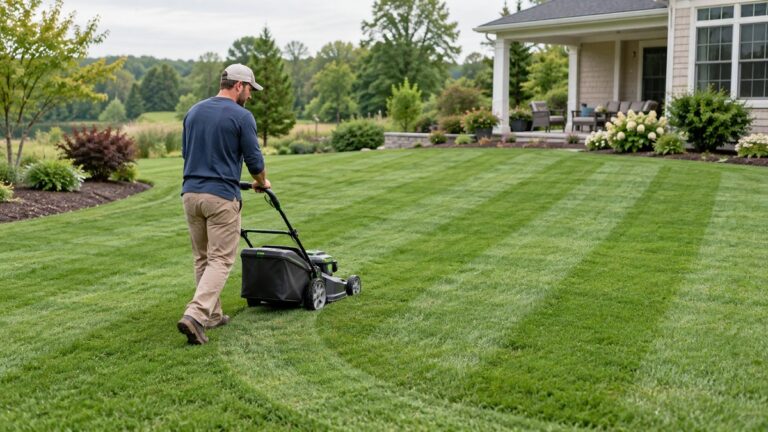
- Check the depth. Illinois Extension describes a light covering as one you can run over: “If you have a light covering of leaves, just run the lawn mower over them.” Illinois Extension also warns that “if the layer of leaves becomes too thick, it can smother the grass.”
- Estimate the cover. Ask Extension sets the limit: “You don’t want more than 60% of the lawn covered/shaded.” Judge the share by eye, and if leaves hide more than about 60 percent of the grass, rake or bag the surplus.
- Clear debris. Ohio State Extension says: “Before mowing remove debris from lawn.” Do this before you start the mower.
- Check the blade. Use a mulching blade if you have one, because it “will chop the leaves multiple times.” If your only blade is a raking blade, do not use it on the lawn. Ask Extension says that “Do NOT mulch with a raking blade on your mower because it will tear the new grass out of the ground.”
- Mow over the leaves. Ask Extension describes the result: “The smaller leaf pieces easily settle into the lawn and over time breakdown to enrich the soil.” Illinois Extension says the same of raked leaves: run a lawnmower over them “to cut them into smaller pieces.”
- Rake or bag the excess. When the cover goes past the limit, rake or bag the surplus, as Ask Extension advises: “rake or use a bagger to remove some.” Another Ask Extension answer says the surplus can be “raked or blown onto nearby garden beds to break down at their own pace there.”
- Leave some leaves whole. Ask Extension recommends: “if possible, try to keep them intact, or compromise and do a bit of both.”
After you mow: clean the deck
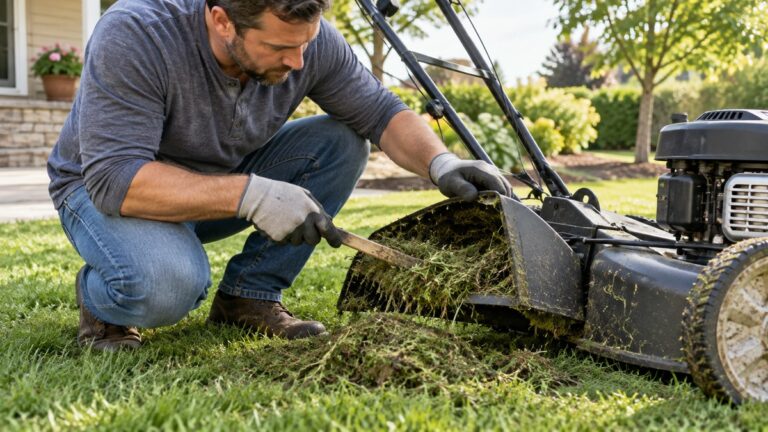
Clean the deck once the leaves are gone. Husqvarna’s cleaning guide says to “Use a brush to remove leaves, grass and dirt.” Ohio State Extension advises: “Remove excess grass clippings from the mowing deck.” On a battery mower, the same guide adds: “CAUTION: Do not use water to clean the battery lawn mowers.” Use the brush, not a hose, and keep the battery out while you work on the deck.
What the leaves do after mowing
Mowed leaves feed the soil over time. Ask Extension says that “Mulched leaves left on a lawn will biodegrade into organic matter that nourishes the soil, yes.” Illinois Extension adds that “Shredded leaves will break down faster, and they are less likely to be blown by the wind.” On tree mulch, an Ask Extension answer recommends shredding with a mower first “so they are not as apt to fly away in the wind.”
How fast the leaves break down depends on the leaves. Illinois Extension says “The rate of decomposition for leaves will depend on the leaf size, tree species and moisture level.” It adds that “Brown leaves break down faster if they are shredded and moistened.” Ask Extension makes the same point about size: “Particle size also affects efficiency. The smaller the plant pieces, the more rapidly they will break down.”
The sources disagree on the fertilizer value. Illinois Extension cites a retired educator’s figure for a two-inch layer of leaf mulch: “Adding a two-inch layer of leaf mulch adds approximately 150 pounds of nitrogen, 20 pounds of phosphorus, and 65 pounds of potassium per acre.” An Ask Extension master gardener answer disagrees: “Leaves are a poor fertilizer.” We show both figures because they conflict, and the sources do not settle the difference.
Wildlife, new grass and what to leave alone
Leaves also shelter wildlife. Ask Extension says “Lots of insects (pollinators, predators, etc.) and other wildlife benefit from intact leaf litter, and this benefit is significantly reduced when the leaves are mulched/shredded/chopped up.” Illinois Extension suggests a way to keep that benefit: “you could leave an area of your lawn untouched to provide these insects a habitat for the winter.”
New grass needs more care. The same Ask Extension master gardener answer says that new seed is at risk because “you have incompletely rooted grass seeds which are susceptible to being mechanically disrupted by raking or mowing.” If you have just overseeded, do not use a raking blade on the lawn.
Other ways to handle leaves you do not mow
Mowing is not the only option. Illinois Extension says that “Leaves can be collected through a bagging system on your lawn mower or raked or blown into piles.” Ask Extension argues for keeping the leaves on site: “Mulching fallen leaves is still better then removing and disposing of them entirely as an alternative.” If you need a bagger for the surplus, the small electric lawn mowers with a bag post is a place to start.
Leaves can also be stored for later. Illinois Extension describes one method: “storing them in garbage bags with small holes that allow leaves to break down naturally.” The result is leaf mold, which “can then be used as mulch” or added to a compost pile. The sources we opened do not give a timeline for leaf mold.
How we chose
We looked for extension answers and pages that describe mowing leaves into a lawn, plus extension and manufacturer pages on mower setup and debris. We opened eleven pages on 2026-10-22. One Ask Extension page returned a private-question notice and is not cited, and the other ten are cited. We did not rank the sources, and we did not pick a single best blade.
What we could not verify
How much leaf cover a particular lawn can take. The 60 percent figure comes from one Ask Extension expert answer, and the sources we opened do not explain how that figure was reached.
Whether your mower’s mulch kit or deck fits a given model. The sources we opened do not list kit fits, so check your model’s manual. The manuals that came up in search were PDF files, which the fetch method cannot open.
What the sources do not say
The sources do not give a leaf depth in inches for a light covering. They use the words “light” and “too thick” without a number. They also do not give a number of passes over the leaves, a height to mow at for leaf mulching, or a waiting time for the leaves to break down on the lawn.
The fertilizer question is open. The nitrogen figure comes from one Illinois Extension post for a two-inch layer, and the Ask Extension answer calls leaves a poor fertilizer. The sources we opened do not settle which view applies to your lawn.
FAQ
Can you mow leaves into the lawn instead of raking them?
Yes, for a light covering. Illinois Extension says: “If you have a light covering of leaves, just run the lawn mower over them and they will decompose, adding nutrients and organic matter to your lawn.” Keep the cover under about 60 percent of the grass, and rake or bag any excess. If the layer is too thick, the grass can be smothered.
Do you need a mulching blade to mulch leaves?
The sources do not say a mulching blade is required. Illinois Extension says that “Mulching blades on a lawn mower will chop the leaves multiple times to make even smaller particles,” so a mulching blade gives finer pieces. A raking blade is the one to avoid, because Ask Extension says it “will tear the new grass out of the ground.”
Will mulched leaves feed my lawn?
The sources disagree. Ask Extension says that mulched leaves “will biodegrade into organic matter that nourishes the soil.” Illinois Extension gives a nitrogen figure for a two-inch layer, while an Ask Extension master gardener answer says “Leaves are a poor fertilizer.” Organic matter is the point both sides agree on, so treat the fertilizer value as uncertain.
Can I mulch leaves on a newly seeded lawn?
Be careful. Ask Extension says that new seed is at risk because “you have incompletely rooted grass seeds which are susceptible to being mechanically disrupted by raking or mowing.” Do not use a raking blade on the lawn. The sources we opened do not say how long to wait after seeding before mowing leaves.
Does leaving leaves on the lawn help wildlife?
It can. Ask Extension says “Lots of insects (pollinators, predators, etc.) and other wildlife benefit from intact leaf litter.” The benefit is reduced when the leaves are mulched. Illinois Extension suggests that you “could leave an area of your lawn untouched” as a habitat for insects over winter.
Bottom line
Mow a light covering of leaves into the lawn with a mulching blade if you have one, and rake or bag the share that covers more than about 60 percent of the grass.
Sources
- Ask Extension: Mulching leaves on lawn or bagging them? (opened 2026-10-22)
- University of Illinois Extension: Don’t Bag Your Fall Leaves, Use Them (opened 2026-10-22)
- University of Illinois Extension: Don’t rake fall leaves, recycle them (opened 2026-10-22)
- Ask Extension: Mulching leaves? (opened 2026-10-22)
- Ask Extension: Mulch leaves on the lawn? (opened 2026-10-22)
- University of Illinois Extension: So MANY Leaves! (opened 2026-10-22)
- Ask Extension: Best practices for using leaves as mulch (opened 2026-10-22)
- Ohio State University Extension: Power Lawn Mowers (AEX-591210) (opened 2026-10-22)
- University of Illinois Extension: Mowing Your Lawn (opened 2026-10-22)
- Husqvarna US: How to clean a battery lawn mower (opened 2026-10-22)