How to Store Lithium-Ion Batteries Long Term
As an Amazon Associate we earn from qualifying purchases.
If you are asking how to store lithium ion batteries long term, the sources agree on the temperature direction and disagree on the charge level. Keep the pack at a moderate temperature, away from heat. For a cordless pack, the two Husqvarna cordless guides point to a middle charge, while a Husqvarna robotic-mower page asks for a full charge. This guide sets out each figure with its source, and the research behind the heat advice.
Quick answer
- Temperature: the EPA advises room temperature and no long periods of extreme heat or cold, and Husqvarna’s UK guide gives 5 to 25 C for its BLi-X 36V battery.
- Charge level: Husqvarna UK gives 30 to 50 percent for long-term storage, and Husqvarna Ireland gives 50 percent. The 50 percent level sits inside both.
- Heat and a high charge both speed up capacity loss during storage, according to a research paper on lithium-ion cells. The paper models cells, not tool packs.
Storage temperature by source
The table lists each storage rule as the page states it. A cell marked not stated means the page does not give that figure.
| Source | Pack or product | Storage temperature | Storage charge level |
|---|---|---|---|
| EPA frequently asked questions (US) | Lithium-ion batteries in general | Room temperature; avoid long periods of extreme heat or cold | not stated |
| Husqvarna UK guide (UK) | BLi-X 36V battery | 5 to 25 C (41 to 77 F) | 30 to 50 percent |
| Husqvarna Ireland guide (Ireland) | Husqvarna battery | 5 to 25 C | 50 percent |
| Husqvarna winter storage, petrol mowers (US) | Battery and charger on a petrol-mower page | 5 to 40 C | Lithium: follow the battery maker’s recommendation |
| Husqvarna Automower winter guide (US) | Robotic mower battery | Indoors, above freezing | Fully charged before power-off |
| PubMed Central simulation (research) | LiFePO4/graphite cells, simulated | 40, 47.5 and 55 C, simulated | 10, 50 and 90 percent, simulated |
The two Husqvarna cordless guides are the most specific. Their storage temperature ranges match, and both say 5 to 25 C. The petrol-mower page is wider, at 5 to 40 C for the battery and charger. A pack kept between 5 and 25 C fits all of the Husqvarna temperature ranges in this post, which makes that band the safe choice to plan around when the brand’s own figure is not in hand.
The EPA gives the general rule for lithium-ion batteries. It says: “It is best to store Li-ion batteries at room temperature.” It adds: “Avoid long periods of extreme cold or hot temperatures (e.g., dashboard of car in direct sunlight).” The EPA page gives no number, so use it for direction and use the Husqvarna figures for the numbers.
The BLi-X guide gives the most specific storage rule in this group: “Store the battery between 5-25°C (41-77°F) to prevent degradation.” It also rules out a hot car, direct sunlight, and unconditioned spaces such as outdoor sheds and garages. Check your own storage spot against the same 5 to 25 C band before you commit to it.
State of charge for long storage
The charge level is where the sources differ most. The BLi-X guide says: “For extended storage, ensure that the battery has a partial charge to avoid deep discharge.” It gives a band: “Charge to 30-50% before long-term storage.” The Irish guide sets one figure: “For a longer service life, always store the battery at 50% charged.” It adds: “If the levels are lower than 50% charged, charge it to 50% before storage.”
The robotic-mower page asks for the opposite: “Final charge: Fully charge your mower and switch it off before storage. This protects battery health during dormancy.” That page covers a robotic mower’s battery, so it does not set the rule for a cordless tool pack. For a pack, the two cordless figures overlap at 50 percent. A pack held at 50 percent sits inside the BLi-X band and matches the Irish rule, which makes 50 percent the one level that both Husqvarna cordless guides allow.
Why heat and charge level matter
A research paper on calendar aging explains the mechanism. The PubMed Central article defines the term this way: “calendar aging refers to the gradual degradation of battery performance over time when the cell is stored at a constant state-of-charge (SOC), with no external current flow.” The loss is driven by side reactions inside the cell, and the paper says those reactions speed up with heat and with a high charge.
The paper says: “These reactions are accelerated by elevated temperatures and high SOC levels and contribute to the irreversible loss of lithium, resulting in capacity fade and increased internal resistance over time.” It also says: “Elevated temperatures significantly accelerate degradation reactions, which can lead to rapid performance deterioration if not properly managed.”
The paper is a computer simulation of LiFePO4/graphite pouch cells, and it models a fixed set of conditions. It covers “three storage temperatures (40 °C, 47.5 °C, and 55 °C) and three state-of-charge (SOC) levels (10%, 50%, and 90%).” Those temperatures are hotter than the Husqvarna ranges above, so the paper supports the direction of the advice, not a number for your pack.
The paper also explains the charge effect on the electrolyte. It says: “This model captures the experimentally observed trends in which conductivity declines faster at elevated temperatures and higher SOC levels due to increased rates of solvent oxidation, salt decomposition, and gas evolution reactions.” In plain terms, the electrolyte inside the cell loses conductivity faster when the pack is hot and highly charged, which points in the same direction as the temperature and charge advice above.
The practical point is direction. A pack kept cool and at a middle charge avoids both of the conditions the paper links to faster aging. The paper does not give a number of months for a tool pack, and the sources in this post do not give one either.
Steps for long-term storage
These steps cover a cordless tool pack in general. They are not the winter steps for a mower, and they do not repeat them.
- Set the charge level first. Bring the pack to the level your brand gives. The BLi-X guide gives 30 to 50 percent for long-term storage, and the Irish guide gives 50 percent. A level of 50 percent meets both cordless figures, so use it when the brand gives no figure of its own.
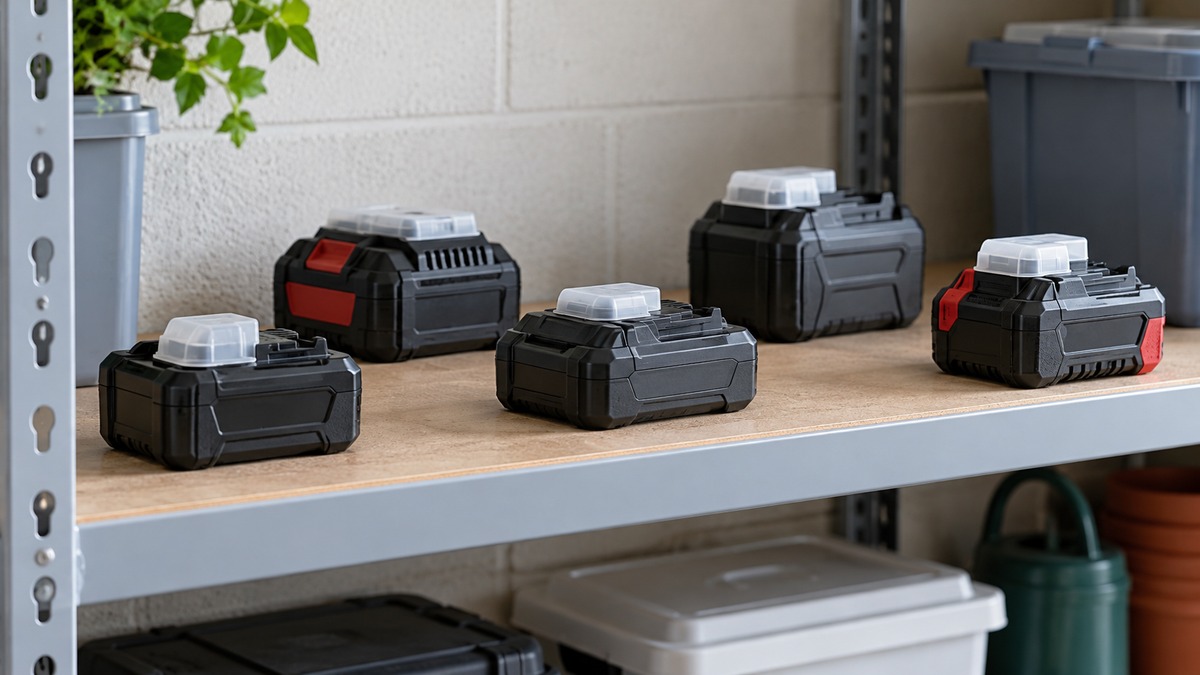
- Pick a spot inside the temperature band. Use 5 to 25 C, and keep the pack out of a hot car, out of direct sunlight, and out of unconditioned spaces such as outdoor sheds and garages. Confirm the spot’s temperature before you store the pack there, because the sources give ranges and not a reading for any space. The petrol-mower page sets a wider band, and says: “The battery and battery charger must be kept in storage between 5 °C and 40 °C.”
- Store the pack in a sturdy, non-metallic container. The BLi-X guide says: “Store the battery in a sturdy, non-metallic box to prevent contact with static electricity or conductive materials.”
- Cover the terminals only when you move the pack. The BLi-X guide says: “When packing for transport, use non-conductive tape over the terminals to avoid short circuits.” That line is for transport, so do not treat it as a storage rule.
For the voltage and amp ratings printed on a pack, see lawn mower battery voltage and amps. For the voltage of lawn and garden tool packs in general, see battery voltage for lawn and garden tools, and for the trade-offs of battery mowers, see pros and cons of battery-powered lawn mowers.
Safety for stored lithium packs
Heat and fire are the two risks the sources name. The EPA says long periods of exposure to extreme temperatures “can result in battery damage.” The Husqvarna petrol-mower page says: “Higher temperatures or high temperature sources, such as fire, can cause damage to the battery.” Keep the stored pack away from fire and from any heat source.
Swelling is a separate warning. The EPA says: “The swelling indicates damage to the battery and is a potential fire hazard.” It advises that you assess the situation and, if there appears to be no imminent threat of fire, contact the manufacturer of the product or the retailer where it was bought. Do not treat a swollen pack as an ordinary stored battery.
How we chose
We opened six pages on 2026-10-22, and each returned HTTP 200. Four are manufacturer pages from Husqvarna: the UK BLi-X guide, the Irish battery guide, the US petrol-mower page and the US robotic-mower page. One is an EPA page, and one is a PubMed Central research paper. The criteria were that a page had to state a storage temperature, a storage charge level, or a mechanism for storage damage.
Two of the Husqvarna pages are non-US locale pages, from the UK and Ireland. They are included because the US Husqvarna pages we opened do not give a cordless battery figure. Each figure stays with the brand that states it. No figure here should be applied to another brand’s pack, because each manufacturer page covers only its own batteries. The EPA and research sources supply direction, and the manufacturer pages supply the numbers, because the numbers come from pages that name a specific product.
What we could not verify
- Storage figures from DEWALT, Milwaukee, EGO, Ryobi and STIHL. The storage figures for those brands that came up in search were in PDF manuals or forum posts, which the tool could not quote.
- A time limit for storage at any charge level. The sources give no number of months after which a pack needs checking.
- Whether a pack stored at 50 percent in the cold loses capacity at a particular rate. The PubMed Central paper models other cells.
- Your own storage spot. The temperature ranges are limits, not readings from your garage or shed.
- Whether the robotic-mower charge rule carries over to a cordless pack. That page covers a robotic mower only, and no opened source says it applies to tool packs.
What the sources do not say
The EPA page gives no state-of-charge figure. The BLi-X and Irish guides give no storage time, and the petrol-mower page gives no charge level for lithium. No opened source gives one charge level that works for every lithium pack, and the research paper gives no figure that applies directly to a tool pack. The BLi-X guide does not say how often to check a stored pack, and the EPA page does not give a charge level at all.
FAQ
Should I store a lithium-ion battery full or empty?
Neither extreme is the answer the sources give for a cordless pack. The two Husqvarna cordless guides both point to a partial charge, with one giving a band and the other a single figure. The robotic-mower page asks for a full charge before power-off, but it covers a robotic mower. The EPA page gives no charge level.
What temperature is best for long-term storage?
The EPA says room temperature is best. Husqvarna’s UK and Irish guides give 5 to 25 C, and the US petrol-mower page gives 5 to 40 C for the battery and charger. A pack kept between 5 and 25 C fits every Husqvarna range in this post.
Does heat really shorten a battery’s life in storage?
The PubMed Central study says elevated temperatures significantly accelerate degradation reactions. It is a simulation of LiFePO4/graphite pouch cells, and its storage temperatures run from 40 to 55 C. It supports the direction of the advice, not a number for your tool pack.
Can I store a lithium battery in the garage or shed?
The BLi-X guide says to avoid a hot car, direct sunlight, and unconditioned spaces such as outdoor sheds and garages. Check the spot against the 5 to 25 C range before you store the pack there.
What should I do if a stored battery is swollen?
The EPA says swelling indicates damage and is a potential fire hazard. It advises assessing the situation and, if there appears to be no imminent threat of fire, contacting the manufacturer of the product or the retailer where it was bought.
How often should I check a stored pack?
The sources do not give a check schedule for a cordless pack. The Husqvarna US robotic-mower page says older robotic models may need charging every three months, but that applies to robotic mowers, and the page points to the operator’s manual.
Bottom line
If the brand gives no figure, store the pack at about 50 percent charge in a spot between 5 and 25 C, which is the one charge level both Husqvarna cordless guides allow.
Sources
- EPA: Frequent Questions on Lithium-Ion Batteries (opened 2026-10-22)
- Husqvarna UK: How to maintain and store your BLi-X 36V battery for maximum performance (opened 2026-10-22)
- Husqvarna Ireland: How to store your Husqvarna battery over winter (opened 2026-10-22)
- Husqvarna US Support: Winter storage (opened 2026-10-22)
- Husqvarna US Support: Complete winter storage guide for your Automower robotic lawn mower (opened 2026-10-22)
- PubMed Central: Impact of temperature and state-of-charge on long-term storage degradation in lithium-ion batteries (opened 2026-10-22)