Protecting Cordless Yard Tools From Rain
As an Amazon Associate we earn from qualifying purchases.
Protecting cordless yard tools from rain comes down to one rule: keep the tool and its battery out of rain and damp, and store them dry afterward. DeWalt’s support page says power tools cannot be used in any wet condition. OSHA says electric tools should not be used in damp or wet locations unless they are approved for that purpose. EGO’s battery page describes its IPX4 rating as covering splashing water equivalent to light rain. This guide sets out what the sources we opened say, what they leave out, and what to do if a tool or battery gets wet.
Quick answer
- Do not run cordless yard tools in rain. DeWalt’s general rule is that power tools cannot be used in any wet condition.
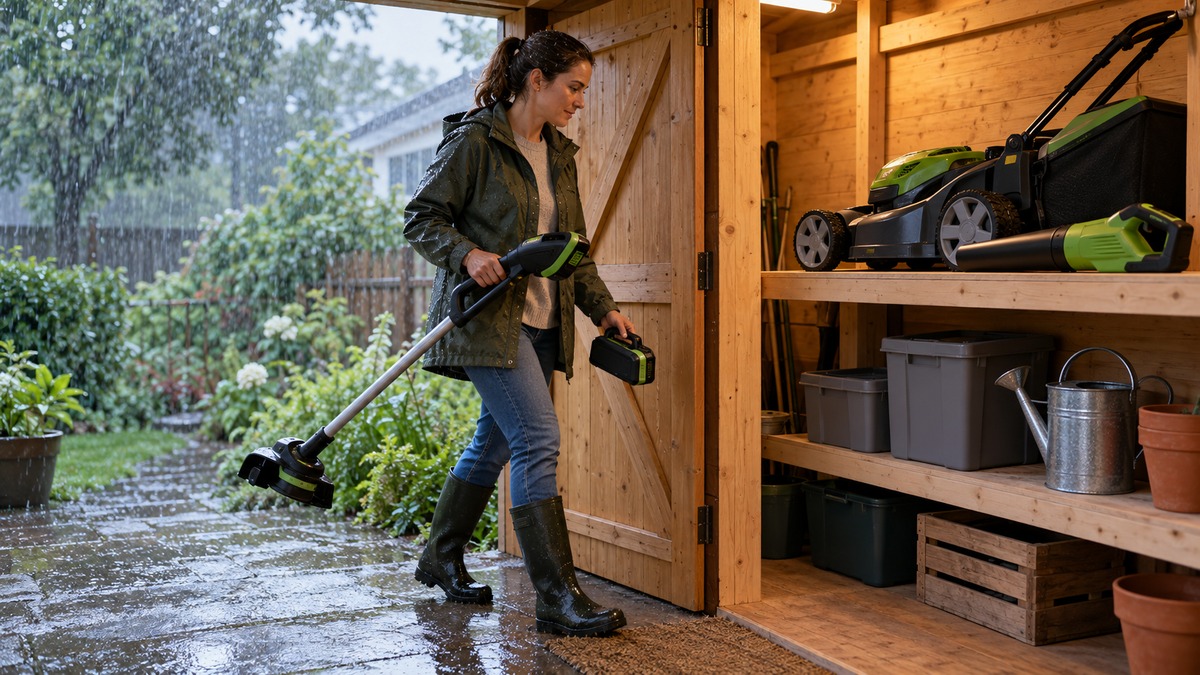
- Store cordless tools and batteries in a dry place when they are not in use, as OSHA advises for electric tools.
- EGO’s battery page describes its IPX4 rating as splash protection equivalent to light rain. The sources we opened do not show that it covers running a mower in rain.
- If a battery was in water longer than the manufacturer recommends, EGO says to take it to an EGO dealer for inspection.
Why water and damp matter for cordless tools
The main risk is electrical. OSHA’s guidance on power tools says ordinary water conducts electricity. It also says water can still get into a tool’s housing even when the tool is double insulated, and once water reaches live parts inside the housing it can create a path to the user. That is why OSHA’s rule covers damp locations as well as wet ones.
Water matters for the battery and the motor, not only the wiring. Husqvarna’s cleaning guidance for battery mowers says water can enter the battery or the motor and cause a short circuit or damage the product. That page is about cleaning with water rather than rain, so it does not set a rain limit. It does show the same mechanism: water that reaches the battery or motor is the failure the manufacturer is trying to prevent.
Water is also a question of how much. DeWalt’s page is categorical and does not separate a light shower from a soaking. The OSHA page does not give an amount of water either. The sources we opened do not set a depth, a time or an amount of rain that a tool can take.
What the battery and mower pages say
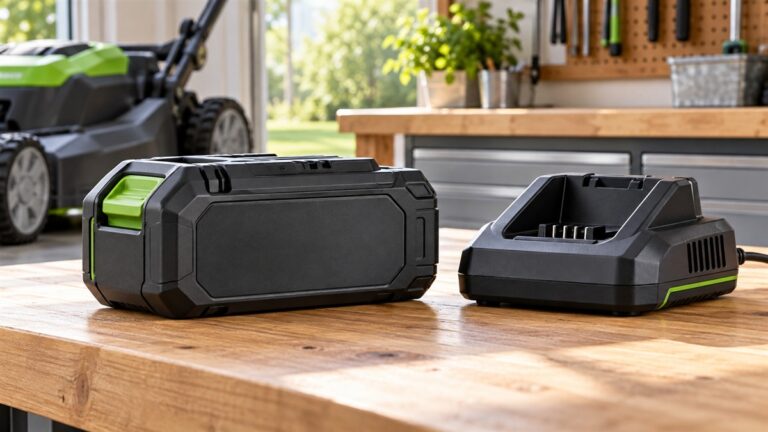
EGO’s battery page says all EGO batteries are IPX4 rated. It describes that rating as proven safe for use after splashing with water, equivalent to light rain. The same page says batteries exposed to water for longer than recommended should go back to an EGO dealer for inspection. The recommended time is not given on the page, so the sources do not say how long a battery can stay exposed.
EGO’s 21-inch Select Cut mower page lists IPX4-rated weather-resistant construction among its features. That is a construction feature. The page does not say the mower can be run in rain, and the text we opened does not use the word rain for the mower at all.
Read together, the two EGO pages set out a splash rating for the battery and a weather-resistant construction feature for the mower. Neither page gives a rain-use rule for the mower. The DeWalt page does give a general rule, and it is dated February 14, 2023 in the text we opened.
Which tools this covers
The sources we opened cover three groups: battery and corded power tools in general, EGO batteries and a 21-inch EGO mower, and Husqvarna battery lawn mowers. They do not cover string trimmers, hedge trimmers, leaf blowers or edgers in rain. If your tool is one of those, the sources do not tell you whether it shares the same rule. Check the manual for that model.
Corded tools are covered by the DeWalt and OSHA pages as well. Those pages do not give a cord length or a gauge, and this guide does not add one.
What each source says about water and damp
The table lists each situation and what the opened sources state about it. “Not stated” means the sources we opened do not cover that point.
| Situation | What the source states | Source |
|---|---|---|
| Running a power tool in wet conditions | Cannot be used in any type of wet condition | DeWalt support page |
| Damp or wet work locations | Not to be used unless approved for that purpose | OSHA eTool |
| Storage when not in use | Store in a dry place | OSHA eTool |
| Battery exposed to splashing water | IPX4 rating, equivalent to light rain | EGO battery page |
| Battery exposed to water beyond the recommended limit | Return to an EGO dealer for inspection; limit not stated | EGO battery page |
| Mower construction | IPX4-rated weather-resistant construction (listed feature) | EGO mower page |
| Cleaning a battery mower with water | Do not use water; water can enter the battery or motor | Husqvarna US help center |
| Wet clippings left on the deck | Hold water and cause the metal to rust | University of Illinois Extension |
| Running a mower in rain | Not stated on the EGO mower page we opened | EGO mower page |
| Drying time for a wet battery | Not stated | Not stated |
| Charging a damp battery | Not stated | Not stated |
Safety first: water and electric tools
Water and electric tools are a shock risk. DeWalt’s page says using a cordless or corded tool in wet conditions may result in shock, personal injury, death, fire or property damage. OSHA says that double insulation does not stop water from reaching live parts once it gets inside the housing. Treat rain and standing water as a reason to stop the job, not a reason to finish it.
Illinois Extension says that whenever your hand goes near the blades of an electric mower, you should remove the battery first. The same rule applies before you clean or clear the deck, which is where wet clippings collect.
Store cordless tools dry between jobs
OSHA says to store electric tools in a dry place when they are not in use. For a mower, that means clearing wet clippings from the deck before it goes into storage. Illinois Extension says grass clippings stuck to the bottom of the mower deck hold water and cause the metal to rust, which shortens the life of the equipment. Use a leaf blower or an air compressor to clear clippings and dust, and scrape off anything stuck fast with a putty knife.
If the wet grass is the bigger problem, see electric mowers and wet grass for how the mower side of the question is handled.
If a tool or battery gets wet
Use these steps when a cordless tool or battery has been in rain, splashed or soaked. Each step names the source it follows.
-
Stop using the tool and move it out of the wet area. DeWalt says power tools should not be used in wet conditions, and OSHA says not to use electric tools in damp or wet locations unless they are approved for that purpose.
-
Remove the battery before you handle the tool. On a Husqvarna battery mower, the warning says to turn the safety key to 0, remove the battery and wait a minimum of 5 seconds to prevent accidental starts. OSHA’s guidance on a double-insulated tool that falls into water says to disconnect the power source before grabbing it. The OSHA page does not name a battery, so the step to remove the battery is an inference from that rule.
-
Check how long the battery was in water. If it was in water longer than the manufacturer recommends, EGO says to take it to an EGO dealer for inspection. The EGO page does not give the time limit, so ask the dealer for it.
Common mistakes to avoid
Each mistake below is tied to a fact in the sources we opened.
- Treating a splash rating as permission to mow in rain. The EGO battery rating covers splashing water equivalent to light rain. The DeWalt page says power tools cannot be used in any wet condition.
- Hosing off a battery mower. Husqvarna says not to use water on the product, because water can enter the battery or motor.
- Leaving wet clippings on the deck. Illinois Extension says clippings that hold water cause the metal to rust.
- Keeping the battery in while you work under the deck. Illinois Extension says to remove the battery for electric mowers whenever your hand goes near the blades. The Husqvarna warning says to wait at least 5 seconds after removing it.
- Assuming one brand’s rule covers another brand. The DeWalt, EGO and Husqvarna pages each state their own rules, and the sources we opened do not say that these rules apply across brands.
How we chose
We kept only pages that could be opened as HTML and that state a rule for a tool, a battery, or water and electricity in general. We preferred US manufacturer pages, then OSHA and university extension pages. Retail listings were not used for any rule. The EGO pages are the manufacturer’s own product pages, and they are cited only for the battery rating and the mower’s construction feature.
We cite six pages. We also opened a Ryobi storm preparation page that does not state a rule for tools in rain, so it is not cited. All pages were opened on 2026-10-22. The DeWalt page shows a date of February 14, 2023, and we record it as dated. This list describes which sources we opened and what they say. It is not a ranking of brands.
What we could not verify
- The operator manuals for the STIHL and EGO mowers that search returned were not opened. The fetch tool used here does not read PDF files, and the STIHL links end in .pdf. So we cannot quote what a specific model manual says about rain or storage.
- None of the pages we opened says that a specific cordless mower can be run in rain.
- The EGO battery page gives no time limit for water exposure.
- The DeWalt page is a general support article dated February 14, 2023. It is not written for a specific model.
What the sources do not say
- How long a wet battery must dry, or whether it can be charged while damp. The sources we opened give no drying time.
- Whether the IPX4 battery rating also applies to the charger. The EGO battery page does not state a water rating for the charger.
- How much rain, splash or standing water a tool can take. No depth or time limit appears in the pages we opened.
- Whether cordless trimmers, edgers, blowers and hedge trimmers share the water rating of the EGO battery. The pages we opened do not cover them.
- Storage humidity or temperature for wet-weather storage. The OSHA page says to store tools dry and gives no humidity level.
FAQ
Can I run a cordless mower in the rain?
The sources we opened say no, as a general rule. DeWalt’s support page says power tools cannot be used in any type of wet condition. The EGO mower page lists weather-resistant construction, but it does not say the mower can be run in rain.
The IPX4 rating on EGO’s battery page describes splashing water equivalent to light rain. That describes the battery, not permission to mow in the rain. Check your model’s manual, because the manuals were not among the pages we opened.
Is an IPX4 battery rating the same as waterproof?
The EGO battery page does not call the rating waterproof. The rating it describes covers splashing water, and the page says it is proven safe for use after splashing with water equivalent to light rain.
The same page says that batteries exposed to water for longer than recommended should go back to an EGO dealer for inspection. The time limit is not given in the text we opened.
What should I do if a cordless battery gets soaked?
Remove it from the tool and do not use it until you have checked how long it was in water. If the exposure was longer than the manufacturer recommends, EGO says to take the battery to an EGO dealer for inspection.
If the battery also will not take a charge afterward, see lawn mower batteries that will not charge. The sources we opened do not say how long to dry a wet battery or whether it can be charged while damp.
Where should I store cordless yard tools during wet weather?
Store them in a dry place when they are not in use. OSHA’s guidance on electric tools says the same. Before storage, clear wet clippings from the mower deck, because Illinois Extension says clippings that hold water cause rust.
The pages we opened do not give a humidity level or a temperature for wet-weather storage, so dry is the only stated standard we can point to.
Can I hose off a cordless mower after mowing wet grass?
The sources we opened say no for battery mowers. Husqvarna’s cleaning page says not to use water on the product, because water can enter the battery or the motor and cause a short circuit or damage the product. It recommends a brush to remove leaves, grass and dirt.
For a deck caked with wet clippings, Illinois Extension says to scrape the buildup off with a putty knife and to blow off loose clippings with a leaf blower or air compressor. Remove the battery first, as that extension page says for electric mowers.
Does a splash rating mean a mower is safe in light rain?
The sources we opened do not say that. The EGO battery page describes splash protection equivalent to light rain for the battery. It does not say the mower, its drive, its blade or its charger can run in light rain, and the DeWalt page says power tools cannot be used in any type of wet condition.
Where a battery rating and a general rule seem to point in different directions, follow the stricter rule until your model’s manual says otherwise.
Bottom line
Treat rain as a reason to stop. Do not run the tool in rain, store it dry when you are finished, and if a battery was in water longer than the manufacturer recommends, take it to the manufacturer’s dealer for inspection instead of using it.
Sources
- DeWalt: Can power tools be used in wet conditions? (opened 2026-10-22)
- OSHA: eTool, Construction, Electrical Incidents, Power Tools (opened 2026-10-22)
- EGO POWER+: 4.0 Amp Hour, 56v Battery (opened 2026-10-22)
- EGO POWER+: 21 inch Self-Propelled Mower Select Cut kit (opened 2026-10-22)
- Husqvarna US Help Center: How to clean a battery lawn mower (opened 2026-10-22)
- University of Illinois Extension: Mower Maintenance (opened 2026-10-22)