Mowing Your Lawn for the First Time in Spring
As an Amazon Associate we earn from qualifying purchases.
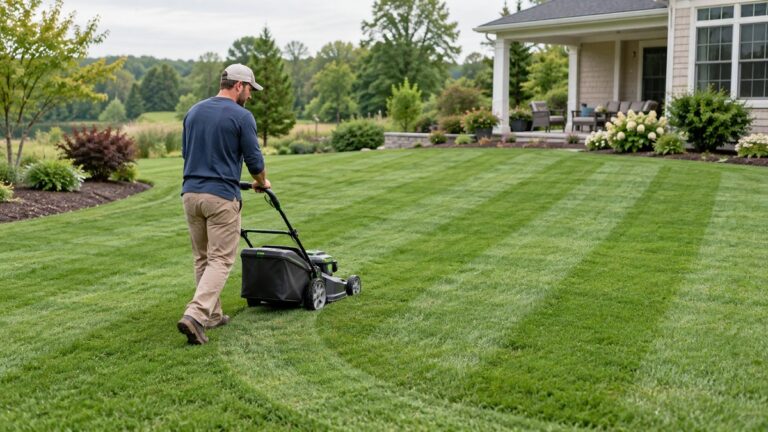
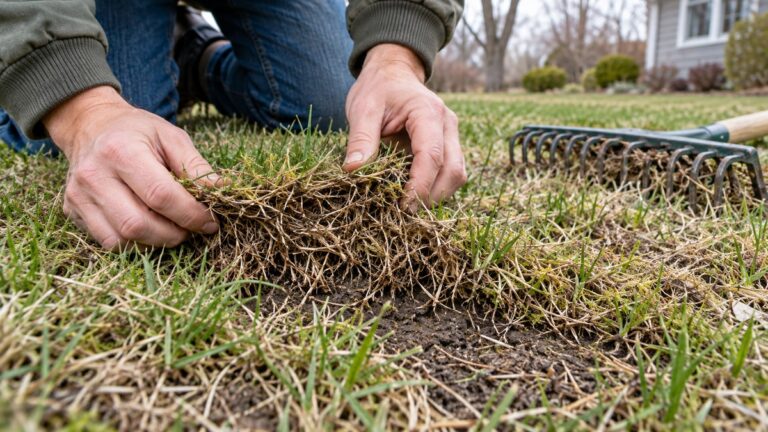
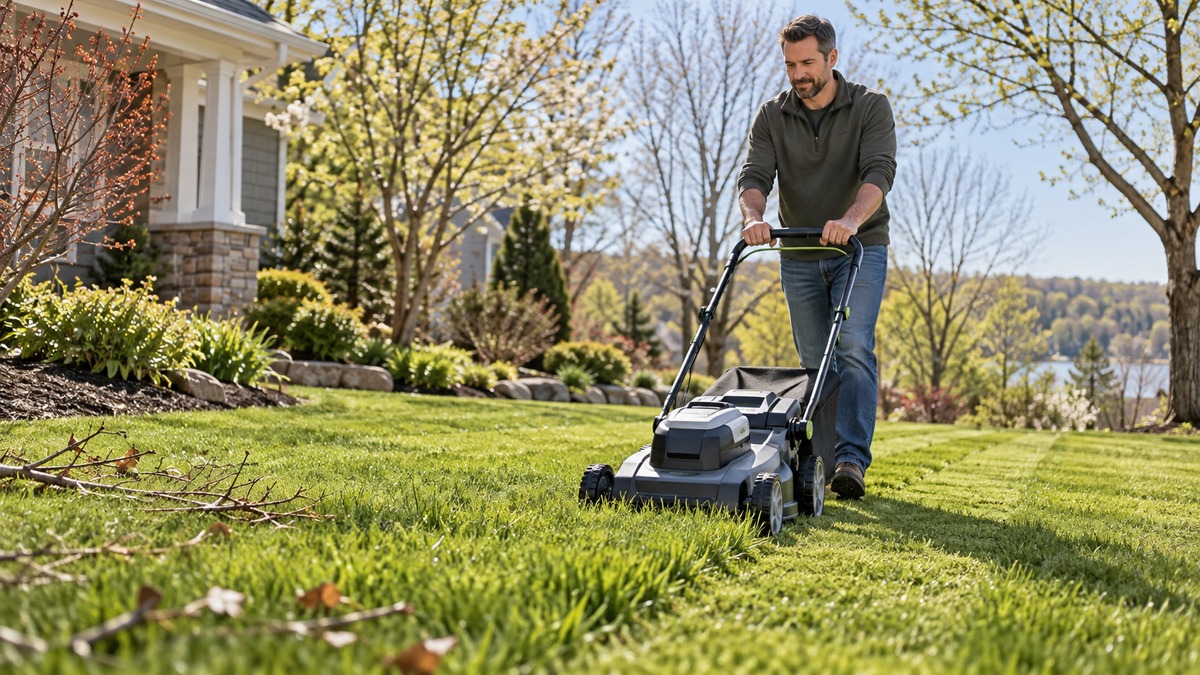
If you are working out how to mow lawn for the first time in spring, start with the grass rather than the calendar. Extension sources say there is no set date for the first cut. Timing depends on growing conditions and grass type, and the height you have set decides when the grass is ready. This guide covers the trigger height for the first cut, the one-time low cut that some warm-season lawns can take, and what to do with clippings when the grass has grown tall over winter.
Quick answer
- Start the first cut when the grass reaches the trigger height for your setting, not on a date. Iowa State gives 4.5 to 5.25 inches for a 3 to 3.5 inch setting and 3 to 3.75 inches for a 2 to 2.5 inch setting.
- Bermudagrass and zoysia can take one very low cut at the start of spring growth. Centipede and St. Augustine should be cut only slightly lower and should not be scalped.
- If the grass was too tall at the first cut and more than a third of the leaf came off, remove the clippings instead of leaving them on the lawn.
- Expect frequent cuts once spring growth starts. Iowa State notes that cool-season lawns grow well in cool spring weather.
When the first cut is due
The sources agree that timing follows growth. Iowa State says that when to start mowing depends on the growing conditions and the type of grass in the area, and it does not give a set date. Mississippi State’s turf newsletter ties the one low cut it discusses to the moment the lawn begins its initial spring growth. Neither source gives a calendar day that would work for every yard.
UC IPM takes the same approach. It says to decide when and how often to mow by taking into account the growth rate of the grass during each season and the desired height of the lawn. It also says cool-season grasses are most active during the spring and fall, so spring is an active growing period for those lawns. If the grass is still wet from rain or dew at that point, see the guide to mowing wet grass with an electric mower before you go out.
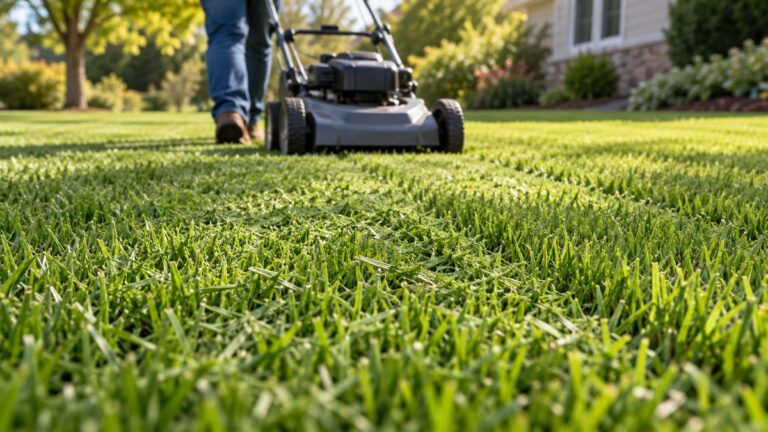
The practical rule is a trigger height. Iowa State works it out from the cutting height. At a 3 to 3.5 inch setting, start once the grass reaches 4.5 to 5.25 inches, so that no more than a third of the leaf blade comes off in one pass. At a 2 to 2.5 inch setting, start once the grass reaches 3 to 3.75 inches. You are not choosing a height for the whole season here, only the point at which the first cut is due.
First-cut triggers and limits from the sources
The table lists each figure with its source. Where a source says nothing about one column, the cell reads “not stated”.
| Source | Grass or setting | Action for the first cut | Limit or note |
|---|---|---|---|
| Iowa State, When Do I Start Mowing In Spring? | Setting 3 to 3.5 in | Start when grass reaches 4.5 to 5.25 in | No more than one-third of the leaf blade in one mowing |
| Iowa State, When Do I Start Mowing In Spring? | Setting 2 to 2.5 in | Start when grass reaches 3 to 3.75 in | not stated |
| Mississippi State, Lawns First Mowing of Spring (2011) | Bermudagrass and zoysia | One very low cut (scalping) at the start of spring growth | not stated |
| Mississippi State, Lawns First Mowing of Spring (2011) | Centipede and St. Augustine | Cut slightly lower than the optimum height | Do not scalp |
| New Mexico State, Mowing Your Lawn | Zoysia and bermudagrass | Very low setting to remove dead tissue | Removes 50 to 75% of dead tissue |
| New Mexico State, Mowing Your Lawn | All lawns | Single cut | More than 40% of height can cause scalping |
| Iowa State, Mowing Tips for Spring | Grass that is too tall at the first cut | Clippings can pile up | More than 1/3 of the leaf blade removed |
Read the table in order. The Iowa State rows give the trigger for a typical setting. The Mississippi State and New Mexico State rows cover warm-season lawns that can take a low cut. The last row is the clippings check. None of the sources gives a single first-cut height that suits every grass type, so the trigger height has to come from your own mower setting.
Warm-season and cool-season lawns
Warm-season lawns handle the first cut differently. Mississippi State says bermudagrass and zoysia have a strong network of rhizomes and stolons that rebuild the canopy quickly once soil and air are warm enough. That is why those lawns can be cut very low, or scalped, at the start of spring growth. New Mexico State says the same two grasses can take a very low setting that removes 50 to 75 percent of dead tissue, which helps the lawn green up faster in spring.
Centipede and St. Augustine are different. Mississippi State says they have only stolons to develop a new canopy, so they can be cut slightly lower than their optimum height but should not be scalped. Use the same rule for both: a low first cut for bermudagrass and zoysia, and a small step lower for centipede and St. Augustine.
The scalp advice in these sources applies to warm-season lawns only. Iowa State describes the cool-season lawns common in Iowa as loving cool spring temperatures and rain, which is why mowing will need to be frequent in spring. Keep the first cut at the trigger height and let the regular interval take over. The scalp is a one-time step for warm-season lawns. It is not a habit to repeat through the season.
Scalping and the one-time cut
The first cut is where scalping most often comes up in these sources, so the rules matter here. Mississippi State says scalping or close mowing should happen only once, when the lawn begins its initial spring growth, and not throughout the season. New Mexico State adds that removing more than 40 percent of the height in one mowing can cause scalping, and that scalping during periods of stress can damage or kill the turf. A first cut taken at the trigger height avoids the problem. A low scalp is only for the warm-season lawns named above, and only once.
Clippings from the first cut
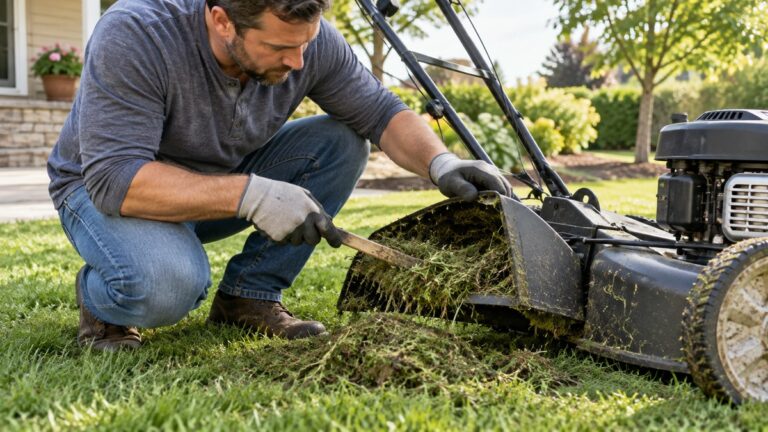
Iowa State says that when the lawn is mowed properly, grass clippings do not need to be removed or bagged. The first cut is where that can fail. If the grass is too tall and more than a third of the leaf blade is cut off, the clippings can pile on the lawn. Iowa State warns that these piles must be removed by bagging or raking, because they will smother, weaken and potentially kill the turf beneath them.
Mississippi State adds a point for the first cut of the year. Because there will be an excess of old clippings after winter, it suggests collecting them rather than leaving them on the lawn. The first cut is the point where that advice applies.
Safety
New Mexico State notes that rotary mowers, the type most home lawns use, can be dangerous because they can throw objects, and that they may scalp uneven turf. The sources we opened do not say how to clear a lawn before a cut, so this guide does not give that step, and it gives no other safety step for the first cut.
The sources we opened do not give blade-service or battery steps for this topic, so this guide gives none. If you want to look at the blade or the battery before the first cut, the guide to Black and Decker lawn mower blades covers blade choices, and the guide to lawn mower batteries that will not charge covers charging problems.
How we chose
We searched for extension pages that describe the first spring cut in their own words, then opened five. They are two Iowa State University Extension and Outreach pages (a spring FAQ updated April 18, 2025, and a spring tips article dated April 2023 by its address), a Mississippi State University Extension turf newsletter from 2011, the UC IPM lawn guide from the University of California, and a New Mexico State University Cooperative Extension publication. We excluded several extension newsletters that are published as PDF or Word files, because this tool cannot read them. We opened all five sources on 2026-10-22. We did not rank the sources.
What we could not verify
The sources do not give a first-cut date for any state, and the Mississippi State newsletter is from 2011, so its guidance may not match current grass varieties. The sources we opened do not explain how to set the first-cut height on a mower with a single fixed height. We did not find a height figure for centipede or St. Augustine in any of the five pages.
What the sources do not say
None of the five pages gives a first-cut date by region, and none says how wet grass changes the first cut. They do not say what to do after a warm spell followed by a late frost, and they do not give a growth rate for a specific yard. They also do not give blade-service or battery steps for the first cut, so those are left out of this guide.
FAQ
When should I mow for the first time in spring?
Iowa State says there is no set date to start mowing. The start depends on growing conditions and grass type. Use the trigger height instead of a date. With a 3 to 3.5 inch setting, that trigger is 4.5 to 5.25 inches, which keeps the removal within one-third of the leaf blade.
What height should I set for the first cut?
Iowa State’s spring pages use a 3 to 3.5 inch setting as their example, and say a 2 to 2.5 inch setting means waiting until the grass is 3 to 3.75 inches tall. The sources we opened do not give one first-cut height that suits every grass type. Pick the setting you will keep for the season, then use the matching trigger height from the table.
Should I scalp my lawn at the first cut?
Only if it is bermudagrass or zoysia. Mississippi State says those can be cut very low once, at the start of spring growth. Centipede and St. Augustine can be cut a little lower than usual, but the sources say not to scalp them. New Mexico State says removing more than 40 percent of the height in one mowing can cause scalping, so a low first cut is a one-time step, not a rule for every mowing.
What should I do with clippings after the first cut?
Iowa State says clippings do not need to be removed when the lawn is mowed properly. If the grass was too tall and more than a third of the leaf blade came off, remove the piles by bagging or raking, because they can smother the turf. Mississippi State also suggests collecting old clippings from the winter rather than leaving them on the lawn.
Why is my lawn slow to green up in spring?
UC IPM says fertilizer and water change the growth rate of the grass, and that growth rate sets how often the lawn needs cutting. A lawn short of water or fertilizer may grow more slowly, so the trigger height may take longer to reach. The sources we opened do not explain why a particular lawn is slow, so this guide does not diagnose the cause.
Will my lawn need mowing more often in early spring?
Often, yes. Iowa State says mowing will need to be done frequently in spring because cool-season lawns grow well in cool temperatures and abundant spring rain. Keep checking the grass height against the trigger height for your setting, and expect the interval to change as the weather and growth change.
Bottom line
Make the first cut when the grass reaches the trigger height for your setting, not on a date. At a 3 to 3.5 inch setting, that means 4.5 to 5.25 inches, so no more than a third of the leaf blade comes off in one pass.
Sources
- Iowa State University Extension and Outreach: When Do I Start Mowing In Spring? (opened 2026-10-22)
- Iowa State University Extension and Outreach: Mowing Tips for Spring (opened 2026-10-22)
- Mississippi State University Extension: Lawns First Mowing of Spring (3-14-11) (opened 2026-10-22)
- UC IPM, University of California: The UC Guide to Healthy Lawns, How much, when, and how often to mow (opened 2026-10-22)
- New Mexico State University Cooperative Extension Service: Mowing Your Lawn (opened 2026-10-22)