When a Lawn Needs Dethatching
As an Amazon Associate we earn from qualifying purchases.
Knowing when a lawn needs dethatching comes down to how thick the thatch layer is. The sources we opened put the point for action at about half an inch in an Illinois Extension page and in an Ask Extension answer that quotes the University of Massachusetts Extension, and at one inch in a Penn State Extension page. A thin layer is normal and helps the lawn. This guide covers how to measure thatch, which threshold to use, when dethatching helps and when it does not, and what to do next.
Quick answer
- Thatch up to about half an inch is normal, and the Illinois page says a thin layer gives a more cushioned surface.
- Dethatch when thatch is over about half an inch (Illinois Extension) or one inch or more (Penn State Extension). The sources do not agree on the threshold.
- Dethatch only in cool weather with adequate moisture, not in heat, drought, wet soil, or late fall.
- If the cause is still there, the thatch comes back. Over-fertilizing and overwatering are named causes.
What thatch is and what makes it build up
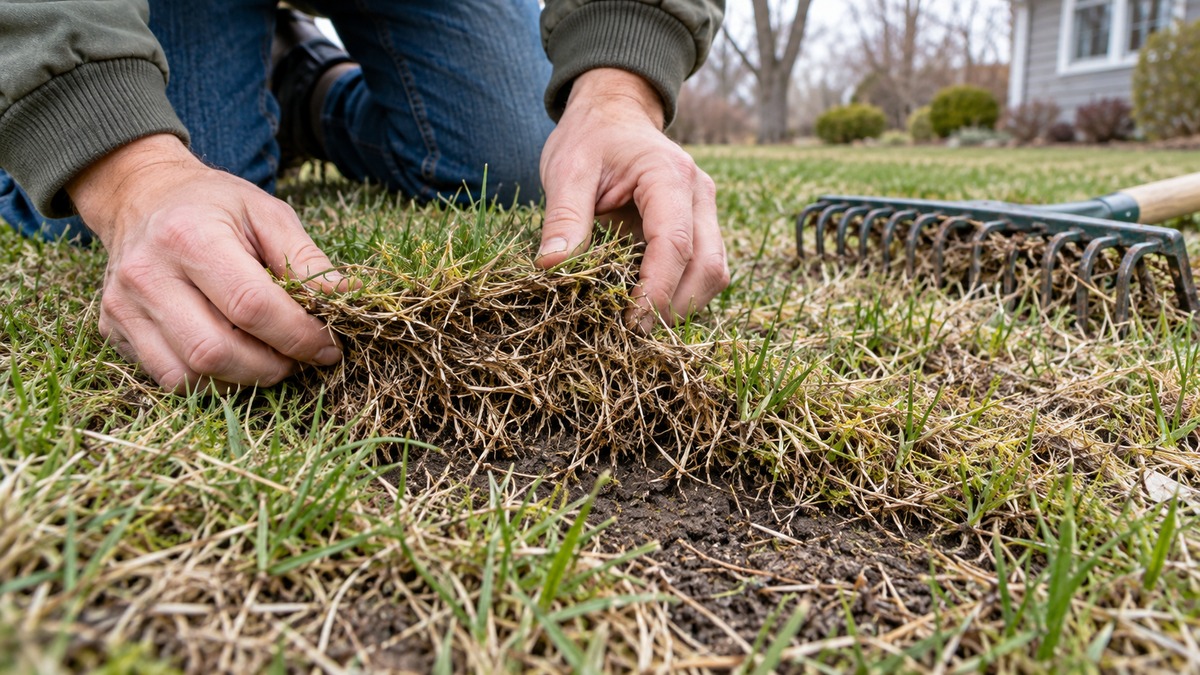
The Ask Extension answer defines thatch as a layer of grass roots and stems that builds up between the living grass and the soil. It explains that thatch is a normal part of an actively growing turfgrass and that a thin layer can add resilience to heavy traffic.
Thatch builds up when growth outpaces breakdown. The Illinois page names excessive nitrogen fertilizer and overwatering as common contributors, because both push the lawn to grow fast. Clippings left on the lawn after mowing are not the cause, according to the same page.
Poor soil also plays a part. The Illinois page lists compacted soil as one of the environmental factors that encourages a thatch layer, so thatch problems often have more than one cause.
How to measure thatch
The University of Massachusetts Extension method, quoted in one Ask Extension answer, uses a small plug of turf. Cut a small triangular plug of turf several inches deep, look at the spongy layer above the mineral soil, and compress it. The method is meant to determine whether a lawn has a thatch problem.
If that layer is more than about half an inch to three-quarters of an inch thick when you compress it, the answer says you should consider dethatching or starting a program that encourages the layer to break down. A second Ask Extension answer, on thatch and aeration, says photos are not enough. It says the photos did not lead it to believe the lawn had excessive thatch, and that the thatch thickness itself must be checked.
Which threshold to use
The sources set the point for action at different depths, and they give different timing. The table shows each figure next to the timing the same source gives.
| Source | Threshold stated | Timing stated |
|---|---|---|
| Illinois Extension, Managing Thatch in Lawns | Over ½ inch: lawn problems may begin and thatch needs to be controlled | Tear out thatch in late August for cool-season lawns |
| Penn State Extension, Lawn Management through the Seasons | One inch in depth or more | Cool weather and adequate moisture; not during high heat, drought, or late fall |
| Ask Extension answer quoting the University of Massachusetts Extension | More than about ½ to ¾ inch when compressed | Spring and fall are the best times; not when the lawn is wet |
| Ask Extension, Thatch and aeration | Thicker than ½ inch | Early fall, for machine dethatching |
The lowest threshold is half the highest one. The timing advice also differs, with late August, early fall, and spring and fall all named. The sources we opened do not say which threshold applies to your grass or your climate, so use the plug method to get your reading and then choose the threshold it fits.
When dethatching helps
- The thatch is over your chosen threshold. The Illinois page says that once thatch passes half an inch, lawn problems may begin.
- The layer is causing pests or disease. The Illinois page says excessive thatch creates a favorable environment for pests and disease, and an unfavorable one for grass roots.
- The weather is cool and the soil is moist. Penn State says dethatch only in cool weather with adequate moisture.
- The lawn is not under stress. Penn State advises against removal during high temperatures, drought, or late fall, when winter desiccation may occur.
When dethatching will not help
A thin layer is not a problem to fix. The Illinois page says a layer of less than half an inch gives a more cushioned surface for walking and playing, and it ties the need for control to thatch that passes half an inch.
Dethatching also does not fix a lawn whose cause is still there. The Illinois page says thatch torn out with a dethatcher or vertical mower will most likely return unless the cause is corrected. It names heavy nitrogen and overwatering as the usual causes to address first.
A wet lawn is another poor time. One Ask Extension answer suggests not dethatching when the lawn is wet, even though it names spring and fall as the best seasons overall. If the lawn is also wet at mowing time, see electric mowers for wet grass.
Finally, dethatching is not an annual job. Penn State says it is not necessary to dethatch every year, and that you should dethatch only when buildup becomes excessive.
Steps: decide and dethatch
- Measure the thatch. Cut a small triangular plug of turf several inches deep, examine it, and compress the spongy layer above the soil.
- Compare the reading with the table. If the layer is well under half an inch, the Illinois and Ask answers treat it as normal. Penn State would not dethatch until the layer reaches one inch.
- Fix the cause before you dethatch. The Illinois page says excessive nitrogen fertilizer and overwatering push growth fast, and it advises avoiding both overfertilizing and overwatering.
- Pick cool, moist conditions. Penn State says to dethatch only in cool weather with adequate moisture, and the Ask answer says not to dethatch when the lawn is wet. Avoid heat, drought, and late fall.
- Start small if you are unsure. One Ask Extension answer says you might try raking a small area at a time to remove the thatch. The same answer says special rakes are available to dethatch, and that a metal rake you may already have may do the trick.
- Plan for repair. The Illinois page says mechanical dethatching is hard on the turf and that overseeding is usually required afterwards. Core aeration followed by topdressing is the other method it names.
What dethatching does to the lawn
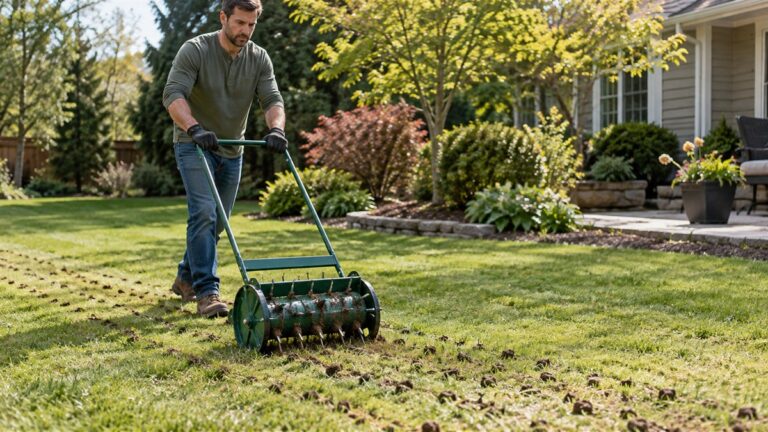
Mechanical dethatching is rough on the lawn. The Illinois page says roots sit in the thatch rather than the soil, so plants pull out easily when the thatch is removed. The Illinois equipment page says this equipment is fairly destructive, so reseeding is suggested afterward.
Plan for reseeding before you start, since the Illinois page says overseeding is usually required afterwards.
Safety around dethatching
The sources we opened do not give safety steps for dethatching. The Illinois equipment page describes dethatchers and vertical mowers as machines with rotating blades arranged vertically that can cut into turf and soil. It does not give dethatcher safety steps, so none appear here.
The same page’s personal protective equipment advice is written for mowing. It recommends impact-resistant safety glasses or sunglasses because mowing throws debris at high speed from beneath the mower. The sources do not say whether that advice carries over to dethatching.
How we chose
We searched for extension pages and Ask Extension answers on thatch depth and dethatching timing, then opened the pages we could reach. We kept sources that state a threshold, a timing rule, or a condition where dethatching does not help. Two Illinois Extension pages, one of them the equipment page, a Penn State Extension page, and two Ask Extension answers cover the points in this post. The University of Massachusetts method is quoted in one Ask Extension answer; we did not open the University of Massachusetts page itself. We did not cite an Illinois Lawn Talk thatch page, because the copy we opened had no body text. We opened all five sources on 2026-10-22.
What we could not verify
- Which threshold applies to your grass. The sources give half an inch and one inch, and the sources we opened do not say which fits your lawn.
- When to dethatch in your area. The timing advice names late August, early fall, and spring and fall, and the sources do not reconcile them.
- Whether a photo shows a thatch problem. The Ask answer says photos did not show one in its case, and it asks for a measured thickness instead.
What the sources do not say
The sources we opened do not give dethatching machine settings, blade depth, or a pass count. They do not give safety steps for dethatching equipment, and they do not set a thatch threshold for warm-season grass separately. If you want a comparison of electric dethatchers, see electric dethatchers compared.
FAQ
How thick does thatch have to be before I dethatch?
The sources differ. Illinois Extension says problems may begin once thatch is over half an inch. An Ask Extension answer quoting the University of Massachusetts Extension says about half an inch to three-quarters of an inch when compressed. Penn State Extension sets the point at one inch or more.
Is thatch the same thing as grass clippings?
No. The Illinois page says clippings dropped on the lawn after mowing are not the cause of thatch buildup. Thatch is the layer of roots and stems that builds up between the living grass and the soil.
Should I dethatch in spring or fall?
The sources do not agree on one season. The Ask Extension answer says spring and fall are the best times. The Illinois page suggests late August for cool-season lawns. Penn State advises cool weather with adequate moisture, and avoids late fall. Choose a cool, moist period and avoid heat, drought, and late fall.
Can I rake the thatch instead of using a machine?
For a small area, the Ask Extension answer says you might try raking a small area at a time. It mentions special rakes and a metal rake you may already have. The sources we opened do not give a rake method for a whole lawn.
Will dethatching fix the problem for good?
Not if the cause remains. The Illinois page says thatch torn out mechanically will most likely return unless the cause is corrected. It names core aeration followed by topdressing as the way to address the reasons thatch builds up.
Do I need to dethatch every year?
No. Penn State Extension says it is not necessary to dethatch every year, and that you should dethatch only when buildup becomes excessive.
Bottom line
Dethatch only when the measured thatch is over the threshold you choose and the weather is cool and moist, and fix the fertilizer and water causes first.
Sources
- Ask Extension: How to know if you need to dethatch your lawn? (opened 2026-10-22)
- Illinois Extension: Managing Thatch in Lawns (opened 2026-10-22)
- Penn State Extension: Lawn Management through the Seasons (opened 2026-10-22)
- Ask Extension: Thatch and aeration (opened 2026-10-22)
- Illinois Extension: Maintaining Lawn Equipment (opened 2026-10-22)