Best Electric Chainsaw for Large Trees: Six Models Compared
As an Amazon Associate we earn from qualifying purchases. Details
The best electric chainsaw for large trees is a corded model with the longest bar you can handle, but none of the six chainsaws on page one is listed for felling a big trunk. The bars run from 12 to 18 inches, and the extension sources we opened say battery saws are less effective with larger cuttings than corded saws. This guide compares six electric chainsaws from six brands by bar length, power source, kickback features and warranty. It uses only what each listing states and what the university pages say, so it covers limbs, storm debris and mid-sized rounds rather than big-tree felling.
Quick answer
- For the biggest cuts in this group, choose a corded saw with an 18-inch bar. Three listings state that bar length: BLACK+DECKER CS1518, SENIX CSE15-M and Oregon CS1500.
- Expect a limit on big trunks. The University of Wisconsin-Madison Extension says battery-powered saws have a lower power output, so they are “not as effective with larger cuttings” than corded saws.
- Kickback is the main hazard. Cornell’s Small Farms Program says kickback devices “will reduce but will not prevent kickback.”
- Check the chain tension and the chain brake before every session, and wear protective gear.
What large tree work asks of an electric saw
“Large” is a loose word, and it changes the choice. A saw that handles a fallen limb is not the right saw for a trunk that fills the bar, and the listings do not say where that line falls. What they do state is bar length, power source, a motor rating, and whether the bullets mention a kickback feature or a chain brake. Those are the facts this guide compares, in that order, because they decide what a saw can cut and how safely it can be run.
The power source is the first trade-off. The University of Wisconsin-Madison Extension compares the two directly: corded saws have more power, and battery-powered saws have a lower power output, so they are not as effective with larger cuttings. A corded saw gives a steady supply with no charge to wait for, but it ties you to an outlet and a cord. A battery saw reaches places an outlet cannot, but the same page says it falls behind a corded saw on bigger work.
We did not find a source in the pages we opened that gives a rule for matching bar length to trunk diameter. The Cornell and Illinois pages discuss kickback and safe operation, and the UW page discusses power. None of them gives a maximum trunk size for a given bar. This guide therefore does not state one, and it does not assume that an 18-inch bar cuts an 18-inch trunk.
Read the bar as a limit on reach, not as a promise. The BLACK+DECKER listing says its saw is ideal for “cutting branches up to 18-in thick.” That is a listing claim, and this guide keeps it as a claim rather than a fact.
The six listings at a glance
Table 1 sets out what each listing states for power source, bar length and warranty. The values come from the title, the bullets or the spec rows, as each listing gives them.
| Listing | Power source | Bar length (per listing) | Power figure (per listing) | Warranty (per listing) |
|---|---|---|---|---|
| CRAFTSMAN CMECS600 | Corded electric | 16 in | 12-amp motor | 3-year limited |
| BLACK+DECKER CS1518 | Corded electric | 18 in | 15-amp motor | 2-year limited |
| Oregon CS1500 | Corded electric | 18 in | 15A in bullets; 2400 watts in spec table | 2-year Oregon warranty |
| SENIX CSE15-M | Corded electric | 18 in | 15-amp motor | 3-year |
| OUTESAWSUPER 16 in | Corded electric | 16 in | 1500 watts in spec table | not stated in data read |
| SEESII M12 Studio | Battery, two 4.0Ah batteries | 12 in | 1200W brushless motor | not stated in data read |
Two listings disagree with themselves. The Oregon bullets say 15A, while its spec table lists 2400 watts. The OUTESAWSUPER spec table lists 1500 watts and gives no amp rating. Watts and amps measure different things, and the sources we opened give no conversion for these saws, so this guide does not convert one into the other. We did not resolve either difference, and the picks below quote each listing’s own figure.
The Seesii saw is the only battery model in this set. Its 12-inch bar is the shortest of the six, and its spec rows list a battery power source, a 12-inch chain length and a weight of 9.9 pounds. The SENIX spec rows give conflicting weight and power values from different variants, so this guide does not quote a weight for that saw.
Bar length and what it changes
A longer bar gives more reach, and reach is what a large limb asks for. Three listings state an 18-inch bar: BLACK+DECKER, SENIX and Oregon. Two state 16 inches: CRAFTSMAN and OUTESAWSUPER. The Seesii saw has a 12-inch bar. On reach alone, the 18-inch models come first for the largest cuts in this group.
Reach is not the whole story. A longer bar also adds weight at the tip and a longer cut path, and both change how the saw handles. The listings with a clear weight figure show 6.19 pounds for the CRAFTSMAN, 9.9 pounds for the Seesii battery saw, 10.58 pounds for the OUTESAWSUPER, 12.5 pounds for BLACK+DECKER and 12.6 pounds for Oregon. The two 18-inch models with a clean weight figure, BLACK+DECKER and Oregon, are the heaviest in the set.
Chain design is the other half of the bar question, and the bullets say little about it. The Oregon listing names a PowerSharp self-sharpening chain, and the BLACK+DECKER listing names a low-kickback bar and chain. The other listings name the bar length but not the chain design, so this guide cannot compare them on chain type.
The OUTESAWSUPER listing gives the most detail on speed, with a 6500 RPM no-load speed and a 12.5 m/s chain speed. Speed does not tell you how large a cut the saw can make, and the guide does not treat a higher figure as a larger cut.
Corded or battery for big cuts
Five of the six listings are corded: CRAFTSMAN, BLACK+DECKER, Oregon, SENIX and OUTESAWSUPER. The Seesii saw runs on two 4.0Ah lithium batteries. The UW Extension page explains why that difference matters for big cuts, because battery-powered saws have less power and are not as effective with larger cuttings.
The Seesii listing describes its battery as delivering extended runtime for big jobs, and it describes a 1200W brushless motor. Those are listing claims. The bullets give no run time in minutes and no number of cuts per charge, so the runtime claim cannot be checked from the listing or from the sources. A battery saw makes sense for reach away from an outlet. It should not be expected to match a corded saw on large cuts.
The SENIX listing makes the opposite case. It says corded operation means there is no battery charge to wait for, and it says the saw plugs into a standard 120-volt outlet. For a long session at one site, that is a real advantage, as long as the outlet and the cord reach the work.
The cord is the constraint the listings leave out. None of the bullets we read gives a cord length, and the spec rows do not list one either. Measure the distance from the outlet to the farthest cut before you buy a corded saw. Nothing on the listing page lets you check that in advance.
Kickback: the hazard that matters most
Kickback is the reason most chainsaw safety advice starts with the bar. Cornell’s Small Farms Program says so plainly: “The majority of chainsaw accidents come from kickback.” The Cornell page is about reducing that risk, and it places the emphasis on the saw a buyer chooses.
Cornell also sets the limit on what a bar feature can do: “These devices will reduce but will not prevent kickback.” A low-kickback bar and chain lowers the risk. It does not remove it, and a buyer who treats the feature as a guarantee is working from a wrong picture.
Three listings name a kickback or brake feature in their bullets. The CRAFTSMAN bullets describe a 16-inch low kickback bar and chain. The BLACK+DECKER bullets say its low-kickback bar and chain reduce kickback force and frequency. The Oregon bullets name a Chain Brake for safety. The OUTESAWSUPER listing mentions a brake in a bullet our capture cut short, so this guide does not use that claim.
The SENIX and Seesii bullets we read do not name a kickback or chain brake feature. That does not mean those saws lack one. It means the bullet text in our capture does not say so, and a buyer should confirm the feature on the product page before ordering.
The Illinois Extension firewood cutting page makes the same point from the other side: “Be prepared for kickback; use saws that reduce kickback danger (chain brakes, low kickback chains, guide bars, etc.).” That list names the features that lower kickback danger, and those are the features to look for in the bullets.
Chain brake, chain tension and startup checks
The chain brake stops the chain when it is engaged, and the Illinois page sets a rule for when to use it: “Shut off or engage the chain brake whenever the saw is carried more than 50 feet, or across hazardous terrain.” That rule is easy to apply when the saw is carried a long way between cuts, so it belongs in the routine rather than in the memory.
The Oregon listing says its design includes a Chain Brake for safety. The CRAFTSMAN and BLACK+DECKER bullets name tool-free chain tensioning, and the Oregon listing names tensioning without tools as well. Tool-free adjustment makes the chain easier to set, which matters because the Illinois page tells the operator to check before starting.
The same page gives the pre-start check in one line: “Check controls, chain tension, and all bolts and handles to ensure they are functioning properly and adjusted according to the manufacturer’s instructions.” A buyer can use that line as a short list before each session: controls, chain tension, bolts and handles.
Oiling is a checkpoint too. Five bullet sets describe automatic oiling. The CRAFTSMAN bullets mention a built-in oil window, the BLACK+DECKER bullets add an oil level indicator window, the SENIX bullets name a 5.8 oz. oil tank, the OUTESAWSUPER bullets describe oiling from the oil tank, and the Oregon bullets describe automatic lubrication. The Seesii title also names auto oiling. A saw that oils itself still needs a look at the oil level before use, and the listings that show an indicator make that look simpler.
The Oregon listing’s self-sharpening system reduces one maintenance task, but it does not replace the pre-start checks the Illinois page describes. A sharp chain is not the same as a safe saw.
Protective gear, and what electric saws change
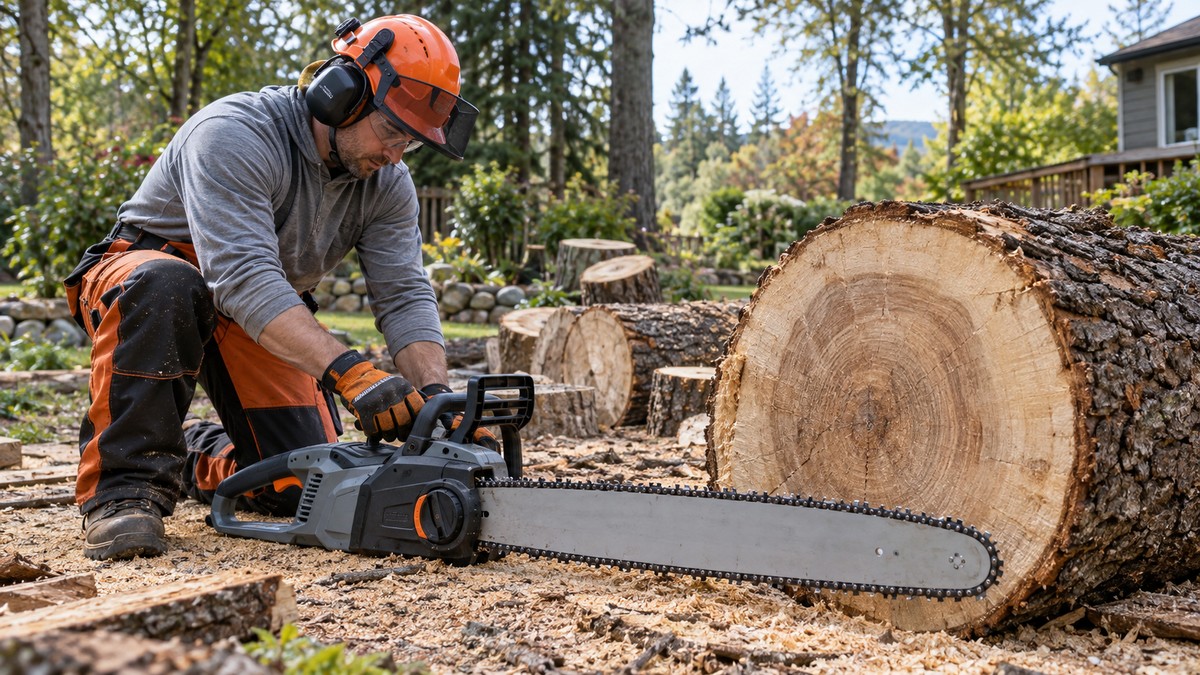
The Illinois page lists protective gear in one sentence: “Personal protective equipment (PPE), for the head, ears, eyes, face, hands, and legs are designed to prevent or lessen the severity of injuries to loggers and other workers using chain saws.” That covers the head, ears, eyes, face, hands and legs, and the page gives no shorter list.
Chaps need a closer look with electric saws. The UW page says: “With electric saws, chaps still offer some protection but may be less effective than with gas saws due to the constant high torque of electric motors.” Chaps are still worth wearing, but the page warns against treating them as equal protection on an electric saw.
The listings say little about protective gear. None of the bullets we read includes chaps, a helmet or eye protection in the set, so a buyer who wants them must buy them separately. This guide does not name specific gear, because the sources we opened do not set a standard that a buyer could check a product against.
Choosing for the job in front of you
Start with the largest cut you actually make, not the largest one you imagine. For limbs and storm debris, the two 18-inch corded models and the two 16-inch corded saws cover most of the work the listings describe. For firewood rounds, the Illinois firewood page is the relevant source, and its safety rules apply whatever the bar length.
If the cut is near the top of the bar, prefer the longer bar and a corded power source, because the UW page says battery saws are less effective with larger cuttings. If the work is spread across a yard with no outlet near the trees, a battery saw covers more ground. The listings give no runtime to check, so test the claim before you rely on it for a long job.
If you want a saw that handles one maintenance task for you, the Oregon listing’s self-sharpening chain is the one feature in this set that its bullets name directly. If you want a feature that lowers kickback force, the BLACK+DECKER and CRAFTSMAN bullets name a low-kickback bar and chain, and Cornell’s limit still applies.
If a listing you want does not name a kickback feature, do not assume it has one. Check the product page, and if the bullets stay silent, treat the feature as absent until the seller confirms it.
1. BLACK+DECKER Electric Chainsaw Corded, 18-Inch, 15-Amp Lightweight Chain Saw with Automatic Oiler (18-inch corded saw with a low-kickback bar and a cord retainer)
Pros
- The bullets describe a 15-amp corded saw with an 18-inch bar for pruning and branches up to 18 inches thick
- The bullets name a low-kickback bar and chain that reduce kickback force and frequency
- The bullets include an extension cord retainer that keeps the plug from pulling out of the saw
Cons
- The branch thickness claim is a listing claim that the sources we opened do not confirm
- The bullets do not state a cord length, which decides how far the saw reaches
Best for: An owner who wants an 18-inch corded saw with a kickback-reducing bar for limbs and mid-sized branches
Skip if: You need battery power or a cord length you cannot confirm from the listing
View on Amazon (affiliate link)
2. SENIX Electric Chainsaw,18" Corded Cutting,CSE15-M (18-inch corded saw for storm cleanup with no battery to charge)
Pros
- The bullets describe an 18-inch corded electric chainsaw powered by a 15-amp motor
- The bullets say the saw plugs into a standard 120-volt outlet, so there is no battery charge to wait for
- The bullets describe automatic oiling from a 5.8 oz. built-in oil tank and tool-less chain tensioning
Cons
- The bullets do not name a kickback-reducing bar or chain, so that feature is unconfirmed
- The spec rows give conflicting weight and power values across variants, so no weight is quoted here
Best for: A homeowner who wants an 18-inch corded saw for storm cleanup and limbs at one site
Skip if: You need a confirmed low-kickback bar or a saw that works away from an outlet
View on Amazon (affiliate link)
3. Oregon CS1500 Self-Sharpening Electric Chain Saw (18-inch corded saw with a self-sharpening chain and a chain brake)
Pros
- The bullets describe a PowerSharp self-sharpening chain that the listing says sharpens the chain in 3 to 5 seconds
- The bullets name a Chain Brake for safety and tensioning without tools
- The bullets say the saw arrives pre-assembled with a 2-year Oregon warranty
Cons
- The bullets give 15A, but the spec table lists 2400 watts, and this guide did not resolve the difference
- The bullets name a chain brake but do not name a low-kickback chain
Best for: An owner who wants an 18-inch corded saw that sharpens its own chain and names a chain brake
Skip if: You need a confirmed kickback rating, since the bullets name no kickback-reducing chain
View on Amazon (affiliate link)
4. CRAFTSMAN Electric Chainsaw, 16 Inch, 12 Amp Corded Chain Saw Electric, Ergonomic, Powerful Motor (16-inch corded saw with a 12-amp motor and a low-kickback bar)
Pros
- The bullets describe a 12-amp corded motor and a 16-inch low kickback bar and chain
- The bullets describe auto-oiling with a built-in oil window and no priming
- The bullets state a 3 Year Limited Warranty, the longest warranty term in the set
Cons
- The 16-inch bar is shorter than the three 18-inch corded models in this set
- The bullets do not give a watt figure or a cord length to compare with the other corded saws
Best for: A yard with limbs and firewood rounds where a 16-inch bar is enough and a low-kickback bar is wanted
Skip if: You need the longest bar in this group for the largest cuts the listings describe
View on Amazon (affiliate link)
5. Electric Chainsaw 16 Inch Corded Chainsaw Chain Saws Tree Cutting (16-inch corded saw with a listed 6500 RPM no-load speed)
Pros
- The bullets describe a 16-inch blade with a no-load speed of 6500 RPM and a chain speed of 12.5 m/s
- The bullets describe automatic lubrication that feeds oil from the tank to the bar and chain
- The bullets say low vibration technology reduces vibration during extended use
Cons
- The bullets name no kickback-reducing bar or chain, and the brake bullet was cut short in capture
- The spec table gives 1500 watts and no amp rating, so the power figure is hard to compare with the other models
Best for: A buyer who wants a 16-inch corded saw and values the vibration and oiling claims
Skip if: You need a kickback feature confirmed in the bullets before you buy
View on Amazon (affiliate link)
6. SEESII 12-Inch Electric Chainsaw Cordless, Brushless Motor (12-inch battery saw for limbs away from an outlet)
Pros
- The bullets describe two 4.0Ah lithium batteries and a built-in battery indicator
- The bullets describe a 1200W brushless motor for fast chain speeds
- The bullets describe a 12-inch cutting bar for pruning branches and cutting lumber
Cons
- The bullets say extended runtime for big jobs but give no run time, so the claim cannot be checked
- The UW page says battery saws are less effective with larger cuttings, which limits a 12-inch battery bar on big trunks
Best for: Someone who needs a saw away from an outlet for limbs and small branches
Skip if: Your job is large trunks or long cutting sessions, since no run time is listed
View on Amazon (affiliate link)
How we chose
We searched Amazon.com for “best electric chainsaw for large trees” in Chrome on 21 October 2026 and read the first results page. We kept corded and battery chainsaws whose titles or bullets name them as chainsaws. We dropped a 55-inch manual rope saw, because it has no power source, and a 6-inch mini chainsaw, because it is a different class of tool. We also dropped pole saws, which are a different tool for this question.
We chose one listing per brand, which gives six brands in all: CRAFTSMAN, BLACK+DECKER, Oregon, SENIX, OUTESAWSUPER and Seesii. For each listing we read the title, the first bullets and the spec rows. We did not use prices, ratings or review counts, and we did not use any bullet that our capture cut short.
The picks below run from the 18-inch corded saws to the 12-inch battery saw. That order follows bar length, not any ranking of quality.
What we could not verify
- Whether any saw in this group cuts a trunk of a given diameter. The listings give bar length, and the sources we opened give no trunk-size rule.
- The BLACK+DECKER claim that its saw is for “branches up to 18-in thick.” It is a listing claim, and the sources we opened do not confirm it.
- The battery runtime described for the Seesii saw. The bullets say “extended runtime” and give no time.
- Cord length on the corded models. None of the bullets we read gives one.
- The Oregon amp and watt figures, which differ between the bullets and the spec table, and the OUTESAWSUPER watt figure, which has no amp rating.
- The brake feature in an OUTESAWSUPER bullet, which our capture cut short.
- Warranty terms beyond the length each listing states.
Mistakes to avoid
- Choosing a battery saw for big cuts. The UW page says battery saws are less effective with larger cuttings.
- Treating a low-kickback bar as protection from kickback. Cornell says these devices reduce kickback but do not prevent it.
- Carrying the saw a long distance with the chain brake off. The Illinois page sets a 50-foot rule for engaging it.
- Starting the saw without checking the controls and chain tension, which the Illinois page asks for before starting.
- Skipping protective gear because the saw is electric. The UW page says chaps offer less protection on electric saws, not none.
- Buying the 12-inch Seesii for a big job because of the phrase “extended runtime for big jobs.” The runtime claim is unverified.
FAQ
Can an electric chainsaw cut a large tree?
Not as a general rule. The bars in this set run from 12 to 18 inches, and the sources we opened give no trunk size that any of these saws can cut. The UW page advises against assuming battery power for larger cuts, and the listings do not give enough detail to promise a clean cut through a large trunk. Check the bar length against the cut you have in mind before you start.
Is a corded electric chainsaw better than a battery one for big cuts?
On the sources we read, yes. The UW page says corded saws have more power output, and battery-powered saws are less effective with larger cuttings. A battery saw still fits work away from an outlet, but the runtime claim on the Seesii listing is not verified.
Do low-kickback bars stop kickback?
No. Cornell says “These devices will reduce but will not prevent kickback.” Treat the feature as a reduction in risk, and keep the chain brake and protective gear in use.
Do chaps protect you when you run an electric saw?
They offer some protection, but less than they do on a gas saw, according to the UW page: “may be less effective than with gas saws due to the constant high torque of electric motors.” The page says they still offer some protection, so they remain worth wearing.
What bar length should I look for?
Match the bar to the cut you make most often. The listings in this guide give 12, 16 and 18 inches. None of the pages we opened gives a rule that ties bar length to trunk diameter, so this guide does not give one either.
Does a high no-load speed mean a saw cuts bigger wood?
Not by itself. The OUTESAWSUPER bullets give a 6500 RPM no-load speed, and the listing does not connect that figure to the size of the cut. Read the bar length and the power source before you read the speed.
Bottom line
Pick a corded saw with an 18-inch bar for the largest cuts in this set, and measure the cord before you buy. Check the chain brake, the chain tension and your protective gear before every session. If the job is bigger than the bars and power figures in these listings, this set does not answer the question, and this guide does not pretend it does. For the next step, read the electric chainsaw sharpener guide or the best chainsaw guide.
Sources
- Cornell Small Farms Program, Reducing the risk of chainsaw kickback (opened 2026-10-21): https://smallfarms.cornell.edu/2018/07/chainsaw-safety-part-4-reducing-the-risk-of-chainsaw-kickback-just-say-no-to-kickback/
- University of Wisconsin-Madison Extension, Chainsaw buying and maintaining (opened 2026-10-21): https://forestry.extension.wisc.edu/learn/chainsaw/buying-and-maintaining/
- University of Illinois Extension, Firewood cutting safety (opened 2026-10-21): https://extension.illinois.edu/firewood/cutting-safety