Battery Backpack Blowers: What They Are For
As an Amazon Associate we earn from qualifying purchases.
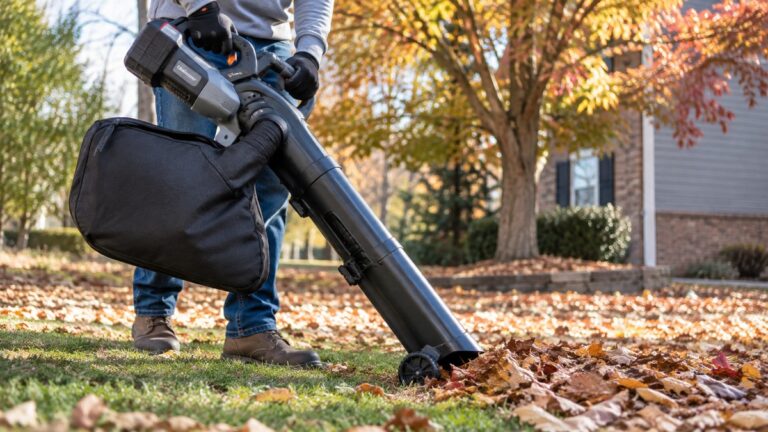
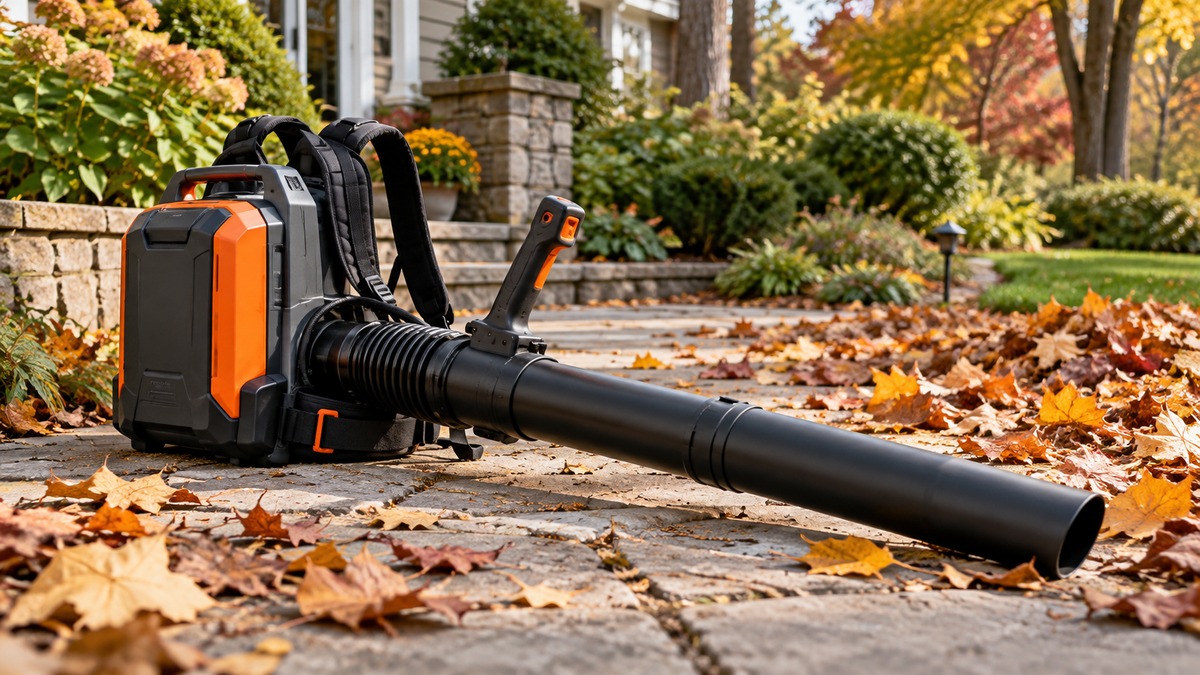
Battery backpack blowers explained in brief: a cordless blower fitted with a harness, so you wear the unit on your back while you work. Husqvarna’s US buying guide says a backpack suits longer sessions and more material, such as leaves, sand and gravel across larger land areas. This guide covers what these blowers are for, how the harness and battery shape the job, and where a handheld or a petrol backpack fits better. It ranks no models, and it quotes manufacturer figures only with their labels.
Quick answer
- A battery backpack blower is for longer sessions, more material and larger areas, according to Husqvarna’s US buying guide.
- The harness spreads the weight across your back, arms and hands. Ryobi and EGO both list an adjustable harness on their backpack pages.
- Runtime is a manufacturer figure under stated conditions. Ryobi states over 2 hours on two 40V 8Ah batteries with the variable speed trigger on low.
What a battery backpack blower is
The pages opened describe the same basic idea: a cordless blower worn on the back on a harness, instead of carried in the hand. The design moves the weight from the arms to the body, as the Husqvarna guide describes, and the sections below cover the harness and the controls.
The harness
Husqvarna’s guide says that while backpack blowers weigh more than handheld units, ergonomic harnesses spread the weight to reduce fatigue and strain on your back, arms and hands. Ryobi’s 40V backpack kit page describes a contoured back and shoulder harness with adjustable straps for comfort. EGO’s 600 CFM backpack page lists an adjustable harness with a waist belt. The pages opened do not give a weight figure for any battery backpack unit, so the harness is the only weight point you can check on the page.
The controls
Ryobi’s kit page describes two modes, one for maximizing power and one for maximizing runtime, and an LCD screen that shows the mode and the battery life. It also describes a variable speed trigger. EGO’s page describes variable speed control that lets you dial the power from 260 to 600 CFM for the job at hand. Both features let you match the output to the work, which matters for the runtime section below.
Air output, as labelled
Ryobi labels its kit at 850 CFM air volume and 180 MPH air speed, and EGO labels its unit at a variable range of 260 to 600 CFM. These are manufacturer figures in different measurement terms. The pages do not describe how the figures were obtained, so they cannot be ranked against each other, and this guide does not try to rank them.
What battery backpack blowers are for
Husqvarna’s US buying guide gives the clearest statement of use in the pages opened. It says backpack leaf blowers provide the added power and air speed needed to clear leaves, sand, gravel and other debris from larger land areas. It also says that if you are working for longer periods and with more material to blow, a backpack blower is the right choice. The guide’s wording is about the job, not the brand, so the same reasoning applies to any battery backpack you compare.
Ryobi’s page makes a similar claim for its kit. It describes the blower as ideal for tackling tough applications, damp or dry leaves, and compacted grass. Those are the jobs a backpack is built for, and they are the jobs to check against the list in the next section before you buy.
Backpack or handheld: what the sources say
The Husqvarna guide asks you to start with the job, not the machine. Its first question is how big your yard is and how many leaves you need to remove each year. The table below turns the guide’s comparison into rows, and it marks what the guide does not say.
| Factor | Handheld | Battery backpack | Source |
|---|---|---|---|
| Session length | Shorter periods | Longer periods | Husqvarna US buying guide |
| Amount of material | Smaller amounts | More material | Husqvarna US buying guide |
| Weight | Typically lighter | Heavier; harness spreads the weight | Husqvarna US buying guide |
| Typical area | Light-duty yard projects and smaller lawns | Larger land areas | Husqvarna US buying guide |
| Heavy wet leaves | Not stated | Guide suggests a petrol backpack for this work | Husqvarna US buying guide |
| Modes | Not stated | Power or runtime mode (Ryobi kit) | Ryobi product page |
The table shows that the guide draws a clear line on session length and material, but it draws no line on a specific number of leaves. The guide does not give a threshold for heavy work, so the choice between a battery backpack and a petrol backpack for wet leaves is a judgment you make from the job. For a wider set of cordless options, see the cordless leaf blower roundup.
Runtime and batteries
Ryobi’s kit page states over 2 hours of runtime, with the label that the figure uses two 40V 8Ah batteries and the variable speed trigger on low. That is a manufacturer figure under a named condition. The same page says you can choose between maximizing power and maximizing runtime, but it gives no runtime for the power setting. Treat the 2-hour figure as the low-setting figure only.
EGO’s FAQ makes a related point about speed. It says turbo can be fun to use, but it requires more power, which drains the battery faster. It then recommends experimenting with different speeds to find the lowest setting that still efficiently gets the job done. That advice is the manufacturer’s, so cite it as EGO’s guidance rather than a general rule. The EGO 600 CFM page gives no runtime figure of its own.
Husqvarna’s guide says that some extra batteries or a backpack battery allow you to work a full day. That is a general statement with no figure, so it does not replace the runtime labels on a specific product.
Worked calculation: battery pairs for a longer job
The formula is battery pairs equals job time divided by stated runtime per pair, rounded up. The inputs are the stated 2 hours on two 8Ah batteries with the variable speed trigger on low, which is the Ryobi figure, and a job time of 4.5 hours, which is an example and not a figure from any source. The result is 4.5 divided by 2, which is 2.25, so the job needs three full pairs on the stated figure. A higher power setting would shorten the time, but the page gives no figure for it, so the calculation holds only for the stated condition.
Battery care and fit
Battery care is simple on the pages opened. Store the battery in a cool, dry place, and keep it away from liquids, oils and extreme temperatures, as the DeWalt battery safety page advises. That page is for DeWalt batteries, so the same advice is not stated for every brand.
Fit is the other point to check. Ryobi’s page describes its 40V system as one battery for over 85 products. That claim is for the Ryobi system only. Do not assume that a battery from one brand fits another brand’s blower, because the pages opened do not show any cross-brand fit. For battery platform compatibility on a DeWalt leaf blower, see the guide on batteries for a DeWalt leaf blower.
Safety around a battery backpack blower
The one distance warning in the pages opened is for a petrol blower. Husqvarna’s US start page says: air is released as soon as the engine is started, even when it is idle, and no one should stand close to the blower or the blower tube. That warning is for a petrol model, and the battery pages opened do not give the same warning. Keep bystanders at a similar distance anyway, and check the battery model’s manual for its own rule.
For the battery itself, the DeWalt page says to store and charge batteries in a cool, dry location, and to avoid exposing them to liquids, oils, or extreme temperatures. Keep the pack in that condition between sessions. The harness is adjustable on the Ryobi and EGO pages, and both describe that as a comfort feature.
For handheld models you may compare with a backpack, see the guide on DeWalt 20V brushless handheld blowers.
How we chose
We looked for manufacturer pages and a manufacturer buying guide that describe what a battery backpack blower is for, or that give a labelled figure for one. On 2026-10-22 we opened five pages: the Husqvarna US buying guide, the EGO US 600 CFM backpack page, the Ryobi US 40V backpack kit page, the Husqvarna US petrol blower start page, and the DeWalt battery safety page. Other manufacturer pages were also opened, but none gave a usage description for a battery backpack, so none is cited. Retail listings were not used. No models were ranked, and no sales or review data was used.
What we could not verify
- Real runtime for any named battery backpack on a full yard or with wet leaves.
- Air output that is comparable across brands. The labels use different units, and the pages do not describe a method.
- Whether any battery backpack works with another brand’s battery.
- The weight of any battery backpack unit. The pages say backpacks weigh more than handhelds but give no figure.
What the sources do not say
The EGO 600 CFM page gives no runtime figure, and the Ryobi page gives a runtime figure only for its low setting. The Husqvarna category and product pages for battery blowers that were opened loaded navigation text only, so this guide does not quote them. No source gives a bystander distance for a battery backpack model, and the one distance warning in the pages opened is for a petrol blower. The guide gives no threshold for heavy work, so the battery-or-petrol choice for wet leaves stays a judgment.
FAQ
What is a battery backpack blower for?
Husqvarna’s US buying guide says a backpack leaf blower clears leaves, sand, gravel and other debris from larger land areas. It suits longer sessions and more material than a handheld does.
Is a battery backpack better than a handheld?
It depends on the job. The Husqvarna guide says a handheld suits shorter periods and smaller amounts of leaves, and a backpack suits longer periods and more material. For heavier wet-leaf work, the same guide suggests a petrol backpack.
Are battery backpack blowers heavier?
The Husqvarna guide says backpacks weigh more than handheld units. It adds that the harness spreads the weight to reduce fatigue and strain on the back, arms and hands. The pages opened give no weight figure for a battery backpack.
How long does one battery pair run?
Ryobi’s kit page states over 2 hours with two 40V 8Ah batteries and the variable speed trigger on low. The page gives no runtime for the power setting, and the EGO 600 CFM page gives no runtime figure at all.
Does a higher speed drain the battery faster?
EGO’s FAQ says turbo requires more power and drains the battery faster. It recommends finding the lowest setting that still gets the job done efficiently. That advice comes from the manufacturer and applies to its own blower.
Can I use a battery from another brand?
The pages opened do not support it. Ryobi describes its 40V battery as the one for its own system, and DeWalt tells owners to use its own authentic batteries with its own tools. Check the owner’s manual for the blower and the battery before you buy either one.
Bottom line
For a long session or a heavy load over a large area, a battery backpack with a harness fits the job. For short, light work, a handheld is the simpler choice, and for heavy wet leaves the Husqvarna guide points to a petrol backpack.
Sources
- Husqvarna US: How to Buy a Leaf Blower: What to Know (opened 2026-10-22)
- EGO POWER+: 600 CFM Cordless Backpack Leaf Blower (opened 2026-10-22)
- Ryobi: 40V HP Brushless 850 CFM Backpack Blower Kit (opened 2026-10-22)
- Husqvarna US: How to start a leaf blower, petrol-powered leaf blower support (opened 2026-10-22)
- DEWALT: Top 10 Lithium Ion Battery Storage & Safety Tips (opened 2026-10-22)