How to Measure Your Yard for a Mower
As an Amazon Associate we earn from qualifying purchases.
How to measure your yard for a mower starts with the arithmetic extension pages use for lawn area. Split the grassed part into simple shapes, measure each shape, add the results, and take away the house, driveway and other structures that have no turf. The pages we opened measure lawn area for seed, sod and fertilizer, not for mower choice, so this guide uses their methods as written and says where they stop.
Quick answer
- Measure the grassed area in square feet, not the total lot.
- Split an irregular lawn into rectangles, triangles and circles, then add the pieces.
- Subtract the house, driveway and other structures that have no turf.
- To get square yards, divide the square feet by 9.
Safety while you measure
Measuring the lawn involves no blade, deck or battery work, so the battery rule for blade work does not come into this step. Illinois Extension says that for an electric mower the battery should be removed before the blades are removed, to prevent any accidental engagement. Follow that rule first if you move on to blade work.
The pages we opened give no other safety steps for measuring with a tape or a wheel, so none is given here.
What the measurement is for
University of Maryland Extension says to measure the square footage of your lawn so you know how much area seed or sod, fertilizer and lime will cover. Oklahoma State University gives the same reason: the total is needed to buy the right amounts of fertilizer, seed, sod and other materials. A yard total is the number those purchases depend on, so it is the first figure to get right.
None of the pages we opened connects lawn area to a mower’s size, cutting width or coverage. Once you have the total, look at the mower pages on this site for your yard size. If the total points to a small yard, see cordless mowers for small yards. For larger land, see lawn mowers for large land. For a robot option on a small lawn, see robot lawn mowers for small lawns.
Steps to measure the grassed area
Each step names the page it comes from.
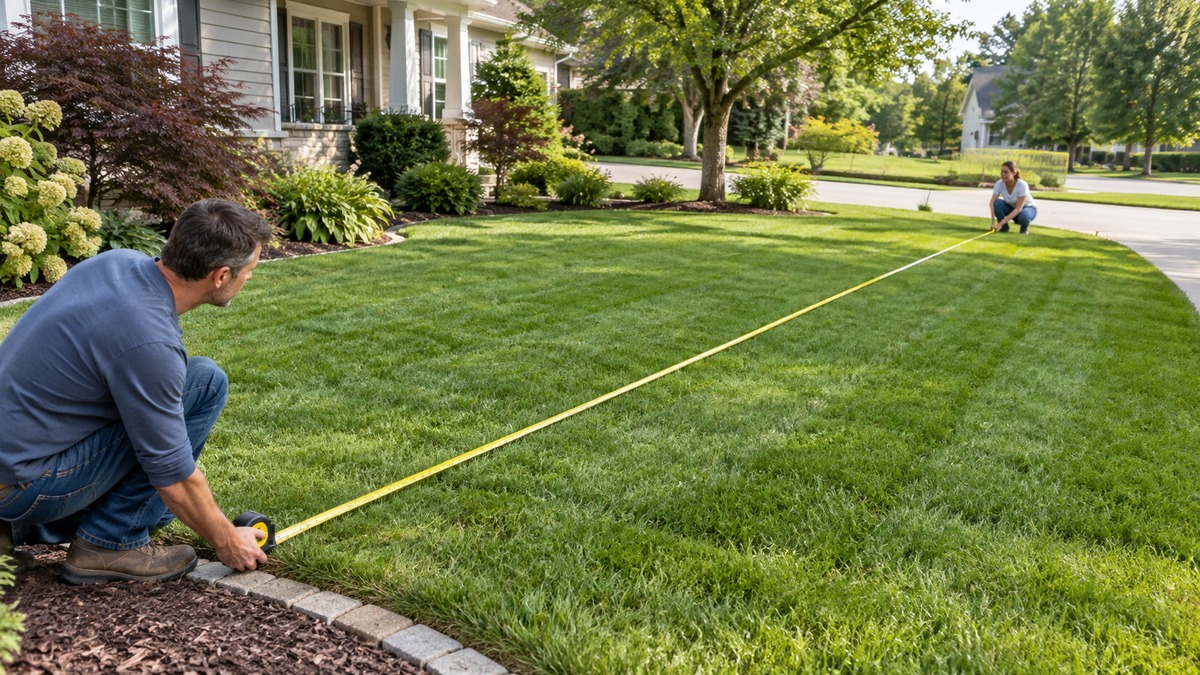
- Get a tape measure or a measuring wheel. Penn State Extension says the tools used to measure a site usually include a tape measure or a measuring wheel, and its Figure 1 shows a measuring wheel in use on a lawn.
- Split the grassed part into simple shapes. Oklahoma State University describes this method: divide the lawn into smaller sections, such as rectangles, triangles and circles, calculate each section, and add them up to get the total lawn area.
- For a rectangle, multiply the length by the width. Penn State says most sites are rectangular, so the total can be found by multiplying the length of the site by the width. Iowa State Extension gives the same rule as Area = length × width.
- For a triangle, measure the base and the height. Iowa State Extension says to measure the length of the base and then the height, the distance from the top point down to the base. Its formula is Area = base × height × 0.5.
- For a circle, use the radius. Iowa State Extension says to multiply pi, written as 3.14, by the radius squared. It defines the radius as the distance from the center of the circle to the edge.
- For a curved edge, use width lines. Iowa State Extension says to find the longest line within the shape, then measure perpendicular width lines to it at equal spacing. Add the width-line lengths and multiply by the spacing. More width lines give a more precise area.
- Subtract the house, driveway and other structures. Penn State says turf will not grow in those areas, so their total area is subtracted from the total area of the site. Oklahoma State gives the other method: find the whole lot, then subtract the non-lawn spaces.
- Add the pieces to get the lawn total in square feet. Iowa State Extension says to find the area of each piece and add them together for an irregular shape.
- Convert to square yards if you need them. Oklahoma State’s sod footnote says 1 square yard equals 9 square feet, so divide the square-foot total by 9.
Area formulas at a glance
The table lists each shape or step, its formula or rule, and the page that gives it. Where a page gives no figure or rule, the cell says “not stated.”
| Shape or step | Formula or rule | Source |
|---|---|---|
| Rectangle | Area = length × width | Iowa State Extension; Penn State Extension |
| Triangle | Area = base × height × 0.5 | Iowa State Extension |
| Circle | Pi (3.14) × radius squared | Iowa State Extension |
| Irregular outline | Sum of width-line lengths × spacing between lines | Iowa State Extension |
| Irregular lawn | Split into shapes, measure each, add the areas | Oklahoma State University; Penn State Extension |
| Non-lawn spaces | Subtract the area of the house, driveway and other structures | Penn State Extension; Oklahoma State University |
| Square yards | 1 square yard = 9 square feet | Oklahoma State University |
| Sketch of the lot | not stated | All pages opened |
| Mower size or coverage from area | not stated | All pages opened |
Rectangles, triangles and circles
Most lawns are closest to a rectangle, and Penn State says that is the simplest case: multiply the length by the width. Iowa State gives the same rule in formula form. Oklahoma State says lawn area is normally calculated in square feet.
A triangle takes one more measurement. The base is the side along the ground, and the height is the straight distance from the top point down to the base. Iowa State’s formula multiplies the base by the height and then by 0.5, which is the same as halving the product.
A circle uses the radius. Iowa State says the radius is the distance from the center to the edge, and the area is pi multiplied by the radius squared, with pi written as 3.14 on that page.
Irregular outlines and width lines
When an outline is curved, the simple shapes do not fit. Iowa State describes width lines: pick the longest line through the shape, then measure lines across it at right angles at equal spacing. The more width lines you take, the more precise the result, according to the same page. The total is the sum of the width-line lengths multiplied by the spacing between lines.
Penn State says the same thing in shorter form: refer to its figure on irregular shapes. Its figure is not in the text the tool can read, so this guide does not describe the figure in detail.
Subtracting structures and converting units
Penn State says a house, driveway and other structures take up part of the site, and that no turf will grow there. Calculate their total area and subtract it from the total site area. Oklahoma State describes the same idea as a second method: find the whole lot, then subtract the non-lawn spaces.
Oklahoma State’s sod footnote states that 1 square yard equals 9 square feet. That is the only conversion the pages we opened give, so square yards are square feet divided by 9.
Sketching the lot
The pages we opened do not describe a sketch step. Penn State’s Figure 3 shows a sample property and how to calculate the area of the lawn, but the figure is not in the text the tool can read. The steps above do not depend on it.
How we chose
We opened five pages on 2026-10-22: Iowa State Extension’s FAQ on lawn area, Oklahoma State University’s lawn establishment guide, Penn State Extension’s lawn establishment page, University of Maryland Extension’s established-lawn page, and Illinois Extension’s mower maintenance page for the battery pointer. We kept the lines that give area methods, the reason to measure, and the subtraction rule. We did not use PDF files, because this tool cannot read them. We did not rank measuring tools or mower models.
What we could not verify
No page we opened links lawn area to a mower’s coverage, deck width or battery runtime. The Iowa State page’s formulas are general shape formulas, and this guide uses them for lawns only. The pages do not discuss slopes or trees for this purpose, so a yard with either may need a method the sources do not describe. We could not check the Penn State figures, because the figures are not readable as text.
What the sources do not say
- Whether a sketch of the lot is needed, or how to draw one.
- How to measure a yard with trees, slopes or raised areas.
- Whether a measuring wheel is more accurate than a tape on uneven ground.
- Any link between lawn area and a mower’s cutting width, coverage or battery runtime.
Common mistakes to avoid
- Measuring the whole lot instead of the grassed area. Penn State says to subtract the structures that have no turf.
- Skipping the house and driveway. Oklahoma State and Penn State both include them in the subtraction.
- Guessing at an irregular outline. Iowa State says to split the shape and add the pieces, or use width lines.
- Mixing square feet and square yards. The Oklahoma State footnote gives the 9-square-foot conversion.
FAQ
Do I need a tape measure or a measuring wheel?
Either is listed as a tool. Penn State Extension says the tools usually include a tape measure or a measuring wheel, and its figure shows a measuring wheel in use on a lawn. The pages do not say which is more accurate, so choose the one that fits your ground.
How do I measure a yard that is not a rectangle?
Split it into simple shapes, measure each one, and add the areas. Oklahoma State University describes this method for lawns. For a curved edge, Iowa State Extension describes width lines: measure lines across the shape at equal spacing and multiply the sum of their lengths by the spacing.
Should I subtract the house and driveway?
Yes. Penn State Extension says turf will not be established under the house, driveway and other structures, so their area is subtracted from the site total. Oklahoma State University describes the same subtraction as its second method.
Why does the lawn area matter?
The total tells you how much seed or sod, fertilizer and lime to buy. University of Maryland Extension says to measure the square footage so you know how much area those will cover, and Oklahoma State University gives the same reason for purchasing.
How do I convert square feet to square yards?
Divide the square-foot total by 9. The Oklahoma State University sod footnote says 1 square yard equals 9 square feet, and the pages we opened give no other conversion.
Does the square footage tell me which mower to buy?
The pages we opened do not link lawn area to any mower’s size or coverage. Coverage figures on a product page are the manufacturer’s own claims, and the pages we opened do not confirm them. Use the total to choose a mower category, and check the manual or listing for the rest.
Bottom line
Use the grassed area after you subtract the house, driveway and other structures, not the total lot, for every purchase or sizing decision.
Sources
- Iowa State University Extension and Outreach: How do I determine the size of my garden bed or lawn in square feet? (opened 2026-10-22)
- Oklahoma State University: Establishing a Lawn in Oklahoma (opened 2026-10-22)
- Penn State Extension: Lawn Establishment (opened 2026-10-22)
- University of Maryland Extension: Maintaining an Established Lawn (opened 2026-10-22)
- Illinois Extension: Mower Maintenance (opened 2026-10-22)