How to Winterize an Electric Lawn Mower
As an Amazon Associate we earn from qualifying purchases.
How to winterize an electric lawn mower comes down to four jobs: clean the deck and underside, handle the blade only with the battery removed, fully charge the battery before storage, and keep the mower and battery dry and indoors. The pages we opened cover these jobs in different detail. Most of the storage figures come from a robotic mower guide, so this post labels those figures and says where a walk-behind mower is not covered.
Quick answer
- Clear the clippings from the deck and underside, because stuck clippings hold water and can rust the metal.
- Remove the battery before any blade work and before any cleaning that brings your hand near the blade.
- Fully charge the battery before storage, then keep it in a cool, dry place indoors.
- Check the owner’s manual for model-specific details, including any charging needed during storage.
Safety before any blade or deck work
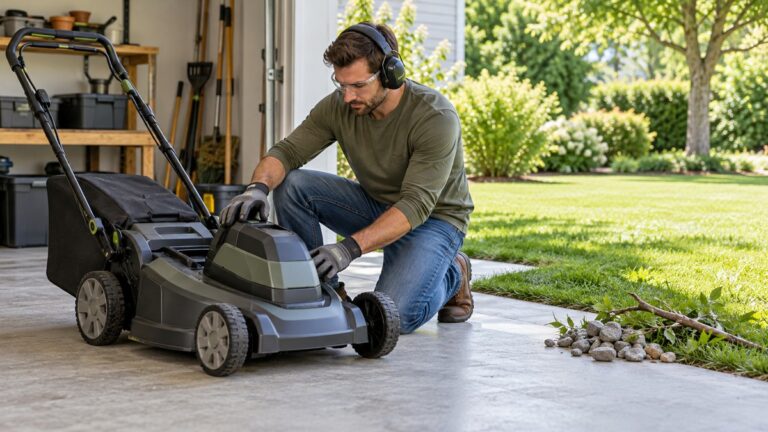
Illinois Extension says that for electric mowers the battery should be removed before the blades are removed, to prevent any accidental engagement. The same page places the battery rule in its cleaning section, so the battery comes out before you reach under the deck as well.
Iowa State Extension describes blade removal on an electric mower with heavy leather gloves, the battery removed, and a short 2×4 to keep the blade from turning. Oklahoma State University notes that cordless electric mowers pose most of the same hazards as gasoline mowers.
The sources do not state how long to wait after removing the battery before you handle the blade, so no waiting time is given here.
Winterizing steps, in order
These steps combine what the pages say about the mower and its battery. A step that applies only to robotic models is marked as such.
- Read the owner’s manual for your model. Illinois Extension says to consult the user manual before maintenance or operating. The manual is also where blade bolt torque and any storage charging rules are listed for your model. The pages we opened do not give those figures for walk-behind electric mowers.
- Remove the battery. Do this before any blade or under-deck work. Illinois Extension ties the battery rule to blade removal and to any time your hand goes near the blades.
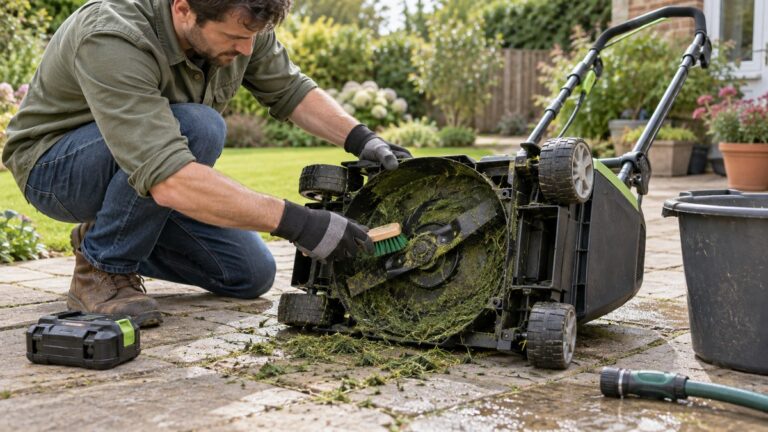
- Clear the clippings from the deck and underside. Illinois Extension says clippings stuck to the bottom of the deck hold water, and that the water causes the metal to rust and shortens the equipment’s life. Its method is to inspect underneath the deck routinely, scrape buildup off with a putty knife, and blow off the rest with a leaf blower or air compressor. The Husqvarna robotic guide asks for the same result in its own words: remove all grass clippings and debris from moving parts.
- Sharpen the blade while it is off. Iowa State Extension says winter is a good time to service a mower, and recommends sharpening the blades and cleaning the deck while the blade is out. Take the blade off only with the battery removed, as in step 2.
- Tighten the blade bolt to the manual’s torque. Illinois Extension says to use a torque wrench on reinstallation, to the specification in the user manual. The pages we opened do not give that number.
- Fully charge the battery before storage. DeWalt says a battery stored for longer than six months should be fully charged first, and that it should be disengaged from the tool before extended storage. Husqvarna’s robotic guide says to fully charge the mower and switch it off before storage.
- Check the charging contacts (robotic models). Husqvarna’s robotic guide says to check the charging contacts on both the mower and the charging station for corrosion or debris. The pages we opened do not describe contact checks for a walk-behind mower, so treat this step as robotic only.
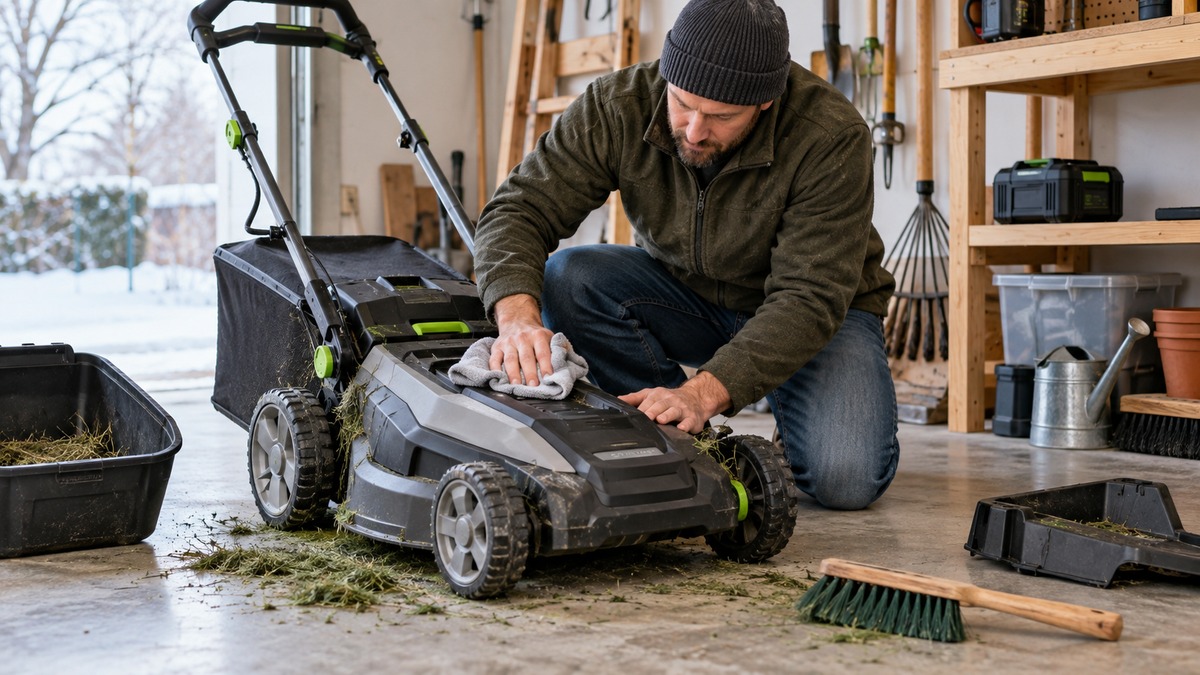
- Store the battery in a cool, dry place indoors. DeWalt advises a cool, dry location and says to avoid liquids, oils and extreme temperatures. Oklahoma State University says to keep batteries indoors in a dry, climate-controlled area when possible.
- Store the mower indoors and dry (robotic models). Husqvarna says its robotic mower should be stored indoors only, in a dry place above freezing, with the power supply disconnected. The pages we opened do not give the same rule for a walk-behind mower.
- Decide whether the battery needs a mid-winter charge. Husqvarna says most of its robotic models need no charging during storage, while some older models need a charge every three months. Check the manual for your model. The pages we opened do not state a mid-winter charging interval for a walk-behind battery.
- Do not try to repair the battery yourself. DeWalt says not to attempt repair or service, and to visit a service center for help with a battery.
Battery storage over the winter
Charge level before storage
Two of the pages give the same starting point: a full charge before storage. DeWalt says a battery stored for longer than six months should be fully charged first. Husqvarna’s robotic guide says the mower should be fully charged before it is switched off for storage. Neither page gives a percentage for a long storage period, and the pages do not say whether a partial charge is safer.
Temperature and place
DeWalt says to keep batteries away from extreme temperatures but gives no figure. Oklahoma State University says to keep batteries in a dry, climate-controlled area when possible. The Husqvarna robotic guide gives a number for its mower: storage above freezing, which the page writes as above 0°C or 32°F. That figure applies to the robotic mower, and the pages we opened do not give a battery temperature range for a walk-behind mower.
During the winter
Husqvarna says most robotic models need no charging during storage, and older models may need a charge every three months. The pages do not say whether a walk-behind battery should be topped up in mid-winter. DeWalt’s instruction to disengage the battery from the tool before extended storage is general battery guidance, and it applies to a removable battery of any size. For chargers, see the guide to charging systems for lawn mowers.
If a battery will not charge before storage, see the guide to a lawn mower battery that is not charging. For the battery’s voltage and amp-hour rating, see the guide on lawn mower battery voltage and amps.
Winter storage checks at a glance
The table lists each check, what the pages we opened say, and which page says it. Where a page gives no figure or does not cover a walk-behind mower, the cell says “not stated.”
| Winter check | What the sources say | Source |
|---|---|---|
| Owner’s manual | Consult it before maintenance; torque and storage charging are model-specific | Illinois Extension; Husqvarna (robotic) |
| Battery removal | Remove for blade work and whenever a hand goes near the blades | Illinois Extension |
| Deck underside | Clippings hold water and cause rust; scrape buildup off and blow the rest away | Illinois Extension; Husqvarna (robotic) |
| Blade sharpening | Good time to sharpen the blades and clean the deck while the blade is out | Iowa State Extension |
| Blade bolt torque | Use a torque wrench to the manual’s specification; figure not stated | Illinois Extension |
| Charge before storage | Fully charge; disengage the battery from the tool for extended storage | DeWalt; Husqvarna (robotic) |
| Battery storage temperature | Cool, dry, away from extremes; a figure in degrees is not stated | DeWalt |
| Battery storage place | Dry, climate-controlled area indoors when possible | Oklahoma State University |
| Mower storage place | Indoors only, dry, above 0°C or 32°F, power supply disconnected | Husqvarna (robotic) |
| Charging during storage | Most robotic models none; some older models every three months; walk-behind not stated | Husqvarna (robotic) |
| Charging contacts | Check for corrosion or debris | Husqvarna (robotic) |
How we chose
We opened five pages on 2026-10-22: three university extension pages, one tool maker’s battery support page, and one robotic-mower winter guide from a manufacturer’s US support site. We kept the lines about cleaning, blade care, battery charge and storage, and the manual check. The Iowa State page is written for winter in general, and its fuel and oil lines are for gas engines, so those lines are not used. The Husqvarna guide covers robotic models only, so each of its steps is labelled. We did not rank products or compare brands, and no product appears in this guide.
What we could not verify
No page we opened gives a storage charge level or a mid-winter charging interval written for a walk-behind electric mower. The mid-winter rule comes from the robotic guide. That guide does not say whether a walk-behind mower needs the same steps. The DeWalt page covers DeWalt tools in general and does not describe a mower. The pages we opened do not describe where the battery sits on every model, so the battery-removal step assumes a removable battery. The Oklahoma State page is a teen guide, and its storage line is general.
What the sources do not say
- A storage charge percentage for a walk-behind electric mower’s battery.
- A mid-winter charging interval for a walk-behind battery.
- A storage temperature for a walk-behind battery in degrees.
- A blade bolt torque value for any electric mower.
- How long to wait after removing the battery before handling the blade.
- How a walk-behind mower should rest in storage. The Husqvarna guide says its robotic mower should rest on all wheels on a flat surface.
Common mistakes to avoid
- Leaving clippings on the deck over the winter. Illinois Extension says stuck clippings hold water and cause the metal to rust.
- Working under the deck with the battery connected. Illinois Extension says to remove the battery whenever your hand goes near the blades.
- Storing the mower outdoors. The Husqvarna robotic guide says to store indoors only, and the Oklahoma State page says to keep batteries indoors when possible.
- Skipping the manual. Illinois Extension says to consult the user manual before maintenance, and the Husqvarna guide says to check the manual for charging needs.
FAQ
Should I charge the battery fully before winter storage?
Yes, both DeWalt and the Husqvarna robotic guide say to fully charge before storage. DeWalt specifically says a battery stored for longer than six months should be fully charged first and disengaged from the tool. Neither page gives a percentage for a long storage period, so the pages do not say whether a partial charge is safer.
Do I need to remove the battery to clean the deck?
Yes, for an electric mower. Illinois Extension says that whenever your hand goes near the blades, the battery should be removed, and it places that rule in the cleaning section right after its advice to scrape the underside of the deck. Iowa State says the blade being off is a good time to clean the deck, which is another reason to work with the battery out.
Where should I store the battery over winter?
DeWalt recommends a cool, dry spot and warns against liquids, oils and extreme temperatures. The Oklahoma State teen guide suggests an indoor spot that is dry and climate-controlled, where that is possible. Neither page gives a temperature in degrees, so the sources do not say what cool or climate-controlled means in numbers.
Does a battery mower need a charge in the middle of winter?
The Husqvarna robotic guide says most of its models need no charging during storage, but older models may need a charge every three months. The pages do not say whether a walk-behind battery needs the same, so check the manual for your model before you decide.
Is winter the right time to sharpen the blade?
Iowa State Extension says winter is a good time to service the mower, and it recommends sharpening the blades and cleaning the deck while the blade is out. Dull blades make a mower work harder and tear the grass rather than cut it cleanly, according to the same page. Remove the battery before taking the blade off.
Can I hose off the deck before I store the mower?
The pages differ. Iowa State describes a strong stream of water and a putty knife for packed debris on the underside of the deck. Illinois Extension recommends a leaf blower or air compressor and warns to be careful of wiring and hoses. If you use water, check the manual for your model first and keep the battery out while you work under the deck.
Bottom line
Clean the deck, remove the battery before any blade work, and fully charge the battery before it goes into storage.
Sources
- Illinois Extension: Mower Maintenance (opened 2026-10-22)
- Iowa State University Extension and Outreach: Winter Garden Tasks (opened 2026-10-22)
- Oklahoma State University: Lawn Care Safety and Basic Maintenance Tips for Teens (opened 2026-10-22)
- DEWALT: Top 10 Lithium Ion Battery Storage & Safety Tips (opened 2026-10-22)
- Husqvarna: Complete winter storage guide for your Automower robotic lawn mower (opened 2026-10-22)