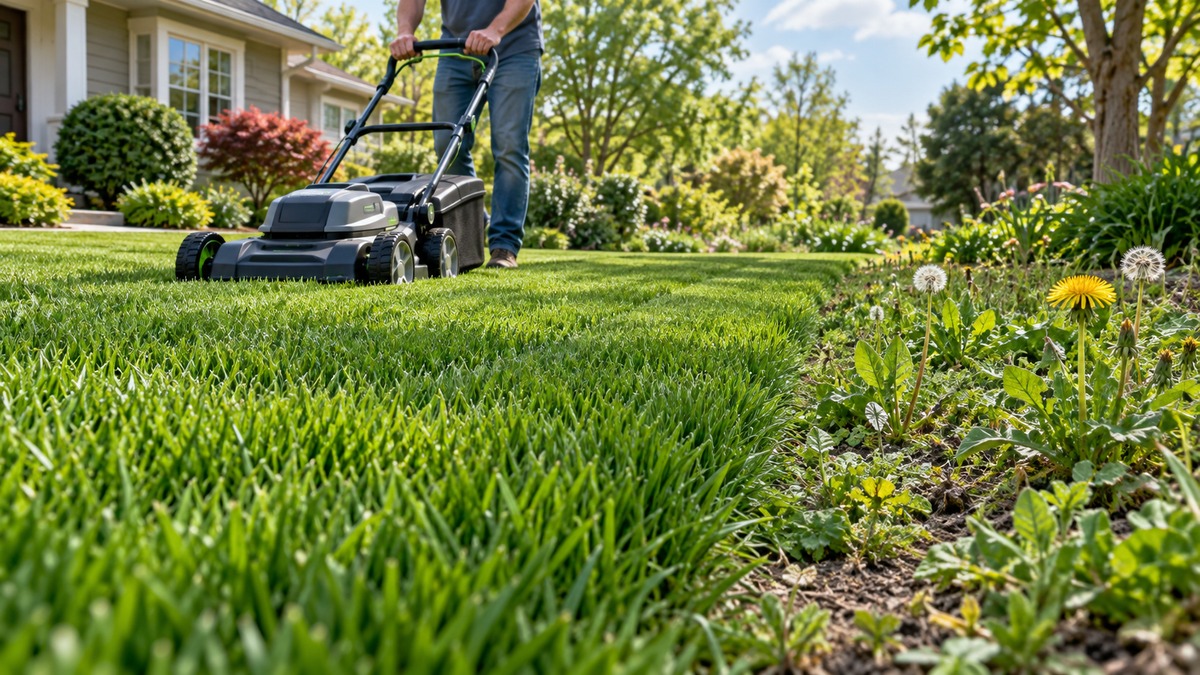
Mowing Habits That Keep Weeds Down
As an Amazon Associate we earn from qualifying purchases.
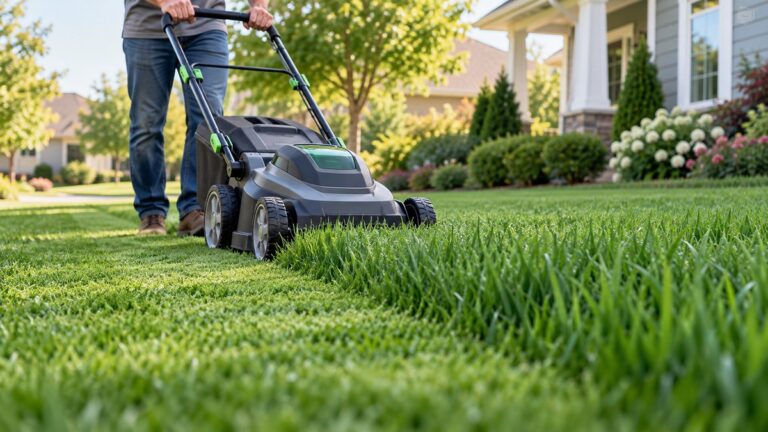
Mowing habits that keep weeds down come down to three things: how high the grass stays, how much of the blade you remove at each cut, and how often you mow. University extension pages from Maryland, Illinois, Colorado, Wisconsin and Penn State describe these habits in similar terms. Taller grass shades the soil, and short, heavy cuts give weeds an opening. Illinois Extension treats mowing as one part of a wider set of lawn practices, with removal as a separate step for weeds that remain.
Quick answer
- Keep the grass high enough to shade the soil. The Wisconsin page says taller grass from higher cuts shades the soil and gives much less crabgrass.
- Never remove more than one-third of the blade in a single cut.
- Mow by how fast the grass grows, not by a fixed calendar, and keep the blade sharp.
- Do not mow for a few days before and after a weed-killer application, according to Illinois Extension.
Safety notes for mowing and weed control
Two safety points come from the sources. First, Illinois Extension says that for an electric mower the battery should be removed before blade work, and whenever your hand goes near the blades. That includes the moment you scrape clippings from under the deck, which the same page places in its cleaning section.
Second, Illinois Extension says to read the herbicide label for potential hazards when a lawn sits over the root zone of trees, and gives dicamba as its example. The sources we opened do not name herbicide products or rates, and this post does not recommend one.
Cut height: the habit with the most effect
Why taller grass helps
University of Maryland Extension says proper mowing reduces weed invasion and lessens disease pressure, because it minimizes grass stress. Wisconsin Horticulture calls improper mowing height the easiest correctable lawn care mistake, and says lawns mowed too short face a variety of issues, in particular weed infestations. Its explanation is about light: crabgrass flourishes in open turf that lets more light reach the soil, and taller grass from higher cuts shades the soil, which means much less crabgrass.
The heights the pages give differ. Colorado State University gives two inches to three and one-half inches as the preferred range for Colorado turfgrass species. Illinois Extension asks whether you are mowing at a 3 to 4 inch cut height, and Maryland uses a 3-inch lawn as its example. These numbers depend on grass type and region, so no single height is given here for every lawn. For mowers suited to taller grass, see lawn mowers for cutting tall grass.
Why scalping invites weeds
Colorado State University says mowing to less than two inches can reduce drought and heat tolerance, and can raise insect, disease and weed pest problems. It also says scalping is never recommended. Maryland goes further for cool-season grass: mowing too short is a major contributor to lawn deterioration and to weed abundance, especially crabgrass. The pages agree that short cutting stresses the grass and gives weeds room, even though they name slightly different heights.
Shade changes the height
Penn State Extension advises that in shade the clipping height should be considerably higher than for the same grass in full sun, about one inch higher. The page does not give a separate weed count for shaded and sunny lawns.
How much to remove, and how often
The one-third rule in numbers
Maryland, Colorado, Wisconsin and Penn State all use the same limit: remove no more than one-third of the grass blade in a single mowing. Maryland gives a worked example, that to maintain a 3-inch lawn height you should mow when the grass reaches 4 inches.
The calculation below uses that example’s 4-inch grass and the one-third limit.
- Formula: the most you can remove in one cut = grass height × 1/3.
- Input: grass height of 4 inches, from Maryland’s example.
- Result: 4 × 1/3 = 1.33 inches at most. Cutting from 4 inches down to 3 inches removes 1 inch, which is under the limit.
The same limit explains why an overgrown lawn is hard to cut back. Maryland says that letting grass get too tall between mowings can lead to plant shock, dried-out leaf tips and reduced grass health, because larger amounts of leaf surface are removed at once.
Mow by growth, not the calendar
Wisconsin Horticulture says to mow based on the rate of grass growth, not the weekly calendar. Colorado State University gives a range of four to ten days between mowings, and says to mow often enough that the one-third limit holds. A lawn that has grown a lot since its last cut is the case Maryland warns about, where a large share of the leaf comes off at once.
For mowing wet grass with an electric model, see running an electric lawn mower in wet grass.
Keep the blade sharp
Colorado State University says to sharpen blades after every third mowing, or at least once a month. Illinois Extension’s weed checklist includes keeping blades sharp alongside the height and one-third habits. The sources do not tie blade sharpness to weed counts directly, so treat it as part of a clean cut rather than a weed control on its own. For a mower choice aimed at an even cut, see lawn mowers for an even cut.
Clippings and weeds
Clippings are a separate question from height and frequency. Maryland says a mulching mower chops clippings into fine pieces and returns them to the lawn, which it prefers to bagging because it returns organic matter and nutrients. Maryland also says clippings do not contribute to thatch buildup or increase turf diseases. Wisconsin says that if you follow the one-third rule there is no need to collect clippings, since they filter back down and decompose. Colorado State University says clippings left on the lawn can be beneficial to the plants and save mowing time.
None of these pages says that leaving clippings lowers weed counts. The benefit they describe is nutrients, time and thatch, so do not expect a clipping habit to replace height or the one-third rule.
Timing mowing around weed control
Illinois Extension advises not mowing for a few days before and after a weed-killer application. It also suggests spot-treating weeds rather than broadcasting weed killer over the whole lawn. Those steps belong with the mowing schedule, because a freshly mowed lawn and a freshly treated lawn are both disturbed by the next cut. The page does not give a day count for the gap beyond “a few days.”
Mowing habits at a glance
The table lists each habit, what the pages we opened say about it, and the page that says it. Where a page gives no figure, the cell says “not stated.”
| Habit | What the sources say | Source |
|---|---|---|
| Cut height | Preferred range for Colorado species is 2 to 3.5 inches; under 2 inches raises weed pest problems | Colorado State University |
| Cut height example | Illinois asks about a 3 to 4 inch cut; Maryland uses a 3-inch lawn as its example | Illinois Extension; University of Maryland Extension |
| Shade | Mow about one inch higher than in full sun | Penn State Extension |
| One-third rule | Remove no more than one-third of the blade in one cut | Maryland; Colorado; Wisconsin; Penn State |
| Interval | Based on growth rate, not the calendar; four to ten days is a common range in Colorado | Wisconsin Horticulture; Colorado State University |
| Scalping | Never recommended; short mowing contributes to weed abundance, especially crabgrass | Colorado State University; University of Maryland Extension |
| Clippings | Returned clippings do not cause thatch; mulching returns nutrients | University of Maryland Extension; Wisconsin Horticulture |
| Blade sharpness | Sharpen after every third mowing or at least monthly | Colorado State University |
| Herbicide timing | Do not mow a few days before and after application | Illinois Extension |
| Weed reduction figure | 50% to 80% for tall fescue at proper height, the page’s figure | University of Maryland Extension |
| Clippings reduce weeds | not stated | All pages opened |
How we chose
We opened six university extension pages on 2026-10-22: Maryland’s lawn maintenance page, Illinois’s weed page and its mower maintenance page, Colorado State’s mowing guidelines, Wisconsin’s mowing article, and Penn State’s page on shaded turf. We kept the lines on cut height, frequency, clippings, blade condition and weed-control timing. We left out older articles and any page we could not open. The Penn State page is about shaded turf, so its height rule is used only for shade. We did not rank habits or products, and no product appears in this guide.
What we could not verify
The pages do not measure how many weeds a habit prevents. The only weed figure is Maryland’s 50% to 80% for tall fescue at proper height, and the page explains it by reduced regrowth energy rather than by a study we opened. Height ranges differ by grass type and region: Colorado gives two to three and one-half inches, Illinois asks about three to four inches, and Maryland’s example is three inches. The Maryland figure is stated for tall fescue lawns only, so it may not carry over to other grasses.
What the sources do not say
- Whether leaving clippings lowers weed counts.
- A weed count or percentage for any habit other than Maryland’s tall fescue figure.
- One cut height that works for every lawn grass.
- Whether dandelions and other broadleaf weeds respond to mowing height the same way crabgrass does. The Wisconsin page describes crabgrass, and the Illinois page treats weeds by type.
- The exact number of days to wait between mowing and a weed-killer application, beyond “a few days.”
Common mistakes to avoid
- Scalping the lawn. Colorado State University says scalping is never recommended.
- Taking more than a third of the blade off at once. Maryland links large removals to plant shock and dried-out leaf tips.
- Letting the grass grow too tall between cuts. Maryland says this removes larger amounts of leaf surface in one pass.
- Mowing on a fixed calendar. Wisconsin Horticulture says to mow by growth rate instead.
- Running a dull blade. Colorado State University says to sharpen after every third mowing or at least monthly.
- Mowing right before or after a weed-killer application. Illinois Extension says to avoid it for a few days either side.
FAQ
What height should I mow to keep weeds down?
The sources give different numbers because grass type and region matter. Colorado State University gives two to three and one-half inches as the preferred range for Colorado turfgrass species. Illinois Extension asks whether you are mowing at a 3 to 4 inch cut height, and Maryland’s example uses a 3-inch lawn. In shade, Penn State advises about one inch higher than the same grass in full sun. Choose the height for your grass, and keep the one-third limit in mind.
Is it ever a good idea to cut grass very short?
The pages say no. Colorado State University says scalping is never recommended, and that mowing below two inches can raise weed pest problems. Wisconsin Horticulture says lawns mowed too short face weed infestations. Maryland calls short mowing a major contributor to weed abundance, especially crabgrass, for cool-season grass.
How often should I mow to keep weeds down?
Mow by growth rate, not a fixed day. Wisconsin Horticulture says to base the schedule on how fast the grass grows, and to follow the one-third rule. Colorado State University gives four to ten days between mowings as a common range. The one-third rule is the limit that decides whether a cut is too heavy, so a faster-growing lawn needs more frequent cuts.
Should I bag the clippings to stop weeds?
The sources do not say that bagging stops weeds. Wisconsin Horticulture says that if you follow the one-third rule, you do not need to collect clippings, since they filter down and decompose. Maryland says mulching clippings returns organic matter and nutrients, and that clippings do not add to thatch or turf disease. None of the pages says returned clippings reduce weed counts.
Does shade change how high I should mow?
Yes, according to Penn State Extension. It advises setting the clipping height about one inch higher than the same grass would get in full sun. The same page says never to remove more than one-third of the total leaf surface in one mowing. No weed counts are given for shaded versus sunny lawns.
Should I mow before I put down weed killer?
Not in the days around the application. Illinois Extension advises not mowing for a few days before and after application, and suggests spot-treating weeds rather than broadcasting weed killer over the whole area. The same page says to read the label for hazards when a lawn sits over tree roots, and gives dicamba as its example.
Bottom line
Never remove more than one-third of the blade in a single cut. That one limit sets both how high you keep the deck and how often you need to mow.
Sources
- University of Maryland Extension: Maintaining an Established Lawn (opened 2026-10-22)
- Illinois Extension: Managing Weeds in Lawns (opened 2026-10-22)
- Colorado State University PlantTalk: 1515 Mowing Guidelines (opened 2026-10-22)
- Wisconsin Horticulture: Mowing Can Make or Break Lawns (opened 2026-10-22)
- Penn State Extension: Growing Turf Under Shaded Conditions (opened 2026-10-22)
- Illinois Extension: Mower Maintenance (opened 2026-10-22)