How High Should You Mow Your Lawn?
As an Amazon Associate we earn from qualifying purchases.
If you are asking how high should you mow grass, the short answer is that Illinois Extension suggests 2½ to 3 inches for most home lawns. The right number depends on the grass species, though. Penn State Extension and Illinois Extension list different ranges for several species, including Kentucky bluegrass, perennial ryegrass and tall fescue, so one height for every lawn does not hold up. This guide lists the ranges the sources state, shows how to measure and set the height on the mower, and explains the one-third rule that decides how often to mow.
Quick answer
- For most home lawns, Illinois Extension suggests a mowing height of 2½ to 3 inches.
- Penn State Extension gives a range for each species, such as 1.5 to 2.5 inches for Kentucky bluegrass and 2.0 to 3.0 inches for tall fescue.
- Remove no more than one-third of the grass blade in a single cut, so mow more often when the grass grows fast.
- Measure the cutting height from the bottom of a wheel to the blade, and consider raising the deck one notch in winter.
Why one height does not fit every lawn
Each grass species has a range of heights it tolerates. Ask Extension states that “every species has a mowing tolerance range.” If you cut below that range, the grass cannot get enough energy from the sun to stay dense. If you cut above it, the lawn starts to thin. Ask Extension says grass starts to thin once it is cut above about 3 inches. Inside the range, cutting lower and more often makes the leaf finer and the turf denser. Mower choice matters too, and the pros and cons of battery-powered lawn mowers post covers the trade-offs.
Each species has its own range
Penn State Extension’s species page gives a separate mowing height for each turfgrass it covers. For Kentucky bluegrass it says the grass “should be maintained at 1.5 to 2.5 inches in height,” and that during hot and humid weather the height should stay at or above 2.0 inches. Tall fescue has a suggested range of 2.0 to 3.0 inches. Zoysiagrass is lower, at about 1.0 inch. The same page says creeping bentgrass “will tolerate extremely low mowing heights,” but it ties those heights to heavy management, so they are not a home-lawn target.
Shade and winter change the target
Shade changes the target. Ask Extension advises that when grass grows in shade, you should mow “at the higher end of the mowing range because the grass struggles to get enough light.” Winter is the other case. The ground can get soft, so the mower sinks in a little, and the same source says “it is not a bad idea to raise the mower one notch higher.” The reason it gives is that a higher cut “helps the plant get a little more light when the days are shorter.”
Height ranges by grass species
The table puts each stated range next to the page it came from. Where a source does not cover a species, the cell says so. Where two sources give different ranges for the same grass, both are listed.
| Grass | Height stated | Source |
|---|---|---|
| Kentucky bluegrass | 1.5 to 2.5 inches; at or above 2.0 inches in hot, humid weather | Penn State Extension species page |
| Kentucky bluegrass | 2 to 3 inches | Illinois Extension mowing page |
| Perennial ryegrass | 1.5 to 2.5 inches for general turf | Penn State Extension species page |
| Perennial ryegrass | 2 to 3 inches | Illinois Extension mowing page |
| Tall fescue | 2.0 to 3.0 inches | Penn State Extension species page |
| Tall fescue | 2½ to 3½ inches | Illinois Extension mowing page |
| Tall fescue, turf type | 3 to 4 inches | Illinois Extension spring post (2026) |
| Fine fescues | 2.0 inches or above | Penn State Extension species page |
| Creeping red fescue | 1½ to 2 inches | Illinois Extension mowing page |
| Zoysiagrass | About 1.0 inch | Penn State Extension species page |
| Zoysiagrass | 1 to 3 inches | Illinois Extension mowing page |
| Bermudagrass | 1 to 2 inches | Illinois Extension mowing page (Penn State: not stated) |
| Buffalograss | 1½ to 3 inches | Illinois Extension mowing page (Penn State: not stated) |
| Creeping bentgrass | 3/16 to 3/4 inch tolerated, not a home-lawn height | Penn State Extension species page |
The sources disagree in several places. Kentucky bluegrass is 1.5 to 2.5 inches on the Penn State page and 2 to 3 inches in the Illinois table. Tall fescue appears at 2.0 to 3.0 inches, at 2½ to 3½ inches, and at 3 to 4 inches for turf-type tall fescue in Illinois Extension’s 2026 spring post. Penn State says fine fescues do well “at 2.0 inches or above,” while the Illinois table gives creeping red fescue 1½ to 2 inches. Illinois Extension also notes that other state university recommendations “suggest going as high as 4 inches.” When you see a conflict like this, use the figure that matches your grass and check your local extension office.
Safety before you touch the deck
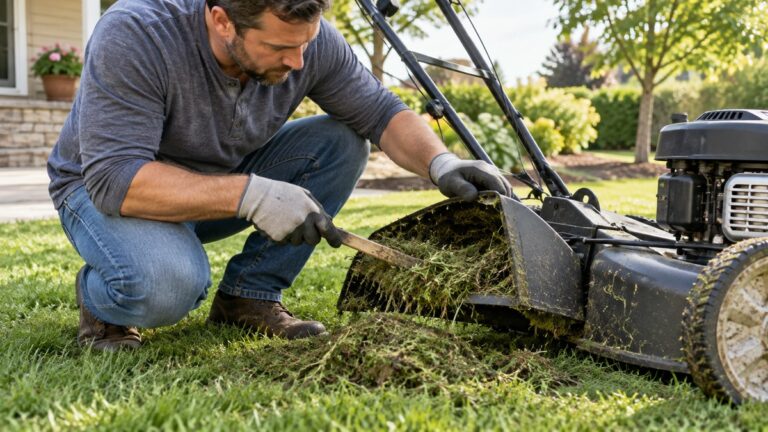
Changing the cutting height means working on the deck, so take the battery out first. Husqvarna’s battery mower guidance warns: “To prevent accidental starts, turn the safety key to 0, remove the battery and wait a minimum of 5 seconds.” The page gives that warning for cleaning, but the sources we opened do not give a separate deck-adjustment procedure, so use the same battery-off order before any deck work.
Wet grass is a second safety point. Illinois Extension says it is “never advisable to mow when the grass is wet.” Wait until the lawn is dry before you change the height or mow.
How to measure and set the height
- Identify the grass. The sources we opened do not explain how to identify a species. If you are not sure what you have, ask your local extension office before you pick a number from the table.
- Choose a height inside that species range. For a lawn with more than one species, the sources we opened do not say which species to follow. The Illinois baseline of 2½ to 3 inches is a reasonable starting point for most home lawns.
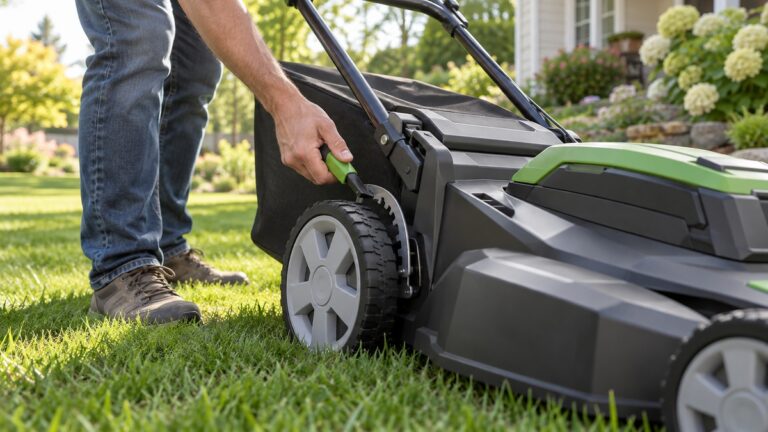
- Measure on the mower. Before you measure or adjust, turn the safety key to 0, remove the battery and wait at least 5 seconds, as the Husqvarna warning says. Ask Extension is direct: “No the cutting height is measured on the mower.” Measure from the bottom of a wheel to the blade.
- Check the blade. Illinois Extension calls blade sharpness a critical area: “A sharp mower blade will cut the grass blade cleanly.” Do any blade work only with the battery removed, as in step 3.
The one-third rule and how often to mow
The one-third rule is simple to state and harder to follow. Illinois Extension puts it this way: “remember not to remove more than one-third of the grass leaf in a single cutting.” It says lawns should be mowed “according to the rate of grass growth,” and that in spring this “will likely mean more than once a week.” Ask Extension is less strict. One expert writes that “in my opinion, it is a bit over blown.”
Worked example
Formula: the most you should remove in one cut is grass height × 1/3, and the cut height is grass height minus that amount. Inputs: a hypothetical lawn that has grown to 4.5 inches, and the one-third rule from Illinois Extension. Most you should remove = 4.5 × 1/3 = 1.5 inches. Cut height = 4.5 − 1.5 = 3.0 inches. Result: set the deck at 3.0 inches or higher for that cut. A lawn that has grown this tall in spring may need a second cut that week, as Illinois Extension notes. If you want to think about the cutting tool first, the mowers picked for cutting tall grass post is a useful next read.
Seasonal and site adjustments
Illinois Extension says that, “though not typically necessary, the first and last mowing of the year can be slightly shorter.” It warns: “Do not cut so short that you scalp the lawn.” It also says that “scalping in spring and allowing the grass to remain excessively high at the end of fall encourages weed and disease problems.” In short, adjust the setting for the season, but do not swing far from the range for your species.
If a wet lawn is the real problem, the electric mower options for wet grass post covers how the mower choice affects that. Illinois Extension adds that mulching mowers “do not perform at peak efficiency if the lawn is too tall (removing more than one-third of the grass blade) or if the lawn is wet.”
How we chose
The criteria were narrow. We looked for university extension pages and Ask Extension answers that give a mowing height in inches for named grass species, and one manufacturer help page for the battery-off warning. We opened six sources on 2026-10-22 and copied each figure from the saved page text before using it. Two of the six are Ask Extension answers, one is a 2026 Illinois Extension spring post, one is the Illinois mowing page, one is a Penn State species page, and one is a Husqvarna help page. We did not rank the sources and did not pick a single best height.
What we could not verify
The height range that your specific mower allows. We did not open a manual for any model, and the sources do not list deck settings for any machine. The ranges here are general, so the sources we opened do not adjust them for your soil, rainfall or local climate. Check your local extension office for regional advice before you pick a height.
What the sources do not say
The sources we opened do not give one height that works for every lawn, and they do not say how far a particular deck can be lowered or raised. They do not explain how to tell one grass species from another. The Penn State species page gives no height for bermudagrass or buffalograss, and the Illinois table is the only one of the two sources that covers them. The sources we opened do not say which height to use for a lawn that mixes species.
FAQ
How high should you mow grass for most lawns?
Illinois Extension suggests 2½ to 3 inches for most home lawns and says that for most home lawns, “the easiest strategy is to set your mowing height and leave it at that.” Ask Extension gives 1.5 to 3 inches for most grasses. If you cannot tell which grass you have, start with the Illinois baseline and check the species table once you know.
What is the one-third rule for mowing?
The one-third rule says you should not remove more than one-third of the grass blade in a single cutting. Illinois Extension states it that way. One Ask Extension expert calls the rule “a bit over blown.” In spring, mow often enough that you never take more than a third at a time.
Should I raise the mower in winter?
Ask Extension says that in winter the ground can get soft, so the mower sinks in a little, and that “it is not a bad idea to raise the mower one notch higher.” The same answer says a higher cut “helps the plant get a little more light when the days are shorter.” The sources we opened do not give a fixed winter height, so one notch higher is the advice to follow.
Does mowing grass shorter make it thicker?
Within the species range, yes. Ask Extension explains that “the lower and more frequent you mow, the denser and finer the leaf texture will get.” It also warns that if you go below the tolerance range, the grass cannot get enough energy from the sun to stay dense. Illinois Extension adds that you should not cut so short that you scalp the lawn. The same sources also point to a sharp blade and to staying inside the species range.
Is it safe to mow wet grass?
Illinois Extension says it is “never advisable to mow when the grass is wet.” The same page says mulching mowers do not work at peak efficiency on a wet lawn. The sources we opened give this as general mowing advice, not as a separate rule for electric mowers. Wait until the grass is dry before you mow, and take the battery out before any work on the deck.
Bottom line
Choose a cutting height inside the range for your grass species, and mow often enough that you never take more than one-third of the blade in one cut.
Sources
- Ask Extension: Cutting height for grass (opened 2026-10-22)
- Penn State Extension: Turfgrass Species for Pennsylvania (opened 2026-10-22)
- Ask Extension: Correct Lawn Grass Length? (opened 2026-10-22)
- University of Illinois Extension: Mowing Your Lawn (opened 2026-10-22)
- University of Illinois Extension: Spring lawn care: What should you really be doing? (opened 2026-10-22)
- Husqvarna US: How to clean a battery lawn mower (opened 2026-10-22)