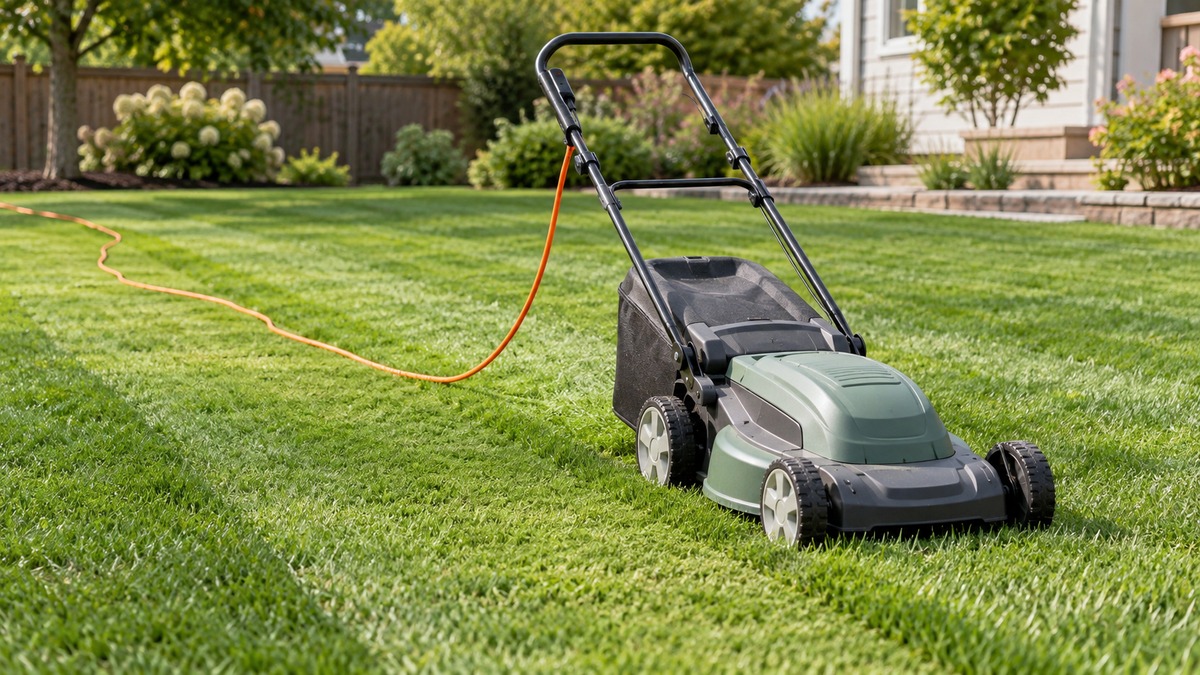
Using an Extension Cord With a Corded Mower
As an Amazon Associate we earn from qualifying purchases.
How to use extension cord with corded mower comes down to three things: check the cord before each use, match the plug and outlet, and keep the connection away from water. The sources we opened give those rules for electric tools in general and for workplaces. They do not give a cord length or gauge for any corded mower, so this guide does not state one.
The guide draws on one OSHA rule page, one OSHA eTool page, one OSHA interpretation letter and one University of Illinois Extension post, all opened on 2026-10-22. Where a source covers construction or a workplace, this guide says so, because a home lawn is not a job site.
Quick answer
- Inspect the cord and plug before each use, and take out of service any cord whose jacket or insulation is damaged.
- Keep your hands dry when you plug in or unplug the mower, and do not use electric tools in damp or wet locations unless the tool is approved for them.
- OSHA’s guidance names a ground-fault circuit interrupter as an acceptable protection method, but the sources do not set a home GFCI rule for a corded mower.
- The sources do not state a cord length or gauge for any corded mower, and they do not give a rule for mowing wet grass.
Step-by-step: connecting a corded mower to an extension cord
The steps below turn the rules the sources give into an order you can follow. They are not a replacement for the mower’s own manual, which is the document that sets the cord requirements for your model.
- Inspect the cord and plug before use. OSHA’s general industry rule for cord sets calls for a visual check before use, looking for external defects such as loose parts, deformed or missing pins, and damage to the outer jacket or insulation. Do the same check on the mower’s own cord, and on any extension cord you add.
- Take a damaged cord out of service. The OSHA eTool warns that cord damage is often limited to the insulation, which exposes energized conductors. The same page says to remove damaged portable electric tools from use. A cord with exposed wire is not a cord to plug in.
- Match the plug and the outlet, and keep the ground. OSHA says the plug and receptacle contacts should be checked for proper mating before the plug goes in. A cord used with grounding-type equipment must contain an equipment grounding conductor, and the rule bars adapters that break the grounding connection.
- Keep your hands dry at the plug. OSHA’s rule says employees’ hands may not be wet when plugging and unplugging flexible cords and cord-connected equipment while the equipment is energized. Dry hands are the rule the sources give, and this guide does not add to it.
- Stay out of damp and wet spots. The eTool says not to use electric tools in damp or wet locations unless they are approved for that purpose. OSHA’s general rule also says that flexible cords used in highly conductive locations, such as places with standing water, must be approved for those locations.
- Protect the outlet with ground-fault protection. The eTool names a ground-fault circuit interrupter as one acceptable method for extension cord use. The sources do not say whether a home outlet needs one for a corded mower, so check the mower’s manual for its requirement.
- Lay the cord so it does not trip anyone. The eTool says to make sure cords from electric tools do not present a tripping hazard. Keep the cord out of walkways and other paths where people move.
- Never carry the mower by the cord, and never yank the cord. The eTool says never to carry a tool by its cord and never to yank the cord to disconnect it from the receptacle. Unplug by the plug, not by the cord.
- Check the cord again at the end of the season. The University of Illinois Extension yard equipment post says to check the condition of the power cord and any extension cord you use as part of winter prep.
Safety: damp spots, plugs and cord damage
Most of the safety rules in this guide come from OSHA, and they were written for workplaces. The main points are that a damaged cord is a shock risk, that a wet hand at a plug is a shock risk, and that damp or wet locations need approved equipment. The sources give those points in plain terms, and this guide repeats them rather than adding new ones.
Two points need care for a home lawn. First, the OSHA eTool notes that extension cords in construction take a lot of wear, and that damage is often hidden under the jacket. A cord that looks fine from the outside may still be damaged. Second, the sources do not say whether wet grass counts as a damp or wet location for a corded mower, so this guide does not decide that question for you.
What the sources say, in one table
The table lists each point the sources cover and the source behind it. The cells that say “not stated” mark the points the sources we opened do not cover.
| Point | What the sources state | Applies to a home corded mower? | Source |
|---|---|---|---|
| Cord inspection | Visual check before use for external defects and jacket or insulation damage | Yes, as a practice; the rule is written for workplaces | OSHA 1910.334 |
| Damaged cords | Damage can be limited to the insulation and expose live conductors; remove damaged tools from use | Yes, as a practice | OSHA eTool, power tools |
| Plug and outlet fit | Check that contacts mate before plugging in; keep the grounding conductor; no grounding-breaking adapters | Yes, as a practice | OSHA 1910.334 |
| Wet hands | Hands may not be wet when plugging or unplugging an energized cord connection | Yes, as a practice | OSHA 1910.334 |
| Damp or wet locations | Electric tools not used in damp or wet locations unless approved; conductive locations need approved cords | Unclear for wet grass; not stated | OSHA eTool; OSHA 1910.334 |
| GFCI | One acceptable method is a ground-fault circuit interrupter; a GFCI or an assured grounding program must be in place at the far-end receptacle of a temporary cord set | Stated for construction; home rule not stated | OSHA eTool; OSHA interpretation 1986 |
| Temporary wiring | A cord set used to reach a remote spot is temporary wiring, not a substitute for fixed wiring | Stated for construction; home rule not stated | OSHA interpretation 1986 |
| Cord handling | Do not carry a tool by its cord; do not yank the cord to unplug it | Yes, as a practice | OSHA eTool, power tools |
| Winter check | Check the power cord and any extension cord you use | Yes | University of Illinois Extension |
| Cord length | Not stated | Not stated | Not stated in the sources opened |
| Cord gauge | Not stated | Not stated | Not stated in the sources opened |
| Wet grass rule | Not stated | Not stated | Not stated in the sources opened |
The table shows why the guide is short on numbers. The rules that the sources state are about inspection, fit, dry hands, wet places and handling. Cord length and gauge are the points most readers ask about, and they are the points the sources do not give for a corded mower.
Why the cord is temporary wiring
An OSHA interpretation letter from 1986 describes an extension cord used to reach a spot away from the building’s wiring as temporary wiring. The letter calls the cord set a substitute for fixed wiring, and it says a GFCI or an assured grounding program must be in place at the receptacle at the cord’s far end. The letter is about tools in a building under construction, not about a lawn.
The lesson for a home lawn is narrower. A cord is a temporary connection, so the outlet you start from and the cord you add both matter. The sources do not tell you what a home outlet must have, so the outlet’s protection is a question for the mower’s manual and for the outlet itself.
If you want an extension cord option for a mower, see the guide to extension cord options for electric mowers. That guide covers the product choice. This one covers the rules the sources give for using a cord safely. If you are weighing the corded option itself, the guide to self-propelled corded electric mowers sets out that category.
How we chose
We looked for pages that state rules for extension cords and electric tools: one OSHA rule page, one OSHA eTool page on power tools, one OSHA interpretation letter and one University of Illinois Extension post. We opened four pages on 2026-10-22, each with an HTTP 200 response. The steps above paraphrase the rules those pages state, and each step carries its source.
We left out retail listings, since they are allowed only for stated specifications. We left out owner’s manuals offered as PDF files, because the tool used for this draft cannot read PDFs, and several of the best-known corded mower manuals are PDFs. We also left out general buying guides and forum threads. The sources are not ranked, and no product is recommended here.
What we could not verify
We could not verify a cord length or gauge for any corded mower. The corded mower manuals that carry those figures are offered as PDF files, and the pages we could open did not state them. We also could not verify the amp rating of any corded mower, since none of the pages we opened gives one.
We could not verify whether a home outlet must have GFCI protection for a corded mower, because the OSHA material is written for workplaces and construction sites. We could not verify a wet grass rule for mowers at all.
What the sources do not say
The sources do not say how far a corded mower can run from an outlet, and they do not give a maximum extension cord length. They do not give a cord gauge for any mower, and they do not say which cord jacket ratings a mower needs.
They also do not say whether a plug-in GFCI counts as protection for a corded mower at home, and they do not describe how to check a GFCI. They do not say whether a mower can be used in rain or after rain, so this guide does not say that either.
FAQ
What gauge extension cord do I need for a corded mower?
The sources we opened do not state a gauge for any corded mower. The OSHA material covers cord inspection, grounding and plug fit, not gauge. Check the mower’s manual for the cord it specifies, and do not pick a gauge from a general chart.
The manual is the place to look for cord guidance for your model, which this guide cannot state.
Is a GFCI required when I use an extension cord with a mower?
The sources do not set a home rule for this. OSHA’s eTool names a ground-fault circuit interrupter as one acceptable protection method, and its 1986 letter says a GFCI or an assured grounding program must be in place at the far-end receptacle of a temporary cord set. Both are construction or workplace sources.
For a home outlet, check the mower’s manual for its requirement, since the sources here do not state one.
Can I mow wet grass with a corded mower?
The sources we opened do not give a rule for wet grass. The OSHA eTool says not to use electric tools in damp or wet locations unless they are approved for that purpose, but it does not say whether a lawn is one of those locations. Read the mower’s manual on wet conditions before you mow after rain.
If the grass is wet, the dry-hands rule still applies at the plug. Keep your hands dry whenever you plug in or unplug the mower.
What should I do if the extension cord is damaged?
Stop using the cord and take it out of service. The OSHA rule calls for inspection before use and for checking the jacket and insulation. The eTool warns that damage is often limited to the insulation, which exposes energized wires, so a cord with visible damage is not safe to plug in.
Do not keep using a damaged cord. The sources do not describe a repair method, so this guide does not offer one.
Can I use an adapter to plug the mower into a different outlet?
The OSHA rule for cord sets says adapters which interrupt the continuity of the equipment grounding connection may not be used. A plug adapter that breaks the ground path is not allowed by that rule, and the sources do not describe any adapter that is allowed.
If the plug does not fit the outlet, the sources do not give a workaround. The plug and receptacle contacts should match before the plug goes in, so use an outlet that matches the plug and check the mower’s manual.
Should I check the cord again at the end of the season?
Yes. The University of Illinois Extension yard equipment post says to check the power cord and any extension cord you use as part of winter prep. The post is a home gardening source, so its advice applies to home use directly.
The same post notes that corded yard tools need the least winterizing of the electric group. The cord check is still on the list, so do not skip it.
Bottom line
Inspect the cord before every use, and do not plug in a cord with damage or a plug that does not match the outlet. For any question the sources do not answer, such as cord gauge, cord length or wet grass, follow the mower’s manual before you mow.
Sources
- OSHA: 1910.334 Use of equipment (opened 2026-10-22)
- OSHA: eTool, Construction, Electrical Incidents, Power Tools (opened 2026-10-22)
- OSHA: Interpretation letter on ground fault protection and extension cords (1986) (opened 2026-10-22)
- University of Illinois Extension: Yard Equipment Maintenance Tips (opened 2026-10-22)