Pros and Cons of Electric Mower: Five Corded Picks
As an Amazon Associate we earn from qualifying purchases. Details
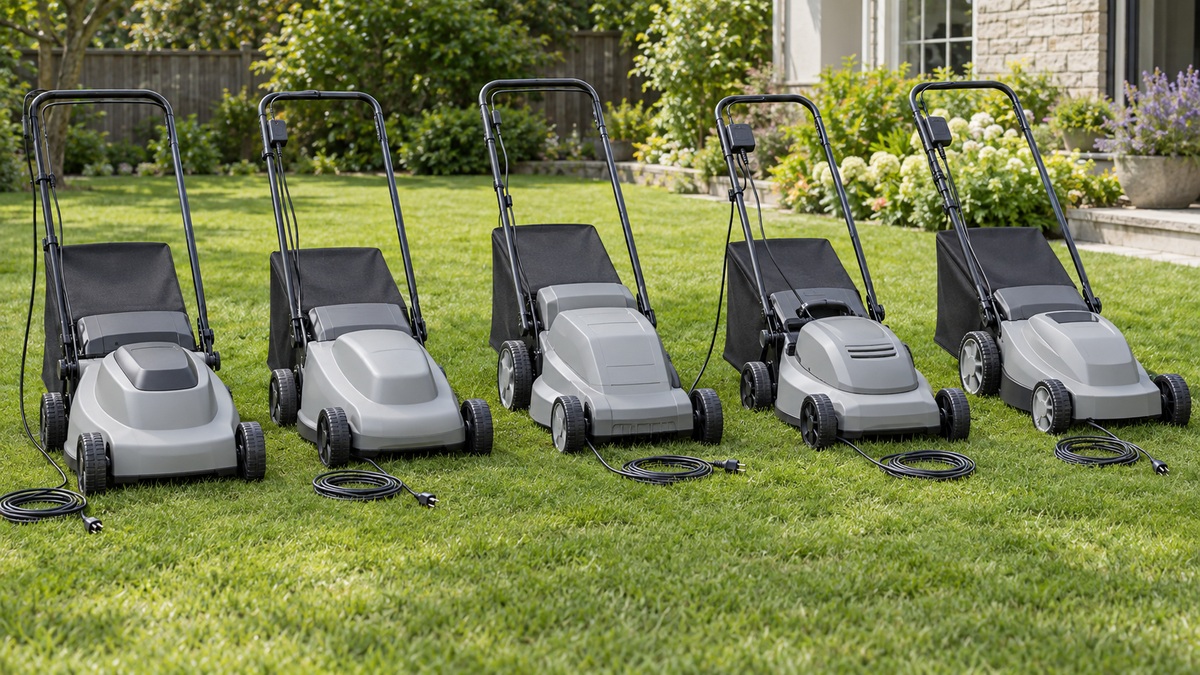
The pros and cons of electric mower ownership become much clearer when you compare the cord, deck, cutting range, bag, and weight together. This guide examines five corded push mowers for homeowners who want to avoid fuel and battery charging but still need a practical cutting setup. The choices span 12.6-inch to 20-inch cutting widths, several height systems, and different collection setups. You will see which design suits tight landscaping, which favors fewer passes, and which offers the most clipping-control choices. You will also learn where the cord and product-listing inconsistencies create real limits. The goal is a mower choice tied to your lawn layout, storage space, and preferred clipping method.
At a glance: the five corded mowers compared
| Mower | Motor | Cutting width (stated) | Height range | Bag |
|---|---|---|---|---|
| LawnMaster MEB1114K | 11 Amp | 15 in | Conflicting figures in listing — confirm before ordering | 7 gal |
| CRAFTSMAN 20-Inch | 13 Amp | 20 in (widest of the five) | 1.5-4 in (broadest verified range) | Bagging, mulching, side discharge |
| Hoteche | 10 Amp, 1200W | 12.6 in (32 cm) — narrowest of the five | 3 levels; endpoints conflict between spec fields and bullets | 30L bag |
| BLACK+DECKER BEMW472BH | 10 Amp | 15 in | 1-3 in (6 positions) | Included; capacity not stated |
| BILT HARD | 11 Amp | 15 in (title) vs. 17 in (specs) — conflicting | 1 in minimum; 5 positions | 9.2 gal |
Figures are exactly as stated in each listing, checked 2026-10-11. Three of the five (LawnMaster, Hoteche, BILT HARD) have internal conflicts between their title, spec fields, and bullets — confirm the current figures on the listing before ordering, especially if deck width needs to clear a gate or storage opening.
Quick answer
A corded electric mower makes the most sense when your lawn stays within reach of an appropriate outdoor extension cord and you value continuous electrical power. The CRAFTSMAN has the widest listed deck at 20 inches and supports bagging, mulching, and side discharge. The BLACK+DECKER suits a compact lawn because its listing identifies a 15-inch width, 10 Amp motor, and ideal use on 1/8 acre. The LawnMaster combines a compact format with a 7-gallon bag, while the fifth lists a larger 9.2-gallon catcher. Choose by mapping cord access first, then compare cutting width, height range, mower weight, and clipping handling. Read the mower manual before selecting or operating an extension cord.
The central tradeoff: continuous power versus cord management
All five choices use corded electric power. That removes a battery-runtime question from the purchase, and none requires gasoline according to the relevant listings. The tradeoff is physical reach. A power cord must travel from a suitable outlet to every mowing area without becoming a cutting hazard or snagging around beds, trees, steps, or fences. The supplied information does not state a recommended extension-cord length or gauge, so those details must come from the manufacturer’s manual.
The cord can be manageable on a simple rectangular lawn with a clear outlet path. It becomes more demanding on a divided yard with narrow passages and several obstacles. Trace a route before buying. Start at the outlet, identify the farthest grass, and note every place where the cord must change direction. If that route crosses a driveway or wraps around multiple objects, a corded mower’s main limitation may outweigh its continuous-power advantage.
Cord control also changes how you mow. Work away from the outlet so the cable remains behind the cutting path. That is a practical routing choice, not a promise that any arrangement is safe. Follow the mower and cord manufacturers’ instructions. Anyone who cannot maintain clear awareness of the cable should choose a different power format rather than treating the cord as a minor inconvenience.
Cutting width changes pass count and maneuverability
The supplied widths range from 12.6 inches to 20 inches. A wider deck covers a broader strip on each pass, which can reduce the number of parallel runs across an open area. It also occupies more space while turning beside beds, gates, and walls. A narrow deck reverses those priorities: more passes may be required, but positioning can be easier in confined grass.
The CRAFTSMAN lists a 20-inch cutting width, the broadest figure in this group. The LawnMaster and BLACK+DECKER each list 15 inches in their specifications, although the LawnMaster also has a conflicting 14-inch bullet. The fifth product presents another conflict: its title says 15 Inch while the specifications say 17 inches. Do not rely on either disputed width until the current product page or manual resolves it. The Hoteche lists 32 centimeters in its specifications and describes a 12.6-inch deck in its title and bullets.
Width should serve the lawn’s geometry. Broad, unobstructed grass gives a wider deck room to work. Tight turns, short strips, and small storage openings can favor a compact chassis. Check the full product dimensions as well as the deck width because the mower’s widest point and folded storage shape may matter more than the nominal cutting strip.
Cutting height determines whether the mower matches your target
Height adjustment is not identical across these products. The second listing states a range from 1.5 inches to 4 inches, which provides the highest maximum among the five. The fourth lists 1 inch to 3 inches across 6 positions. The fifth also lists 1 inch to 3 inches but uses 5 positions. Those numbers help you reject a mower that cannot reach your preferred setting before smaller conveniences influence your choice.
The first listing is internally inconsistent. Its specifications state 6 positions from 1 inch to 3 inches, while a bullet says 5 positions from 1.4 inches to 3 inches. Treat its lower settings and position count as unresolved. The third listing has a similar mismatch: specifications show 1.1 inches to 2.6 inches, while the bullets describe 3 levels from 1 inch to 2.2 inches. Confirm the current adjustment system before choosing either model.
A wider range is useful only when you intend to use it. If one consistent height suits your grass, a simple adjustment system may be enough. If seasonal conditions require different settings, prioritize verified endpoints and a control you can operate according to the manual. Never infer a cutting height from wheel size or overall dimensions; those measurements describe different parts of the machine.
Clipping handling affects the work after each pass
The CRAFTSMAN has the most explicit clipping versatility. Its listing states 3-in-1 mulching, bagging, and side discharge, and the included components name a collection bag and side-discharge chute. That is the strongest match here for someone who expects to change clipping methods rather than collect every time.
The first listing names a 7-gallon collection bag. The third lists a 30L grass bag, and the fifth lists a 9.2-gallon catcher. These capacities are not directly comparable until you keep the units distinct. A larger stated volume can mean fewer emptying stops under similar mowing conditions, but the amount of material collected varies with the lawn and cut. The fourth includes a collection bag and claims enhanced clipping collection from its winged blade, yet it does not provide a bag capacity.
Choose a bagged setup when collecting clippings is central to your routine. Choose the CRAFTSMAN when switching among three named discharge modes matters more. Do not assume that a mower supports mulching or side discharge unless the listing states it and identifies the required components. For replacement bags, chutes, or blades, verify the exact model rather than matching by deck width alone.
Weight, wheels, and storage shape
Mower weight influences lifting, transport, and direction changes. The third listing calls the mower 16 lbs in a bullet, while its specifications list 7.95 kg. Those values are not identical, so confirm its current weight before treating it as the lightest model. The fifth states 21 lbs, and the first states 28lbs in a bullet while its specification gives 12.7 kg. The second specification lists 20.8 pounds. The fourth specification lists 7 pounds, an unusually large difference from the other machines, so verify that value on the product page rather than basing a lifting choice on it.
Wheel information is limited. The LawnMaster lists 7.75-inch rear wheels and a folding push handle. That combination is relevant when storage depth and navigation are priorities. The fourth emphasizes a bike-style handle intended to improve maneuverability. The fifth describes easy handling around tight spaces and flower beds, but its overall dimensions are 61 inches deep, 41 inches wide, and 19.5 inches high. Confirm whether those measurements describe the assembled product and how the handle stores.
Storage choices should use the whole mower rather than weight alone. Identify whether you must lift it over a threshold, turn it inside a shed, or fit it beneath a shelf. Our guide to a small electric lawn mower with bag explores that narrower use case. If width is your priority, compare it separately with the choices in our 21-inch electric mower guide.
Five corded mower profiles
The LawnMaster favors compact mowing and bag collection. Its 11AMP title, listed 15-inch cutting width, and 7-gallon collection bag create a straightforward small-lawn package. The 7.75-inch rear wheels and folding handle add useful handling and storage details. Its drawback is conflicting information about cutting width, height positions, minimum height, and weight. Confirm those points before ordering. Skip it if you require an undisputed adjustment range.
The CRAFTSMAN favors broad passes and flexible clipping control. Its 13 Amp motor pairs with a 20-inch deck, while the listing provides bagging, mulching, and side discharge. The stated 1.5-inch to 4-inch range is the broadest verified range in this set. Its 20.8-pound listed weight is another concrete comparison point. Skip this mower if a 20-inch chassis would be awkward around your gates, beds, or storage route.
The Hoteche is the narrowest clearly described mower. Its title specifies a 12.6 Inch cutting width, and the bullets pair a 1200W motor with a 30L bag. Three height levels are described, but their endpoints conflict with the specification fields. The bullet also associates the design with lawns up to 0.3 acres. Skip it when you need a verified height range or want fewer passes across a broad, open lawn.
The BLACK+DECKER is explicitly positioned for a compact property. Its listing names a 10 Amp motor, 15 inch deck, and ideal use for 1/8 acre. It provides 6 cutting positions from 1 inch to 3 inch, plus a bike-style handle and included collection bag. No bag volume is stated. Skip it if bag capacity is essential to your comparison or if the listed weight remains unconfirmed.
The BILT HARD combines an 11A motor with a 9.2 gallon collection bag and 5 cutting positions from 1 inch to 3 inches. Its bullet gives a 21 lbs weight and describes a handle-release stop. However, the title’s 15 Inch deck conflicts with the 17-inch specification. Skip it if exact cutting width determines whether the mower will pass through your storage opening.
1. LawnMaster MEB1114K Electric Corded Lawn Mower 15-Inch 11AMP (Best compact bagger)
Specs from the listing (checked 2026-10-11):
- Power Source: Corded Electric
- Cutting Width: 15 inches
- Wheel Size: 7.75 inches
Pros
- The listing includes a 7-gallon collection bag and 7.75-inch rear wheels.
Cons
- The listing conflicts on deck width, cutting positions, minimum height, and weight.
Best for: Compact lawns where collection and folding storage matter
Skip if: You need an undisputed cutting-height range
View on Amazon (affiliate link)
2. CRAFTSMAN Electric Push Lawn Mower, 20-Inch Deck, Corded, Powerful 13-AMP Motor, 6 Setting Height (Best wide-deck choice)
Specs from the listing (checked 2026-10-11):
- Power Source: Corded Electric
- Cutting Width: 20 inches
- Maximum Adjustable Cutting Height: 4 inches
Pros
- The 20-inch deck supports bagging, mulching, and side discharge.
Cons
- The wider chassis may be awkward around narrow gates and tightly spaced beds.
Best for: Open lawns where fewer nominal passes and clipping flexibility matter
Skip if: Your access or storage route cannot accommodate a 20-inch deck
View on Amazon (affiliate link)
3. Hoteche 10-Amp Corded Electric Lawn Mower – 12.6 Inch Cutting Width, 30L Grass Bag, 3 Height (Best narrow deck)
Specs from the listing (checked 2026-10-11):
- Power Source: Corded Electric
- Cutting Width: 32 centimeters
- Product Dimensions: 23.22″D x 14.96″W x 9.84″H
Pros
- The listing pairs a 12.6-inch deck with a 30L grass bag.
Cons
- Its specification fields and bullets disagree about the cutting-height endpoints.
Best for: Small mowing areas with tight turns
Skip if: You require a verified height range before ordering
View on Amazon (affiliate link)
4. BLACK+DECKER Electric Lawn Mower with Bike Handle, 15-Inch, 10-Amp, Corded (BEMW472BH) (Best for a compact property)
Specs from the listing (checked 2026-10-11):
- Power Source: Corded Electric
- Cutting Width: 15 inches
- Number of Positions: 6
Pros
- The listing gives 6 height positions from 1 inch to 3 inch and identifies 1/8 acre use.
Cons
- No collection-bag capacity is stated.
Best for: A compact lawn where a 15-inch deck and bike-style handle fit the route
Skip if: Bag volume is a required comparison point
View on Amazon (affiliate link)
5. BILT HARD Corded Electric Lawn Mower 15 Inch, 11Amp Electric Push Mower with 9.2 Gallon Collection (Best large listed catcher)
Specs from the listing (checked 2026-10-11):
- Power Source: Corded Electric
- Minimum Adjustable Cutting Height: 1 inches
- Number of Positions: 5
Pros
- The listing states a 9.2 gallon catcher and 5 cutting-height positions.
Cons
- The title says 15 Inch while the specifications list a 17-inch cutting width.
Best for: Collection-focused mowing after the deck width is confirmed
Skip if: Exact cutting width determines access through your gate or shed
View on Amazon (affiliate link)
How to choose among the five
Begin with the cord route, because no deck or bag advantage fixes an unsuitable power path. Next, measure the narrowest gate and storage opening. Compare that real limit with the product’s complete dimensions, not merely the cutting width. If the listing contains conflicting dimensions, pause and confirm them.
Then set a required cutting-height interval. The CRAFTSMAN is the clear choice when a verified 4-inch maximum is necessary. The fourth or fifth can suit a target within their stated 1-inch to 3-inch ranges. The first and third need additional confirmation because their height fields and bullets disagree.
Choose the clipping method last. The CRAFTSMAN is the documented choice for mulching, bagging, or side discharge. The first, third, fourth, and fifth emphasize collection. Their bag details differ, and the fourth supplies no capacity. If you plan to bag every mowing session, consider how often you are willing to stop and whether you can comfortably remove and carry the filled container.
When choosing a cord, use the manual rather than a generic recommendation. The required gauge is not stated in these listings. Our extension cord for electric mower guide can frame the questions, but the mower manufacturer’s instructions control the final match.
Comparing pass width on a 120-inch strip
Take a straight grass strip that is 120 inches wide as a simple case. The comparison counts nominal passes only and does not predict mowing time; it assumes each pass uses the full stated deck width and ignores overlap.
With the 20-inch CRAFTSMAN, divide 120 inches by 20 inches per pass: 120 ÷ 20 = 6 passes. Check it by multiplication: 6 × 20 inches = 120 inches. A second check reaches the same total: 20 + 20 + 20 + 20 + 20 + 20 = 120 inches.
With a 15-inch deck, divide 120 inches by 15 inches per pass: 120 ÷ 15 = 8 passes. Reverse the operation: 8 × 15 inches = 120 inches. Verify again by grouping: 4 × 15 inches = 60 inches, and 60 inches × 2 = 120 inches.
The estimate shows a difference of 8 − 6 = 2 passes. Confirm that subtraction by addition: 6 passes + 2 passes = 8 passes. Real mowing requires overlap and turning, so use this arithmetic only to compare nominal deck coverage.
Common mistakes that weaken an electric mower choice
The first mistake is selecting by amperage alone. Motor input does not tell you whether the mower fits a gate, reaches your preferred height, or supports your clipping method. Read the width, height range, included parts, and cord instructions together.
The second mistake is treating every dimension as cutting width. Overall depth, width, and height describe the product envelope. A deck figure describes the cutting path. Keep those measurements separate when checking storage space or counting passes.
The third mistake is overlooking contradictions. The LawnMaster, Hoteche, and BILT HARD listings contain disagreements between titles, specifications, or bullets. Do not choose an uncertain measurement merely because it is favorable. Confirm it before purchase.
The fourth mistake is assuming all collection systems work alike. The listed bags range across different capacities and units, and one product gives no capacity. Mulching and side discharge are documented only for the CRAFTSMAN.
The fifth mistake is improvising cord specifications. None of these product records supplies the extension-cord gauge or permitted length. Consult the manual and use outdoor power equipment only as directed.
Safety facts to weigh before you buy
Federal rules for certain walk-behind power lawn mowers cover labeling and performance requirements. The cited regulation defines a walk-behind power lawn mower as a motor-driven grass cutter with a minimum cutting width of 12 in, or 305 mm. It also explains that the standard aims to reduce injuries from contact with the rotating blade.
The rule includes a shield test using a foot probe. For covered rotary mowers, shields must also withstand a 50 lb, or 222 N, static tensile force for at least 10 seconds. These regulatory facts do not prove that a particular listing has a specific certification. Check the label and manual for the exact mower, keep guards in place, disconnect power before blade work, and follow all manufacturer instructions.
FAQ
Is a corded electric mower suitable for a small lawn?
It can be when a suitable outlet reaches the whole mowing area and the cable can follow a clear route. The BLACK+DECKER is specifically described for 1/8 acre and has a 15-inch deck. The third listing mentions use up to 0.3 acres. Treat those as product-specific statements, then check the manufacturer’s cord requirements and your own obstacles.
Which mower has the widest verified cutting deck?
The CRAFTSMAN lists a 20-inch cutting width and pairs it with a 13 Amp motor. That is the widest undisputed deck in this group. The fifth listing is inconsistent because its title says 15 Inch while its specifications say 17 inches. Confirm that product’s current dimensions before comparing it directly with the verified 20-inch figure.
Which mower offers the highest cutting setting?
The CRAFTSMAN reaches a listed maximum of 4 inches and starts at 1.5 inches. The first, fourth, and fifth list 3-inch maximums, though the first has conflicting minimum and position details. The third also contains inconsistent endpoints. Choose the second when a verified 4-inch maximum is essential rather than assuming every adjustment system covers it.
Which mower can mulch or side discharge?
The CRAFTSMAN explicitly provides 3-in-1 mulching, bagging, and side discharge. Its included-components field names both a collection bag and side-discharge chute. The other four mowers focus on collection and do not provide equivalent three-mode evidence. Do not infer extra discharge modes from a mower’s deck style; check the current product page and included parts.
Which listed mower has the largest collection bag?
The fifth states a 9.2-gallon catcher, while the first states 7 gallons and the third gives 30L. Because gallons and liters are different units, avoid ranking them without a careful conversion. The fourth includes a bag but does not state its capacity. Select based on a confirmed capacity and the way you plan to handle collected clippings.
What should I do when the title and specifications disagree?
Do not choose the more appealing number. The BILT HARD shows a 15 Inch title but a 17-inch specification, and the first and third have height conflicts. Check the current product page or manufacturer’s manual before ordering. A disputed width can affect gate clearance and the number of passes, while a disputed height range can prevent your intended cut.
Do these mower listings specify an extension-cord gauge?
No extension-cord gauge is stated for these five products. That missing detail matters because all five are corded electric machines. Consult the exact mower manual for permitted cord type, length, and gauge, and follow the manufacturer’s operating directions. Do not copy a cord recommendation from another mower simply because the amperage or deck width appears similar.
Bottom line
Choose the CRAFTSMAN for a verified 20-inch deck, a 4-inch maximum setting, and three clipping modes. Choose the fourth for a listing aimed at 1/8 acre with a compact 15-inch cut, or the fifth when a 9.2-gallon bag matters and you can resolve its width conflict. The first suits compact storage and collection after its inconsistent specifications are confirmed. A corded mower is the wrong choice when your outlet route cannot keep the cable controlled across the entire lawn.
Sources
- 16 CFR 1205.1: walk-behind mower definition, scope, and purpose of the safety standard
- 16 CFR 1205.4: shield foot-probe and static-force test requirements
Explore the Electric Yard Tool Resource Library for more guides in this topic.