How to Cut Tall Weeds With a String Trimmer
As an Amazon Associate we earn from qualifying purchases.
Knowing how to cut tall weeds with a string trimmer comes down to working in stages instead of taking everything in one pass. The manufacturer pages opened for this guide describe bringing overgrown growth down to about half its height first, letting it recover, and then cutting again to a lower height. They also describe sweeping the head side to side while moving forward, and using a lower head speed near hard objects. Those pages cover tall grass and overgrown lawns, not weed species, so read the limits section before you rely on the method.
Quick answer
- Cut in stages. Take the growth to about 50 percent of its original height on the first pass, rest it for 2 to 4 days, then cut again to about 6 inches.
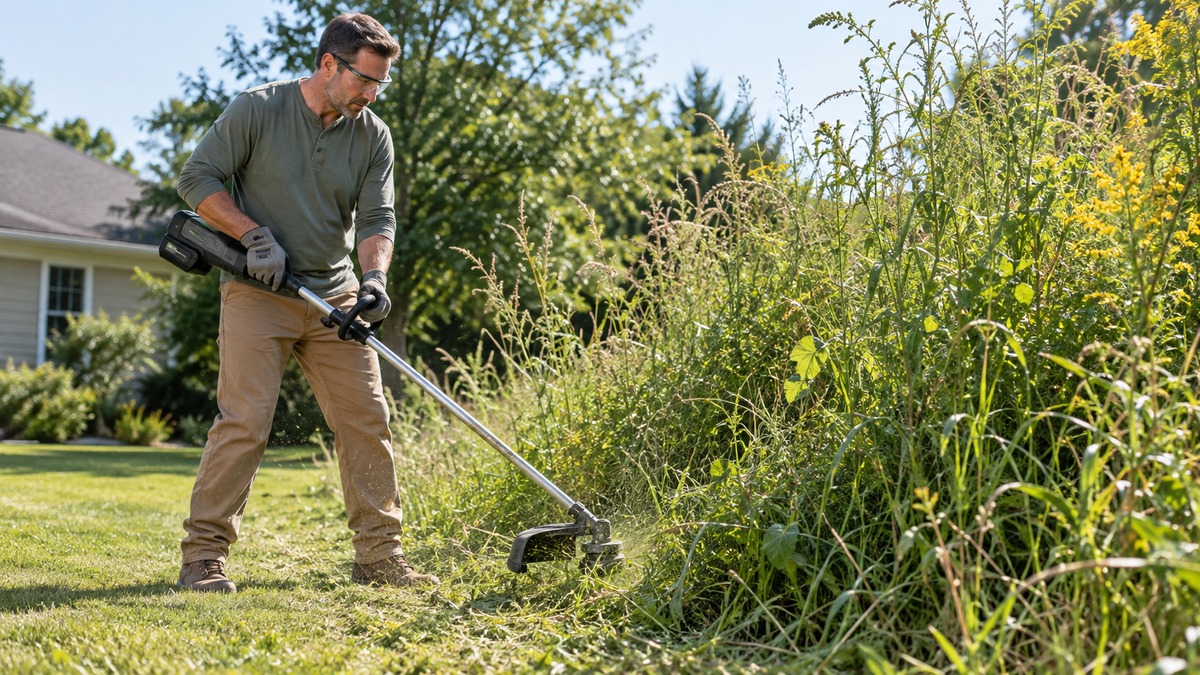
- Sweep side to side while moving slowly forward through tall growth, rather than driving the head straight into it.
- Use a lower head speed near fences, curbs and walls, and stop the engine before clearing any growth caught in the guard.
Why tall growth needs more than one pass
The Husqvarna Australian overgrown-lawn page starts from a case that is easy to picture: grass taller than your knees. For growth like that, the page describes a two-stage cut rather than a single pass. The first stage takes the grass down to about half its original height. The reason it gives for stopping there is recovery. Once the grass is down to about half its height, the page says to let it recover and repair itself, and it calls that rest period crucial for regrowth.
The page’s method is written for an overgrown lawn rather than for weeds, so apply it to tall weeds with that limit in mind. The page does not cover weeds, and it does not claim the method works on every growth type.
Before the first pass
Start with fresh line. The Husqvarna Australian overgrown-lawn page says to add fresh trimmer line before starting, because that ensures optimal cutting performance and prevents interruptions during the trimming process. Check the line before you reach the tall growth, not partway through the patch.
Choose the conditions as well. The same page says that ideally you want sunny and warm days for this kind of work, and that the grass should be dry when you cut it, which it links to a healthier lawn. Those are lawn-care points, not trimmer specifications, so treat them as planning rules for the day.
The two-pass method, step by step
- Measure the growth. The page’s example case is grass taller than your knees. Treat growth at that height as a case for a staged cut.
- First pass to about half height. The page says to reduce the grass to about 50 percent of its original height before the next step.
- Rest for 2 to 4 days. After the first pass, the page says to wait approximately 2 to 4 days before the next cut.
- Second pass to about 6 inches. The page says to repeat the cut with a trimmer and reduce the height to approximately 6 inches during this second cut.
- Sweep, do not plunge. For large areas of tall growth, the Husqvarna Australian trimmer guide says to use a side-to-side sweeping motion while slowly moving forward.
- Use a lower head speed near hard objects. The Husqvarna US battery trimmer page says line can weld when the head runs continuously at high speed against fences, curbs or walls. Use a lower head speed near those objects and vary the throttle.
Repeating the cut over several sessions
The same page says that for particularly overgrown lawns, it may be necessary to schedule multiple sessions over the course of a month. Its cadence is to repeat the process every 4 to 5 days to maintain the height you want, and to reduce the cutting height by one third each time until you are satisfied with the height. The page writes that cadence for mowing and trimming together, so use it as a planning frame for tall growth rather than as a trimmer-only rule.
Plan the sessions on a calendar. The two stages above are separated by a rest of 2 to 4 days, and the page’s cadence after that is every 4 to 5 days. That gives a rough window of about a month for a badly overgrown patch, which is the page’s own estimate. A lawn that is only a little overgrown may need fewer sessions, and the pages opened do not give a number for that case.
Worked calculation: the target heights for two passes
The rule behind the table is simple. The first-pass target is 50 percent of the starting height, and the second-pass target is about 6 inches, which is the figure the page gives. The formula is first-pass target equals starting height multiplied by 0.5. The inputs are the starting heights in the table, which are examples, and the 50 percent and 6-inch figures, which come from the page. The results follow from that arithmetic.
| Starting height (inches) | First-pass target, 50% (inches) | Rest before second pass | Second-pass target (inches) | Source |
|---|---|---|---|---|
| 16 | 8 | 2 to 4 days | About 6 | Husqvarna AU overgrown-lawn page |
| 24 | 12 | 2 to 4 days | About 6 | Husqvarna AU overgrown-lawn page |
| 30 | 15 | 2 to 4 days | About 6 | Husqvarna AU overgrown-lawn page |
| Under 12 | Not stated | Not stated | Not stated | Not stated in the pages opened |
At 12 inches the first pass lands at about the second-pass target. The pages opened do not say whether a shorter growth needs a second pass at all, so that case is left as not stated.
Safety when clearing tall growth
Stop the engine before you clear anything caught in the trimmer. The Husqvarna US working-techniques page for its petrol trimmer warns that branches or grass sometimes get caught between the guard and the cutting attachment, and it says to always stop the engine before cleaning. That page is for a petrol model, so check the manual for a battery model before you clear a jam.
The same page carries a vibration warning. It says overexposure to vibration can lead to circulatory damage or nerve damage in people who have impaired circulation. It lists symptoms that include numbness, loss of feeling, tingling, pricking, pain and loss of strength, and it tells readers to contact a doctor if they notice them. Get medical advice if those symptoms begin.
Keep the head moving near hard objects. The Husqvarna US battery trimmer page says line welding comes from continuous high-speed trimming against fences, curbs or walls. The fix it gives is a lower head speed near those objects and a varied throttle.
When a string trimmer is the wrong tool
The Husqvarna Australian overgrown-lawn page also says to avoid using a lawn mower on long grass, because it can hinder the blades from spinning and potentially overheat the motor. It recommends a trimmer for the first stage, which is why the method above starts with one.
The Husqvarna US buying guide for grass trimmers gives the clearest limit in the pages opened.
If you work a lot in tall grass or overgrown areas outside the garden, it says you need a more high-performing trimmer with suitable attachments, or a brushcutter. It adds that for areas with short grass, several trimmers match the needs of a well-kept garden. The guide does not give a height at which a string trimmer stops being the right tool.
For edging work along a border, see the guide on edging a lawn with a string trimmer. For choosing a trimmer model in the first place, see the guide on electric string trimmer options.
Keeping the line working through tall growth
The pages opened do not give a line-feed method for a battery head, so they do not cover reloading. If you need to replace the line, the guide on changing the string on a Ryobi 40V trimmer covers that job for one brand. This guide assumes the line is in place and the head is turning.
How we chose
We looked for manufacturer and extension pages that describe a cutting technique for tall growth, a safety warning for the trimmer head, or a limit on what a string trimmer should be used for. On 2026-10-22 we opened five pages. Two are Husqvarna Australian pages, which are non-US locale pages. They are used for the staged cut and the sweeping motion because the US pages on the same technique could not be opened: the US working-techniques page lists trimming, cutting and sweeping sections, but its section text was not in the saved page. The US buying guide and the US battery trimmer page are used for the limits and the line-welding point. The Husqvarna US working-techniques page is used for its safety warnings. Operator manuals in PDF form were not used, because the tool cannot open PDFs.
What we could not verify
- Whether the two-pass method suits weeds with woody stems. The pages opened describe grass and overgrown lawns.
- A head-overload limit for a cordless string trimmer. The pages opened do not state one.
- The cutting height or the number of inches per pass for any specific trimmer model.
- Whether the US sections on the Husqvarna working-techniques page give the same sweeping method as the Australian page.
What the sources do not say
The pages opened do not give an inch-per-pass figure for a string trimmer. The 50 percent figure belongs to an overgrown lawn, and the page does not extend it to weeds. None of the pages opened gives a line-load limit or explains how to avoid overloading the head. The US working-techniques page lists its technique sections, but the text of those sections is not in the saved page, so this guide does not quote them. Nothing in the pages opened covers woody or thick weed stems.
FAQ
Should I cut tall weeds in one pass?
The Husqvarna Australian overgrown-lawn page describes a two-stage cut for grass taller than your knees. It says to reduce the growth to about 50 percent of its original height first, let it recover, and cut again later. The page does not describe that method for weeds.
How far should the first pass go?
The page says to reduce the grass to about 50 percent of its original height. For a 16-inch growth, that is 8 inches. The table in this guide shows the same arithmetic for other starting heights.
How long should I wait between passes?
The page says to wait approximately 2 to 4 days after the first cut before the second. It gives the reason as recovery, and it calls the rest period crucial for regrowth.
Which way should I sweep the head?
The Husqvarna Australian trimmer guide says to use a side-to-side sweeping motion while slowly moving forward when clearing large areas of tall grass. Head angle and how you hold the trimmer are separate steps, and this guide does not cover them.
Can a string trimmer cut thick, woody weeds?
The pages opened do not say. The Husqvarna US buying guide says heavy work in tall or overgrown areas calls for a more high-performing trimmer or a brushcutter, so a string trimmer may not be the right tool for the thickest growth.
Why does the line weld together when I trim?
The Husqvarna US battery trimmer page says line welding can occur when the head runs continuously at high speed against hard, stationary objects such as fences, curbs or walls. Use a lower head speed near those objects and vary the throttle during operation.
Bottom line
Cut tall growth in two stages with a rest between them, take the first pass to about half the starting height, and move to a brushcutter when the growth is tall and overgrown, as the US buying guide suggests.
Sources
- Husqvarna AU: Grass Cutting: How to Cut an Overgrown Lawn (opened 2026-10-22)
- Husqvarna AU: How To Choose & Use a Grass Trimmer Like a Pro (opened 2026-10-22)
- Husqvarna US: Working techniques, petrol-powered trimmer support (opened 2026-10-22)
- Husqvarna US: Buying guide for the best grass trimmers (opened 2026-10-22)
- Husqvarna US: Trimmer line is melting (opened 2026-10-22)