How to Clear a Clogged Mower Discharge Chute
As an Amazon Associate we earn from qualifying purchases.
If you want to know how to clear clogged discharge chute on lawn mower models safely, start by powering the mower down and removing the battery before you reach in. Then brush out the packed grass. This guide follows the steps that manufacturer and extension pages give, quotes them, and points out where the sources differ, including whether water can be used on a battery deck.
The Worx support page ties a clogged chute to a catcher that is not picking up clippings. The pages below cover the battery step, the cleaning method and the points they leave out.
Quick answer
- Turn the mower off, remove the safety key and the battery, and wait before you reach into the chute.
- Empty the collector and remove the mulch plug if your mower has one, then clear the chute with a brush or scraper.
- Do not use water on a battery mower. Husqvarna says water can enter the battery or motor and damage the product, and ECHO’s battery guidance says to keep battery mowers away from water.
- The sources give no chute procedure for every model, and none states whether the blade must stop before you clear the chute.
Safety before you reach into the chute
Battery removal comes first. The University of Illinois Extension page says that whenever your hand goes near the blades on an electric mower, you should remove the battery. Husqvarna’s battery-mower cleaning page puts shutdown ahead of any cleaning: turn the safety key to 0, remove the battery, and wait at least 5 seconds to prevent accidental starts.
The Worx page for a discontinued 56V mower lists the same shutdown items as part of its fix for a clogged chute. It says to release the operating bail to turn the mower off, then remove the safety key and batteries. That page covers one model only, so use it as a reference for the shutdown steps rather than as a procedure for your mower.
OSHA’s lockout and tagout guidance is written for workplaces, not home mowers. It still describes the same risk: the unexpected startup or release of stored energy during servicing can cause serious injury. If the battery will not charge after maintenance, see the guide to a lawn mower battery that will not charge.
Tools for the job
- A brush. Husqvarna’s cleaning steps use a brush to remove leaves, grass and dirt, and that is the method the battery-mower page describes.
- A scraper or brush for caked-on debris. ECHO says to use a scraper or brush to remove caked-on debris from the deck.
- A leaf blower or air compressor for loose debris. Illinois Extension suggests either one to blow off clippings, dust and debris, and it warns you to be careful of wiring and hoses.
- Your owner’s manual. The Worx page is for a discontinued model, and the other pages are general. None of the pages we opened gives a chute diagram for your model.
Do not use a pressure washer on the mower. Husqvarna’s cleaning page says not to use a high-pressure washer to clean the product.
Step-by-step: clearing the chute
Work through these steps in order. Each one names the page it comes from.
- Stop the mower and remove the safety key. On the Worx model, release the operating bail to turn the mower off, then remove the safety key and batteries.
- Remove the battery and wait. Husqvarna says to turn the safety key to 0, remove the battery and wait a minimum of 5 seconds. Illinois Extension asks you to remove the battery on an electric mower whenever your hand goes near the blades.
- Empty the collector. Husqvarna says to remove and empty the collector, and the mulch plug if your mower has one, before cleaning.
- Put the mower on its side if the model allows it. Husqvarna’s cleaning steps say to put the product on its side before brushing it out. Keep the battery out during this step.
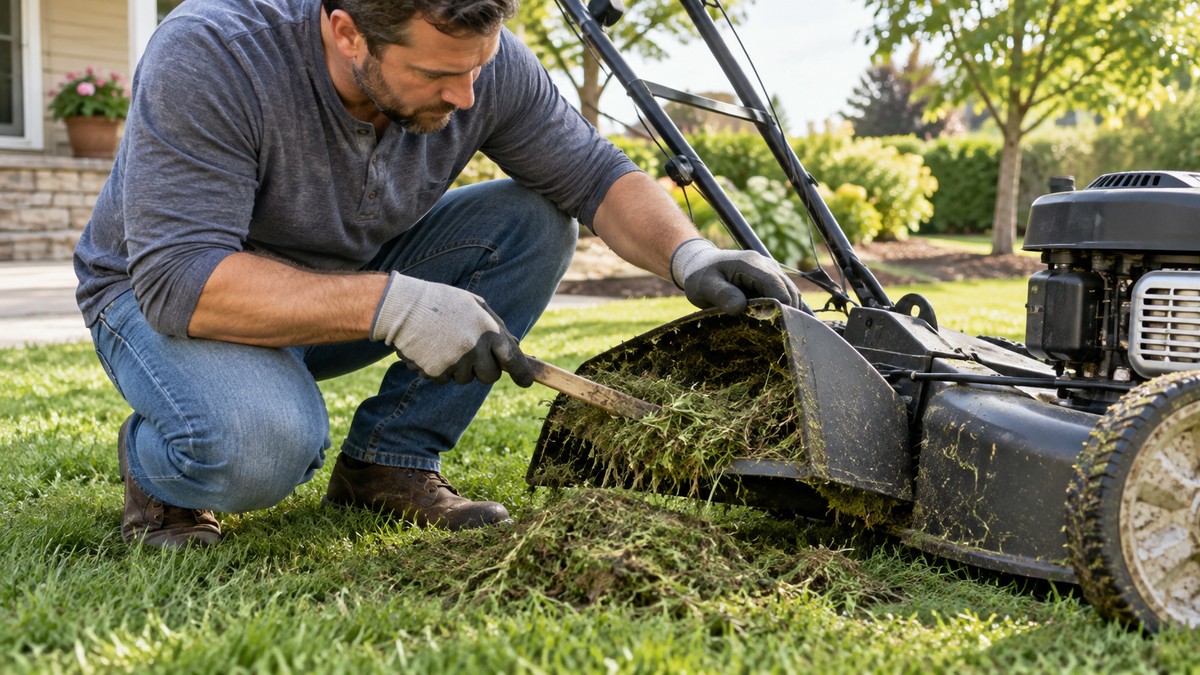
- Clear the chute. Brush out the grass, leaves and dirt. For packed material, use a scraper or brush, as ECHO describes.
- Blow out loose debris. If loose clippings or dust remain, Illinois Extension suggests a leaf blower or air compressor, with care around wiring and hoses.
- Check the underside. Illinois Extension says to inspect underneath the mower routinely for accumulated clippings.
- Keep water out. Do not wash a battery mower with water. Husqvarna warns that water can enter the battery or motor and cause a short circuit or damage the product.
What the sources say about each method
The table lines up each method with the page that describes it. A cell that says not stated means the cited page does not give that detail.
| Method or point | What the source says | Source |
|---|---|---|
| Shutdown before cleaning | Turn the safety key to 0, remove the battery, wait at least 5 seconds | Husqvarna US |
| Chute fix on a discontinued model | Release the operating bail, remove the safety key and batteries | Worx (WG774) |
| Battery when hand is near blades | Remove the battery on electric mowers | Illinois Extension |
| Brush | Remove leaves, grass and dirt with a brush | Husqvarna US |
| Scraper or brush | Remove caked-on debris from the deck | ECHO |
| Leaf blower or air compressor | Blow off clippings, dust and debris; be careful of wiring and hoses | Illinois Extension |
| Garden hose on the deck | ECHO says the deck can be hosed occasionally if very dirty | ECHO |
| Water on a battery mower | Do not use water; water can enter the battery or motor | Husqvarna US |
| Water and battery mowers | Never expose battery mowers and batteries to water, rain or wet conditions | ECHO |
| Pressure washer | Do not use a high-pressure washer on the product | Husqvarna US |
| Blade stop before clearing | Not stated | All cited pages |
Where the sources disagree on water
ECHO’s maintenance page gives two instructions that do not match. In its general section, it says you can hose down the deck occasionally if the mower is very dirty. In its battery section, it says never to expose battery-powered mowers and batteries to water, rain or wet conditions. Husqvarna’s battery-mower page is firmer still: no water on the product. For a battery mower, the sources we opened agree on a brush, and they do not support a hose.
Illinois Extension adds a third point. Some mowers have a port for a garden hose to clean underneath the deck, and it tells you to follow the manual for how that feature works. The sources we opened do not say which battery mowers have such a port, so the manual is the only place to check. The water warnings above are about battery mowers, and this post does not extend them to petrol models.
Why clippings build up in the chute
ECHO says that after every mow you should remove grass clippings and debris from the deck and undercarriage. It explains that grass buildup can limit airflow, affecting cutting performance, and it can promote rust and corrosion. Illinois Extension makes a similar point: clippings stuck to the bottom of the deck hold water, which causes the metal to rust and shortens the equipment’s life.
Husqvarna’s battery-mower page says to clean the mower after every use. It links a dirty cutting deck to poor cutting results, higher energy consumption and shorter battery runtime due to increased resistance. Those runtime and energy effects are the manufacturer’s statements, and the page gives no figures for them. For cutting in damp grass, see the guide to electric lawn mowers in wet grass.
Mistakes to avoid
- Clearing the chute with the battery in. Illinois Extension asks you to remove the battery for electric mowers when your hand is near the blades.
- Spraying a battery mower. Husqvarna warns that water can enter the battery or motor and cause a short circuit.
- Using a pressure washer. Husqvarna says not to use a high-pressure washer on the product.
- Skipping the wait. Husqvarna gives a minimum of 5 seconds after the key goes to 0 and the battery comes out.
- Leaving caked debris on the deck. ECHO says to remove clippings and debris after every mow, because buildup limits airflow.
How we chose
We looked for manufacturer and extension pages that describe clearing or cleaning a mower deck or chute. Retail pages and general blogs were left out. Five pages are cited, each opened on 2026-10-22 and each quoted from the saved page text. Four are US pages: Husqvarna’s US support site, ECHO’s US site, University of Illinois Extension and OSHA. The Worx page is from its North American support site and covers a discontinued model. The OSHA page is used only for the general statement about unexpected startup.
Husqvarna’s zero-turn and snow-blower chute pages were not used, because they cover other machine types.
What we could not verify
- A chute procedure for the models most readers own. The only chute-specific page we opened is for a discontinued model.
- Whether the blade must stop before you clear the chute. The pages we opened do not state it.
- A wait time for every battery model. Only the Husqvarna page gives the 5-second figure.
- Whether a hose is safe on any particular battery deck. The pages disagree on hosing, as described above.
What the sources do not say
The sources we opened do not say when to reinstall the battery after clearing the chute. They do not name a tool for the chute itself beyond a brush, a scraper, or a blower for loose debris. They do not explain what to do if the chute is blocked by a hard object rather than packed grass, and they do not describe how to take off a catcher or chute cover on any model. They do not say which models have a hose port for the underside of the deck, or what each manual says about using it.
FAQ
Do I have to remove the battery to clear the chute?
Yes, for an electric mower. Illinois Extension says to remove the battery for electric mowers whenever your hand goes near the blades. Husqvarna’s battery-mower page starts its cleaning steps with the safety key set to 0 and the battery removed. The Worx page for a discontinued 56V model lists removing the safety key and batteries as part of its chute fix.
How long should I wait after I remove the battery?
Husqvarna’s battery-mower cleaning page says to wait a minimum of 5 seconds after you turn the safety key to 0 and remove the battery. The sources we opened give that figure for Husqvarna only, so check your own manual for any different time.
Can I hose out the chute?
Not on a battery mower, according to Husqvarna, which says water can enter the battery or motor and cause a short circuit or damage the product. ECHO says its deck can be hosed occasionally when very dirty, but its battery section says to keep battery mowers away from water. For a battery mower, the sources we opened point to a brush.
What tool should I use to clear the chute?
Husqvarna’s battery-mower page uses a brush to remove leaves, grass and dirt. ECHO suggests a scraper or brush for caked-on debris. Illinois Extension suggests a leaf blower or air compressor for loose clippings and dust, with care around wiring and hoses. The sources we opened do not name a tool for the chute itself.
How often should I clear the deck?
ECHO says to remove grass clippings and debris from the deck and undercarriage after every mow. It explains that buildup can limit airflow and affect cutting performance. Husqvarna’s battery-mower page says to clean the mower after every use and to check that it is clean before using it. Illinois Extension says to inspect underneath the mower regularly for accumulated clippings.
Why does the chute keep clogging?
The sources point to clippings and debris building up on the deck. ECHO says buildup limits airflow and affects cutting performance, and Illinois Extension says clippings that stay on the deck hold water and rust the metal. Husqvarna’s page links a dirty cutting deck to poor cutting results.
The sources we opened do not say which conditions cause a clog on a given model. Check your manual’s maintenance section for model-specific causes.
Bottom line
Turn the mower off, remove the battery, and wait before you reach into the chute. Brush the grass out, and keep water away from a battery mower.
Sources
- Worx support: Mower not picking up clippings with the Grass Collection Bag (opened 2026-10-22)
- Husqvarna US support: How to clean a battery lawn mower (opened 2026-10-22)
- ECHO: Lawn Mower Maintenance Tips (opened 2026-10-22)
- University of Illinois Extension: Mower Maintenance (opened 2026-10-22)
- OSHA: Control of Hazardous Energy (Lockout/Tagout) (opened 2026-10-22)