Mowing in a Pattern Without Creating Ruts
As an Amazon Associate we earn from qualifying purchases.
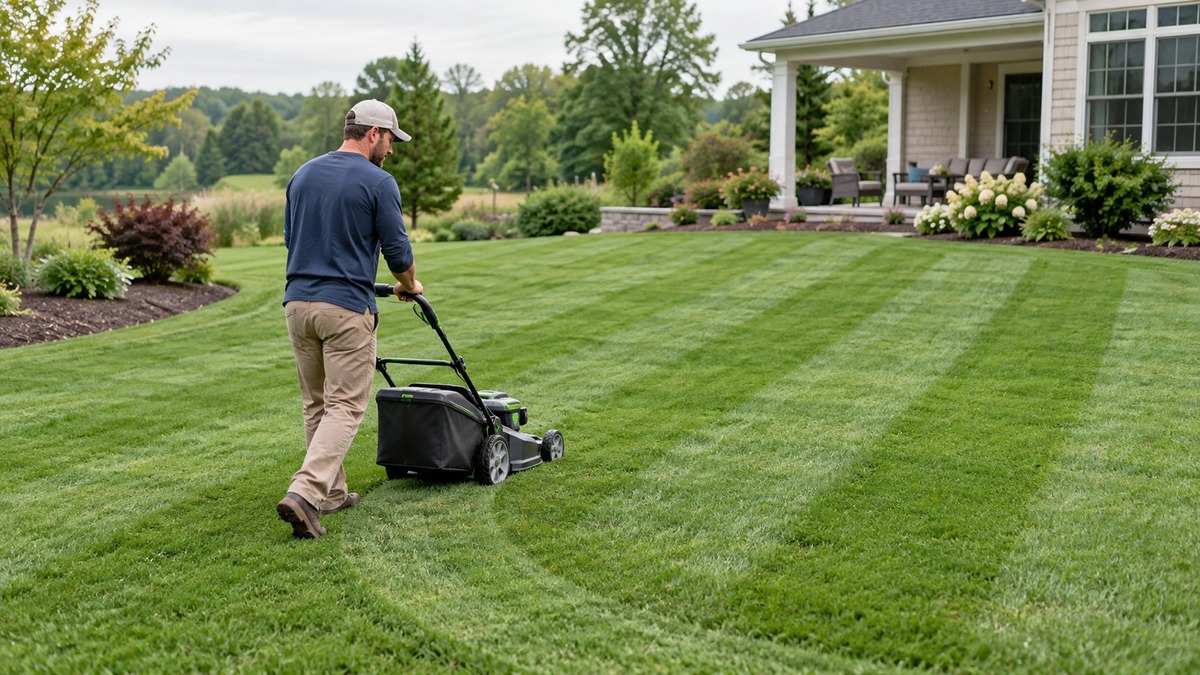
If you want to know how to mow in a pattern without creating ruts, change direction on a regular schedule and cross the last pass at a right angle. Extension publications link one repeated pattern to three effects: grass gets pushed over, mower wheels wear the same ground, and the blade keeps working the same spot. Changing the pattern addresses all three. This guide covers why the pattern matters, the safety points that come with it, the steps for changing it, a table of what each page states, and what the pages do not settle.
Quick answer
- Change the mowing direction every one to two mowings, as Ohio State suggests, or at each mowing, as Iowa State suggests.
- Cross the previous pass at a right angle, meaning 90 degrees.
- Clear sticks, rocks and other debris first, and mow when the grass is dry wherever you can.
- With a push mower on a slope, mow across it. For riding mowers the pages differ on gentler slopes, so check the operator’s manual.
Why the mowing pattern matters
Illinois Extension sums up the stakes this way: “Mowing has a major impact on lawn appearance and health, yet is often overlooked in terms of importance.” Direction is one part of that impact. The three effects below are the ones these pages connect to repeated passes.
Grass gets pushed over
Iowa State University Extension states that “Repeatedly mowing the lawn in the same direction pushes the grass over rather than cutting it cleanly.” Ohio State makes a related point: passing at right angles to the last mow keeps grass from being consistently pushed and flattened, especially at higher cutting heights. Neither page gives a count of same-direction passes before the damage shows.
Wheel wear and compaction
The Iowa State page also says that “different mowing patterns reduce soil compaction and wear from the mower wheels.” That is the closest the pages come to the ruts in this article’s title. None of the six cited pages uses the word “rut,” describes one forming, or says how many passes it takes.
Scalping in one spot
Ohio State also links changing direction to less scalping in specific areas, because the blade does not keep hitting the same ground. The page does not tie scalping to a number of same-direction passes. Height and frequency are outside this guide.
Where the pages disagree
Illinois Extension treats direction changes as a choice rather than a rule. Its page reads: “Periodically change directions if desired, although mowing the same direction each time should not be a problem on taller turf typical of home lawns.” The Iowa State and Ohio State pages do not make that exception. Only the Illinois page allows a single direction on taller turf.
Safety before you change the pattern
Clear loose objects first
Virginia Tech says: “Mower blades can throw loose objects at high speeds. Make sure the area to be mowed is free of loose objects.” Ohio State says that “Foreign objects can fly from the mower, so make sure the mowing area is clear of people, animals, litter, and debris.” Penn State’s riding mower page says: “Clear the area of any sticks, rocks, toys, or other debris.”
Mow dry grass when you can
Iowa State gives a reason as well as a rule: “Also, it’s safer to mow the lawn when the grass is dry as there is less risk of slipping and being injured by the mower.” Virginia Tech adds: “Avoid mowing when the grass is wet.”
Stance and forward movement
Virginia Tech says: “Start a push mower only when standing up with both feet placed firmly on the ground.” On its riding mower page, Penn State says: “Mow only in forward.” The same page adds: “When mowing, always check behind you for children and others before backing up.” Those two riding mower lines do not apply to a push mower.
Slopes
For a push mower, Ohio State says: “When mowing on a slope with a push mower, you should mow across the slope.” Virginia Tech gives the same instruction for push mowers.
For a riding mower, Ohio State says: “When mowing on a slope with a riding mower, you should mow down the slope.” Virginia Tech’s rotary mower page also says to mow down the slope on a riding mower. Penn State gives a different rule: “As a general rule, if you are operating a mower on a slope greater than 15 degrees of slope, you should drive up and down the slope. You can operate the mower side to side if the slope is less than 15 degrees.” On gentler slopes, the Penn State rule does not match the down-the-slope advice from Ohio State and Virginia Tech. Penn State tells operators to “make sure you understand the special considerations and safe practices located in the operator’s manual and online.”
How to change the pattern
Follow these steps at each mowing. Each step names the page behind it.
- Clear the lawn first. Remove sticks, rocks, toys and other debris before the first pass, following the safety points above. Ohio State’s power mower page says: “Before mowing remove debris from lawn.”
- Mow when the grass is dry, where you can. Iowa State recommends dry grass whenever possible. Ohio State says: “Avoid mowing wet turf.” It also notes that wet turf is harder to cut cleanly, clogs rotary mowers, and hinders mulching if you want it. If the grass is wet, skip that mowing. For electric models, see the guide to electric mowers and wet grass.
- Set the new pass at a right angle. Ohio State describes this as passing at right angles (90 degrees) to the direction of the previous mow. If the last pass ran north to south, the next pass runs east to west. The cited pages do not describe a diagonal heading, so this guide uses right angles only.
- Change direction on a schedule. Ohio State calls varying the direction crucial, and asks for a change every one to two mowings. Iowa State asks for a change at each mowing. The table below sets out both intervals, and the FAQ explains the difference.
- On a slope, follow the rule for your mower. With a push mower, mow across the slope. With a riding mower, the cited pages do not agree on gentler slopes, so read the operator’s manual before you choose a heading. The safety section above sets out both rules.
The pattern rules in the sources
The table lists what each cited page states. Where a page is silent on a point, the cell says “not stated.”
| Point | What the page states | Source |
|---|---|---|
| How often to change direction | At each mowing | Iowa State University Extension |
| How often to change direction | Every one to two mowings | Ohio State University Extension |
| Angle of the next pass | Right angles (90 degrees) to the previous mow | Ohio State University Extension |
| Taller turf | Keeping one direction is acceptable | Illinois Extension |
| Compaction and wheel wear | Different patterns reduce them | Iowa State University Extension |
| Ruts named as a result | not stated | not stated in the six pages |
| Wet grass | Avoid mowing it; wet grass is harder to cut and can clog rotary mowers | Iowa State University Extension; Ohio State University Extension; Virginia Tech |
| Push mower on a slope | Mow across the slope | Ohio State University Extension; Virginia Tech |
| Riding mower on a slope | Mow down the slope (Ohio State, Virginia Tech); up and down above 15 degrees and side to side below 15 degrees (Penn State) | Ohio State University Extension; Virginia Tech; Penn State Extension |
| Grain or leaning of the grass | not stated | not stated in the six pages |
| Effect of a pattern on root growth | not stated | not stated in the six pages |
How we chose
We searched for university extension pages on mowing direction, debris, wet grass and slope safety. We left out lawn-care company blogs, retail pages and news items. We opened nine extension pages on 2026-10-22 and cite six of them. Two Illinois pages did not contain mowing-direction text: one was a general lawn landing page, and the mowing safety link opened an unrelated farm management page. One NC State Extension lawn chapter covers compaction from mowing but does not mention direction, so we did not cite it. Several other pages returned a 403 or 404 response and do not count as opened.
Penn State’s page covers riding mowers, so its points apply only to riding mowers. The Iowa State article is dated April 14, 2010. We did not rank the pages. Each one is cited for the points it states.
What we could not verify
- Whether a given pattern changes rut formation on your soil. The cited pages describe practice and mechanism. None reports a measured rut depth.
- Whether the Iowa State advice still matches current turf research. That article is dated April 14, 2010, and its own note says the information may not be the most current.
- Which pattern works best on a particular lawn. The pages give direction rules, not a comparison of patterns.
- The exact slope limit for a riding mower you own. Penn State and the other pages do not agree on gentler slopes, and the operator’s manual is the source to check.
What the sources do not say
- How a pattern changes the grass itself beyond the pushing-over and scalping effects. The cited pages do not say whether a pattern changes how grass leans or grows.
- Whether a diagonal pass does more for the lawn than a right-angle pass. The cited pages name right angles only.
- How wet the soil must be before a mower leaves ruts. No cited page gives a soil condition for ruts.
- Robot mowers. None of the six pages covers robot mowers, so this guide gives no robot pattern advice. For robot models, see robot lawn mowers for small lawns.
- Deck width, number of passes per lawn, or time per pattern. The cited pages do not state them.
FAQ
Do I have to change direction every time I mow?
Not necessarily. Iowa State says to alternate the pattern or direction each time the lawn is mowed. Ohio State calls varying the direction every one to two mowings crucial. The two pages set different intervals on the same principle.
Illinois Extension is the outlier. It says direction changes are optional on taller turf, so a single direction is acceptable there.
Which way should the next pass run?
Cross the last pass at a right angle. Ohio State describes this as passing at 90 degrees to the previous mow. It says the practice keeps grass from being consistently pushed and flattened, especially at higher cutting heights. The cited pages do not describe any other angle, so a diagonal pass is not covered here.
Does changing the pattern stop ruts?
The cited pages do not say that. Iowa State says different mowing patterns reduce soil compaction and wear from the mower wheels, which is the closest they come to ruts. None of the cited pages describes a rut forming, so treat this as a practice to follow rather than a guarantee.
Can I mow wet grass if I change the pattern?
The pages advise against it. Ohio State says to avoid mowing wet turf because it is harder to cut cleanly and clogs rotary mowers. Virginia Tech says never to use an electric mower on wet grass. If the grass is wet, wait for a drier day. If you are still choosing between mower types, see the pros and cons of electric mowers.
How should I mow a slope in a pattern?
With a push mower, cross the slope. Ohio State says so, and Virginia Tech gives the same instruction. With a riding mower, Ohio State and Virginia Tech say to mow down the slope. Penn State says to drive up and down slopes steeper than 15 degrees and to mow side to side on gentler ones. The pages do not agree on gentler slopes, so read the operator’s manual.
Does this apply to robot mowers?
No. None of the six cited pages covers robot mowers, so this guide gives no pattern advice for them. The cited pages cover push and riding mowers only.
Bottom line
When the grass is dry, cross the last pass at a right angle and change direction every one to two mowings. Wet grass waits for a drier day.
Sources
- Iowa State University Extension: Proper Mowing of the Home Lawn | Yard and Garden (opened 2026-10-22)
- Illinois Extension: Mowing Your Lawn | Lawns | Illinois Extension | Illinois (opened 2026-10-22)
- Ohio State University Extension: Lawn mowing | CFAES Knowledge Hub (opened 2026-10-22)
- Ohio State University Extension: Power Lawn Mowers | Ohioline (opened 2026-10-22)
- Virginia Tech Cooperative Extension: Lawn Care: Rotary Mower Safety | VCE Publications | Virginia Tech (opened 2026-10-22)
- Penn State Extension: Riding Lawnmower Safety Practices (opened 2026-10-22)