How to Sharpen a Mower Blade Safely
As an Amazon Associate we earn from qualifying purchases.
How to sharpen lawn mower blade safely starts with the power, not the file. On an electric mower, remove the battery and wait at least 5 seconds before any blade work. Husqvarna’s US FAQ says it does not recommend sharpening a blade, but that a walk-behind blade can be filed or ground once it is off the mower. This guide covers the safety steps, the sharpening method the sources describe, and the balance check, and it says what the sources do not cover.
Quick answer
- Remove the battery and wait at least 5 seconds before any blade work. Husqvarna’s battery mower warning sets that rule.
- Husqvarna does not recommend sharpening. If you sharpen, take the blade off the mower first and never sharpen it while it is mounted.
- Check balance with a nail before the blade goes back on, and file the heavy end until the blade sits level.
- Replace a blade with cracks or dents instead of sharpening it. Husqvarna’s New Zealand guide says so.
Why sharp blades matter
Illinois Extension says sharp mower blades are critical to the health of the lawn. Dull blades bludgeon and tear grass, leaving ragged wounds that are harder for the grass to heal. The same page says an unbalanced blade can wobble, strain the mower and leave an uneven cut.
Husqvarna’s New Zealand guide says that when the blades are dull, the engine has to work harder to cut the grass. The same guide says that dull mower blades make for a less than attractive finish to the lawn. If you would rather not sharpen at home, Illinois Extension says many lawn service businesses also sharpen blades. For blade styles, see blade styles for lawn mowers.
Safety first: power off and read the manual
Blade work is where most of the risk sits. Penn State Extension’s riding lawn mower safety page says the majority of mowing accidents involve contact with a rotating mower blade. Power off comes first, before any tool touches the blade.
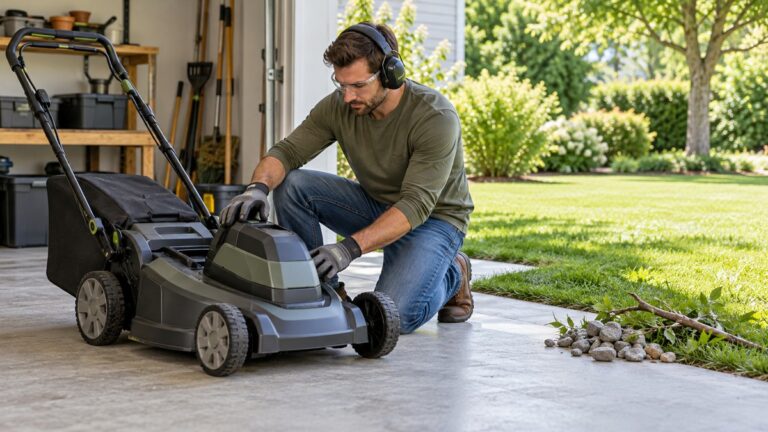
Illinois Extension says that before a mower’s blades are removed, the spark plug should be disconnected or, on an electric mower, the battery removed, to prevent any accidental engagement of the blades. Husqvarna’s battery mower warning gives the same battery step, with the safety key turned to 0 first. Illinois Extension also says to consult your equipment’s user manual before performing maintenance or operating.
Husqvarna’s New Zealand guide tells you to check the service manual before changing a blade, to confirm the safety precautions, safe work procedures and the personal protective equipment you need. Read that section before you start, because this guide does not repeat the removal steps.
Step-by-step: sharpen a blade safely
These steps cover sharpening only. Each step names its source, and the safety note sits inside the step where it applies.
-
Remove the battery and wait at least 5 seconds. Husqvarna’s battery mower warning says to turn the safety key to 0, remove the battery and wait a minimum of 5 seconds to prevent accidental starts. Do this before you touch the blade.
-
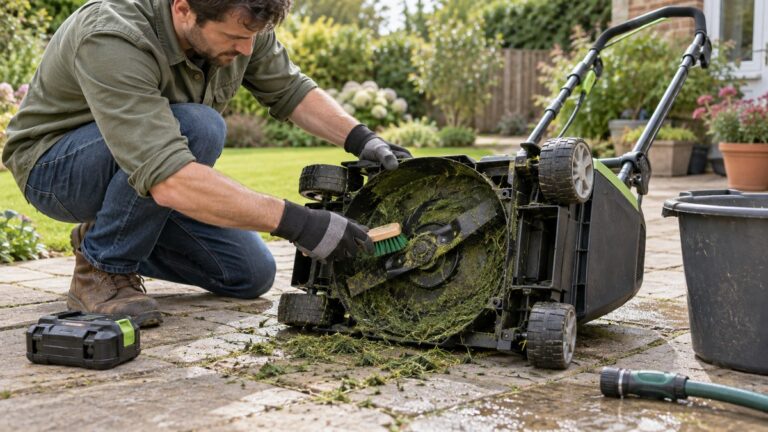
Take the blade off the mower. Husqvarna says to remove the blade first and never sharpen it while it is on the mower. Its FAQ points to the owner’s manual for blade removal and reinstallation, and this guide does not give those steps.
-
Inspect the blade. Husqvarna’s New Zealand guide says to inspect the blade for any damage once it is off. If there are signs of damage, cracks or dents, replace the blade rather than sharpen it.
-
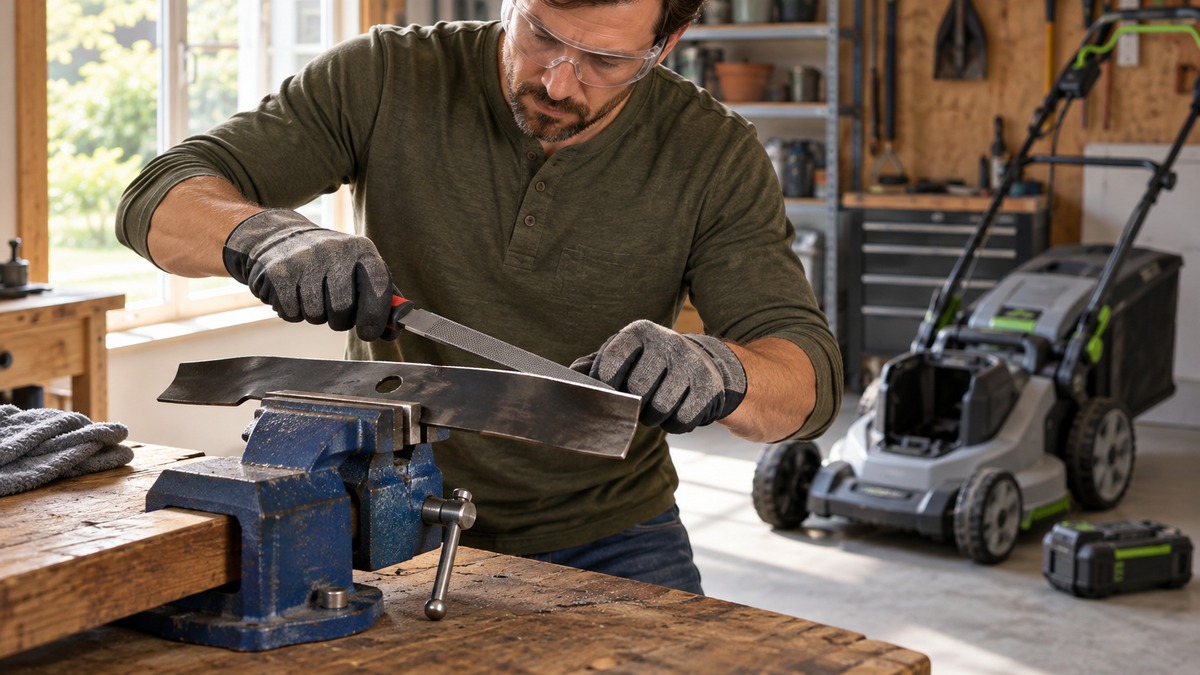
Sharpen with a file or a grinding wheel, only if the blade is intact. Husqvarna’s FAQ names a file or a grinding wheel. Illinois Extension lists a bench grinder, a grinding stone or a simple file. The sources do not give a grinder procedure, grinder speed or protective equipment for a grinding wheel, so this guide gives none.
-
Keep the edge even and stop short of a knife point. Husqvarna’s New Zealand guide says to start at the heavier end, take small amounts at a time, keep the sharpening even across the face, and never sharpen to a knife point. It says to allow for a 1mm edge.
-
Check the balance before the blade goes back on. Use the nail check in the next section. Do not reinstall a blade that has not been balanced.
Check the balance before the blade goes back on
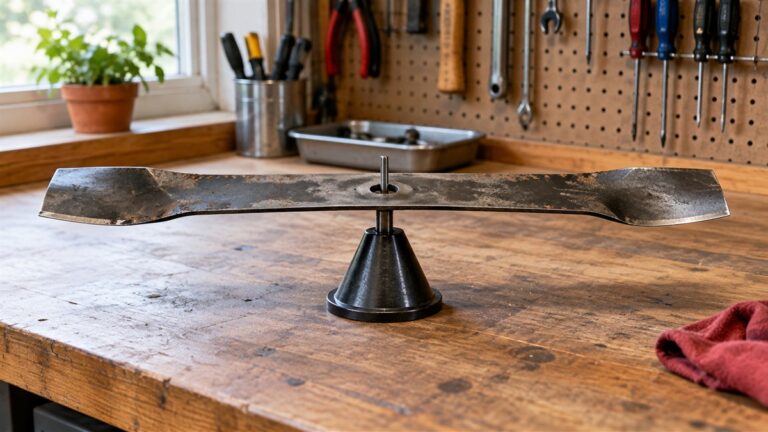
Husqvarna’s FAQ gives a nail check. Drive a nail into a beam or wall and leave about one inch of it exposed. Place the center hole of the blade over the nail head. A blade that stays level on the nail is balanced. If either end moves downward, file the heavy end until the blade balances.
Husqvarna says the blade must be balanced before it is reinstalled, and that an unbalanced blade will eventually damage the mower or engine. Illinois Extension notes that sharpening kits often come with a cone-shaped balancer that can confirm the blade is balanced after sharpening and cleaning.
What the manufacturer says about sharpening
Husqvarna’s position is that sharpening is not the first choice. Its FAQ says it does not recommend sharpening a blade, because a new blade is precision designed and manufactured for excellent quality of cut and balance. The same FAQ says a walk-behind blade can be sharpened with a file or on a grinding wheel, once it has been removed.
Read together, the sources set an order. Check the blade for damage first. If it is damaged, replace it. If it is intact, sharpen it off the mower and then check the balance. For a blade set from a named brand, see Black and Decker lawn mower blades.
Sharpening points by source
The table lists each sharpening point by source. “Not stated” means the sources we opened do not cover it.
| Source | What it says | Applies to |
|---|---|---|
| Husqvarna US FAQ | Does not recommend sharpening; file or grinding wheel only after removal; never on the mower | Walk-behind blades |
| Husqvarna US FAQ | Nail check; file the heavy end until level; balance before reinstalling | Walk-behind blades |
| Husqvarna New Zealand guide (non-US locale) | Inspect for damage; replace if cracked or dented; sharpen from the heavier end in small amounts; allow a 1mm edge; never to a knife point | Walk-behind blades |
| Husqvarna US battery mower warning | Turn the safety key to 0, remove the battery, wait at least 5 seconds | Battery mowers |
| University of Illinois Extension | Disconnect the spark plug or remove the battery before blade removal; file, stone or bench grinder; balance kits | Mowers in general |
| Penn State Extension, riding mower page | Most mowing accidents involve contact with a rotating blade | Riding mowers, general statement |
| Grinder speed, settings or protective equipment | Not stated | Not stated |
| Sharpening interval | Not stated | Not stated |
Common mistakes to avoid
Each mistake below is tied to a fact in the sources we opened.
- Sharpening the blade while it is still mounted. Husqvarna’s FAQ says not to sharpen the blade while it is on the mower.
- Skipping the battery step. Husqvarna’s battery mower warning and Illinois Extension both tie battery removal to preventing accidental starts or accidental engagement of the blades.
- Sharpening a blade that is cracked or dented. A blade with signs of damage, cracks or dents should be replaced, according to the New Zealand guide.
- Taking the edge to a knife point. The same guide says never to sharpen to a knifepoint, and it asks for a 1mm edge.
- Putting back a blade that is not balanced. Husqvarna’s FAQ says an unbalanced blade will eventually damage the mower or engine, and Illinois Extension says it can cause a wobble and an uneven cut.
How we chose
We wanted pages that state a sharpening method, a balance check, or a power-off rule for mower blades. Husqvarna’s US FAQ and its battery mower warning came first. Illinois Extension came next for general tools and the power-off rule. Penn State Extension was used for one general hazard statement, although its page is written for riding mowers. Husqvarna’s New Zealand guide is a non-US locale page. It is cited because the US pages we opened do not give an edge technique, and the post says so wherever that guide is the source.
We cite five pages, all opened on 2026-10-22. We also opened a Husqvarna UK blade-replacement page that gives removal steps and no sharpening text, so it is not cited. This list describes the pages, not a ranking of brands.
What we could not verify
- The owner’s manual for your model. The manuals that search returned were not opened, and the fetch tool used here does not read PDF files, so torque figures and blade-removal steps for a specific model are not confirmed.
- Whether a grinding wheel is suitable for your blade. The Husqvarna FAQ names it as an option, and the pages we opened give no procedure beyond removing the blade first.
- Whether the Penn State statement about rotating blades applies in the same way to walk-behind and electric mowers. That page is written for riding mowers.
- The 1mm edge figure. It comes from a non-US locale page, and the US pages we opened do not repeat it.
What the sources do not say
- A grinder procedure, grinder speed, or protective equipment for a grinding wheel.
- How often to sharpen a blade. No interval appears on the pages we opened.
- The angle to sharpen to. The pages describe the edge without giving a degree figure.
- How much metal can be removed before a blade must be replaced.
- Whether an electric mower’s blade is sharpened differently from a gas mower’s blade.
FAQ
Can I sharpen a mower blade while it is still on the mower?
No. Husqvarna’s FAQ says not to sharpen the blade while it is on the mower, and to remove it first. Illinois Extension says that before a blade is removed, the spark plug should be disconnected or, on an electric mower, the battery removed.
Remove the battery before you do anything near the blade, and wait at least 5 seconds after removing it.
Do I need to remove the battery before sharpening?
Yes. Husqvarna’s battery mower warning ties the battery step to preventing accidental starts, with the safety key at 0 and a wait of at least 5 seconds. Illinois Extension says that for an electric mower the battery should be removed before the blades are removed.
Should I sharpen the blade or replace it?
Check the blade first. Husqvarna’s New Zealand guide says to replace a blade that shows signs of damage, cracks or dents. Husqvarna’s US FAQ says it does not recommend sharpening, because a new blade is precision designed for cut quality and balance.
If the blade is intact, the sources allow sharpening with a file or a grinding wheel, with the blade off the mower.
How do I check whether a blade is balanced?
Husqvarna’s FAQ describes a nail check. Drive a nail into a beam or wall, leave about one inch exposed, and place the center hole of the blade over the nail head. The blade is balanced if it stays level on the nail. If either end drops, file the heavy end until the blade balances.
Illinois Extension says sharpening kits often include a cone-shaped balancer that can confirm the blade is balanced after sharpening and cleaning.
What edge should a sharpened blade have?
Husqvarna’s New Zealand guide says to sharpen evenly across the face, start at the heavier end, take small amounts at a time, and never sharpen to a knife point. It also asks for a 1mm edge.
The US pages we opened do not give an edge shape or angle, so the 1mm figure is the only one in this guide, and it comes from a non-US locale page.
Can I use a bench grinder to sharpen a mower blade?
The sources do not give a grinder procedure. Illinois Extension lists a bench grinder among the tools that can sharpen a mower blade, and Husqvarna’s FAQ names a grinding wheel. Neither gives grinder speed, settings or protective equipment.
Any grinding should be done with the blade off the mower. This guide does not give grinder steps, so use the grinder maker’s own instructions for setup and safety.
Bottom line
Remove the battery first. If the blade is cracked or dented, replace it. If it is intact, sharpen it off the mower and check the balance with a nail before it goes back on.
Sources
- Husqvarna US: Support FAQs (opened 2026-10-22)
- Penn State Extension: Riding Lawnmower Safety Practices (opened 2026-10-22)
- Husqvarna NZ: Lawn Mower Blade Replacement Guide (opened 2026-10-22)
- Husqvarna US Help Center: How to clean a battery lawn mower (opened 2026-10-22)
- University of Illinois Extension: Mower Maintenance (opened 2026-10-22)