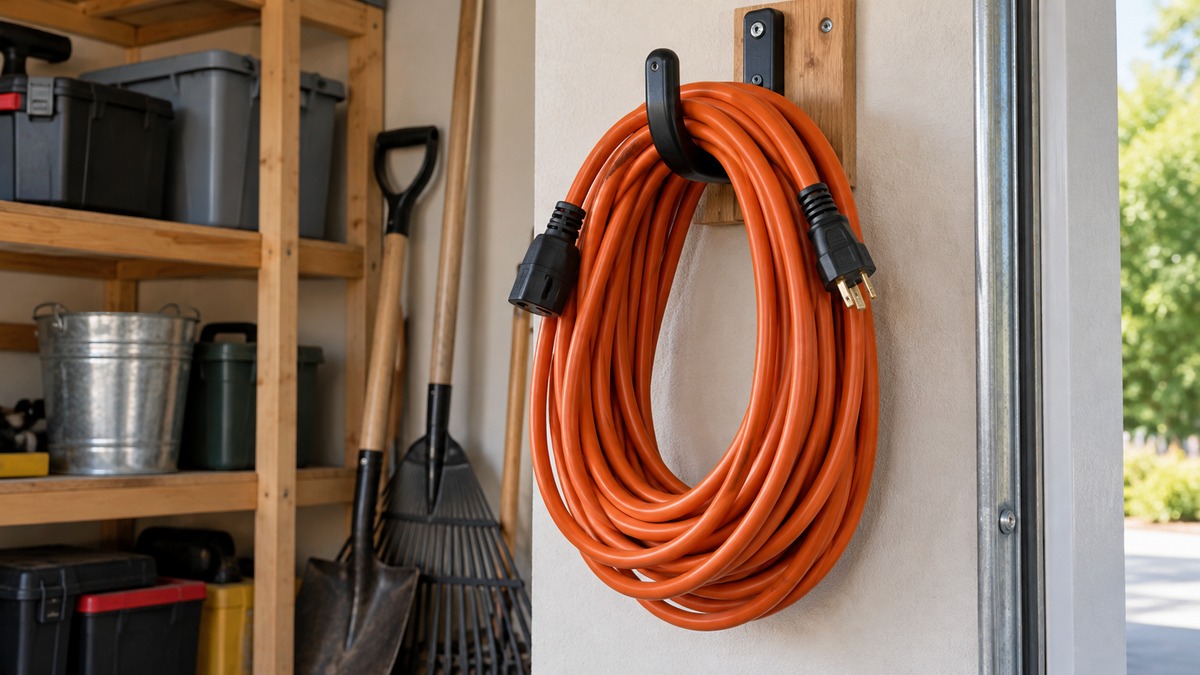
How to Store Outdoor Extension Cords Safely
As an Amazon Associate we earn from qualifying purchases.
Knowing how to store outdoor extension cords comes down to three steps: unplug the cord, check it for damage, and keep it indoors in a dry area, away from staples and pinch points. Outdoor cords are built for weather, but the sources here still say to keep them as dry as possible. The cited pages do not describe a coiling method, so the coiling advice in this post is limited to what OSHA says about fastening and hanging.
Quick answer
- Unplug the cord when you finish, and inspect it for cuts, fraying and exposed wires.
- Store outdoor extension cords indoors in a dry area when they are not in use.
- Do not fasten the cord with staples, and do not hang it in a way that could damage the jacket or insulation.
- Take a damaged cord out of service and replace it. The cited pages do not describe a home repair.
Why storage and damage matter
OSHA’s flexible cords page says that because cords are exposed, flexible and unsecured, they are more susceptible to damage than fixed wiring. It lists door and window edges, staples and fastenings, abrasion from adjacent materials, and simply aging as causes of cord damage. If the conductors become exposed, OSHA says there is a danger of shocks, burns or fire.
The storage rules below follow from that. OSHA’s general industry rule says cords may not be fastened with staples or hung so the jacket or insulation can be damaged, and it requires inspection before use.
Safety before you put a cord away
Unplug the cord first. Gardner Bender says to unplug an extension cord from the power source when you are finished using it, because leaving it plugged in unnecessarily increases the risk of damage and accidents. Then check the cord for cuts, fraying or exposed wires. Gardner Bender says to inspect the cord before each use for these signs of damage, and OSHA’s flexible cords page says exposed conductors create a danger of shocks, burns or fire.
If you find damage, take the cord out of service. OSHA’s rule says a defective or damaged item shall be removed from service. Gardner Bender says damaged cords should be replaced immediately to prevent electrical shocks or fires.
Step-by-step: putting an outdoor cord away
- Unplug the cord from the power source. Gardner Bender says to do this when you finish using the cord, because leaving it plugged in increases the risk of damage and accidents.
- Inspect the full cord. Look for cuts, fraying and exposed wires. OSHA’s general industry rule says extension cords must be visually inspected before use on any shift for external defects, including damage to the outer jacket or insulation, and for evidence of possible internal damage.
- Remove any damaged cord from service. OSHA’s rule says the defective or damaged item shall be removed from service. Gardner Bender says to replace a damaged cord. The cited pages do not describe a repair you can do at home.
- Do not staple the cord or hang it tightly. OSHA says flexible cords may not be fastened with staples or otherwise hung in a way that could damage the outer jacket or insulation. The cited pages do not say how loosely a cord should be coiled.
- Store the cord indoors in a dry area. Gardner Bender says to store outdoor extension cords indoors in a dry area when not in use, because proper storage helps prevent damage from sunlight, moisture or pests.
- Keep the cord out of water and clear of pinch points. Gardner Bender says to avoid puddles and areas where water may accumulate. Its pinch-point advice is written for use, so apply it to the storage spot as well: a cord should not be crushed by a door, a window or heavy objects.
Mistakes to avoid
- Fastening the cord with staples. OSHA says flexible cords may not be fastened with staples.
- Lifting or hanging a tool by its cord. OSHA’s handling rule says flexible electric cords connected to equipment may not be used for raising or lowering the equipment.
- Leaving the cord plugged in after use. Gardner Bender says leaving it plugged in unnecessarily increases the risk of damage and accidents.
- Storing the cord outdoors or in a damp spot. Gardner Bender says to keep the cord indoors and dry when it is not in use.
- Putting away a cord with visible damage. OSHA says a defective or damaged item shall be removed from service, and Gardner Bender says to replace damaged cords.
Outdoor cords and connectors
Start with the cord itself. Gardner Bender says to use an extension cord specifically designed for outdoor use. Oklahoma State University Extension says to be aware of the difference between indoor and outdoor options.
Connectors need the same attention as the cord. OSHA’s flexible cords page says that when a cord connector is wet, electric current can leak to the equipment grounding conductor, and to a person who picks up that connector if they provide a path to ground. It says to limit exposure of connectors and tools to excessive moisture by using watertight or sealable connectors.
What the cited pages say about each storage point
| Storage point | What the cited pages state | Source |
|---|---|---|
| Where to store | Indoors in a dry area when not in use | Gardner Bender |
| Why dryness matters | Storage helps prevent damage from sunlight, moisture or pests | Gardner Bender |
| Fastening and hanging | No staples; no hanging that could damage the jacket or insulation | OSHA 1910.334 |
| Coiling method | Not stated in any cited page | None |
| Inspection | Before each use (Gardner Bender); before use on any shift (OSHA) | Gardner Bender; OSHA 1910.334 |
| Damaged cord | Remove from service (OSHA); replace (Gardner Bender) | OSHA 1910.334; Gardner Bender |
| Repair | Construction cords may be repaired so long as the repair returns them to the approved state. Home repair: not stated | OSHA interpretation 2010-04-04 |
| Unplugging | Unplug when finished; leaving it plugged in increases the risk of damage | Gardner Bender |
| Water | Avoid puddles; keep as dry as possible | Gardner Bender; Oklahoma State University Extension |
| Outdoor rating | Designed to withstand the weather; indoor and outdoor options differ | Oklahoma State University Extension |
| Storage in general (industrial cable only) | No defined shelf life if undamaged and protected from sunlight and precipitation | Southwire tech blog |
Coiling and hanging: what is and is not stated
None of the cited pages describes a coiling method, such as loops, figure eights or wraps. OSHA’s rule covers the fastening: no staples, and no hanging that could damage the outer jacket or insulation. Gardner Bender’s storage advice covers where the cord goes, not how to coil it.
If you hang a cord, OSHA’s wording gives the limit: the hanging must not damage the jacket or insulation. The sources do not name a hook, rack or reel.
How we chose
We limited the sources to OSHA pages, one manufacturer safety article, one extension article, and one manufacturer blog on industrial cable. The OSHA pages cover workplace rules, and most of the storage advice comes from the manufacturer article. Six pages were opened on 2026-10-22, and the quotes behind each claim were checked against the saved text of the page they came from.
Several pages were left out. Three CPSC news releases and a University of Georgia extension article returned access errors, and an Iowa State University Extension blog returned a server error. None of them is cited.
What we could not verify
- Whether the Gardner Bender advice matches the cord you own. The article is general and does not name a cord model.
- Whether indoor storage prevents damage in your climate. The sources give the reasons, sunlight, moisture and pests, but no temperature range.
- Whether a cord can be repaired at home. The only repair rule cited is OSHA’s construction letter.
- Whether the Southwire guidance applies to a consumer cord. It covers industrial power cable.
What the sources do not say
- How to coil a cord, how loose the coil should be, or whether to use a reel.
- How long a cord can sit in storage before it needs inspection.
- Cord gauge or length for any use. The cited pages do not state one, so this post gives none.
- Storage temperature limits for indoor or outdoor cords.
If you are choosing a cord for a corded mower, the extension cord guide for electric lawn mowers is the place to start. For a corded mower in general, see the self-propelled corded electric mower guide. If your lawn is wet when you mow, the electric mower wet grass guide covers that case.
FAQ
Can I store an outdoor extension cord outside?
Gardner Bender says to store outdoor extension cords indoors in a dry area when they are not in use. It says that proper storage helps prevent damage from sunlight, moisture or pests.
Oklahoma State University Extension says outdoor lights and extension cords are designed to withstand the weather and winter elements. That describes use, not storage, so the sources do not say an outdoor cord can be left outside.
Should I wrap the cord tightly around a hook?
OSHA’s rule says flexible cords may not be fastened with staples or otherwise hung in a way that could damage the outer jacket or insulation. The cited pages do not describe a coiling method, so this post does not recommend a wrap style.
A tight wrap that pinches the jacket or insulation falls under the OSHA hanging rule, so do not use one.
How often should I inspect an extension cord?
Gardner Bender says to inspect the cord before each use. OSHA’s general industry rule says extension cords must be visually inspected before use on any shift.
The sources do not give an interval for inspection during storage.
What if the cord has a cut or frayed insulation?
Gardner Bender says to replace damaged cords immediately, because they can cause shocks or fires. OSHA’s rule says a damaged cord must be taken out of service.
No cited page describes a home repair method. OSHA’s construction letter allows repairs so long as the repair returns the cord to its approved state, and that letter concerns construction work.
Does water ruin an outdoor extension cord?
Gardner Bender says outdoor extension cords are designed to withstand moisture to some extent, but it is still crucial to keep them as dry as possible. It also says to avoid placing them in puddles or areas where water may accumulate.
OSHA’s flexible cords page says cords are exposed and unsecured, so they are more susceptible to damage than fixed wiring.
Can I keep a cord in a shed or garage?
Gardner Bender says to store outdoor extension cords indoors in a dry area. A shed or garage fits that description only if it stays dry, and the cited pages do not say which spaces meet the standard.
Bottom line
Decision rule: if a cord is damaged or has been stapled, do not put it away; take it out of service and replace it.
Sources
- OSHA: 1910.334 – Use of equipment. | Occupational Safety and Health Administration (opened 2026-10-22)
- OSHA: Electrical – Flexible Cords | Occupational Safety and Health Administration (opened 2026-10-22)
- OSHA: Whether extension cords may be repaired and returned to use. | Occupational Safety and Health Administration (opened 2026-10-22)
- Gardner Bender (nVent): Outdoor Extension Cord Safety (opened 2026-10-22)
- Oklahoma State University Extension: ‘Tis the season: Tips for keeping your home safe during the holiday season (opened 2026-10-22)
- Southwire Tech Blog: Shelf Life and Cable Life of Cables (opened 2026-10-22)